The day was ending, but not quite. There was still one more leg of the day’s excursion to complete – a night trip cruising for fireflies through the mangrove waterways of Klias Wetlands. It would take another hour or so to reach there, leaving behind the foothills of Mount Kinabalu to head west towards Papar and the coastline along the South China Sea. The day had begun early, having been collected from our hotel during breakfast for an organised tour in the Kinabalu National Park. En route, we drove through the capital city of Sabah, Kota Kinabalu, passing “The Floating Mosque” Masjid Bandaraya which stood at the city’s entrance. Built on a lagoon, the still waters surrounding the white mosque reflected its extraordinary beauty giving the impression of transience as it appeared to shimmer above dry land. Once through the city we began our voyage up towards the clouds. We drove towards Mount Kinabalu (some 4,000 meters high). The sun had been shining for several hours but we drove most of the way in the shadow cast down by the giant mountain; the road itself slow with dense fog of drifting cloud and moisture.

We journeyed up to where the air grew thin. We felt dizzy and nauseous and our heads ached. No matter how much water we drank we felt dehydrated. I was travelling with an Australian mate, Ray, and somehow we had the entire minibus to ourselves (no one else was booked on this excursion), so we were able to stretch out, sprawl out, have a window each and watch the landscape change as we climbed higher. Leaning out of a window I recall looking at the sheer scale of the mountain as we drove around it. Straining my neck out of the moving van I struggled to see the summit which rose at a sharp vertical height upwards. Thick cumulus clouds clung to the mountainside, but for an moment parted and where I expected to see the crown of this monolith, the summit simply rose higher. Waterfalls fell out of the clouds from sinister heights. They were as long as rivers. Entire rivers pouring down, free falling, dropping towards the earth below (an ending obscured in mist).

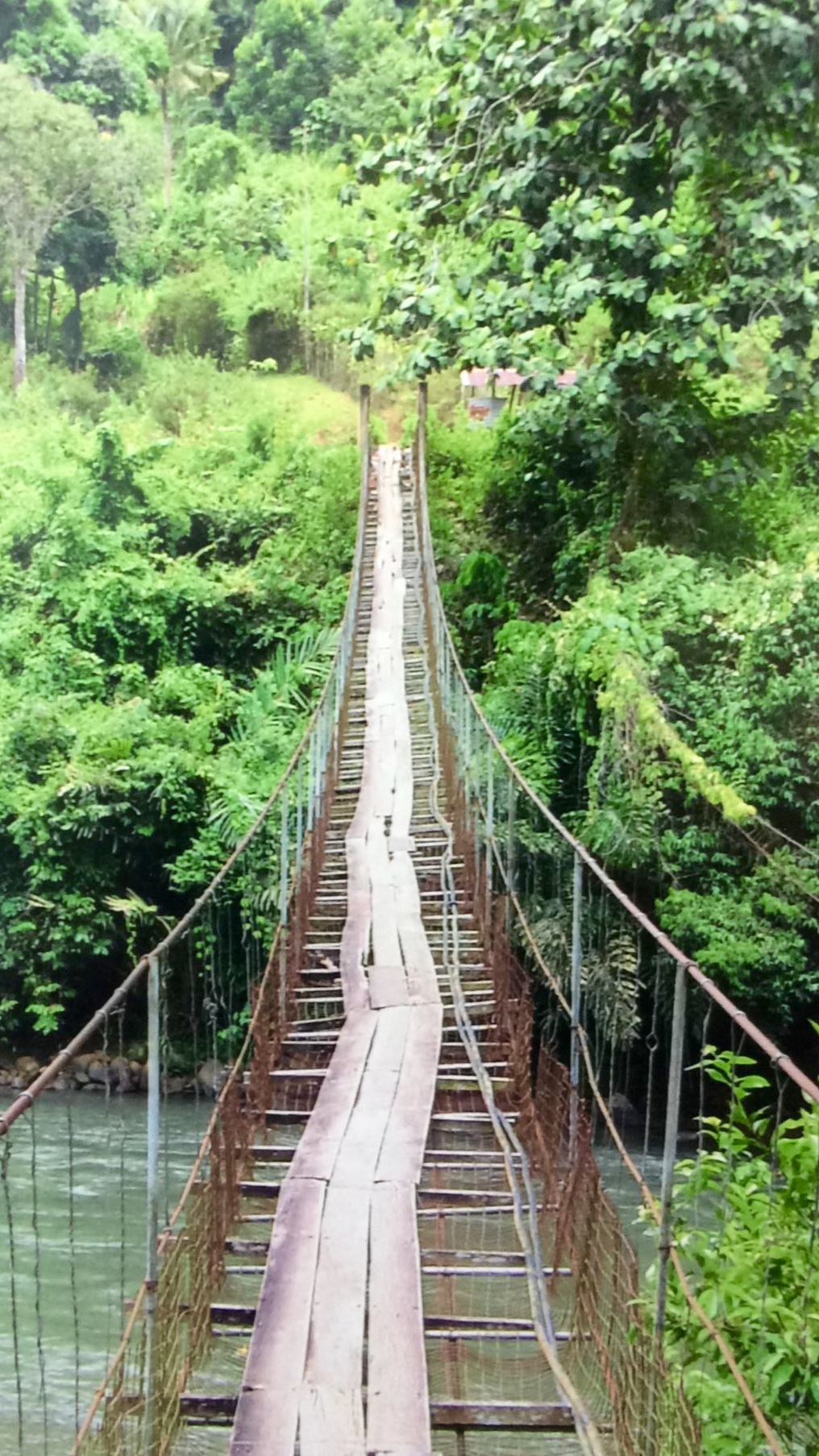
We had lunch at the Kinabalu National Park after a guided tour through the rainforest. Everything was so green. Sunshine pushed its way through fractured space; leaves moved in what little wind was there. The air was warm, the humidity intense. My head was thumping and I felt dizzy. But the rainforest was alive; is always alive. Sounds, smells and sights – always alive. Cicadas were singing, birds whistled and called. Tree tops moved; they don’t sway, they just move – almost on their own accord. The undergrowth is always moving. Water is always sounding. Frogs are croaking. Sounds echo above and below and around you. There are so many shades of green in the rainforest. Every colour sings. Everything is insulated in steam, fragrance and noise. The rainforest is always alive. When there, something calls to you, appeals to something deep within your being, to stay and to be a part of all this forever.
After lunch, we took a detour. Ray had asked the driver if we were near a memorial park in Kundasang. The driver checked his map, made his calculations and said we had time to visit if we wanted. I knew nothing about the memorial park, but Ray had read about the Prisoner of War marches which occurred from Sandakan to Ranau during the Second World War and it was something he wanted to see. So we made the decision to go. It was moving and emotional. We were met by the guardian of Kundasang War Memorial, a Thai man who lived in Kota Kinabalu. He gave us his card: Sevee Charuruks. He explained what had happened, what suffering had been endured and the eventual fate of those who had been here decades earlier. There was a poem written in one of the gardens on a plaque: It is all history now, but as we scan the mountain slopes, it will do no harm to think back to those times of sadness that were to be the seed from which the Memorial grew: Look up in awe, to where the misty peaks meet heaven; Where the spirits of the mountain dwell. Remember those who came this way before. Saw those same rocks through weary eyes before they died. Remember them.

Little was said on the drive back down Mount Kinabalu. The day was ending but there were still a few hours of sunlight left (enough to be at the mangroves before dark). We were tired, we shared food with each other, but mainly we were just lost in our own thoughts. I never asked Ray what he was thinking, but the experience of Kundasang did change us, shaping the way we thought about the world and our place in it. Our headaches cleared the more the road sunk down in altitude back towards the sea. Ray stretched out on his seat – I on mine. We fell asleep for moments, took time to watch the world pass us by, even read the books we’d brought along for the trip. I’d been reading one about John Ruskin, the pre-Raphaelite art critic who believed we should all spend more time sketching and drawing the world we lived in. It was his response to the growing trend of his day: photography. Ruskin believed that sketching things in nature – even something as simple as a leaf – would reveal some kind of deeper appreciation for this existence; a more conscious way of appreciating the world and the moment in which we belonged.
We drove through the last of the small villages in the foothills of Mount Kinabalu. The sun would be setting soon. I looked back at the sheer size of the mountain – it was immense and alive and had a presence so powerful it made you feel diminished and empowered at the same time. The type of feeling the Romantics called an encounter with the Sublime, the type of feeling that moved Wordsworth to try to describe it as “a presence that disturbs me with joy of elevated thoughts; a sense sublime of something far more deeply interfused whose dwelling is the light of setting suns… and rolls through all things.” Our van slowed suddenly to navigate a hairpin bend. There were flat, square houses on my side of the road. Some had flat rooftop areas. As our van swung around the turn my eyes rested on the silhouette of an old man sitting on his roof. The setting sun was behind him. But the sun shone on me, and for some reason I waved at him from the window of the minivan. For a moment the old man did nothing, then as if suddenly charged with energy he bolted upright in recognition and jumped to his feet waving back with his right arm. As the van descended down we exchanged a long wave. His silhouette disappeared into the mist surrounding the foothills but his arm still visible waving for a second longer.

At the wetlands we sat in open boats preparing to cruise through the mangroves to see the fireflies. The sun had set, we had eaten and felt better. Guided by the light of torches, we had made our way into a large, communal canoe, acutely aware of the rocking buoyancy of the vessel as we stepped on board. On one side of the boat, the lights and sounds of the riverbank danced in familiarity – over the starboard edge, only darkness. And in that darkness was a stillness without silence. You could feel the air breathing and moving all around you, pressing against your skin. There were no stars overhead; everything was insulated in steam and low cloud. A large full moon looked majestic high in the heavens. Its silver light spread out across the top of the cloud-cover, filtering soft light down before it dissolved into our darkness. A large, lunar rainbow sat motionless, like a halo, on top of this flat white veil. In the far distance, explosions of an electrical storm momentarily cracked the darkness into patches of deep violet scorched with pearl lightning. Beyond that, horizons and waterways existed without delineation; it was impossible to see divisions of land and sky.
We moved through the water in the land below the wind. The air was cooler with the night but always the humidity clung. Dense, thick foliage from the forest rose either side of the quiet, black water which had carved its way through the land. The river was slick like oil and smelt strongly of pungent bore water. Everything belonged to the earth. We heard loud crashes and snapping in the canopy of trees above and were told this was due to the monkeys jumping from branches. Occasionally leaves that looked like creeper vines floated on the water’s surface like large carpets, bearing purple flowers. Life breathed in the darkness. Sounds reverberated again and again – bird songs, insects, the high pitched squeaks from bats. And then we turned a bend in a river and the darkness became punctured with a great tree alive with fireflies. No words can express the sight we witnessed. Thousands of fireflies shining tiny pinpricks of blinking, coloured light in the fabric of night. Some were green, some looked red, others were yellow. The colours of the fireflies were so vibrant in that darkness. There were other boats from other tours also floating around the Great Tree but few of us took photographs. Some of us tried and captured nothing (only vague images of darkness). Some of us tried to capture the sight in video recordings. But sometimes a higher intelligence within directs you to be still and to just soak in the moment. Some experiences can only be felt to be known.

*
 siesta del somewhere