26 Winter Storms, King Street (Australia)

Image by Karl Powell, The Rain (Perth), 2022

PART ONE: CAN’T WE BE FRIENDS (Ella Fitzgerald)
And then the rains came down again. They fell in a single sheet of grey noise just after midday. King Street disappeared from view. The pavement and flagstones became lakes alive with dancing splashes of raindrop circles. Fallen leaves, flat and brown, once curled, stuck fast to the puddles and wet tarmac. Winter storms had hung around the city all week. Everything had been cold and wet, and wet and cold, so much so that if felt as if the winter had always been there. The river had been languid and grey, reflecting the damp overcast sky which tried its best to censor the sun and any fragment of blue sky. The only colour visible most days had been the red flame flowers showing in the poinsettia trees dotted here and there. And now, another storm blew through, smashing in from the Indian Ocean, scattering people in all directions from St George’s Terrace, making them seek refuge, needing cover from the cold, wet air, obscuring any afternoon plans in an instant.
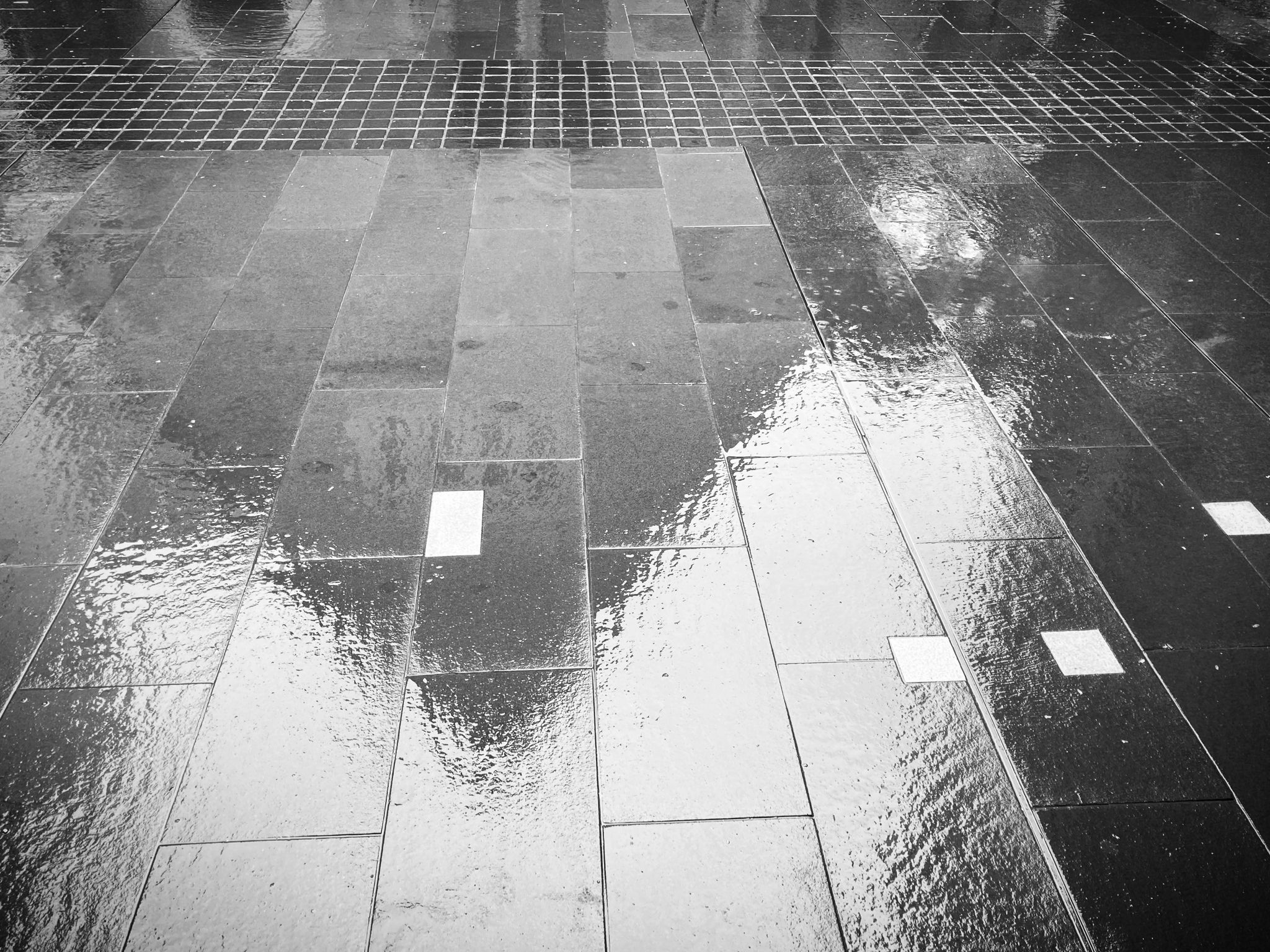
Image by Karl Powell, Black and White (Perth), 2022

Two people caught in the squall huddled in a cuddle underneath the bus stop by Westralia Square for the 935 to Kings Park. They were visible for occasional moments here and there between the pouring spray. They stood with their hoods up. One attempted to put up an umbrella, but was rebuffed by the wind at every opportunity. The wind blew so much into them that the umbrella bent, buckled and was eventually blown inside out. A man ran past them, into the rain. He ran with one hand holding onto his hood, carefully trying to plant his feet, as if not to slip. The hint of a flash of lightning blinked in the peripheral vision then was confirmed with the sound of thunder. A 27 bus pulled up to the bus shelter – yellow headlights on – the two people declined the offer of sanctuary and the vehicle pulled off up towards the top end of the Terrace, leaving behind shifting curtains of rain dancing in the city air – drifting, billowing, blowing. As the winds blew harder the trees moved in concert with each other in the downpour. Branches twisted. Splashes fell everywhere. Rhythmic patterns drummed onto roofs and buildings. Smoke chugged out and upwards in a heated plume from an unseen vent. The rain kept falling.
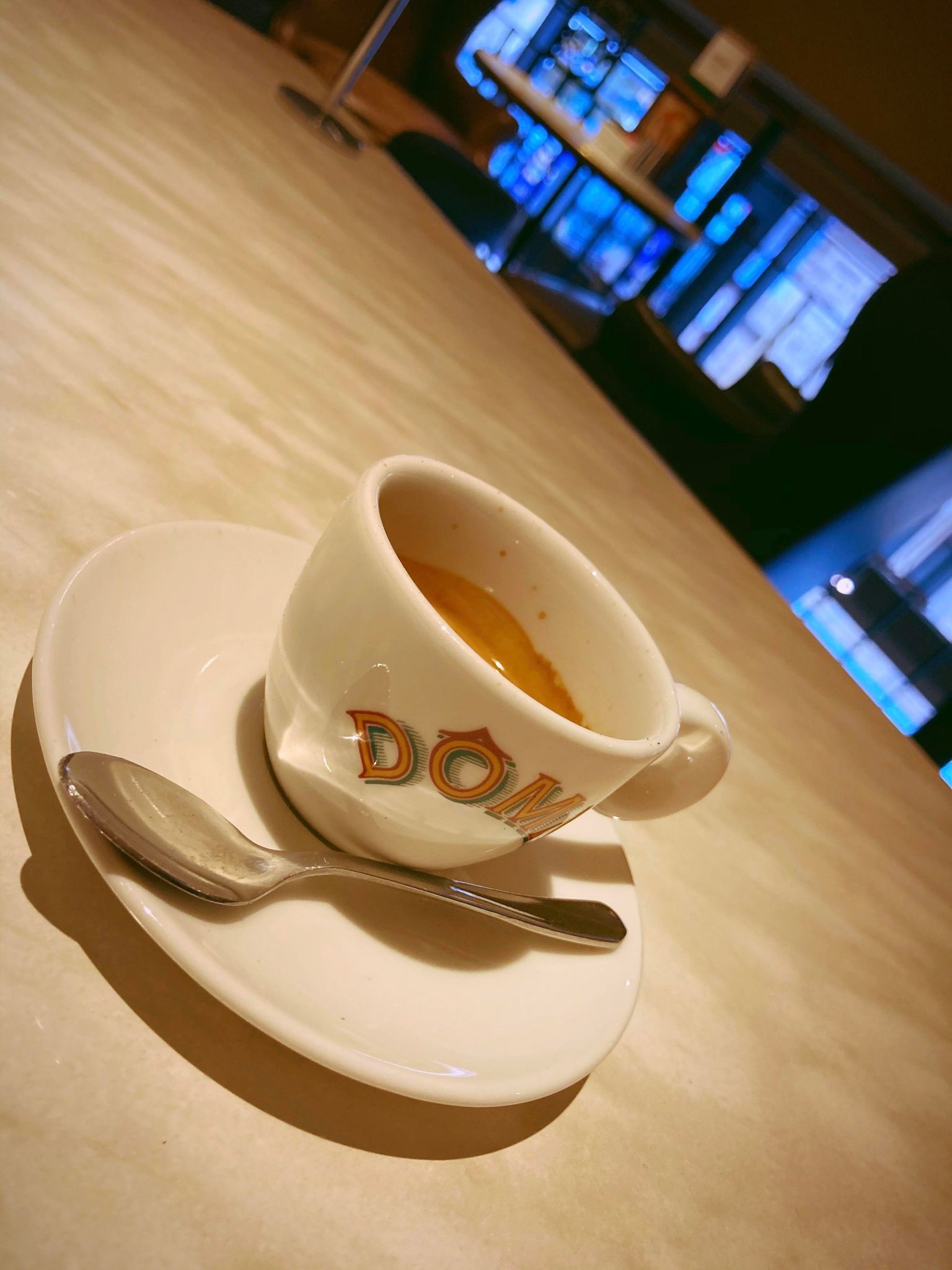
Image by Karl Powell, Espresso (Perth), 2022

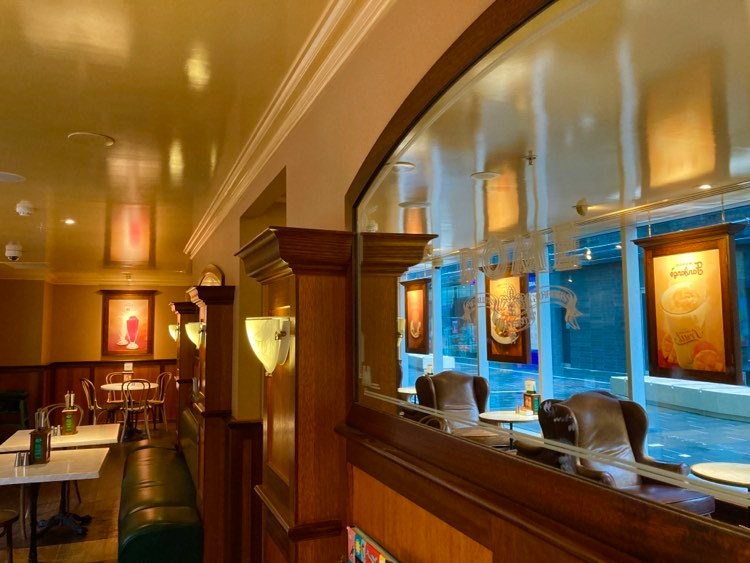
Inside the café everything felt warm. Music played and was a soft contrast to the noise outside. As the mood of the downpour grew darker, the intensity of colour glowed brighter within. The lights inside the café – oranges and lemons – were reflected as the greys outside rose and fell. My order had arrived at about the same time as the rains: an espresso and a croissant. The coffee sat smoking in a white demitasse on white saucer. A small spoon rested there. Sachets of sugar sat next to menus near stainless steel salt and pepper shakers. I didn’t take sugar, but today I felt the need. The espresso was gone in three gulps. I began to pull apart the croissant and ate it slowly watching a man walking in the rain with a barely functioning blue umbrella; half collapsed behind his head, his exposed shoulders looked soaking wet. I had been trying to shazam a song that had been playing a few moments earlier. It was a cover version of Roxanne by The Police. It had been sung by a female and an acoustic guitar; it was a slow adaptation and I had liked it. Despite numerous attempts I could not get it identified, and then when the order arrived with the rains, the song changed and the moment was lost forever.
Image by Karl Powell, One Life (Perth), 2022

PART TWO: BEGIN THE BEGUINE (Sammy Davis Jr.)
A family of four sat on the table next to me. Table 104. They spoke quietly amongst themselves in a language I was unfamiliar with. Two read newspapers, two looked at their phones. Patiently they waited for their order. Most tables were rectangular (mine was – as was theirs), white-marbled tops, wiped clean. A row of circular tables ran the length of the café, alongside a glass window that looked out onto Brookfield Place. A member of staff who was sweeping the floor looked up occasionally from her task out at the rain outside. It was not stopping anytime soon. She moved down the café, brushing along the dark, wooden floorboards, sweeping under chairs and tables without intrusion. Two leather, chesterfield chairs faced each other, empty, tucked snug in a corner. In the kitchen, sizzles sounded and cooked together, perfuming the air with edible aroma. Sammy Davis Junior began to sing from the café’s playlist (I recognised his voice, confirmed by the song). The waitress moved down the café, her footsteps audible, until a bell sounded from the kitchen. Service out. The sound of collected cutlery could be heard. A door squeaked open and swung shut. More footsteps. Table 104 had their food delivered. Two servings at a time. They put away their newspapers and phones and ate as a family.
Image by Karl Powell, Sweet Sugar (Perth), 2022

The rain was not stopping anytime soon. I took out my notebook and pen. For a few days, I had been sketching out an idea I had about Italy. It was a story about friendship and how some journeys can see friendships develop with strangers and eventually soak deep into the memory of a trip. I had been breaking down the story into parts; mapping out each section I thought to be important and required inclusion. The colour, prose and order would be added much later but for now it was important to birth out the idea. This process of the draft was like writing a shopping list; little effort was required, concentration was light but it was effective in teasing out what needed to be said: here I want to write about x, and then I want to describe about y. I watched as the story began to carve itself into being near where the shadow of the pen met the page; where the ink met the paper; where the idea met the world. There was something magical about writing in a café – thoughts and ideas were always there, willing to sit down beside you. There was nowhere else to be. Just there. Looking at pages, looking at people, looking out of windows. A place to put down the routines and responsibilities, to blot out the distractions and to just drift in the flow of a brevity in time. Daydreams. Space to be.

Image by Karl Powell, Kubla Khan (Perth), 2022

And then, as I paused from writing, the opening lines of Coleridge’s poem “Kubla Khan” came into memory. From out of nowhere. The flashes and fragmented impressions presented themselves between the incoherent thoughts and haphazard recollections of my trip through Italy. The words sounded and I stopped writing to love them once again:

In Xanadu did Kubla Khan
A stately pleasure-dome decree:
Where Alph, the sacred river, ran
Through caverns measureless to man
Down to a sunless sea.

I had first encountered that poem on an international flight several years earlier. It had been printed in its entirety in a book purchased on the Romantics, at a shop in an airport prior to departure. During the long flight I read it, and it had made no sense, but the words kept sounding whenever I had looked out of my small window across the clouds and sunlight at 40,000 feet: In Xanadu did Kubla Khan… The book told the story about how the poem came to be: Coleridge had taken an anodyne – opium – and had fallen into a deep sleep at a country inn. As he dreamt he encountered a vision and began to compose the poem in his sleep (some 200-300 lines so he claimed). On waking, he set about dragging the words from his dream into reality and wrote with a fervour. So the story goes, Coleridge was interrupted from his task by “a person on business from Porlock.” An hour or so later Coleridge returned to writing but the vision he had seen in his dream had gone, and he struggled to recall the words he had claimed to have composed in his memory. The task could not be completed. Eventually, he gave up and the poem remained a fragment of what he envisioned – unfinished at 54 lines. For twenty years it remained something Coleridge recited only at private readings to friends, until Lord Byron persuaded him to publish it in 1816: “Kubla Khan, or A Vision in a Dream, A Fragment.”

Image by Karl Powell, Oranges and Lemons (Perth), 2022

PART THREE: ON THE STREET WHERE YOU LIVE (Doris Day)
And so time passed. The rain had finished falling. A gap between storms. Drops of water dripped down from rooftops and treetops, replicating the splashing and crashes which had danced in the courtyard of Brookfield Place an hour or so earlier. The air remained cold. Leaves were wet. The space in the courtyard was free and empty. The paving stones shone with a sheen of the leftover downpour; unable to evaporate, the wetness reflected the damp daylight and sodden shadows. The greens of some young trees began to gain vibrancy. A larger tree near an old building – an old boys’ school – spanned itself out wide and gave the illusion of its branches floating on the moving air. Music continued to play inside. Out of the corner of my eye I saw reflections of customers entering and leaving the café at the top end of the building. A couple near the door stood up and put on their coats. He waited as she picked up her white handbag. They looked at each other and prepared to walk outside together. They held hands as they crossed the courtyard and moved towards St Georges Terrace, their heads cowered down from the threat of more rain. The colours of their clothes walked into the cold afternoon air.  
Image by Karl Powell, City Colours (Perth), 2022

The kitchen’s bell sounded again. Service out. The family on table 104 had finished their meal and relaxed talking quietly to each other (their plates already collected by waiting staff). A group of new people came in and sat nearby. Their voices were loud and vacuous – their conversation bounced off the walls and ceiling. They looked at menus without reading them and laughed a lot in loud shouts. Noise echoed in the café. As they carried on, I looked up and along the building. There was something magic about this café. Maybe it was because it was so close to King Street. Maybe it was because of its long bottle-neck shape – complete with a mezzanine floor. Maybe it was just me: it was a good place to write. The city sprouted up and around it, in blocks and buildings, squares and rectangles. There was something magic about this place; thoughts and ideas always sat down beside you. The kitchen’s bell sounded again (this time in two sharp pings, almost irritated). Service out. It was my cue to carry on with the rest of the day and its chores. It was time to go.
Image by Karl Powell, After the Rains (Perth), 2022

*

25 Nights in AoNang (Thailand)

THE LAST CAFÉ ON THE BEACH

Image by Karl Powell, Beat Music Festival (AoNang), 2018

At the day’s end, the beach is full of life. The warm waters of the Andaman Sea are rushing ashore. They move in to the receding tidal shoreline in running lines of foam. Fishermen are preparing their nets in the shallows, driving stakes in the wet sand before wading into the sea. A huge love heart is carved into the sand high on the beach. The clouds are changing colour. Despite the clouds blotting out the sunset, the colours begin to smudge the higher clouds. Some are already turning pink. Pink against an ebbing blue. Pastel blue. Hue of blue. There are so many people at the beach tonight, just walking together. Many, like me, stop to take photographs; make videos. Five young women, talk and walk and text on their phones; all five have long black hair. A woman in a red dress walks past me holding a little baby in a white dress. The mother stops near the love heart and points towards something out at sea, the toddler looks, the mother says something and then they carry on walking up the beach.

Image by Karl Powell, The Last Cafe (AoNang), 2018

Longtail boats begin to return for the night. Most are growling in the water, churning foam and fumes, returning from Railay Beach. Most stop at the AoNang kiosk – there’s a long, concrete slope moving up off the sand back to the Beach Road. Once the passengers climb down from the wooden boats, one by one, and wade knee deep in the Andaman Sea, the boats slowly reverse, turn, and chug onwards to Nopporat Tharra Pier (tucked around the corner). Having said that, four longtail boats are anchored near the giant marlin statue on the beachfront. All four float, bump, nudge and bob as they move on the shifting tide. Every time I come here, to spend time here, I fall more and more in love with this place. I can’t explain why but I feel so happy here. Just a profound sense of being. I am so happy I came here this evening to write all this down, to preserve it forever in this notebook, etched in ink between feint, ruled lines. This is such a beautiful part of the world.

Image by Karl Powell, Magic Lanterns at Monkey Trail (AoNang), 2018

It will be dark soon. My thoughts turn to moving on, finding something to eat. I look along the beach and can see the lights on in the community of beach massage huts. With the day at an end, they all sit together, share food together, eat a meal together, talk, unwind, relax, giving thanks before going home. I can see TikTik’s hut – the first one – Number 1 Love the Sea (she was worried yesterday that the storms are going to make her roof collapse).

Image by TikTik, Love the Sea (AoNang), 2019

Here, down near the Monkey Trail, close to the small, Buddhist shrine at the end of the beach, everything is magic. The shrine is tall and white – surrounded by small, stone elephants – and houses a golden Buddha that has four faces (looking in different directions simultaneously). Coloured sashes adorn the base of the monument. There are two coconut trees that almost touch, that lean closer and closer to each other – the fingers reaching out of the palm leaves will touch one day soon. The evening is coming. The Last Café on the Beach switches on its magic lanterns. In an instant everything feels magic. Evening winds, warm winds, blow and the branches of these trees move. A mynah bird sings. Chunks of cloud, far out at sea, move across the sky. The light begins to fade. The ocean rushes ashore.

Image by Karl Powell, The Giant Marlin (AoNang), 2018

GREEN CURRY RESTAURANT
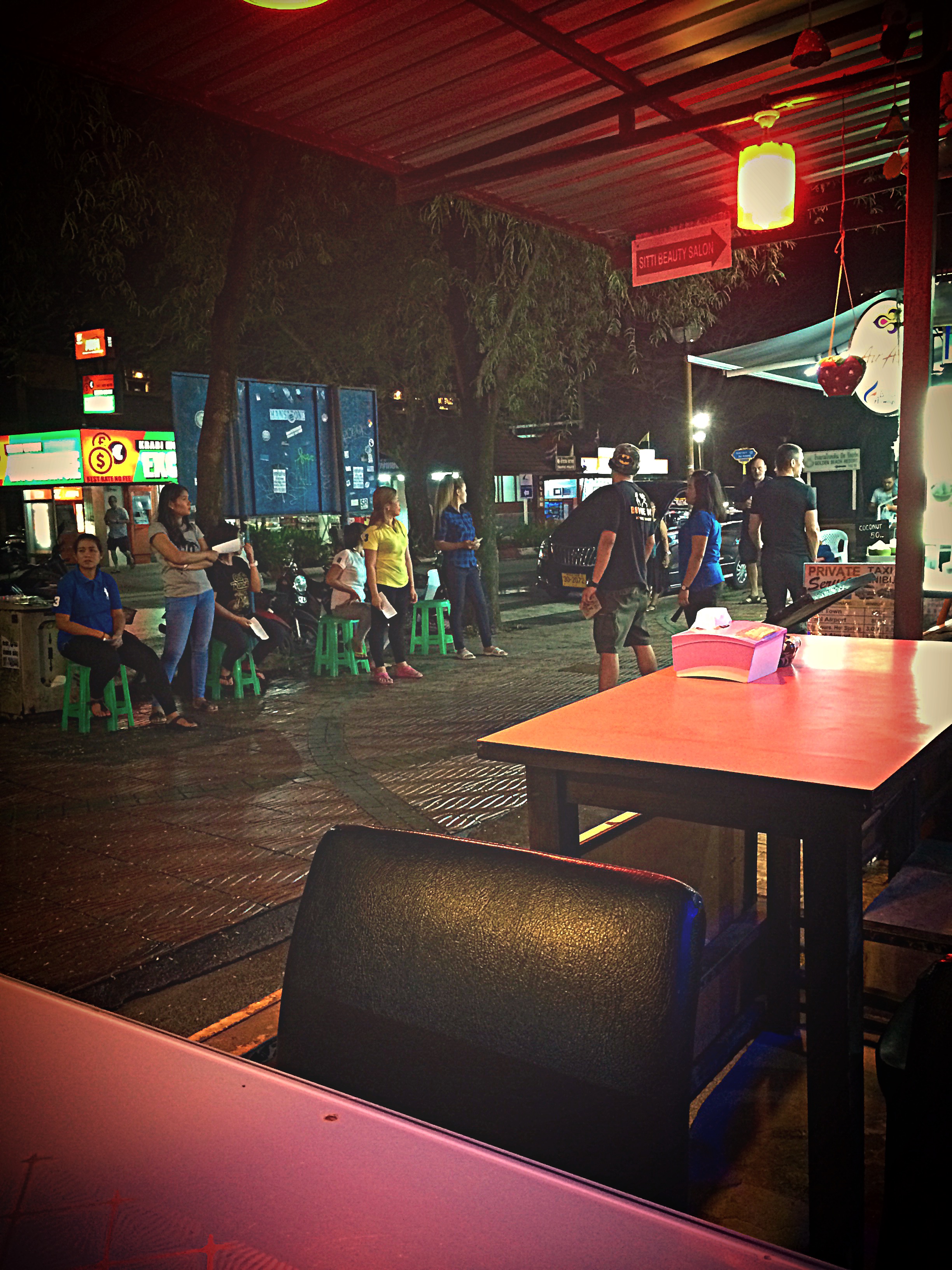
The restaurants prepare for evening service. Ning takes my order at the Green Curry Restaurant and goes off into the kitchen. White, paper napkins flutter in the warm, evening breeze. Occasional raindrops blow in offshore. Hungry feet walk along AoNang Beach Road. They weave between bodies of people who are shopping, who are selling, who are just looking. Colour and noise merge and move. Everything is alluring, enticing – so many colours, so many moving parts – nothing overwhelms. Glittered shop fronts, hidden alleyways, taxis waiting, tuktuks driving, tourists and locals everything is one. Deep house music sounds from one of the new bars, Tribe, offering something else from the intensity of Centrepoint and its warren of live bands. A tannoy car drives past advertising a Muay Thai fight tonight at Krabi Stadium at 9pm: it announces in Thai and English. It drives along the Beach Road, deafening the pavements, heading up towards the Mosque and Tesco Lotus at the top end of town.

Image by Karl Powell, People, Colour and Noise (AoNang), 2018

Across the road, near the giant marlin statue, flickerings of lightning spark far out at sea. Pearl flashes colour the indigo darkness. People sit on the stone steps and watch one of the last longtail boats come ashore. It moves in from the darkness and anchors in the shallows. It has a small, round spotlight on its starboard side. The light it generates dances in the dark waters, bobbing near the surface of the ocean and just below. Dimly lit, across the horizon, the lime green lights of the deep sea trawlers can just barely be seen (but they are there – as are the immoveable outlines of Poda Island and those that surround). Last week, one night walking back to my room, I stood here with some people from New Zealand who were pointing into the waters. We all saw the sea sparkle in neon blues as the ocean crashed onto the sand. Glimmers and flickers; the phosphorous plankton bioluminescence alive in those dark, night-sky waters. Magic, magic moments at midnight. Rolling waves keep coming ashore. The breeze picks up again. White napkins flutter on the tables. My meal arrives.

Image by Karl Powell, Boogie Bar (AoNang), 2018

Down by the Boogie Bar, just a few footsteps into Walking Street, Vijay at HongKong Tailor waits for me. My shirts are ready. Deposit already paid, final fittings already done, just alterations to do. Ready to collect tomorrow. Settle bill then. Open 10am until 11pm. The air is thicker here – indoor and undercover. Footsteps follow footsteps. The live band sings ‘Satisfaction’ by the Rolling Stones and everything moves with people, colour and noise. Ceiling fans twist and turn. I stop at a shop selling clothes – I saw a t-shirt here yesterday. It was a red one, with a map of Thailand and all its provinces. Loved it and should have bought it there and then. But I buy it now. 200THB. As money changes hands, waiting for change, I watch a cat evade electrocution as it weaves between live cables tangled up from the floor to the neck of an ice-cream maker. Its eyes are blue and it looks up at me. And all around me, all I can see, is people, colour and noise. People moving, people browsing, people smiling.

Image by Karl Powell, Leaving Walking Street (AoNang), 2018

LONGHORN BAR
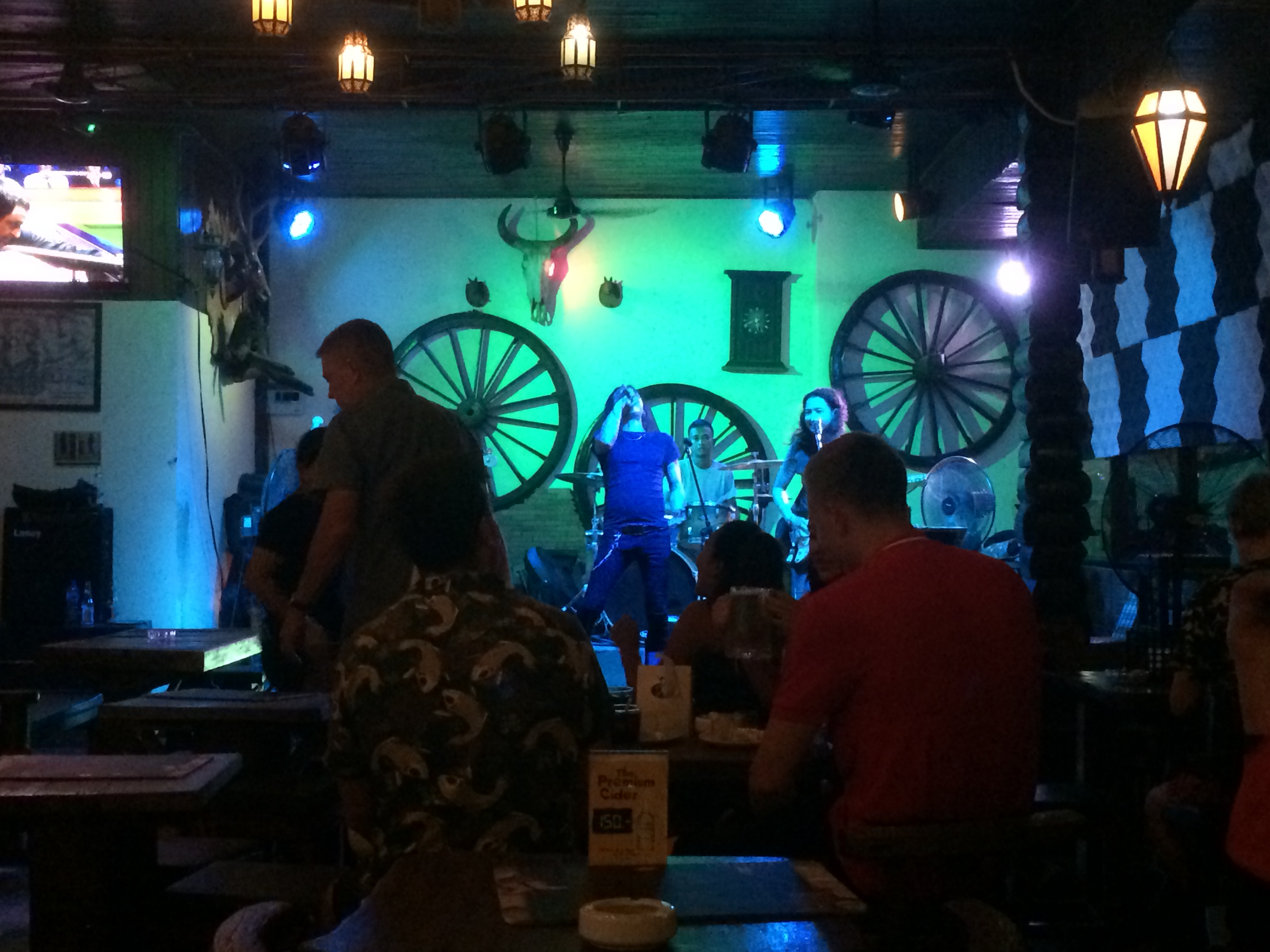
One drink and we go home. That’s the idea; that’s the poster outside the Longhorn Bar as the Beach Road runs back down towards the ocean. The sky flashed again with lightning. It’s been flickering away since sunset, but now it’s moved in, closer to shore. The staff recognise me from the other night and seat me on the high, long, wooden table again, facing inwards, sharing space with a guy from Kodagu, India (on holiday) and two friends from Santiago, Chile (backpacking). The band is singing Amy Winehouse’s ‘Know I’m No Good’ (they invite customer requests when you order a beer here).

Image by Karl Powell, The Longhorn Bar (AoNang), 2019

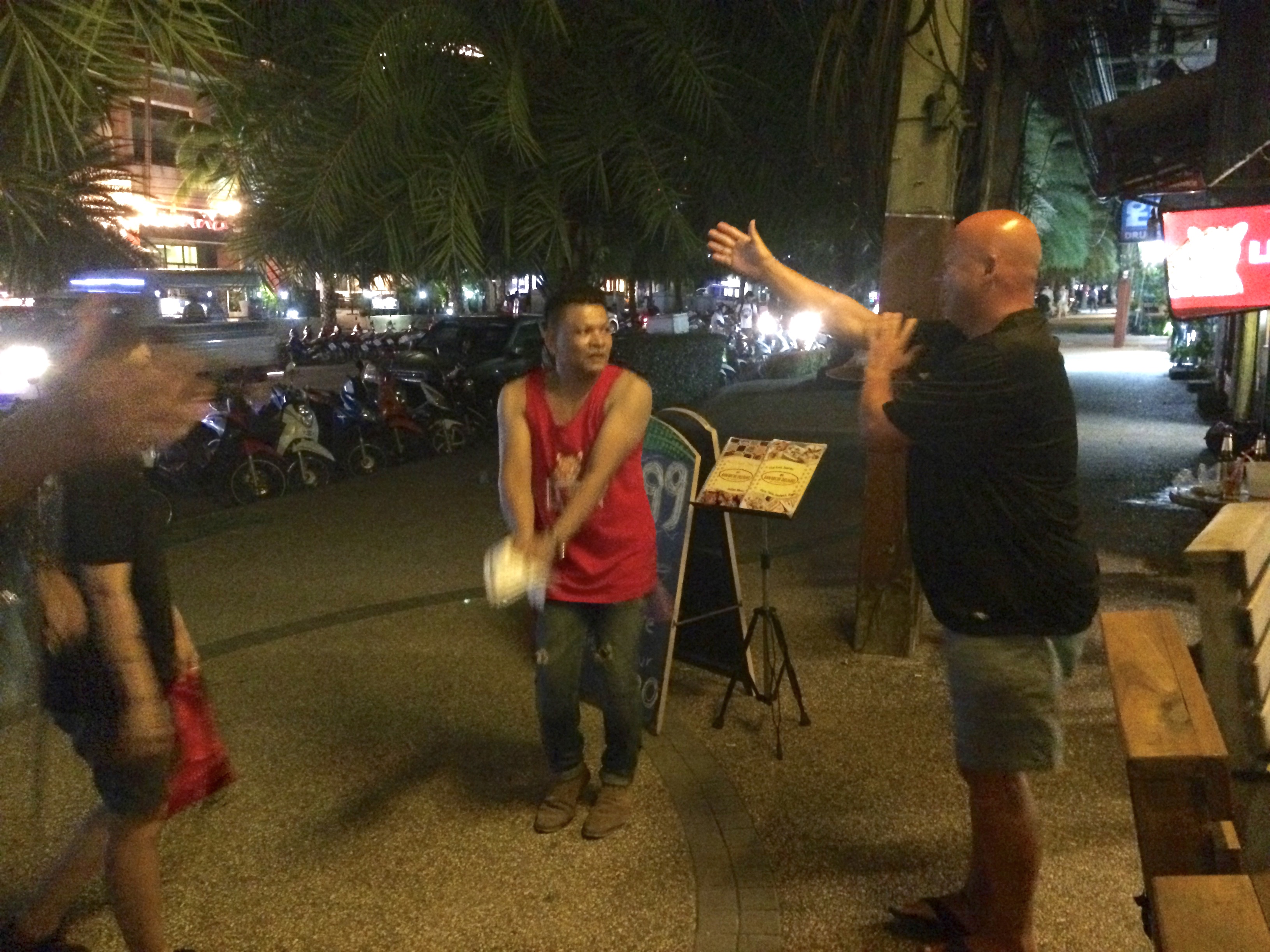
The warm wind continues to blow in off the Andaman Sea. The evening is beginning to bubble up with energy: people are walking past selling handmade items – messaged bracelets, glow sticks, small coloured shapes of wood that mimic the sounds of croaking frogs. Curious tourists walk down the RCA lane, people fade and morph into the neon noise and competition of colour between the shadows, a motorcycle pulls in off the road and begins to weave its way through the long legs and bar stools there, the band begin to sing ‘Highway to Hell.’ A street food stall pulls up at the kerb, firing up the coals for the evening: grilled satay sticks, chicken livers, papaya salads will soon perfume the air. Another flash of lightning illuminates and immediately energises everything.

Image by Karl Powell, Street Food (AoNang), 2018

My bottle of Singha arrives. It was brought by Phon, who I recognise from the other night. She asks me what I’m writing. I tell her it’s a story about AoNang and ask if she’d like to be in it. She looks at my notebook and says she can’t write English, can’t read English, never had money to go to school. As I pay for my beer she draws a smiley face on the bar receipt with her pen and writes something in Thai.

Image by Karl Powell, Sabai Sabai (AoNang), 2018

A group of Chinese tourists file in. There must be about a dozen. They are brought in to the middle of the bar; table and chairs are quickly arranged together to accommodate them. As they quietly sit down and patiently order drinks from the bar staff, a tray of blue shots, in plastic red glasses, is sent over to them. Each person receives one. Now the band sing the Beatles’ song, ‘Ob-La-Di, Ob-La-Da.’ There’s a young guy seated at the bar inside, chatting to a girl who reads something on her phone. Their faces stained by the coloured lights from bright advertisements for Singha, Leo and Chang beers. Both look thoroughly bored and soon leave without speaking, their game of Connect 4 left unfinished. La la la la la la life goes on.

Image by Karl Powell, Mr. AoNang (AoNang), 2018

The lightning crackles again. This time overhead. A flash within your eyes. Then the thunder rumbled booms and vibrations into the ground. Chairs are being moved inside, not just here, but all the restaurants nearby, the massage shops opposite. Everyone is moving inside. Raindrops splat onto the floor. They land with an audible slap. Big drops of water – the size of an old English penny. We are told to come inside, off the high, long, wooden table, away from the danger of lightning – we were reluctant to give up our vantage point, but the bar staff were persistent and concerned for our safety.

Image by Karl Powell, Sultans of Swing, Longhorn Bar (AoNang), 2018

Then water poured and the rain fell down. The noise reverberated inside the bar, muffling the band. From where we are now we look outside and can see only spray thrown into the air. Taxis and traffic try hard to drive, shining white headlights through the rain. People run to find shelter. This is when I wished I had a balcony overlooking AoNang – just to spend an evening watching storms move in off the sea. Just sitting there, smoking a cheroot, outside in the rain, feeling the spray of the downpour approach, tasting moisture in the air, feeling the thunder move in the soles of your feet.

Phon approaches and asks if I want another Singha. Sure, one more drink and then we go home.

Image by Karl Powell, One Drink and We Go Home (AoNang), 2018

*