28 Marrakech مراكش (Morocco)

Image by Karl Powell, Bahia Palace (Marrakech), 2007

PART ONE: MEDINA
The day began in hues of rose sometime before the sunrise. There had been singing at that hour – the first call to prayer, or adhan. Dreamers were asked to wake, to engage with the forthcoming day, dreamers were asked to pray (instead of sleep), to wake and interact with the deeds of the world that had already begun to unfold around them. Everything about the sound felt like a fragment of a dream and I found myself awake and standing outside my room, in the December darkness of Marrakech. From the small, single-door balcony beside my bed, the outlines of the Atlas Mountains stood visible as shifting imprints against the pale jasmine horizon of dawn. Shades of pink and lavender dusted the sky, caught between the fabric of the frozen clouds and still shining wane blue stars. The mornings were cold, as could be some days, and once the sun disappeared at around six o’clock the previous evening an open sky in Marrakech could see winter mist descend down to the ochre earth. The singing continued for a little while longer. The contours of sound drifted through the morning air as colours of lilac lifted and coated this sacred part of Morocco. Then the dawn began to rise and sunlight slowly touched the red walls of the city.

Image by Karl Powell, Medina Morning (Marrakech), 2007

Footsteps wandered through the Medina. Leading never lost. The Medina was alive and awake. Narrow alleyways and winding routes. Archways and shortcuts. Donkeys and motorbikes squeezed past each other in the narrow lanes. Berber rugs and carpets were for sale. Silver, pottery, leather, men and boys making things, metalwork soldered within cobalt sparks, crouching figures worked in the winter sun, the chill of December lingering in the shadows, smoke rose from soldering guns. Donkeys, archways, motorbikes. Colour. Mazes. Bakers baking bread – small flat loaves cooled outside small shops (dirham changed hands; warm flat loaves for breakfast). Carnelian colours, cornelian walls, the Hand of Fatima glinted in gold and silver on almost every door. Ochre doors, almost every door an ochre door. Coloured lamps, painted hide, shining lanterns, dancing flames. Stalls of almonds, rose petals, colours of spice, scarlet mounds of felfla and smoked hlouwa, curled quills of karfa, vibrant yellow towers of quekoum, amber tones of kamoon, baskets with knuckled root of skinjbir, small pouches holding orange, crocus stigmas of zafrane. Donkeys, archways, motorbikes. Gateways lead in and lead out as they had done for a thousand years. Perfumed scent from shops selling cubes of musk and incense hung in the air. The chilled December air. Footsteps wandered through the Medina. Leading never lost. The Medina was alive and awake.
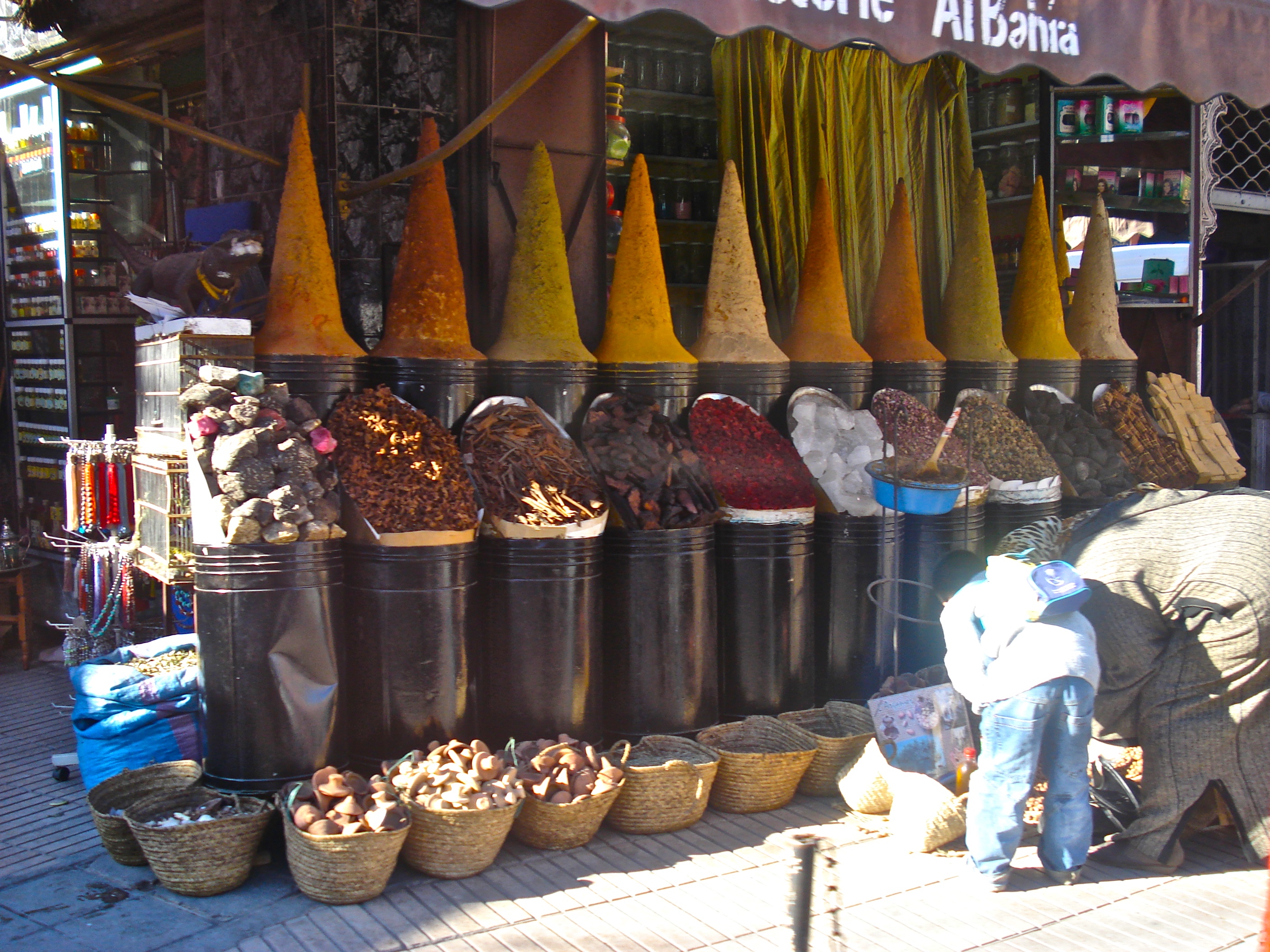
Image by Karl Powell, Spice Stall (Marrakech), 2007

PART TWO: MAJORELLE BLUE
Somewhere near where the Kasbah and Medina met, almost underneath the Bab Agnaou gateway, sometime around midday, an old man called Aziz approached and recommended a rooftop restaurant for me to eat. Aziz introduced himself as a Berber, and spoke slowly and quietly. He led me through a building’s open doorway and up several flights of tight, narrow, L-shaped staircases. Our footsteps echoed as they climbed. Light poured down to greet us. Under a clear blue sky sat tables, cushions and coloured rugs on a large, open courtyard. The sunlight felt so warm on my face. The Medina’s quiet canopy concealed so much life and colour beneath it, yet the rest of Marrakech could be seen from here: the Koutoubia Minaret, the red earth walls of the city, the snow on the peaks of the Atlas Mountains. Bright blue day. Aziz showed me to a table, low down, cushioned, shaded from the sun. He gave me a menu and after I had ordered brought me water and recommended places I should go to see (carefully writing them down on a piece of paper for me): the Bahia Palace, the Saadian Tombs and the Majorelle Garden. He told me each place was a place of great beauty. Somewhere to go and sit with God, said Aziz, somewhere you can go and find the quiet present within each day.

Image by Karl Powell, Rooftop Restaurant (Marrakech), 2007

Lunch was long and lazy. The reflection of a giant palm tree floated in the small, blue, ornamental pool sitting in the centre of the restaurant. There was a fountain at the head of the pool which had running water flowing – rather than shooting – into the body of water. The sound was gentle and demanded little in the way of attention; what ripples that were produced soon dissolved into stillness at the pool’s outer edges. Courses came almost as a procession of entrées, tapas and flatbreads: olives, almonds and medjool dates in small, coloured ceramic bowls. A tagine of lamb was served with a bowl of cous-cous (decorated and divided into six parts with wedges and wheels of lemon, strips of cucumber, and a thick chilli sauce sat in its middle. For dessert – oranges and sweet, mint tea. I listened to the call of a bird which sounded like a long, low sigh and I felt glad that I had come here. The sky looked so blue – a kind of blue I had never seen before (a pure blue that was full of light and seemed endless). In the moments before I left, Aziz wanted me to have a quotation, written in French (from Theodore Monod). Days later I translated it: Immersion in the desert makes for profoundness of being, unattached from all responsibilities, freed from all that is accessory.
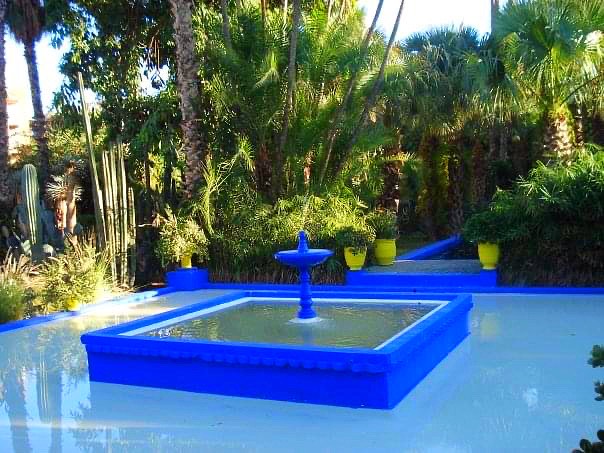
Image by Karl Powell, Majorelle Blue (Marrakech), 2007

PART THREE: DJEMMA EL-FNA
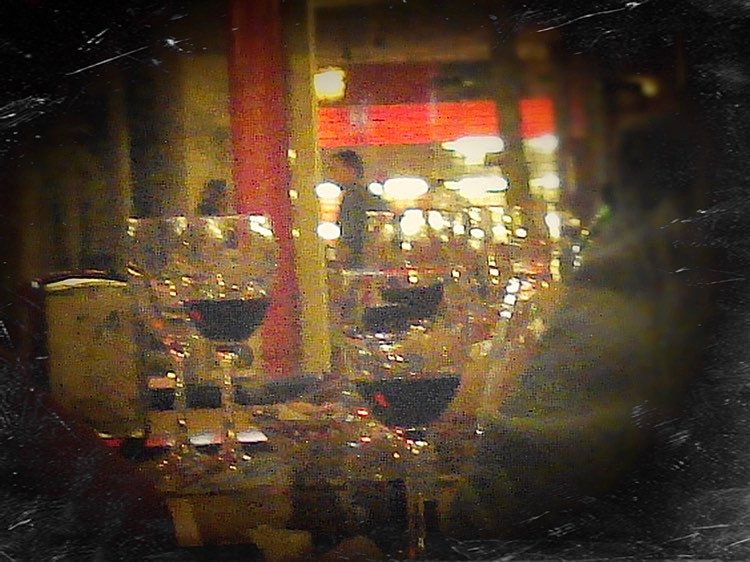
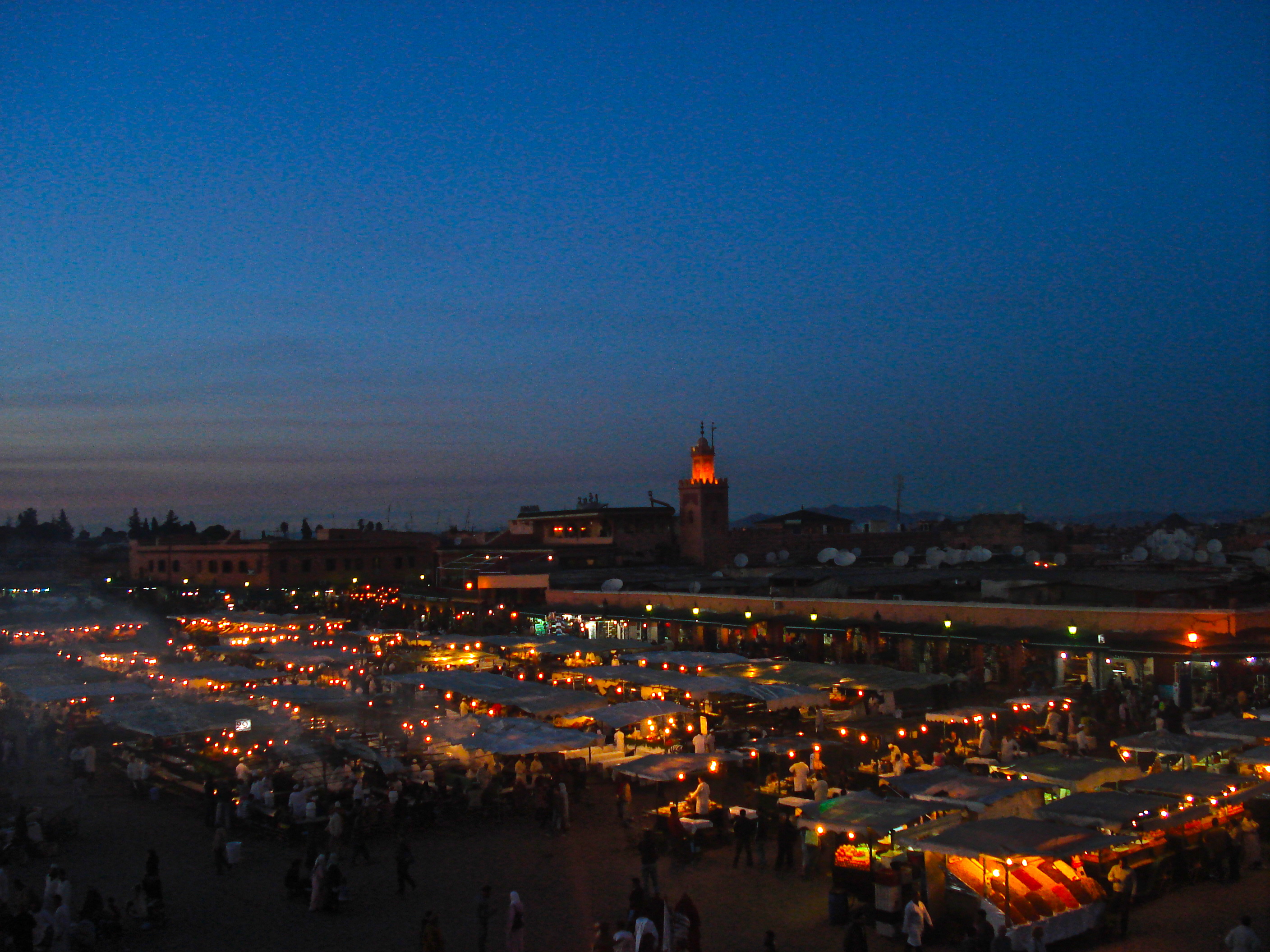
Sat looking out at the kaleidoscope of dusk catching the smoke of cooking food at the Djemma el-Fna Square. Clouds of edible fog rise over tarpaulin market stalls and are filled with every sound you could imagine: shouts, whistles, cymbals, cries, car horns, horses’ hooves, bells, drums, donkeys braying. Everywhere you look something is moving. The colours of the square swirl in all different directions at once: saffron, ochres, rose coloured walls, red robes, white robes, orange trees, clear blue skies, silhouettes of palm trees, the pink patches of snow along the tops of the Atlas Mountains caught in the dead embers of a December sunset. A child’s yellow balloon drifts upwards and across the square, past the minarets, past the people, above the colour and noise. Everywhere you look there is ceaseless movement. The concert of motion drags in one’s gaze, dancing inside a symmetry of chaos, swirling inwards and outwards, whirling in all different directions at once.

Image by Karl Powell, Maghrib: Djemma el-Fna (Marrakech), 2007

The dance goes on. Snake charmers play with hooded cobras, horses shake their heads chiming bells, lanterns blink into life in the low light, cameras flash, money changes hands, food is eaten, motorbikes thread themselves between narrow flinches of people, families, groups, individuals all together in the square. The more you look, the more it moves. Constant life, constant motion, orbital circles, figures of eight, loops of infinity. People pour into the Souk, people pour out of the Souk. Everything is overwhelming to the eyes. And then, everything comes to rest with the call to prayer, the maghrib or sunset prayer. Everything that resembled a world so busy, has emptied and stopped. The Atlas Mountains stand cloaked in purple hues. A time to reflect.

Image by Karl Powell, Reflections (Marrakech), 2007

In the silence I wonder if I will ever return to this wonderful country. In my heart I sincerely hope so. I really wish I had booked more time to stay and explore; I really wish I had found the time to visit Essaouira (it was one of the things I had hoped to see, yet the planets had not aligned). Tomorrow I leave. In the silence I reflect on my time here. All I have encountered is kindness and friendship; this has been my experience and one that will remain inside me forever. And then, as the maghrib prayer ends, life returns to how it was minutes earlier. Motion begins again. The Djemma el-Fna square pulses with energy and good intention. Somewhere below me, I can hear Stir it Up. Loud. As a friend of mine likes to say: wherever you go in the world, someone is always playing the songs of Bob Marley. Darkness has now arrived to Djemma El Fna and soon I will have to find my way back to my hotel. This place is just amazing.

Image by Karl Powell, The Hand of Fatima (Marrakech), 2007

FLIGHT BA6923 (RAK > LGW)
Half way through a three-hour flight. Head thumping, lower back aching. Half way between Marrakech Menara and London Gatwick. Window seat. The flight flew north, towards Casablanca, then seemed to follow the Atlantic coast of Morocco as the African continent began to point up towards Tangier. Nothing but blue skies, only deep Atlantic blue waters, white-tipped waves far below, chalk-smudged cirrus cloud dusted and stretched across the sirocco winds moving across the Straits of Gibraltar. For a moment, the Mediterranean blue opened up on my right stretching out far and wide, then the flight began to tilt and moved across into Southern Spain. There in the distance, where they should be, stood out the mountains of the Sierra Nevada. Sharp, white with snow and pointed. They ran like a spine of visible vertebrae along the body of Andalucia. An elderly couple sit next to me – both from New Zealand. The husband was dressed in a shirt and tie, navy blazer with gold buttons. We spoke for a while after the inflight meal had been served and told me that he had been a Prisoner of War in Borneo. We spoke about Sandakan and he seemed grateful that I had visited there a few years earlier, had been there, to the museum there, and knew about it. He looked me in the eye to thank me for having gone there. Now both are asleep.
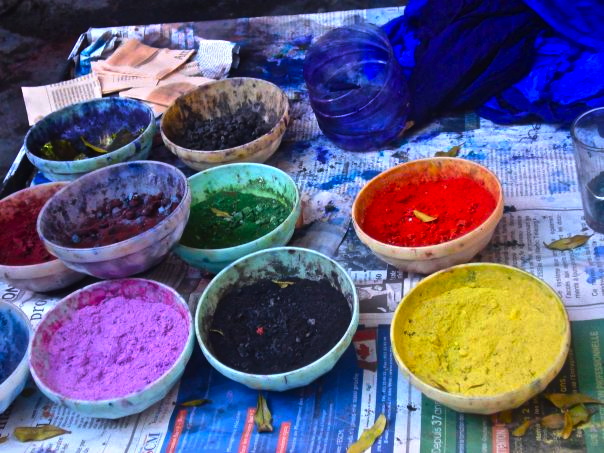
Image by Karl Powell, Kaleidoscope (Marrakech), 2007

GATWICK AIRPORT
It is still December, stood outside Gatwick Airport, a suitcase at my feet, waiting for my National Express coach to take me home. It is due for departure at any minute. It is bitterly cold. The stars look frozen, encrusted in frost across the night sky. Nothing moves. The cold hangs frozen in the air. The darkness makes everything seem so much colder. Nothing moves. There are lights – orange streetlights and yellow headlights. But all the other colours are inside, behind me, there in the warmth of the airport. Pin pricks of colour in Christmas fairy lights, dancing tinsel, television screens showing replays of shows and the weekend’s football matches. Images of Djemma el-Fna keep presenting themselves to me in my mind. The sun would be setting there now. Sounds of bus engines rev up and rumble in the evening mist. A young woman comes out of the electric glass doors behind me, pushing a trolley of suitcases. She asks me if I know where the bus to Sheffield is. She tells me she is from Lithuania and is lost and is tired. All I can do is point her towards a departure board (which does list her bus departing in twenty minutes). She walks off pushing her trolley into the darkness. Into the bleak mid-winter. Into the Gatwick grey.
*
27 Sevilla – Summer Solstice (España)

PART ONE: EL ARENAL

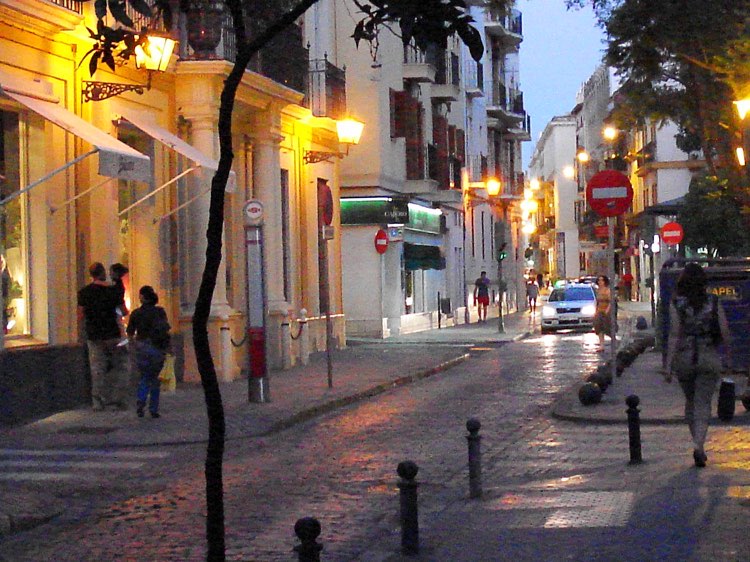
Image by Karl Powell, Seville (Sevilla), 2007

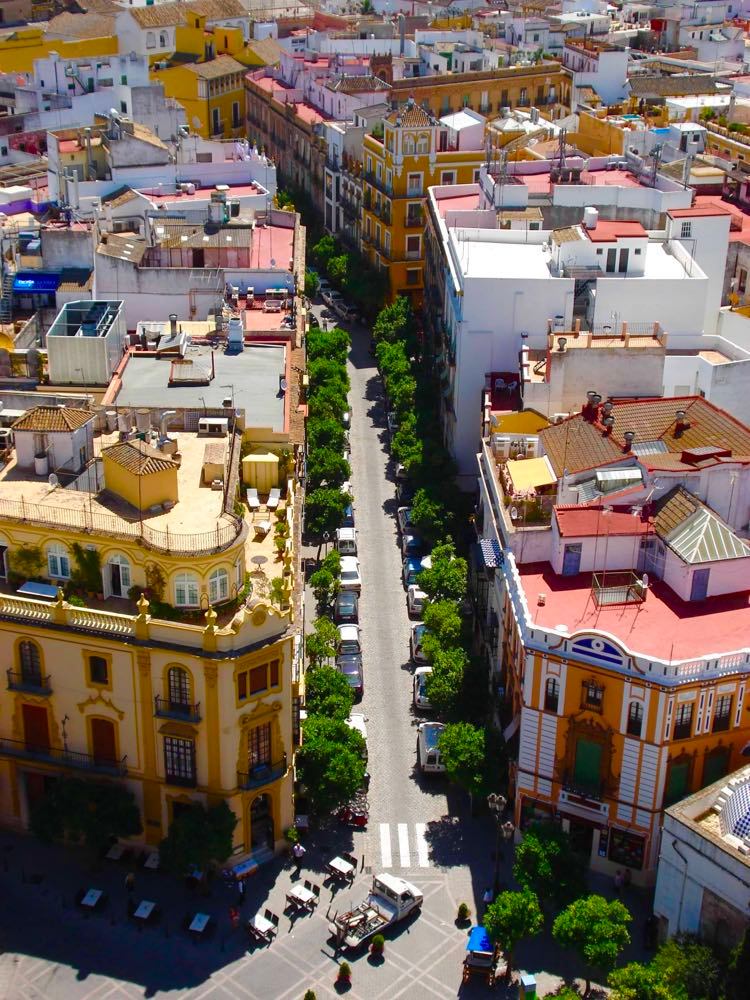
The heat from the Summer Solstice burns everything with white heat. Streets radiate with the midday sun – the midsummer’s sun – the Andalucían sun. Everything about being in Seville today feels that bit closer to the sun. The heat. The light. The glare. Palm trees rise to Heaven open armed with their long, rolled brevas cigar tree trunks toasted to black cinder. Sunshine bright and burning, glaring and dazzling; overhead, shadows shift beneath your feet. The day had started early, walking, wandering, looking, trying to explore what could be found before the bite of the day became too great. The Catedral and Real Alcázar were both within walking distance of the hotel; I managed the first and thought to see the latter after lunch. The morning had been crystalline with sunshine, even scented with the perfume from orange groves and bushes of rosemary. Doves sung within the protection of box hedge trees, near the play of water falling from fountains, which spouted out into octangular bases. Backstreets leant hard against the shadows, crisscrossing different times and ages; routes wandered past the small, orange house of Diego Velázquez, gave glimpses of the Torre del Oro (where once it shone with gold across the waters of the Rio Guadalquivir), and echoed the songs of Bizet’s ‘Carmen’ as she stands still outside the Real Fabrica de Tabacos. And in savouring the shadows, you learn to love Seville so deeply, enriching your own dreams and wishes in this waking life. In the words of Wallace Stevens, “…the day is like wide water, without sound, stilled for the passing of dreaming feet.”

Image by Karl Powell, Catedral y Rio Guadalquivir (Sevilla), 2007

Inside a bodega, a few moments before midday, a camarero chimes white china plates and saucers into stacks at the end of a long, wooden bar. Locals start to arrive and queue. Holas reverberate. A man sits reading a newspaper and smoking a cigarette. Legs of jamon hang from the ceiling. Orders sound, spoons rattle and coffee begins to grind. An old woman is served first. She stands at the bar carrying a small, red leather bag. The camarero asks what she would like:

Senora, qué quiere?
– Dame un whisky.
– Uno simple o doble?
– Simple. Gracias.

He turns and reaches for a large, green bottle of J&B on a shelf (its yellow label stands out, as do the large red letters). He pours her the single shot she ordered and asks if she wants ice:

– Con hielo?
– Sin hielo.

She pays and takes her glass of whisky to an empty table and sits alone. A pot bellied man, maybe in his fifties or sixties, smartly dressed next approaches the bar and asks for coin change. The thin belt around his waist is tight. He needs change for the slot machine against the wall. I watch him play for a while but he wins nothing. The coins go in, lights flash, the wheels spin and stop, but nothing happens. No jackpot. Only the silence of the bar signals another lost round. In the narrow, curved calles beyond an open window, swifts and swallows chirp – flitting in and out of the small, green Judas trees which stand baring their heart-shaped leaves to the searing light. Seville continues to bake.

Image by Karl Powell, Plaza de Toros (Sevilla), 2007

Here I sit, finishing a coffee and considering a wine. The raise of temperature makes perspiration prick through my skin. Am getting hungry, too. The camarero has stopped making café solos and begins slicing cured pork and ham for those who have ordered food. I read through the menu and my limitations with the Spanish language gives way to the desire to eat (some attempt to speak castellano seems to go a long way and smiles can easily be shared wherever the gaps appear). Without prompting, almost anticipating, the camarero comes to take my order, and in a busy bar I labour in language and point to what I’d like to eat from the menu:

Senor, qué quiere?
– Quiero anchoas, pan y otro jamon serrano.
– Y algo más?
– Si, quiero un vaso de vino blanco, por favor.

Soon, a small carafe of white wine was placed in front of me along with an empty glass. Condensation immediately began to cloud and ran like raindrops down the curved body of the glassware. Three small, square dishes then appeared in no particular order: thin shavings of soft, translucent ham, slices of bread and four, fat fillets of plump anchovy (ruby red in freshness and mirrored the length and breadth of my cutlery). These have to be the most delicious anchovies I have ever eaten –garlic and vinegar coat them all. The serrano ham is so sweet to eat. Oil drips from my fingers onto the table. Almost half past twelve now. And all is good. All is good.

Image by Karl Powell, Calles de Sevilla (Sevilla), 2007

PART TWO: BARRIO DE SANTA CRUZ
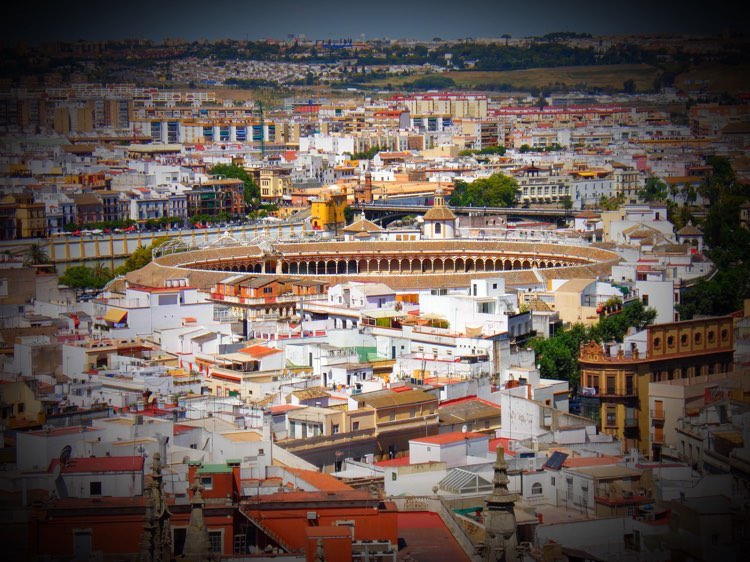
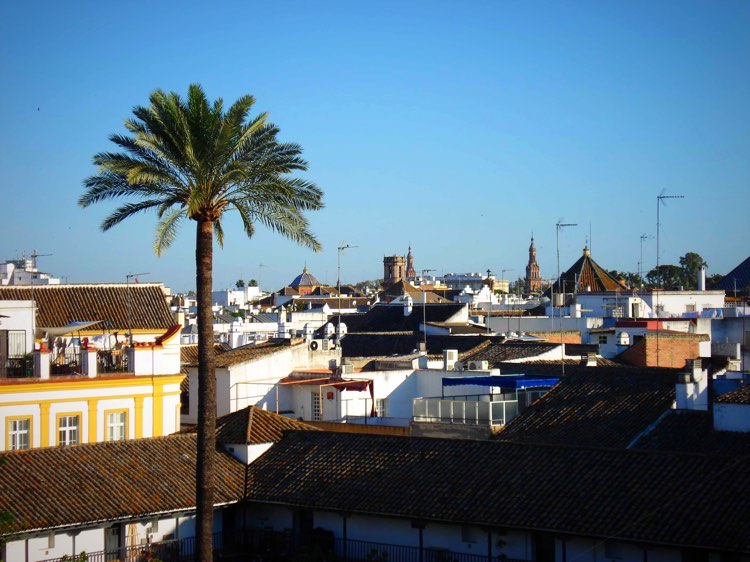
At seven o’clock the bells of Santa Catalina strike. The sun is still high in a cloudless sky. From the rooftop of my hotel most of Seville can be seen. From here, landmarks rise up above the buildings. The Giralda stands tallest (some eight centuries old and counting). Eyes dance along the city. Searching for the pathways taken this morning. Streets look different now. Can no longer see the river. Can barely see the shapes and contours of Triana (let alone hear its deep song of flamenco). Over in the Plaza de Toros, the yellow sand continues to burn. A giant palm tree pokes up over the rooftops. It must be tall as it’s the only one I can see. The trunk rises up to a golden knot. From there, around fifty or so palm leaves sprout. Green fingers wriggle in the air.

Image by Karl Powell, Summer Solstice (Sevilla), 2007

The bells have just finished singing from the Iglesia de la Anunciación. Their echoes fade around the streets of Seville. Even though it’s seven o’clock, it is still hot. The sun is strong. The levanter breeze that came in yesterday has all but evaporated. Nowhere to be seen. Up here on the rooftops the heat is sticky. Thousands of spires reach up to Heaven. White, flat buildings reflect the heat. Birds twitter still. Flies annoy. A dog barks. To quote from the verses of Wallace Stevens, “…what is divinity if it can come only in silent shadows and in dreams?”

Found my way up here yesterday and wanted to come back tonight – just to sit and write and watch the sun set over the Summer Solstice. Came prepared. Went to a shop a few doors down. Practised the language and bought some good things to eat: bread, octopus, cheese, olives, anchovies and a carafe of red wine. The oil on my fingers makes it difficult to hold this pen. There’s a few other people up on the roof tonight. A woman from Argentina came over and asked me what I was writing:

– Que estas escribiendo?
– Solo la puesta de sol.
– Puedo leerlo?

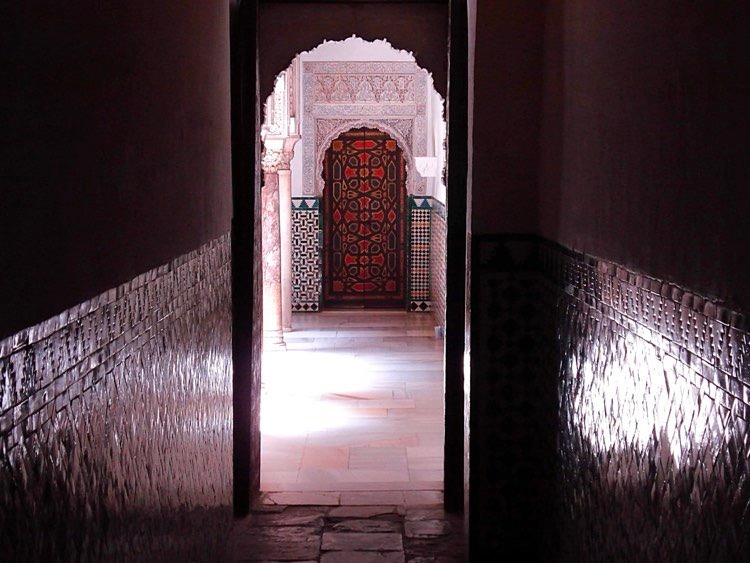
She took my book. She took my pen and wrote her name along with her room number and walked off saying nothing more. My head still spins from the afternoon at the Alcázares Reales. Quite the experience walking through things never seen before. The geometry of Moorish tiles and patterns stimulated imagination, intoxication and dislocated rational thought. The cool, standing stones in archways and soft marble carvings left impressions that began to change something within. I wanted to follow but remain here, determined to write down my dreams and draw a clear path of where I want this life to go. Impossible to know the direction, but the concealed labyrinths of the soul could only close in to show that a path was there. Belief was the way.

Image by Karl Powell, Real Alcazar (Sevilla), 2007

Down below in the cool of the shade, the day is all but over. The streets look tired and world weary in the way that life can sometimes feel after a dynasty of adventures. Bells that rang and peeled moments earlier only seem to drift down there now. Floating, falling, sinking down to the darkness. Loud. Soft. Tumbled echoes. A couple sit beside each other on a small wall outside the hotel. She is dark-haired, voluptuous; he is dark-haired, skinny. Both wear white shirts, open collared, matching black skirt and trousers. They share a cigarette together and smile in their own private Seville. The clouds of smoke that they create rise slowly upwards, lingering here and there, before dissolving forever on the journey. Doves coo and swallows continue to dart and dive into the vacant spaces above their heads. Rooftops and squares. Dark rectangular windows hiding inside white buildings. Oil drips from my fingers. Endless blue above.

Image by Karl Powell, Vino (Sevilla), 2007

PART THREE: EL CENTRO
The sun set about an hour ago and the sky has sunk into a deep, violet fog. It is dark. Church bells clang into each other, sounding solitary markers for a half past ten. And at last the city of Seville is winding down. The place to be – as always – is seated outside, tucked up into a narrow street, heart beating, close enough to where the shadows and voices echo ever-upwards into the starlit skies. That tight, blank canvas of touchstone dreams – that stretched, black fabric where you know you and I will one day return. Underneath those twinkling inscriptions, tables are pulled together, people feast from small white dishes, share bread rolls, refill glasses of wine (even including grandma). This is the place to be. Unaffected by the steady stream of tourists, Seville seems focused on its own sequestered universe. Workers are walking home. Unhurried they move along the long, curving calles. Friends greet each other. Hands touch. Lips kiss. Cerveza pours. The world and its clutter exists elsewhere. Latticed windows reflect neon lights and the images of people searching for other places to go. But this is all there is. An eternal city has nothing else to prove. The dreams it dragged down and brought into being scar and mark the soul that thirsts for beauty; the dreams it dragged down and brought into being shine and charge the body that aches with beauty. And it knows it. There is nothing more to prove. Life becomes an indulgent dance of love in slow, patient footsteps, edging, nudging, moving ever closer to union.

Image by Karl Powell, Midnight (Sevilla), 2007

Midnight has arrived. The hollow chimes from the bells of the Convent de Santa Catalina sound their echoes across the rooftops of Seville. The heat of the day has gone. Only the feint scent of jasmine remains. My heart feels so happy and wishes this evening would never end. The longest day is already over. To quote from the stanzas of Wallace Stevens, “…at evening, casual flocks of pigeons make ambiguous undulations as they sink, downward to darkness, on extended wings.”   

Image by Karl Powell, Doves (Sevilla), 2007

*