34 – High Street, Fremantle (Australia)

Image by Karl Powell (High Street), 2023

Sitting on the sunny side of the street, outside Breaks, I am waiting for my coffee to arrive. Late Friday morning, and already the feeling of another weekend yawns far and wide within languid daydreams – somehow stretching the confines of a week into an expanse of extra time. The sky is clear, blue and endless. Outside this café, people are walking through the sun-shined, sea-port town, leaving their half-caught conversations here and there for others to listen and love; streets are already filling up with day-tripping tourists keen to mooch along through the weekend markets further up on South Terrace. Scents of perfume hang heavy in the drifting breeze. A man with a fridge trolley pushes past everyone in his way labouring with a cargo of orange crates.  Large groups of lunchtime students drift – some going this way, some going that way – are meandering in conversations. The sun shines along the length of High Street. A feint moving breeze blows down from the Town Hall and out towards the sea.

Image by Karl Powell, (Sitting outside Breaks), 2017

The café was filled inside with the sound of female laughter and coffees being made – the hiss and rush of frothing milk. It was busy in and around the café. The High Street was full of noise and people. Almost all tables were taken at the café as well. I sat near the door and had the sun on my back. A girl with a coloured pencil case was writing something down on the table I normally wrote at. Some guy sat at the adjacent table, back turned slightly, almost facing the sunshine. He said good morning to some other guy called Ian who walked past. To my right were three young people talking in French. An old woman dressed like an English Vicar muddled past. An office worker walked quickly then dropped to his knee in the middle of the pavement to tie up a shoelace, then carried on walking, swinging his arms: grey shirt white pants. Lovers of all ages sauntered past arm in arm, hand in hand, sharing the sunshine and the moment of this morning.

A plane, low plane light aircraft fluttered overhead in the endless blue. An old man with short grey hair and an angry face grumbled past my table, limping with a stick. Behind him three youngsters walked past, oblivious to anything other than the delight of their own laughter as each jumped up to touch the awnings and overhanging shop signs. Across the road I saw my friend Shane the archaeologist walking down towards the Round House.

Image by Karl Powell, (Street Artist, South Terrace), 2017

At the corner of the next intersection a street artist was painting a large purple elephant in chalk on the floor.

Image by Karl Powell, (Street Artist’s Elephant, South Terrace), 2017

Everyone around me seemed to be reading – heads down in books and newspapers reading. A guy with a white ponytail sat nearby staring at a crossword. The crossword was large and took up most of the half-folded page of his newspaper. He bobbed his head and tapped his feet to music being played from the record shop next door. A watch on his wrist clearly told the time of a quarter past eleven. Nearby, a lady sketching sat in silence, drawing something with great care, crafting slowly, watching her ideas manifest in pictures. As she continued to draw, she leant on her left hand, elbow resting on the table. A giant pink stone sat in the ring on her finger. It matched the pink hue of her fingernails which shone in contrast to her olive skin. She coughed suddenly and turned her sketchbook: she was drawing rings.

Image by Karl Powell, (Pasta Addiction), 2023

Next door, the record shop had just finished playing George Gershwin’s “Rhapsody in Blue.” I had missed most of the song when ordering my coffee but caught its ending. The record shop already had its doors open before I arrived. They had a big, yellow sign telling the whole of High Street who they were: Record Finder – Specialists in New & Quality Used Records and Cassettes. The interior of the shop looked dark and eclectic – hosting the entire body of music in all its forms. Theirs was a portal into another world – a voyage into new dimensions of Time hitherto unknown and undiscovered; music shops, like bookshops, offered up the opportunity to glimpse into distant corners of the universe and come face to face with something utterly unexpected which somehow aligns with your soul, strikes a chord and eventually changes how you see the world forever (such is the magic of music and poetry).
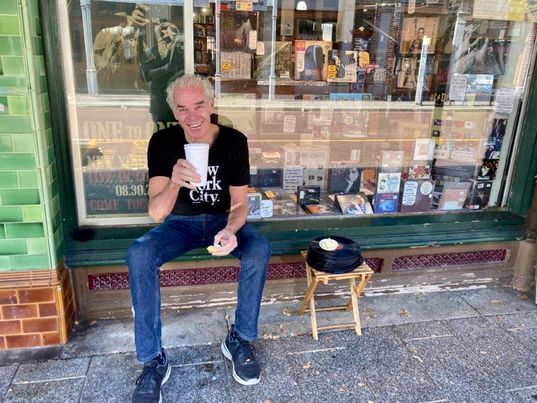
Image by Karl Powell, (Morning Coffee, Record Finder ), 2023

A large, plastic crate of vinyl records balanced on a stool, guarding the shop doorway. Books about jazz sat alongside vinyl in a glass cabinet with words written on a note. Rows of compact discs ran from the entrance into the darkness inside – each with a small, white label in the right-hand corner (like a postage stamp). The ceiling was high. Behind the posters, behind the stacks of records and compact discs, the walls were painted jade green. In the window there was a large poster of Johnny Cash; below it, a box with the name ‘Tchaikovsky’ printed on it. Sunlight fell inside the shop floor, arrowing in through the gaps at the shop’s front and searing the patches of carpet in long, horizontal cuts. A lone seagull moved about the doorway. The bird had flown down out of the sunshine to land at an outside table where people had been eating. The bird landed in silence grabbed a large crust of something, swallowed it whole in one gulp. It then jumped to the floor and moved as if to enter the music shop (loitering in the shadows of the threshold).
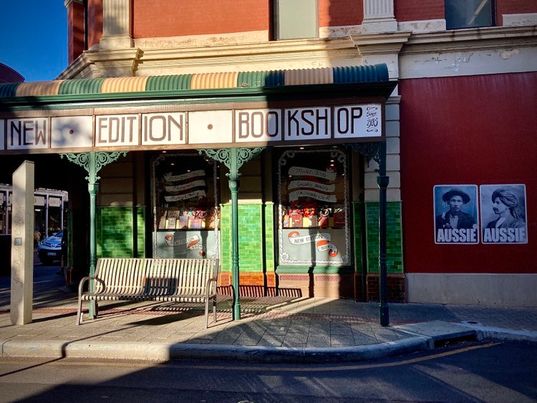
Image by Karl Powell, (New Edition), 2024

One of the record shop owners, sat outside the café on a table, watching the world walk by (offering out a greeting to whoever stopped to talk with him). As I took out my pen and paper and got ready to write on an adjacent table, he ordered another coffee from the waitress with blonde hair.

The humming thunder of a Harley Davidson purrs past us, hammering down towards the Round House and elsewhere. Van doors slam shut as morning deliveries are made. A young woman walks up towards town, carrying a book in one hand, with sunshine bouncing through each curl in her brown hair.

My pen cast a shadow on the table in front of me as I wrote. I watched the way it seemed to weave and dance in front of me on sunlit pages; my will, my ideas scorching blank paper forever.

Image by Karl Powell, (Sunshine on a Wooden Table), 2019

This is all I have today – ten minutes here at the cafe. This is all I have. And this is enough. This will work. With a flat pavement beneath your feet and the sun on your face. This is the place to be: sunshine on a wooden table, a coffee on its way and a ticket to ride. Writing on a wooden table, watching people passing by, blessed by the freedom of an empty page. Casting aside the irritations of seeking out a perfect time and place to write; there are no conditions worth pursuing (all are either absent or elusive). We need nothing more than to enjoy this moment: watching ink flow.

My coffee arrived. The blond waitress brought it.  She told me to ‘Enjoy.’ Midday sunshine was in abundance.

Image by Karl Powell, (Darawn Nature), 2023

I looked around the High Street. Opposite me sat an artist doodling and sketching something in oranges and greens. He had a glass jar of short, coloured pencils on the table in front of him. Eyes closed I could feel the warmth of the sun. The breeze moved past the skin on my face and hands. It was nice to have the sun on my face. I recalled the lines in Hunter S Thompson’s The Rum Diary where Kemp and Chenault have made love just as the novel begins to end, and the two lay together in the darkness of his apartment in Old San Juan – her head resting on his chest – drinking rum in the moonlight, listening to the clink of the ice in their glasses in the total silence they shared; it sounded loud enough to wake the whole of Puerto Rico.

Image by Karl Powell, (Bathers Beach House), 2023

I thought of the beach and began to write again. I began to think of the way that the ocean had looked and felt earlier that morning. Swimming in the endless blue. The feeling of saltwater all around. Floating in the waters of the Indian Ocean as they sparkled with summer’s sunshine. The waters had been sculpted and flat, moving slightly, here and there, broken only by the black dorsal fins of two dolphins coming up for air moving far out in the deep.

A scented candle burning somewhere filled the air with perfume.

Richard the journalist walked past my table and said hello. He stopped and we chatted about some news he had seen overnight in Europe. He told me about the new book he was writing. Told me how difficult the process was. Told me that it was a lot of effort for nothing. Told me the only reason you’d want to write something because you are passionate about it. I wished him luck (knowing he’d complete it and succeed – some people are so committed to their art that all the wind they need within their sails is always blowing near by).

Image by Karl Powell, (Cliff Street), 2019

The record shop began to play The Beatles. Sergeant Pepper’s Lonely Heart Club. After the eponymous track opened, the sounds of ‘With a Little Help From My Friends’ filled the air – and as the chorus tells the whole of High Street how to get high with a little help from our friends, an old man with a bulky, blue backpack appears from nowhere and begins to dance across the pavement, zig-zagging in fleet-footed fox-trots.

Everything was as it should be. Everything felt good. Everything was magic.

There was nothing but clear blue skies.

The sun was getting stronger. I sat still for a few moments more. I closed my eyes and felt the warmth of the sun on my back and heard laughter. It would be time to go soon. I failed to notice my friend, Liz, approach my table from out of my range of  peripheral vision. She’d been watching me write as she walked up the High Street. She came to say hello. We spoke for a while (she was on her lunchbreak, she had a cold and had to hurry as she was on her way to get something to eat).

Image by Karl Powell, (Breaks), 2017

Eventually it was time for me to leave. I finished what was left of my coffee and packed up what I had written. A customer entered the record shop as I stood up and the lone seagull scuttled out of the shadows back into the sunshine on High Street. Almost immediately they began to play ‘There’s Frost on the Moon’ by Artie Shaw. I walked down away from the café, down towards the Roundhouse and the sound of a clarinet followed me all the way down to the corner of Pakenham Street.
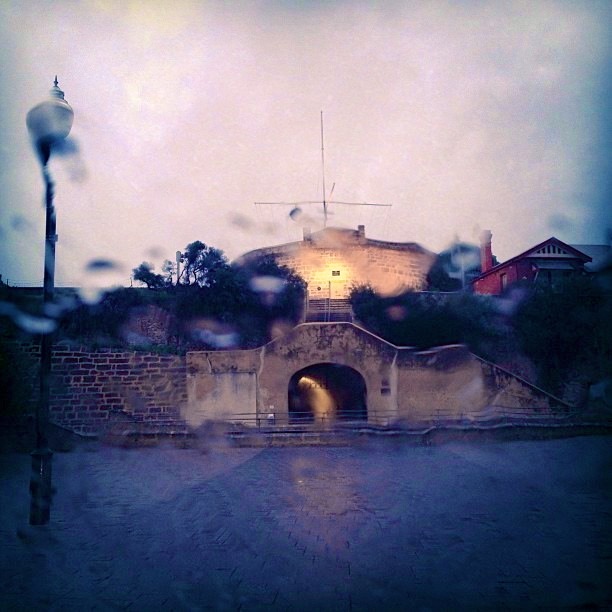
Image by Karl Powell, (Round House), 2017

The Round House basked in sandstone sunlight.  

*

32 New Year’s Day – Kings Park (Australia)

When was the last time you saw the sun rise? When was the last time you stood before the morning’s yawn and waited motionless in the indigo hues of dawn to see the sun rise? When was the last time you saw the sun rise on New Year’s Day?

Image by Karl Powell,  Twenty Twenty-Three (Perth, Australia), 2023

A bird had been singing just before I woke. Only the voice of one bird. But its persistent chirping echoed through the dark city. There had been a wattle-bird sitting on my balcony the morning before but I really couldn’t tell if it was the same bird singing this morning. There were no other noises. No cars, no sirens, no voices. Nothing. The winds were blowing, though – cool winds, Easterly winds bringing heat from the deserts that would arrive in a day or two. Trees near my home rustled their leaves and branches whenever the gusts blew past. The world was almost dark. A few stars were still visible overhead, remaining fixed and shining. With the coming dawn a luminescence had begun to seep through the dark – there was some light present in the sky, giving it an appearance of a blue drained of its vigour and vibrancy. On the horizon, low in the Eastern horizon, colours formed. There was indigo, white tinged with violet, lightness and darkness. A deep orange pooled from nothing flooding that part of the sky with the intensity of a new day. The New Year was coming. I wanted to go to Kings Park to see the sun rise.

In the short period of time it took me to make a coffee all the colours of the sky changed. I stook near a window that faced out towards the east. There were bands and glows of pastel hues, of pinks, yellows and oranges generated out and dissolving into the dawn. In the city, street lights and office lights all along St Georges Terrace were still visible in the darkness. Silhouettes of buildings and trees were pronounced. Somewhere nearby, a neighbour’s gate had been left unlocked and the wind was persistent in nudging it, bumping it, making it tap and knock against its post needing to be closed tight. In the block of flats opposite me one apartment had its lights on (everything else asleep in the building). I drank my coffee and looked out at the world. I could have seen all this from my bed: sunk down and half-asleep, feeling the morning light enter my room, imagining the black becoming gold, then lifting to Verdelho, feeling the warmth of a waking room fill with sunshine and of being aware of the white light of a new day arriving. Even asleep you can feel the morning move over you. But this was New Year’s Day and I wanted to be engaged with its first sunrise – to go up to Kings Park, to watch the sun rise up over the river and to see it shine out across the city; to be able to remember that moment throughout the coming year (whatever the Fates decided was in store).

Image by Karl Powell, Fraser Ave (Perth, Australia), 2023

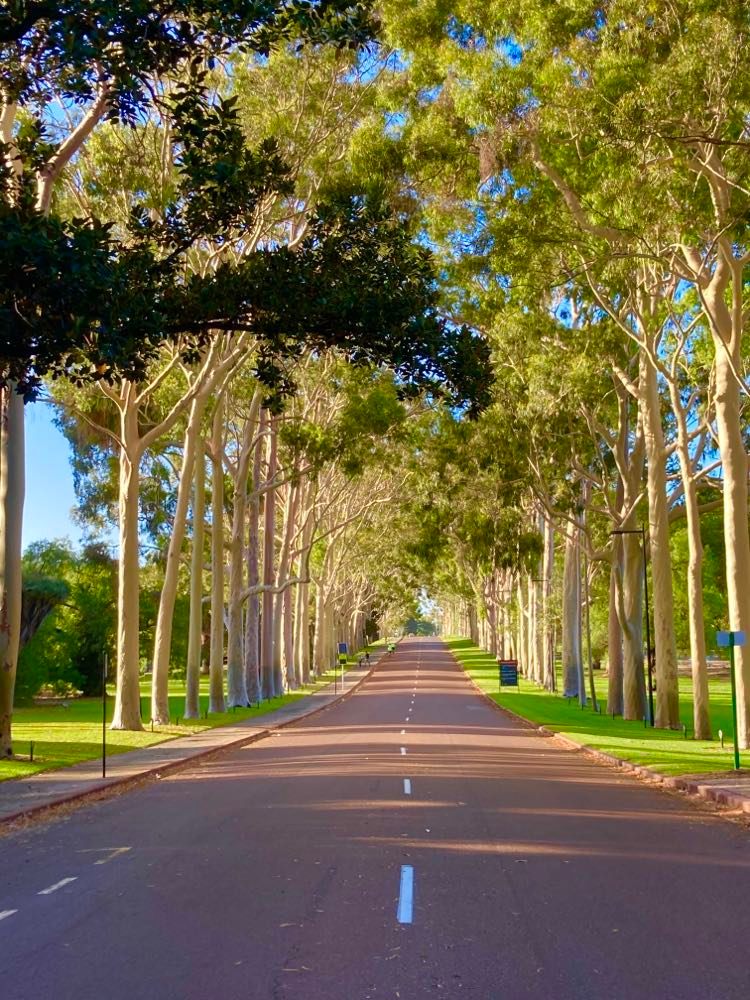
Fraser Avenue was the main road that led into Kings Park from the city. It was a long, straight road and from the park’s entrance conveyed a sense of beauty and elegance due the procession of lemon-scented eucalyptus trees that flanked it and rose high towards the sky. I had reached there a little after five (maybe about a quarter-past). It was light and the park was busy. There were cyclists, runners, dog walkers. The morning bus – the 935 from the park to Belmont Forum – was already operating, moving along out of the park towards the New Year. I made my way towards a slope of green grass, Mount Eliza Range, that faced east and out over the city. There were a lot of people already there before me (more than I had expected). They sat on the grass in groups as friends and family. Some leant against their parked cars. Others just stood between the trees facing the coming year. All waiting.

Image by Karl Powell, Kings Park (Perth, Australia), 2023

From where I stood it was easy to pinpoint exactly where the sun would appear. Most of the horizon was tainted orange with some overnight clouds clinging to the sky; the ridge of sharp edged buildings between the river and the city were silhouettes of varying heights (some reflected light and blurred images). As the morning breeze blew leaves moved all around me. There was traffic moving on the freeways that drove into, along and past the city centre itself. A train – maybe the first one of the day – climbed over the Narrows Bridge, rising up then gliding down into the maze of track leading towards Elizabeth Quay. And in front of this view an old man in a blue shirt and trousers walked his dog, yanking it back onto a path as it stopped to sniff and search inside one of the bushes adjacent there.

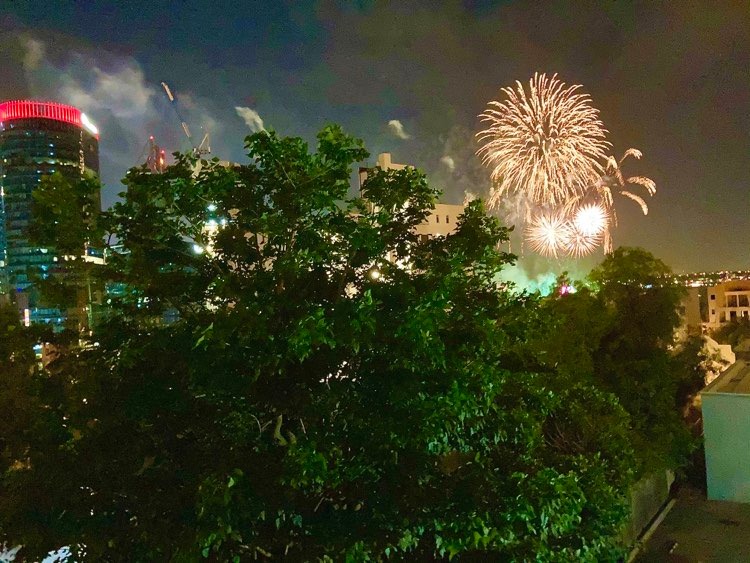
Image by Karl Powell, Fireworks (Perth, Australia), 2023

And so we waited. That corner of the horizon, a glowing swirl of orange and yellow would be where the sun rose. The colours were hypnotic to look at, waiting for the first chink of sunlight, the first glimpse of the New Year. My mind wandered. The breeze that blew was cool without being cold. Images entered my mind – just a few hours earlier I had been celebrating the arrival of midnight with friends – the passing of one year to another. It had been a fancy dress party; we all arrived in costume and inevitably in character. We had all shared a meal together, everyone had brought something. We ate as friends, talked as friends and then danced together as the midnight hour approached. There was a balcony and from there we watched fireworks crackle into the night sky above the city. From there you could see the whole of the city – almost touching some of the buildings with their lights, shadow and towering height. Down below we watched people walking alone, in groups, singing, laughing. Taxis and traffic drove along Hay Street and Milligan Street, illuminating the darkness with their headlights on. We celebrated the year that had been and wished each other good luck for the one that was to be.

Image by Karl Powell,  Box 28 (Perth, Australia), 2010

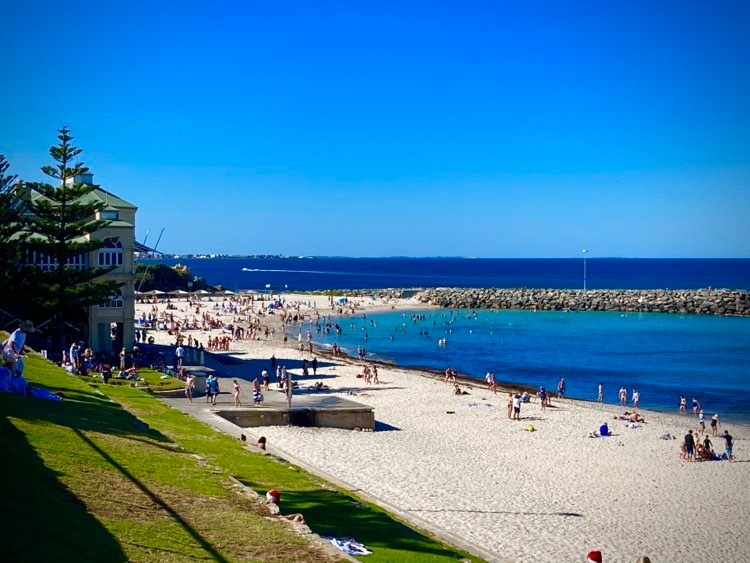
And still we waited in Kings Park. That corner of the horizon, where a glowing swirl of orange and yellow continued to grow. The colours were hypnotic to look at, eyes willing the first chink of sunlight to give us a glimpse of the New Year. My mind wandered again. Just a week ago I was sat on Cottesloe beach celebrating Christmas Day. It was a clear blue sky. Waves had rolled ashore (out of the stillness, out of the quiet ocean). A faint wind blew cool air from the East. The glare of sunlight grew stronger, bouncing off the brilliant sun-bleached sand.

Image by Karl Powell, Cottesloe Christmas (Perth, Australia), 2021

Despite arriving early – early enough that the sun shone behind the Indiana Tea House casting a giant shadow across the sand making it cool – the beach was busy. The sand had been pockmarked with small dunes of footprints – made worse with a small, black dog chasing seagulls that tried to stand there. People in groups, of friends and families, sat together facing the ocean. People were happy. Some drank fruit juice, or poured glasses of champagne, others shared food. There had been an old man, up near the rocks, who had sat alone in a chair, wearing a hat, reading a book; I remembered him because his chair had been positioned so close to the water’s edge that the legs of the chair had sunk deep into the wet sand and the occasional waves that washed over his feet made his toes dance. That day the ocean had been flat – flat from shore to horizon. There had been a swimmer just beyond the reef splashing in strokes between the patches of blue and aqua green. As ever, the shape of Rottnest Island was fixed straight ahead. A large tanker sat further out. No matter how many times you swam in the Indian Ocean blue it always left you feeling so alive and content. Floating in the shallows I looked back at the beach and saw all the people celebrating Christmas together on the sand.

Image by Karl Powell, Christmas Morning North Cott (Perth, Australia), 2021

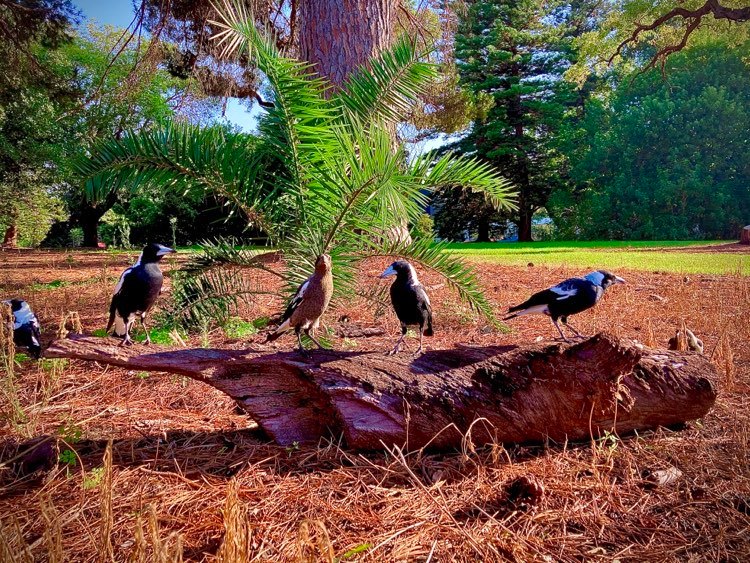
And here I now stand at Kings Park waiting for the sun to rise. I wait with others, facing east, looking out across the Swan River and Heirisson Island. Light is lifting. The entire sky is thawing from the night, turning into a cool blue. The colours of dawn appear in brevities of being, glowing in oranges and pinks before vanishing. More birds begins to sing. A family of magpies walked across the grass at Mt Eliza Ridge looking for food. Just over the Hills and the Darling Ranges yellow light dances and is alive. The sun will rise there. I think about the last time I saw the sun rise. Years ago – maybe ten – I last saw the sun rise here on a New Year’s Day.

Image by Karl Powell, The Magpies (Perth, Australia), 2022

Hints of sunshine glint and coat the side of the city buildings. Only light, not quite sunlight. A lone plane rises up from the land and climbs at an angle. Momentarily it passes in front of the dome of light that sits above the Darling Ranges. The plane turns towards us, aiming to fly overhead, up along the coast, across the Indian Ocean, maybe towards the Middle East or South East Asia. Sunlight touches it smooth body as it moves through the sky. Its engines leave a roar to echo in the empty heavens behind it. The wind continues to blow. Still cool air. Birds chirp and sing. Sky is changing colour. Sky is yellow, is blue, is white. A corona of light is visible. It will emerge there. The sun will rise there.

Image by Karl Powell, Waiting for 2023 (Perth, Australia), 2023

And then sunlight enters the world. The New Year has arrived. As the first arrow of yellow light fires out from beneath the horizon people clap and cheer in spontaneous unison. A bus stops to watch. Happy New Year. At first a small chink of light, a sunshaft, slowly the sun climbs, a sliver, a quarter, a half, and then the full disc of the sun with its full rainbow of glints, squinting blinding light.  A blank canvas. The day begins, the new year stretches out with all its dreams, hopes and promise.

Image by Karl Powell, The New Year (Perth, Australia), 2023

When was the last time you saw the sun rise?

*

26 Winter Storms, King Street (Australia)

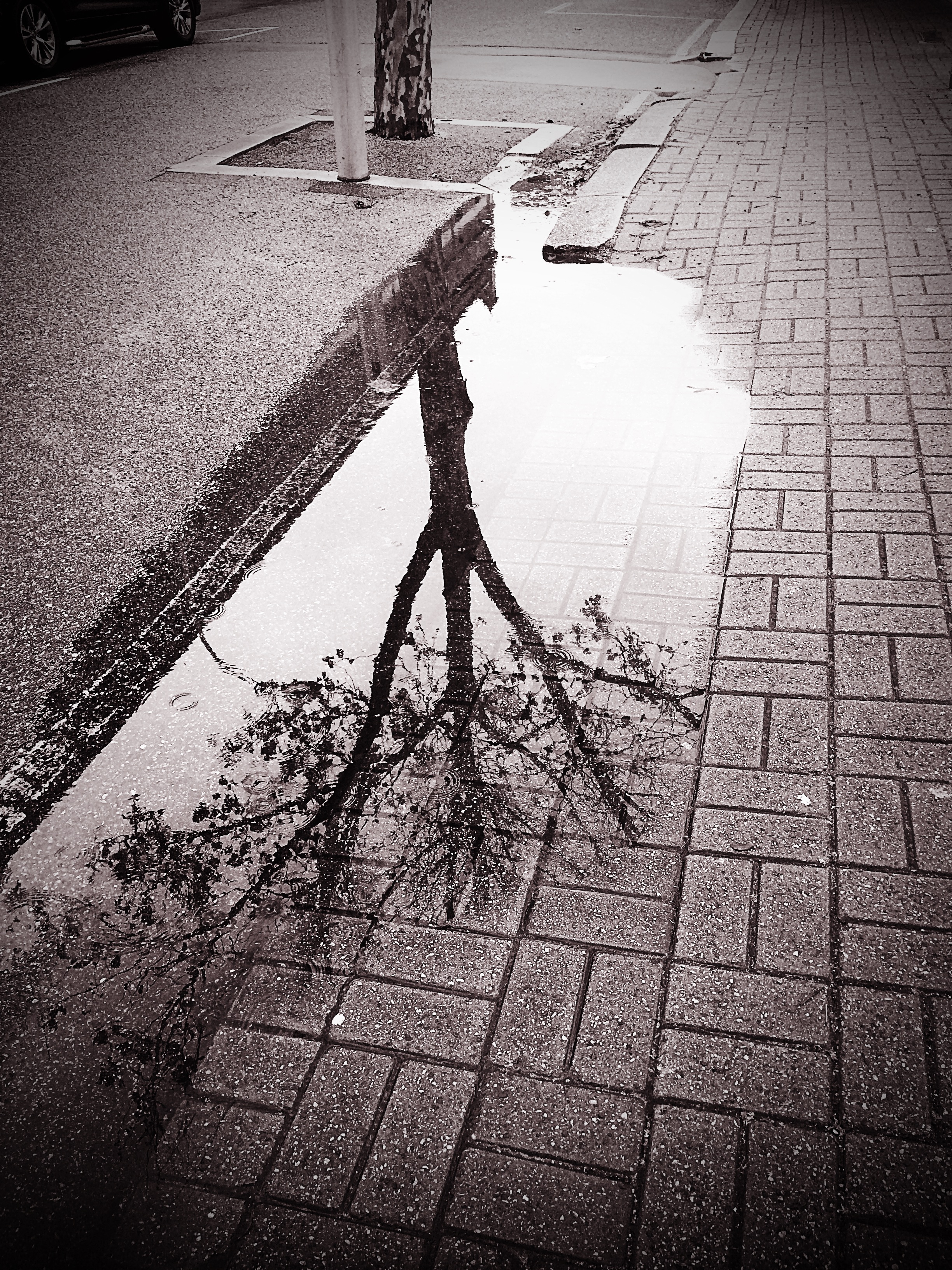
Image by Karl Powell, The Rain (Perth), 2022

PART ONE: CAN’T WE BE FRIENDS (Ella Fitzgerald)
And then the rains came down again. They fell in a single sheet of grey noise just after midday. King Street disappeared from view. The pavement and flagstones became lakes alive with dancing splashes of raindrop circles. Fallen leaves, flat and brown, once curled, stuck fast to the puddles and wet tarmac. Winter storms had hung around the city all week. Everything had been cold and wet, and wet and cold, so much so that if felt as if the winter had always been there. The river had been languid and grey, reflecting the damp overcast sky which tried its best to censor the sun and any fragment of blue sky. The only colour visible most days had been the red flame flowers showing in the poinsettia trees dotted here and there. And now, another storm blew through, smashing in from the Indian Ocean, scattering people in all directions from St George’s Terrace, making them seek refuge, needing cover from the cold, wet air, obscuring any afternoon plans in an instant.

Image by Karl Powell, Black and White (Perth), 2022

Two people caught in the squall huddled in a cuddle underneath the bus stop by Westralia Square for the 935 to Kings Park. They were visible for occasional moments here and there between the pouring spray. They stood with their hoods up. One attempted to put up an umbrella, but was rebuffed by the wind at every opportunity. The wind blew so much into them that the umbrella bent, buckled and was eventually blown inside out. A man ran past them, into the rain. He ran with one hand holding onto his hood, carefully trying to plant his feet, as if not to slip. The hint of a flash of lightning blinked in the peripheral vision then was confirmed with the sound of thunder. A 27 bus pulled up to the bus shelter – yellow headlights on – the two people declined the offer of sanctuary and the vehicle pulled off up towards the top end of the Terrace, leaving behind shifting curtains of rain dancing in the city air – drifting, billowing, blowing. As the winds blew harder the trees moved in concert with each other in the downpour. Branches twisted. Splashes fell everywhere. Rhythmic patterns drummed onto roofs and buildings. Smoke chugged out and upwards in a heated plume from an unseen vent. The rain kept falling.

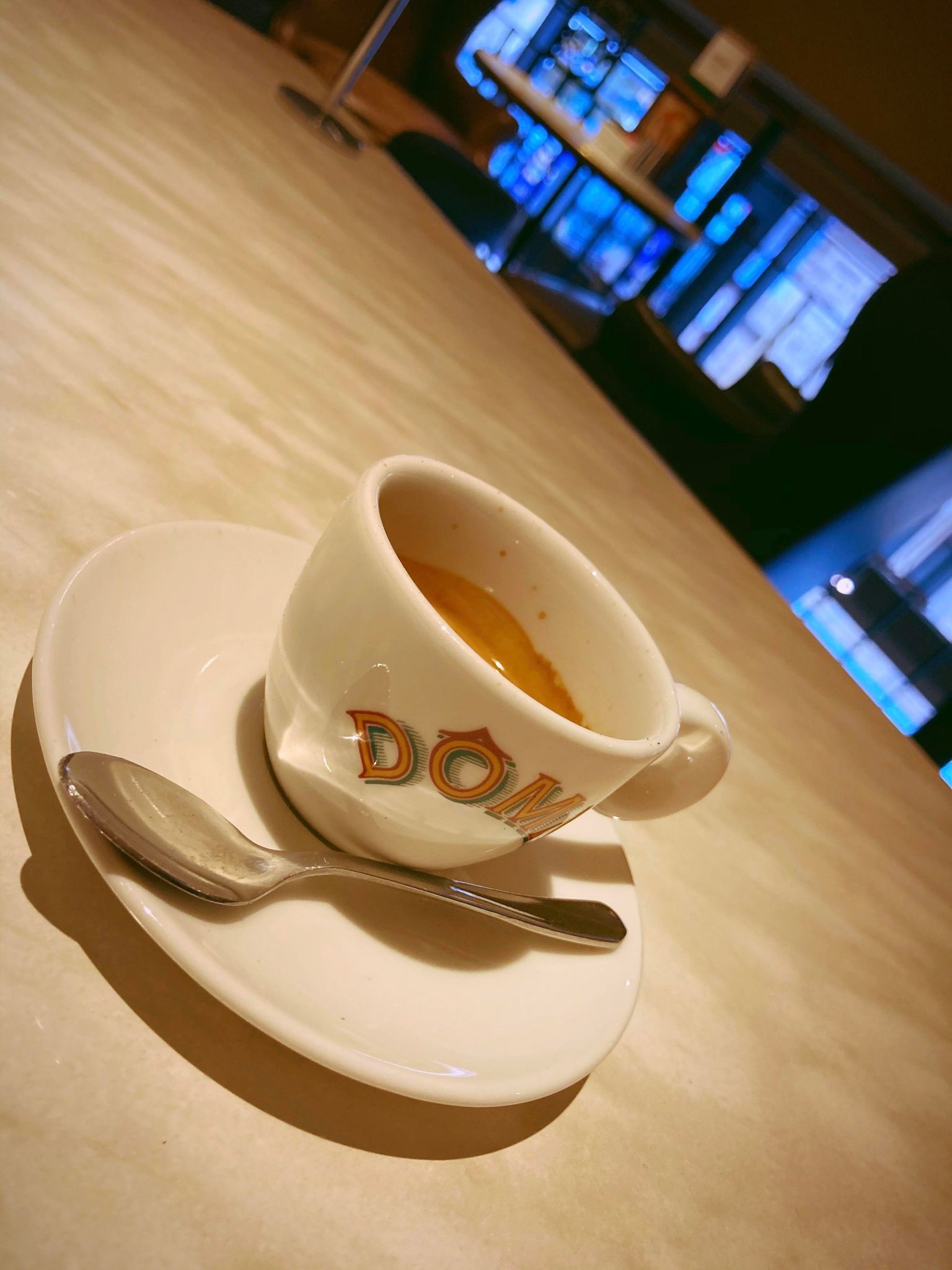
Image by Karl Powell, Espresso (Perth), 2022

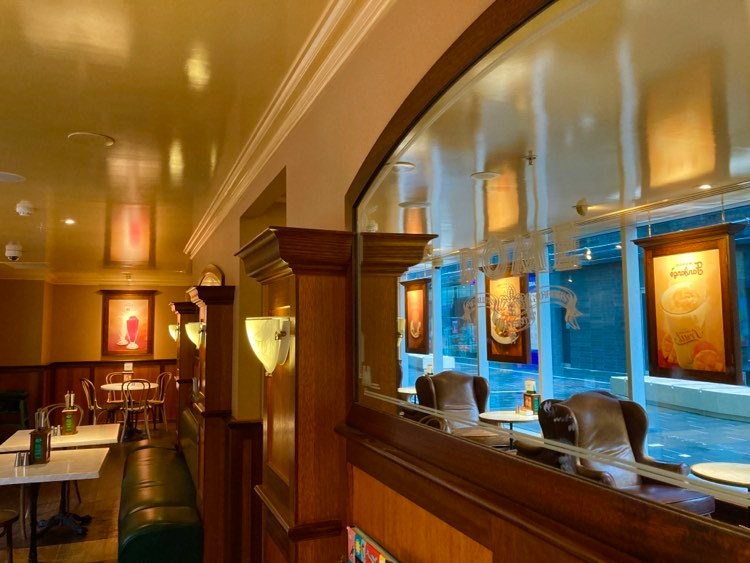
Inside the café everything felt warm. Music played and was a soft contrast to the noise outside. As the mood of the downpour grew darker, the intensity of colour glowed brighter within. The lights inside the café – oranges and lemons – were reflected as the greys outside rose and fell. My order had arrived at about the same time as the rains: an espresso and a croissant. The coffee sat smoking in a white demitasse on white saucer. A small spoon rested there. Sachets of sugar sat next to menus near stainless steel salt and pepper shakers. I didn’t take sugar, but today I felt the need. The espresso was gone in three gulps. I began to pull apart the croissant and ate it slowly watching a man walking in the rain with a barely functioning blue umbrella; half collapsed behind his head, his exposed shoulders looked soaking wet. I had been trying to shazam a song that had been playing a few moments earlier. It was a cover version of Roxanne by The Police. It had been sung by a female and an acoustic guitar; it was a slow adaptation and I had liked it. Despite numerous attempts I could not get it identified, and then when the order arrived with the rains, the song changed and the moment was lost forever.

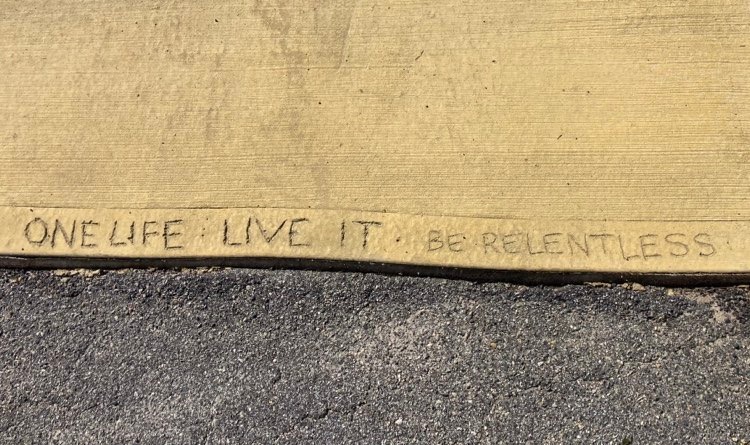
Image by Karl Powell, One Life (Perth), 2022

PART TWO: BEGIN THE BEGUINE (Sammy Davis Jr.)
A family of four sat on the table next to me. Table 104. They spoke quietly amongst themselves in a language I was unfamiliar with. Two read newspapers, two looked at their phones. Patiently they waited for their order. Most tables were rectangular (mine was – as was theirs), white-marbled tops, wiped clean. A row of circular tables ran the length of the café, alongside a glass window that looked out onto Brookfield Place. A member of staff who was sweeping the floor looked up occasionally from her task out at the rain outside. It was not stopping anytime soon. She moved down the café, brushing along the dark, wooden floorboards, sweeping under chairs and tables without intrusion. Two leather, chesterfield chairs faced each other, empty, tucked snug in a corner. In the kitchen, sizzles sounded and cooked together, perfuming the air with edible aroma. Sammy Davis Junior began to sing from the café’s playlist (I recognised his voice, confirmed by the song). The waitress moved down the café, her footsteps audible, until a bell sounded from the kitchen. Service out. The sound of collected cutlery could be heard. A door squeaked open and swung shut. More footsteps. Table 104 had their food delivered. Two servings at a time. They put away their newspapers and phones and ate as a family.

Image by Karl Powell, Sweet Sugar (Perth), 2022

The rain was not stopping anytime soon. I took out my notebook and pen. For a few days, I had been sketching out an idea I had about Italy. It was a story about friendship and how some journeys can see friendships develop with strangers and eventually soak deep into the memory of a trip. I had been breaking down the story into parts; mapping out each section I thought to be important and required inclusion. The colour, prose and order would be added much later but for now it was important to birth out the idea. This process of the draft was like writing a shopping list; little effort was required, concentration was light but it was effective in teasing out what needed to be said: here I want to write about x, and then I want to describe about y. I watched as the story began to carve itself into being near where the shadow of the pen met the page; where the ink met the paper; where the idea met the world. There was something magical about writing in a café – thoughts and ideas were always there, willing to sit down beside you. There was nowhere else to be. Just there. Looking at pages, looking at people, looking out of windows. A place to put down the routines and responsibilities, to blot out the distractions and to just drift in the flow of a brevity in time. Daydreams. Space to be.

Image by Karl Powell, Kubla Khan (Perth), 2022

And then, as I paused from writing, the opening lines of Coleridge’s poem “Kubla Khan” came into memory. From out of nowhere. The flashes and fragmented impressions presented themselves between the incoherent thoughts and haphazard recollections of my trip through Italy. The words sounded and I stopped writing to love them once again:

In Xanadu did Kubla Khan
A stately pleasure-dome decree:
Where Alph, the sacred river, ran
Through caverns measureless to man
Down to a sunless sea.

I had first encountered that poem on an international flight several years earlier. It had been printed in its entirety in a book purchased on the Romantics, at a shop in an airport prior to departure. During the long flight I read it, and it had made no sense, but the words kept sounding whenever I had looked out of my small window across the clouds and sunlight at 40,000 feet: In Xanadu did Kubla Khan… The book told the story about how the poem came to be: Coleridge had taken an anodyne – opium – and had fallen into a deep sleep at a country inn. As he dreamt he encountered a vision and began to compose the poem in his sleep (some 200-300 lines so he claimed). On waking, he set about dragging the words from his dream into reality and wrote with a fervour. So the story goes, Coleridge was interrupted from his task by “a person on business from Porlock.” An hour or so later Coleridge returned to writing but the vision he had seen in his dream had gone, and he struggled to recall the words he had claimed to have composed in his memory. The task could not be completed. Eventually, he gave up and the poem remained a fragment of what he envisioned – unfinished at 54 lines. For twenty years it remained something Coleridge recited only at private readings to friends, until Lord Byron persuaded him to publish it in 1816: “Kubla Khan, or A Vision in a Dream, A Fragment.”

Image by Karl Powell, Oranges and Lemons (Perth), 2022

PART THREE: ON THE STREET WHERE YOU LIVE (Doris Day)
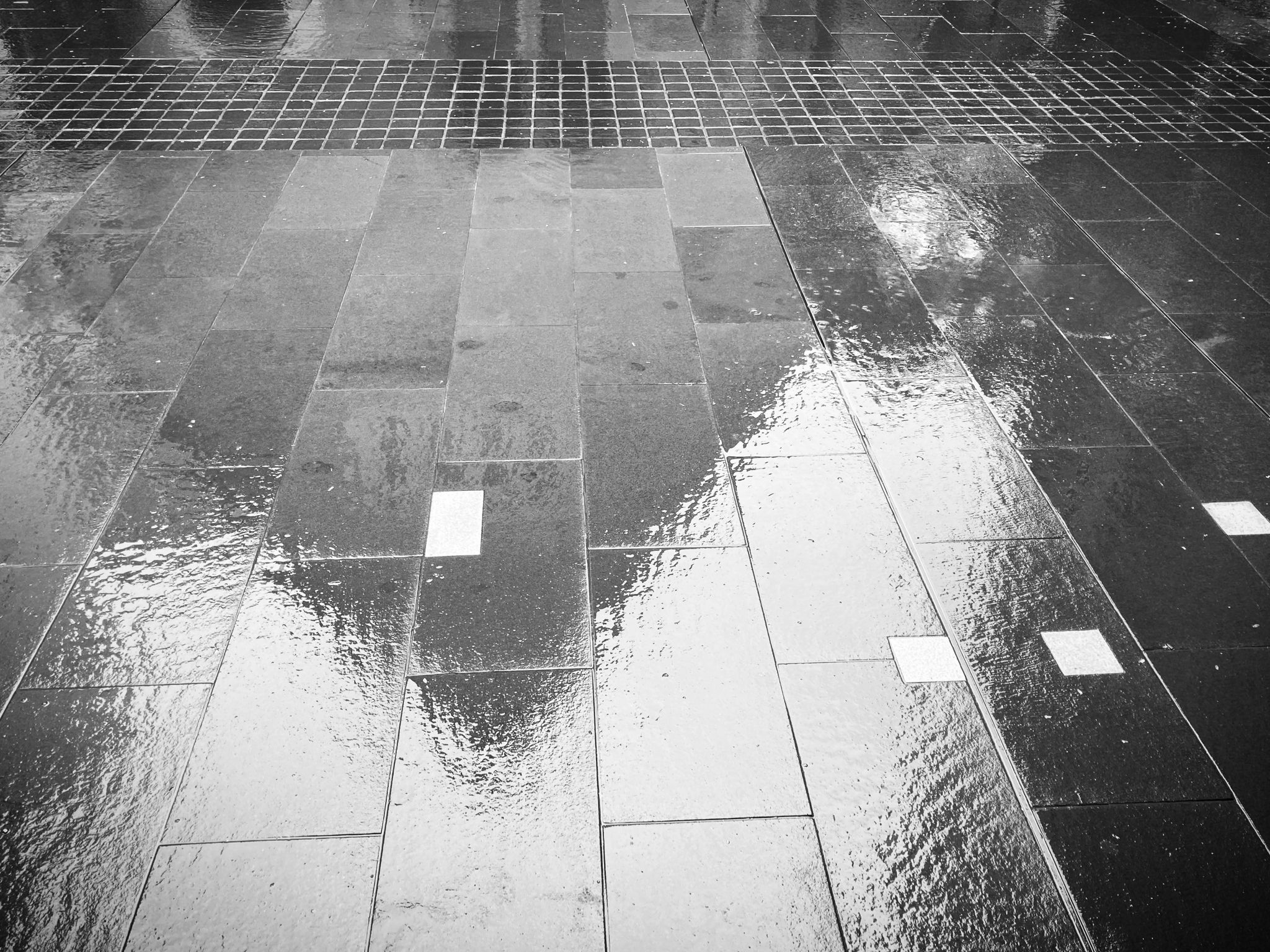
And so time passed. The rain had finished falling. A gap between storms. Drops of water dripped down from rooftops and treetops, replicating the splashing and crashes which had danced in the courtyard of Brookfield Place an hour or so earlier. The air remained cold. Leaves were wet. The space in the courtyard was free and empty. The paving stones shone with a sheen of the leftover downpour; unable to evaporate, the wetness reflected the damp daylight and sodden shadows. The greens of some young trees began to gain vibrancy. A larger tree near an old building – an old boys’ school – spanned itself out wide and gave the illusion of its branches floating on the moving air. Music continued to play inside. Out of the corner of my eye I saw reflections of customers entering and leaving the café at the top end of the building. A couple near the door stood up and put on their coats. He waited as she picked up her white handbag. They looked at each other and prepared to walk outside together. They held hands as they crossed the courtyard and moved towards St Georges Terrace, their heads cowered down from the threat of more rain. The colours of their clothes walked into the cold afternoon air.  

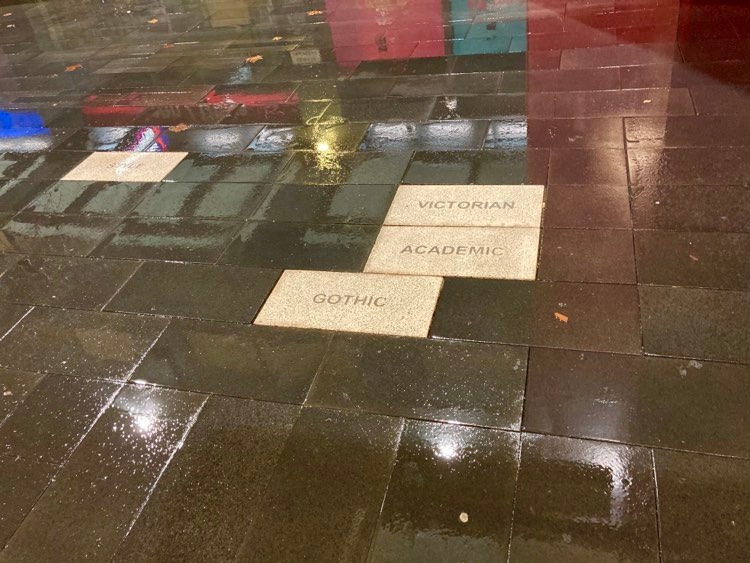
Image by Karl Powell, City Colours (Perth), 2022

The kitchen’s bell sounded again. Service out. The family on table 104 had finished their meal and relaxed talking quietly to each other (their plates already collected by waiting staff). A group of new people came in and sat nearby. Their voices were loud and vacuous – their conversation bounced off the walls and ceiling. They looked at menus without reading them and laughed a lot in loud shouts. Noise echoed in the café. As they carried on, I looked up and along the building. There was something magic about this café. Maybe it was because it was so close to King Street. Maybe it was because of its long bottle-neck shape – complete with a mezzanine floor. Maybe it was just me: it was a good place to write. The city sprouted up and around it, in blocks and buildings, squares and rectangles. There was something magic about this place; thoughts and ideas always sat down beside you. The kitchen’s bell sounded again (this time in two sharp pings, almost irritated). Service out. It was my cue to carry on with the rest of the day and its chores. It was time to go.

Image by Karl Powell, After the Rains (Perth), 2022

*
22 Sunsets of Rottnest (Australia)

LAZING ON THE SAND
Must be nearly six by now. There or there abouts. The late afternoon stretch to sunset has somehow lumbered into being – dragging itself from out of the bite of the white hot heat of the day. The air feels easier to breathe. The sun seems more relaxed now. The whole world – horizons of sky and ocean – are seared blue. Every shade of blue. And blue they will stay.

Image by Karl Powell, Indian Ocean, 2009

Down at the jetty, down at Thompson Bay, the ferries were readying to leave, readying to depart, returning back to Fremantle, North Port and Hillarys. Hot tarmac and summer heat shimmered, boats floated, growing queues stretched, bikes rested in rows patiently waiting to be hoisted on board those vessels heading home. People slowly file on board. Those on the outdoor, upper deck turn to face the island. Some laugh in groups. Many are lost in their thoughts, watching the honeyed light soften in the  sky.

Up at the Settlement all had been busy. It had had an air of chaos to all its moving parts – the kids, the crows, the bicycle bings. People sitting and eating, talking and calling. Noise and colour moved in and around the shops, merged and blurring, sometimes sounding the echoes of peacocks from over at the Lodge. A table had made itself vacant and I sat down there to open my bag and to drink from a bottle of water I had carried in there. Lost in the moment, sat in the shade, a woman came and sat at my table opposite me. She looked at me until I looked up. Two brown eyes I recognised. Lost in the moment, sat in the shade, we said everything that needed to be said with our smiles. She spun a shell upon the table and our hands met. Lost in the moment, sat in the shade, she looked into my eyes and everything in the dream said, I’m in love with you.

Image by Karl Powell, The Basin, 2009

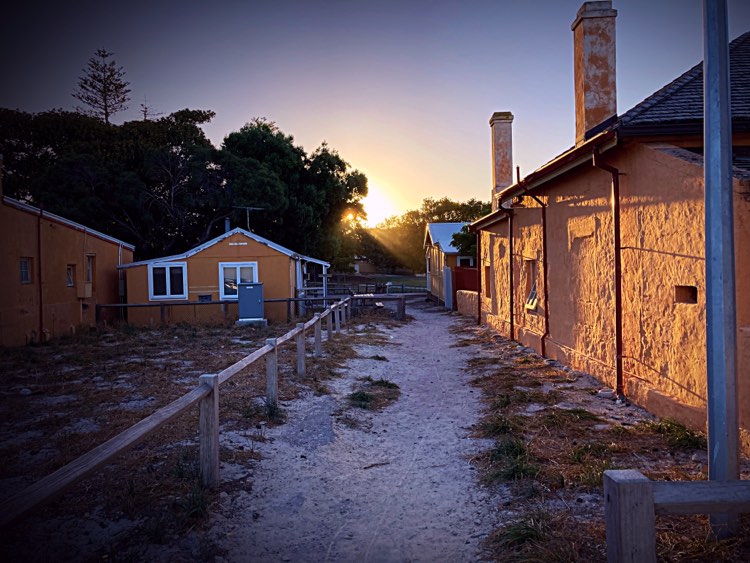
The path out of the Settlement had led forwards, then split and fractured and meandered into several different directions. Orange chalets with white, wooden verandas were dotted about in the dust of the day’s heat. Busy villas overlooked the still waters of Thompson Bay. Pelicans glided across the serenity of gondola waterways. We walked towards the ocean, through a grove of silent trees, over holy ground, along the perimeter fence of an oval. Bicycles flitted past. Quokkas hopped in the bushes and on dried leaves. Sand had began to appear at the edges of the tarmac. And so we left the moment and walked on into the sunshine, moving towards the Basin and down to the ocean waters that pooled there. Giant Norfolk pines rose up before us as silhouettes. Rows of mounted bicycles stretched across, locked and parked (helmets hanging from handlebars). Below, just below them, the sound of waves called. And everything became blue again.

Image by Karl Powell, Silhouettes, 2019

AT THE BASIN
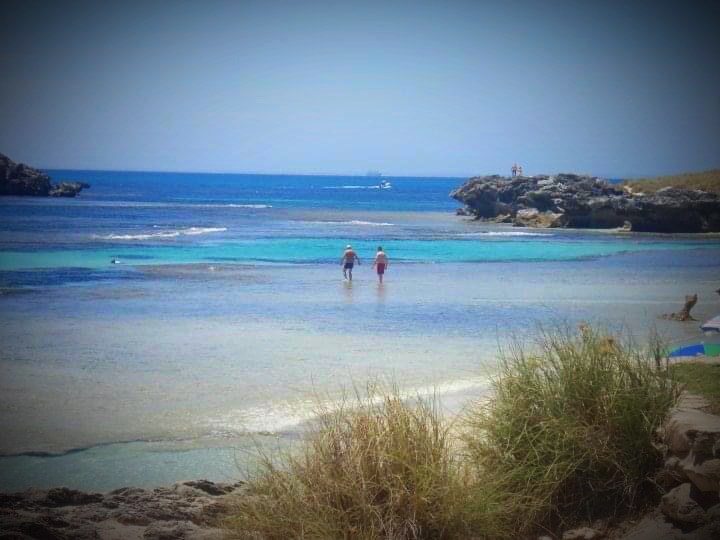
At the Basin the tide was right in. Never seen it so high. The sky was high and wide and everywhere all at once. All clouds had evaporated long ago. The air was hot and smelt of salt water and sunscreen. The waters of the Indian Ocean, as always, were charged with magic. Patches of dark blue allowing long, flat sheens of dancing colour to illuminate and float beneath the sounds of crashing waves. Far beyond them, rolling waves curled and foamed over surrounding reefs hiding in the depths.

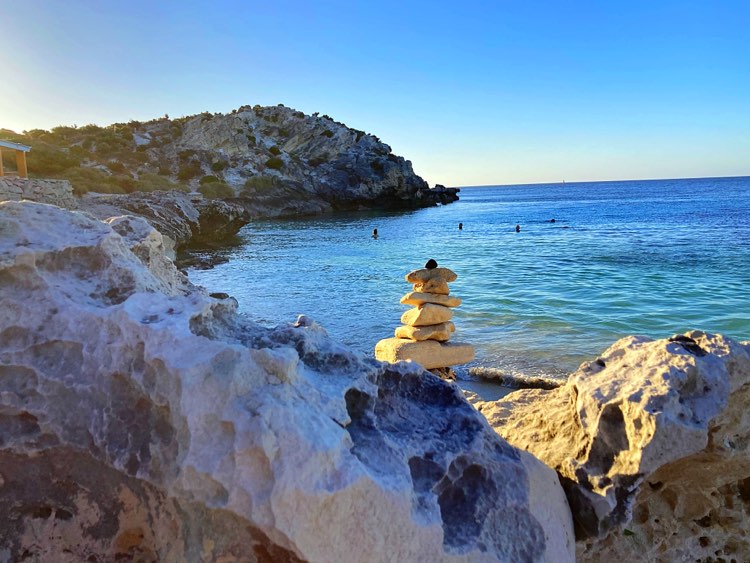
We found some sandstone rocks to sit up on, perched up, looking down onto the sand. They were comfortable enough to sit on. Warm rocks, roasted all day by the January sun. Hardly an inch of sand to spare. Normally there was ample space, gaps and pockets among the towels to sit and stretch out. If the tide was right out then it was possible to walk across the reef, ankle deep, out towards the blue and dive off into its endless silence.

Image by Karl Powell, Low Tide, 2009

There was a big, white lighthouse basking in the sun at the far end of the beach. It was mounted on a cluster of rocks, barnacled and bleached by the sunlight. In my line of vision, bloated waves rose up and smashed their moving topaz against the protrusions of limestone stuck in the sand; wild sprays of rainbow coloured the air. Foam and ocean fell to the shoreline. Then long lulls of silence lapping up onto the sand. The air barely breathing. Nothing hardly moving. The fingers of nearby palm trees desperately seeking something to breeze through them. But only the waters were moving. And those waters shone with its divinities of blue – tinted gins, Moroccan majorelles, clichés of turquoise.

Image by Karl Powell, Blues, 2022

A lone seagull flew overhead. I watched its shadow move across the floating ocean. The bird eventually dropped to the sand, just where the shoreline soaked itself into saltwater. It walked about looking for insects to eat until one enthusiastic wave almost claimed it. And just beyond the reef, a boat full of young men played music; they took turns in occasionally jumping off into the blue. I watched for a while, then their music stopped suddenly and the silence encroached again. Several unsuccessful attempts to start up the boat’s engine engulfed the vessel in choking billows of black smoke. It drifted and twisted for a while before the engine revved up again and then took off slowly around the lighthouse back towards Thompson Bay. There were now only a handful of people remaining; some dotted about the sand, most in the ocean, a few snorkelling around the reef. A small child was throwing a tantrum because his snorkel was not working (his face mask was leaking water). His arms were waving everywhere in frustration. Eventually he threw it into the sand and sat on a towel (ignoring his family’s calls to return to the water).

INTO THE BLUE
And so into the blue. Into the Basin. Cool, cool water, endless and weightless. Stillness and silence. Great drapes of sunlight moving through the floating depths. Fish shimmer nearby. I touch the seabed with my hands, my fingers churn up clouds of sand. Like a mermaid she swims beneath the rolling waves. The slender shoal of long, black hair dances in her every move. The world glints in sea-soaked sunshine. Buoyancy brings us back to reality. She pops up in front of me. I feel her arms around my neck. We kiss. She tastes warm and of the salt water. Her body shines with the ocean dripping from her skin. And that kiss loses itself somewhere between the one hundred sonnets of Pablo Neruda:

There where the waves shatter on the restless rocks…

  Al golpe de la ola contra la piedra indócil…

You and I, amor mío, together we ratify the silence…

  Juntos tú y yo, amor mío, sellamos el silencio…

…we make the only permanent tenderness.

  … sostenemos la unica y acosada ternura.

But these were the dreams you had to follow. These were dreams that ached for you to find them. These were dreams you had to realise to touch.

Image by Karl Powell, Sunset at Basin, 2022

EYES CLOSED
Back on the rocks, above the sand, sleeping in the late afternoon. Side by side. Eyes closed and the sound of the ocean keeps calling. Feels so good. Rhythmic lullabies, hushing and moving. Sun feels so warm on my skin, can feel its warmth on my eyelids. The ocean keeps calling until I sit up and look out across it. Waters in the shallows crash then criss-cross and sigh at the shoreline. Sunlight dances through them. Shells are spinning on the beach, smashed corals within the sand (whites, yellows, oranges – flecked and speckled, pinks and greys); some shells are left upturned on their backs transformed into hollowed cups of seawater. A big wave rolls in from the depths. Over to my right a fisherman casts a line from his yellow fishing rod out into the sea. Pockets of sunshine glow in underwater iridescence, shining bright in the navy darkness. A white yacht sails across the horizon from right to left. After a few more crashes, the world is silent again. Over to my left, above the rise of rocks crumbling down to the ocean, the sun has started a noticeable descent; it’ll end up behind them within an hour or so. The sand is already tinted with pinks and softer hues. Hands touch hands. Eyes close again.

Image by Karl Powell, At the End of the Day, 2022

THE STARS AT THE SETTLEMENT
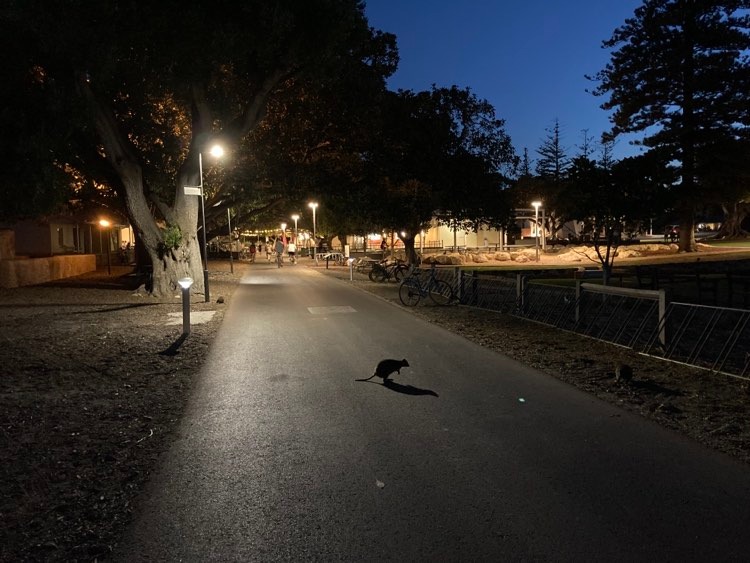
Colours fill the sky. The blue is there, but fading, waning. The sun is setting behind the island coating the landscape in golden warmth. The sun burns its last in a large orange glow. Silhouettes appear everywhere. The lightest of evening breeze skims across the surface of the water. A small boat pulls out. A man in a denim shirt stands on board skippering a voyage into the dusk. Over at the hotel a string of coloured fairy lights and lanterns sway, illuminating the branches there. And you feel so relaxed because after only a few hours this feels like an entire holiday. And you feel so happy when you overhear a girl ask a guy if he’s still here tomorrow night. And the day is ending. Looking at the blinking lights of the buoys anchored in the bays I know I’m in love with you. What a way to watch the day end. The words begin to leave you bit by bit by bit. But I’m in love with you and everything is so quiet and so very peaceful. Grains of sand stick to the skin on your arm. And the stars begin to shine. These are the things that can last for only a day. And I’m so in love with you.

Image by Karl Powell, Quokka at Night, 2022

*

15 Voices of Men (Adelaide, Australia)

Fireworks thump hard into the springtime night sky. It is dark. No starburst of colour is visible in the smooth velvet stillness. Occasional light illuminates in patchwork shadows, finding pockets of space crushed between the city buildings which reach up to obscure all horizons. Noise booms through the warm evening air. There have been fireworks sounding most evenings this week. The holy festival of Diwali has been celebrated here – a time, when it is said, the goddess Laksmi visits homes to bring happiness and prosperity during this Festival of Light. There are fairy lights blinking in some of the frangipani trees in nearby apartment gardens, pinpricks of yellow colour flashing light in the dark. Outside my window, the city itself is quiet. An easterly wind moves through the branches of trees, bringing hot desert air from the Goldfields towards the metropolis. Some of the skyscrapers have coloured neon lights; mainly logos and names – some are just illuminated facades. Crickets sound. A full moon is forecast within a week, but as I write no moonlight is visible within the cosmos (yet). And then, for some reason, I think of the description of the moonless night given by the First Voice in Dylan Thomas’ play for voices, Under Milk Wood:

It is spring, moonless night in the small town, starless and bible-black, the cobblestreets silent and the hunched, courters’-and-rabbits’ wood limping invisible down to the sloeblack, slow, black, crowblack fishingboat-bobbing sea.

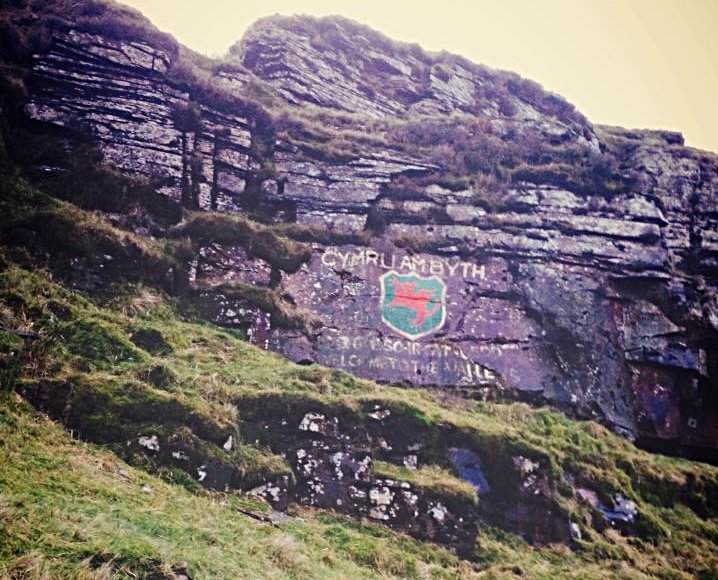
Image by Karl Powell, Bwlch Mountain, 2017

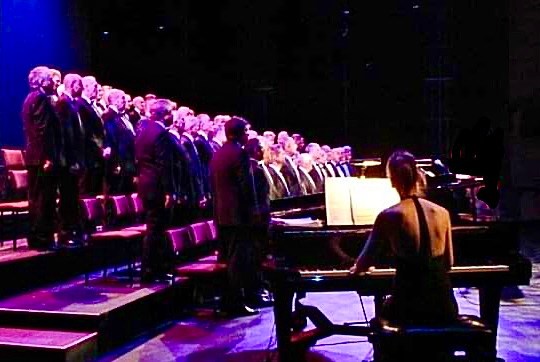
I think of home. Being a migrant on the other side of the world is a curious existence to have. It is both transient and of belonging to other places simultaneously (the old and the new). It is an existence between things; of being changed forever, almost in limbo. Sometimes caught in a concussion of cultures, languages and other identities. Looking in this box tonight I found a small folder of photographs, titled: Treorchy Male Voice Choir (Adelaide). Opening the wallet, I look at these physical pictures and can see and hear sounds and people from over two decades ago. There is a disc of their music here, too, which I am playing now.

Image by Karl Powell, Backstage with the Choir, 2009

Some twenty years ago I was transported home by the voices of men. It was the first time I had possibly understood the true breadth of homesickness. Months earlier, I had been made aware of the famous Treorchy Male Voice Choir touring Australia (for the first time since 1986). In the choir, I had family friends, familiar faces and my woodwork teacher, Mr (Meurig) Hughes – and it was he who had first told me of the choir’s intention to tour. And so dates were confirmed: the choristers would perform twenty-four concerts within a month moving through locations predominately on the eastern side of the sunburn continent: singing in New South Wales, Queensland, Victoria before concluding in South Australia. This final leg of their tour is were I decided to meet them. A long weekend in Adelaide. I was forwarded a copy of their itinerary and was able to plot dates, book flights and secure accommodation in the city of Churches.

Image by Treorchy Male Choir, Parliament Square (Adelaide), 1999

And so, near the conclusion of their Australian tour, I crossed the Nullarbor Plain to fly three hours or so into Adelaide. It was my first time into South Australia. The city centre was a grid of navigable right angled streets, divided in half by a long, straight avenue called King William Street. Sandwiching these interlocking inner-city roads were North Terrace and South Terrace. As luck would have it, the choir was on the South and I the North. On arrival to the capital, I took a taxi from the domestic airport to my hotel, checked in and then walked down to the Chifley Hotel where I had been told the choir were staying. It was now late afternoon. There were two big buses, or coaches, parked opposite the hotel advertising their tour. Outside a few choristers in uniform blue polo shirts were smoking. Their accents told me I was were I was needed to be. Inside the hotel lobby there were lots more blue polo shirts – their official tour shirt when not dressed in black tie for performances. The choir had spent the day travelling from Mount Gambier in the morning, to sing in front of National TV cameras on Parliament Square promoting the tour, to then check in briefly at the hotel before preparing to go to the Festival Theatre to sing. It sounded an arduous schedule. In the hour or so that I was in the Chifley Hotel I managed to find a family friend, Clive Taylor, who told everyone – particularly designated officials – that I was his nephew. This half-truth became my passport to going everywhere with the choir during the weekend in Adelaide.

Image by Karl Powell, Dad, 2008

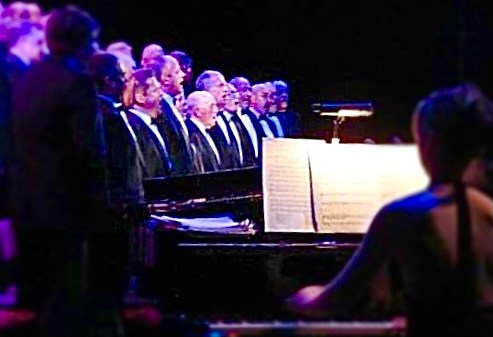
Later that night, I sat with some two-thousand people in the Adelaide Festival Theatre. It was the first time I had seen or heard the Treorchy Male Voice Choir sing as an adult. These were men I had known all my life, some there from childhood, up on stage in front of us all. After the applause of their entrance, after the muffled hush of taking places, after the first sound of melody from their voices, I was transported elsewhere. They sang songs in Italian, English, Xhosa Zulu and Welsh. They sang songs I had grown up with and grown accustomed to. There were songs sung that I knew the names of, there were some songs sung whereby I only knew the sound. The power and beauty in their voices carried through the air and thumped deep upon some hidden space of the heart. There, the emotions of exile shattered in starburst. The power within their spoken words transported me back to childhood, back to a place I left before I truly understood it; with closed eyes, I could see the colours Max Boyce sung about in his ballad ‘Rhondda Grey‘ – that it was the faces of people who lived in the old mining community that coloured the world existing there. When the choir sang the spiritual hymn ‘Oh My Lord What a Morning’ an old man in a dark suit, sat in front of me, began to cry. And in that swell of emotional longing – the brooding ache of hiraeth – there was also present a deep and never-ending bond of belonging to place and time.

Image by Karl Powell, Sunrise over Treherbert, 2017

The performance lasted across two halves. There had been an intermission and interludes from solo performances of choristers and singers, such as the rendition of Unwaith Eto’n Nghymru Annwyl from the compere and publicity officer of the choir, Dean Powell. There was an encore at the end. After the performance, Uncle Clive smuggled me on board one of the buses back to the choir’s hotel. There, in the lobby of the Chifley Hotel, the mood with the choristers was gregarious. We drank together and I met many friends (old and now new). There was also a grand piano there and someone began to play, and the men sung. I stayed until late, very late, before the bar closed and I caught a taxi back to North Terrace. It had been a long day. Before leaving, I had been told to report back to the hotel the next morning to accompany the choir into the Barossa Valley to see them perform in an afternoon concert at Tanundra.

Image by Karl Powell, On Top of the World, 2016

It was an early start the next day. There were two buses of choristers departing the city towards the north east. As to plan, I was smuggled on board one of the buses, sitting next to Uncle Clive. Most of the men were obviously tired, some hungover. The long and demanding schedule was beginning to catch up on their bodies and vocal chords. Throw in the stresses of jet-lag, an eight hour time difference, a month-long separation from families, as well as the transient nature of living in hotels, many were happy to see the long tour draw to a close. This, their final day, required them to perform twice; once at Tanundra before returning to Adelaide for a second evening at the Festival Theatre. Due to ill-health, Uncle Clive sat out the matinee performance, so we were able to sit together in the audience and watch the choristers sing. It was a much smaller audience than the previous night. But it was the first time Uncle Clive had been able to see or hear the choir since becoming a member. During their rendition of Joseph Parry’s Myfanwy, he kept saying how proud he was to belong to them, whispering aloud to himself how good the choir sounded. And they did.

Image by Karl Powell, Choristers in Rehearsal, 2009

On the drive back to Adelaide one of the buses broke down. No one paid any real attention to what was happening until it was announced that the soloists and elderly choristers should go back to the hotel on the other bus, while the rest of us waited on a hard shoulder. We waited for over an hour. It was a hot afternoon, in that dry heat Australia can have, and without a working engine there was no air conditioning either. Only the radio worked. There was nothing that could be done until assistance arrived. We were in the middle of nowhere. Yet no one complained. Most slept or tried to rest. The radio helped – some sung along to the music played to pass time; an impromptu accompaniment of Cat Stevens’ Moonshadow was one which remains in the memory. Eventually help arrived, the engine was fixed and we made it back to Adelaide with enough time to return to Festival Theatre before the curtain went up. The performance – the last performance of the Australian tour – went well. Sitting among the cheering crowd as the curtain came down I felt so honoured to have been adopted by the choir over the weekend, as well as in admiration for these men who had given up their time and money to sing. They had carried their songs across oceans and continents, sung from a place deep within despite being close to exhaustion. Watching them all stand, wave and bow I felt immense sense of admiration for their craft and desire to share their passion and create belonging.

Image by Karl Powell, Tommy’s Bend, Bwlch Mountain, 2017

There was sadness the next morning. There was sadness because I was saying goodbye to family friends (some old, some new). They were going home. Back to where I had once belonged. There was also sadness because I was leaving their familiar reality, this understanding without explanation, to journey three hours west across the Nullarbor Plain. I did not want the connection to end. Our departing flights from Adelaide were scheduled more or less at the same time – albeit from different terminals (them the International, me from the Domestic). The choir made sure I was on their bus to the airport. In fact, they had even smuggled me to an official engagement immediately after the final concert – a sit down reception with an open bar. It had been a late night, but one which I had enjoyed, creating many new friendships – sharing in that special bond that travel can easily create between strangers. With suitcases stacked up in rows outside the bus we said our goodbyes.

Image by Karl Powell, Rockin’ Roger 2007

Looking out now at the silent cityscape tonight, the fireworks have stopped. The sound of the wind still blows through the branches of nearby trees. Tonight I am listening again to the voices of those men singing. Their music is alive here tonight. And I know, that some twenty years later, some of those voices are no longer singing. But they are singing. They are singing in concert out across the darkness of this night sky, this moonless spring night sky. The voices of those men colour the darkness from the twinkling neon lights up towards the shining Southern Cross. Across oceans and continents. Their voices are alive here tonight.

Image by Karl Powell, Boyo, 2009

*

5 Saturday Morning King Street

Morning. My eyes are closed. The early bus is leaving the beach. We are heading back to the city.

Eyes closed – I can see wave upon wave shining ashore, clapping hard down on shoreline sand, spraying sunlight and rainbows into the morning blue. Cool, blue sea breeze moves along the far horizon, flecked white tips dance with ships far out at sea. The moon and stars fell not long after dawn and now only the white hot sun burns down on alabaster sand, filling the pure blue sky with glare, arrowing down on the surface of the Indian Ocean.

Image by Karl Powell, Beach, 2019

The early bus is moving, uphill downhill, turning, heading back to the city. Eyes stay closed. I can feel the sunlight still moving through my skin, saltwater cooling the sting, drying now, hair still wet, body heavy, eyes closed, sand stuck between my toes. Arrived at the beach around 7am when all was still cool. Lay on my back, slept off the night, digging toes down into soft sand. Could feel the sun moving across my skin, shadows walking past (all dark for a moment then light again). Sounds of people all around; happy people laughing. Ocean kept lapping waves on the shore. Opened eyes and nothing but blue – no clouds, no commitments, no sense of time. A plane flying high above, climbing higher in silence, moving off, up along the coast. Someone laughed, three big waves crashed with children screaming in distant laughter. Thought about reading my book, but it stayed there half-open on the beach (pages rippling with occasional sea breeze). Eyes close again.

Image by Karl Powell, Indian Ocean Blues, 2018

As the sun angled up and shone down, I eventually made my way towards the blue to swim. I stood at the shoreline for a moment; I saw one endless sheet of shining blue, glittered and large. I saw cormorants swimming and swooping for shoals of fish; I saw my friend Bruce swimming out past the reef (his yellow swimming cap moving parallel to the coast in a group of four splashing out in the deep). And into the water I waded, deeper until I dived. Underneath the water the great dance of sunlight swayed in buoyant silence, flying with me in the ebb and flow of twirling shells in the gin jade emerald blue, moving back and forth, swaying in hammocks, looking at these gemstone wonders swirling around you until you have to surface once again for air.

Image by Karl Powell, Beach Bruce, 2017

The bus stops suddenly. Eyes open. The driver jumps out from his seat apologising to the congregation – he wants to take a photo of the ocean. Yes, it really is that good today. An entire ocean so flat. Nine huge tankers sit out along the horizon, waiting for a berth at the docks. Then out of nowhere a wave moves in so fast, swelling, racing, arcing up then with an intake of roar it collapses with a bang of surf onto the wet sand. The driver has his photo and jumps back onto the bus. The bus is moving again, leaving the beach behind, heading back to the city. Eyes closed now.

Even on this bus I can still feel the saltwater, the morning, the sunshine moving across me.

Image by Karl Powell, de Chirico in King Street, 2021

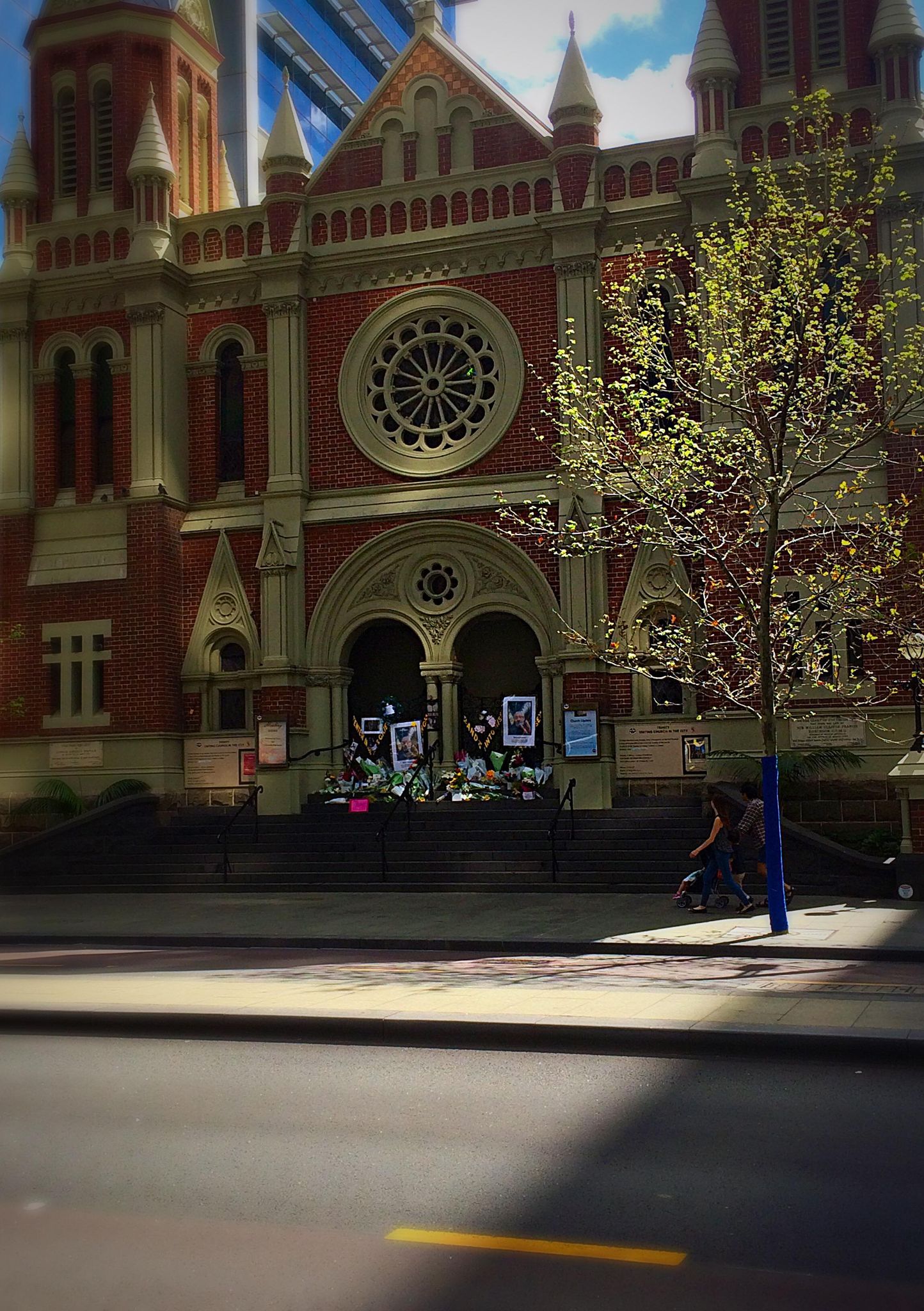
Mid Morning. Stepping off the bus and into the white heat of the city felt like walking into the artwork of Giorgio de Chirico. Silhouettes, sloping shadows, empty spaces. The forecast for this week predicts we will reach 40.c. Burning, blistering heat. Footsteps slow down a pace. Elsewhere, indoors, the shade is the best place to be. Towards King Street, for a coffee, I cross the road, the busy street, shimmering tarmac, heated fumes, passing traffic. I look up and see Neil sitting at the steps of the Trinity Church. Neil on the Trinity steps. Usually, he’s there sat reading; today he’s there sat talking to somebody. He looks up and sees me. I wave, he flashes a peace sign back with his fingers. I think he’s a writer, I think he’s homeless; he’s always on those steps reading, writing, talking to somebody.

Image by Karl Powell, Neil on the Trinity Steps, 2020

Along King Street, the flow of shade stretched past each intersection. It was cooler here and colours could emerge from the bleaching, blinding sun. Murals of art shared space with open armed palm trees, which stood at the corners wriggling thin fingers of palm leaves in what little breeze breathed. A white cockatoo flew high above the street casting a moving shadow over bookshops and buildings, and the two stone lions lazing in sunshine on top of the old theatre, while a Mauritian restaurant began to prepare for its lunch service with the sounds of sega music moving through the heat.

Up at the café, I found the best seat in the house (outside, to the right, tight up against the windows, on the pavement, facing out). There, everything felt like a Saturday should. There, everything always felt as if today would be one of those days in which you would be destined to meet a special someone, someone special, at some stage during the day, one of those once-in-a-lifetime dalliances that starbursts immediately and sparkles throughout the summer. There, it would easier to watch the world walking past, to waste time productively, to idle, to daydream, to convince yourself that this was an essential part of being.

Image by Karl Powell, King Street Mural, 2021

Sunshine was falling into the street, causing parked bicycles to shine as they leant up against white walls. I watched a woman cross the road. She left the shade to walk over into the sunshine. Her hair lit up at once. Shoulder length blonde curls that bounced in life. A man with long, black sideburns growing down his face and a paunch hanging out of a red t-shirt, gunned past on a skateboard; his wheels tore up a sound on the hot, dry tarmac. A taxi pulled up in front of the café. A man dressed in a suit and a white shirt (no tie), got out. He went into one of the apartments above one of the shops opposite my seat. Next door, two girls sat in the sunshine on the steps to their flat. Gloss black hair, sunglasses screening eyes. Brickwork and white paint, two concrete steps that led up to their open doorway. Three shoppers walked past them, each carrying bags and sullen faces. I saw another friend, Jean-mic, walking slow, slow walking (and I mean s.l.o.w.w.a.l.k.i.n.g), broadchested in his t-shirt and shorts, sunglasses on, arms swinging at his side, overtaking us all. Then the cars came. A blue car turned up the street making noise. A speeding white car followed up, slowed down and sounded its horn echoing on the narrow walls – a bald, smiling face waved at me. I only recognised my friend Antonio moments after his car sped off. An elderly couple walked gently past the cafe holding hands and shopping bags in silence.

A small, dragon fly came to rest at my table just as my espresso arrived. It sat there, warming its wings and moved only when I went to drink my coffee. The golden crema cooled in the white demitasse. Sweet on the palate, warm, sip, swallow, bitter, leaving the taste of roasted smoke cooling through the lungs.

The table next to me – a family of four – got up and left the café. The sound of scraping chairs carried in the air. They left behind a newspaper on one of the chairs and it was open at the horoscope page. I leant over and checked over for mine. I read it – it was pretty good without being accurate. It said it was time for legs to be up and running, telling me I was smart enough to strip away flattering words in order to see what was really on offer; creative skills linked to writing would open the way to new successes. So it said. A child came running up the pavement, his footsteps stopped suddenly at the café to say hello – out of breath and panting, it was Gavin, the son of a family I knew. Carrying a copy of Ian Fleming’s ‘Live and Let Die’ he was running late for an acting class but wanted to say hello. I watched him run off up King Street.

Image by Karl Powell, Caffeinated Scribbles, 2016

The sun was high, much higher than when I arrived and now almost overhead. A spinning disc of burning light. The street was hot. The blues and greens were bright. Passing people blurred and my eyes ached. It was time to go home, to sleep a siesta, and then to find a way to make all the words and sentences of the morning breathe and flow into stories that meant something to me. If they made other people happy, then great. But there was an indulgent purpose in being able to spend an afternoon touching and sculpting the moments of your time from fleeting thoughts and visions into captured language on paper. To defy the running rivers of Heraclitus and to step into that same water twice, to swim beneath the great dance of sunlight, to sway in buoyant silence and to look at all the gemstone wonders swirling about you until you had to surface once again for air. And then, when all the writing had finished, and the Muses subsided, the night would fall flat like the morning ocean, to reveal great pools of starlight and the opportunity to dance again.

Image by Karl Powell, Another Sunrise, 2021

*