27 Sevilla – Summer Solstice (España)

PART ONE: EL ARENAL

Image by Karl Powell, Seville (Sevilla), 2007

The heat from the Summer Solstice burns everything with white heat. Streets radiate with the midday sun – the midsummer’s sun – the Andalucían sun. Everything about being in Seville today feels that bit closer to the sun. The heat. The light. The glare. Palm trees rise to Heaven open armed with their long, rolled brevas cigar tree trunks toasted to black cinder. Sunshine bright and burning, glaring and dazzling; overhead, shadows shift beneath your feet. The day had started early, walking, wandering, looking, trying to explore what could be found before the bite of the day became too great. The Catedral and Real Alcázar were both within walking distance of the hotel; I managed the first and thought to see the latter after lunch. The morning had been crystalline with sunshine, even scented with the perfume from orange groves and bushes of rosemary. Doves sung within the protection of box hedge trees, near the play of water falling from fountains, which spouted out into octangular bases. Backstreets leant hard against the shadows, crisscrossing different times and ages; routes wandered past the small, orange house of Diego Velázquez, gave glimpses of the Torre del Oro (where once it shone with gold across the waters of the Rio Guadalquivir), and echoed the songs of Bizet’s ‘Carmen’ as she stands still outside the Real Fabrica de Tabacos. And in savouring the shadows, you learn to love Seville so deeply, enriching your own dreams and wishes in this waking life. In the words of Wallace Stevens, “…the day is like wide water, without sound, stilled for the passing of dreaming feet.”

Image by Karl Powell, Catedral y Rio Guadalquivir (Sevilla), 2007

Inside a bodega, a few moments before midday, a camarero chimes white china plates and saucers into stacks at the end of a long, wooden bar. Locals start to arrive and queue. Holas reverberate. A man sits reading a newspaper and smoking a cigarette. Legs of jamon hang from the ceiling. Orders sound, spoons rattle and coffee begins to grind. An old woman is served first. She stands at the bar carrying a small, red leather bag. The camarero asks what she would like:

Senora, qué quiere?
– Dame un whisky.
– Uno simple o doble?
– Simple. Gracias.

He turns and reaches for a large, green bottle of J&B on a shelf (its yellow label stands out, as do the large red letters). He pours her the single shot she ordered and asks if she wants ice:

– Con hielo?
– Sin hielo.

She pays and takes her glass of whisky to an empty table and sits alone. A pot bellied man, maybe in his fifties or sixties, smartly dressed next approaches the bar and asks for coin change. The thin belt around his waist is tight. He needs change for the slot machine against the wall. I watch him play for a while but he wins nothing. The coins go in, lights flash, the wheels spin and stop, but nothing happens. No jackpot. Only the silence of the bar signals another lost round. In the narrow, curved calles beyond an open window, swifts and swallows chirp – flitting in and out of the small, green Judas trees which stand baring their heart-shaped leaves to the searing light. Seville continues to bake.
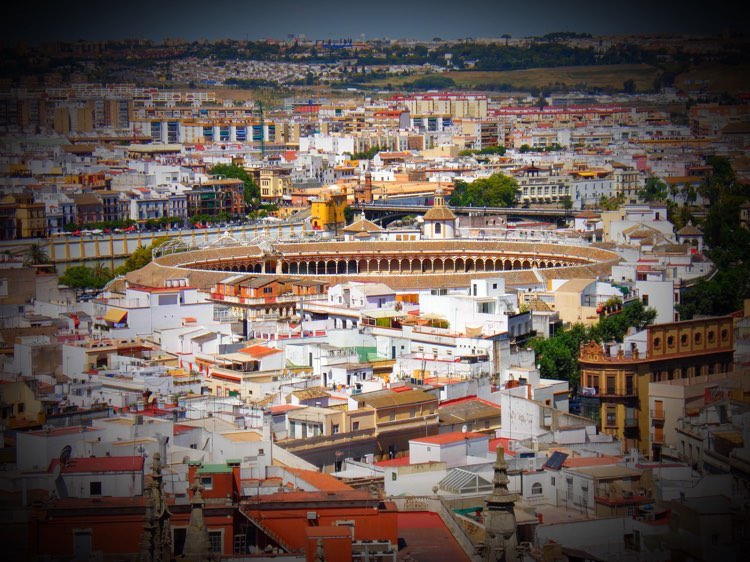
Image by Karl Powell, Plaza de Toros (Sevilla), 2007

Here I sit, finishing a coffee and considering a wine. The raise of temperature makes perspiration prick through my skin. Am getting hungry, too. The camarero has stopped making café solos and begins slicing cured pork and ham for those who have ordered food. I read through the menu and my limitations with the Spanish language gives way to the desire to eat (some attempt to speak castellano seems to go a long way and smiles can easily be shared wherever the gaps appear). Without prompting, almost anticipating, the camarero comes to take my order, and in a busy bar I labour in language and point to what I’d like to eat from the menu:

Senor, qué quiere?
– Quiero anchoas, pan y otro jamon serrano.
– Y algo más?
– Si, quiero un vaso de vino blanco, por favor.

Soon, a small carafe of white wine was placed in front of me along with an empty glass. Condensation immediately began to cloud and ran like raindrops down the curved body of the glassware. Three small, square dishes then appeared in no particular order: thin shavings of soft, translucent ham, slices of bread and four, fat fillets of plump anchovy (ruby red in freshness and mirrored the length and breadth of my cutlery). These have to be the most delicious anchovies I have ever eaten –garlic and vinegar coat them all. The serrano ham is so sweet to eat. Oil drips from my fingers onto the table. Almost half past twelve now. And all is good. All is good.
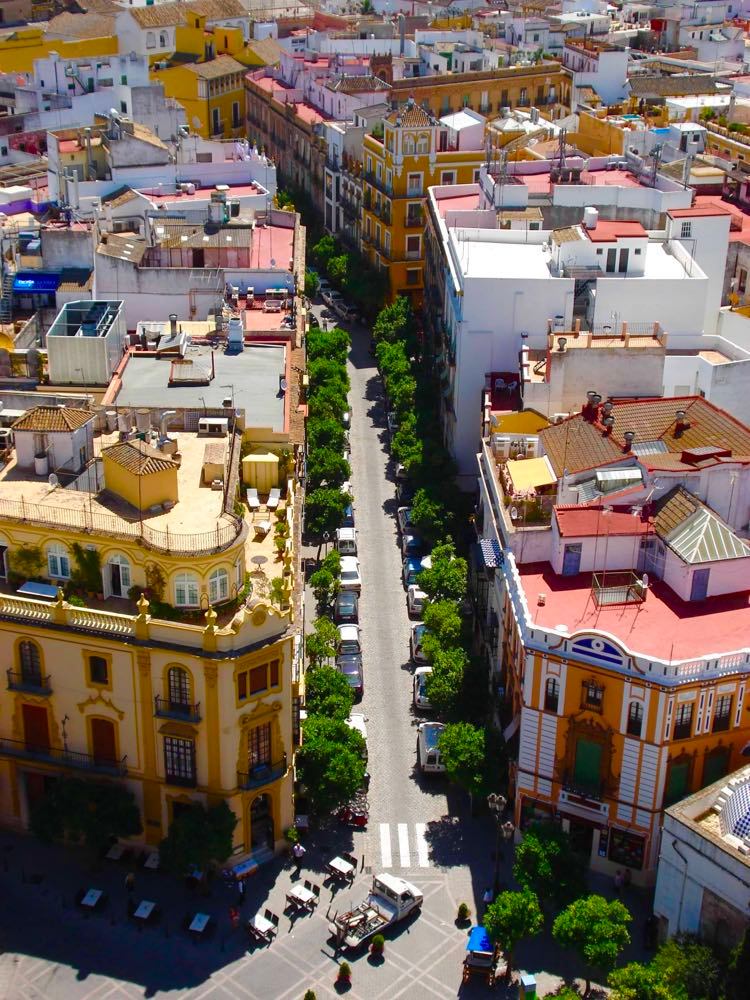
Image by Karl Powell, Calles de Sevilla (Sevilla), 2007

PART TWO: BARRIO DE SANTA CRUZ
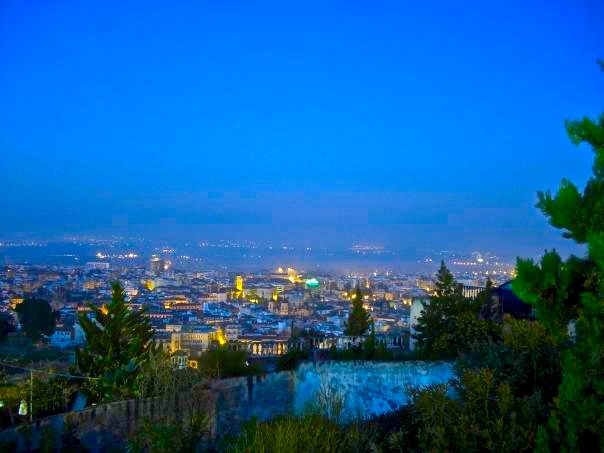
At seven o’clock the bells of Santa Catalina strike. The sun is still high in a cloudless sky. From the rooftop of my hotel most of Seville can be seen. From here, landmarks rise up above the buildings. The Giralda stands tallest (some eight centuries old and counting). Eyes dance along the city. Searching for the pathways taken this morning. Streets look different now. Can no longer see the river. Can barely see the shapes and contours of Triana (let alone hear its deep song of flamenco). Over in the Plaza de Toros, the yellow sand continues to burn. A giant palm tree pokes up over the rooftops. It must be tall as it’s the only one I can see. The trunk rises up to a golden knot. From there, around fifty or so palm leaves sprout. Green fingers wriggle in the air.
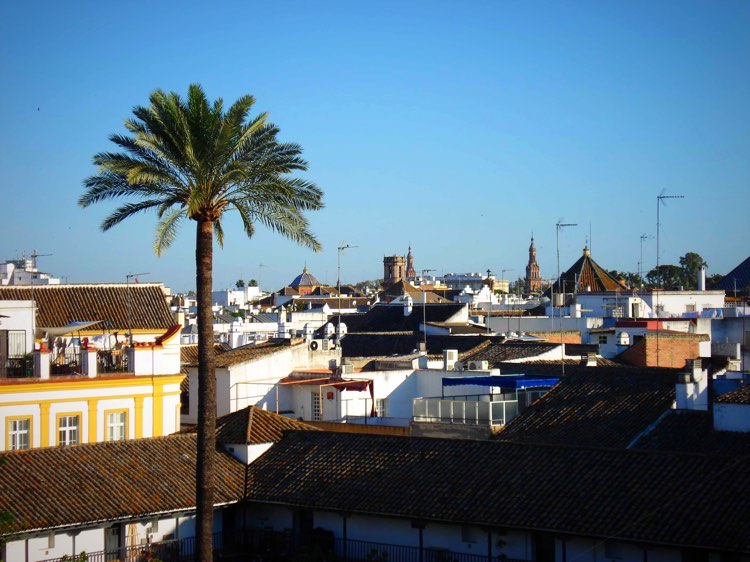
Image by Karl Powell, Summer Solstice (Sevilla), 2007

The bells have just finished singing from the Iglesia de la Anunciación. Their echoes fade around the streets of Seville. Even though it’s seven o’clock, it is still hot. The sun is strong. The levanter breeze that came in yesterday has all but evaporated. Nowhere to be seen. Up here on the rooftops the heat is sticky. Thousands of spires reach up to Heaven. White, flat buildings reflect the heat. Birds twitter still. Flies annoy. A dog barks. To quote from the verses of Wallace Stevens, “…what is divinity if it can come only in silent shadows and in dreams?”

Found my way up here yesterday and wanted to come back tonight – just to sit and write and watch the sun set over the Summer Solstice. Came prepared. Went to a shop a few doors down. Practised the language and bought some good things to eat: bread, octopus, cheese, olives, anchovies and a carafe of red wine. The oil on my fingers makes it difficult to hold this pen. There’s a few other people up on the roof tonight. A woman from Argentina came over and asked me what I was writing:

– Que estas escribiendo?
– Solo la puesta de sol.
– Puedo leerlo?

She took my book. She took my pen and wrote her name along with her room number and walked off saying nothing more. My head still spins from the afternoon at the Alcázares Reales. Quite the experience walking through things never seen before. The geometry of Moorish tiles and patterns stimulated imagination, intoxication and dislocated rational thought. The cool, standing stones in archways and soft marble carvings left impressions that began to change something within. I wanted to follow but remain here, determined to write down my dreams and draw a clear path of where I want this life to go. Impossible to know the direction, but the concealed labyrinths of the soul could only close in to show that a path was there. Belief was the way.
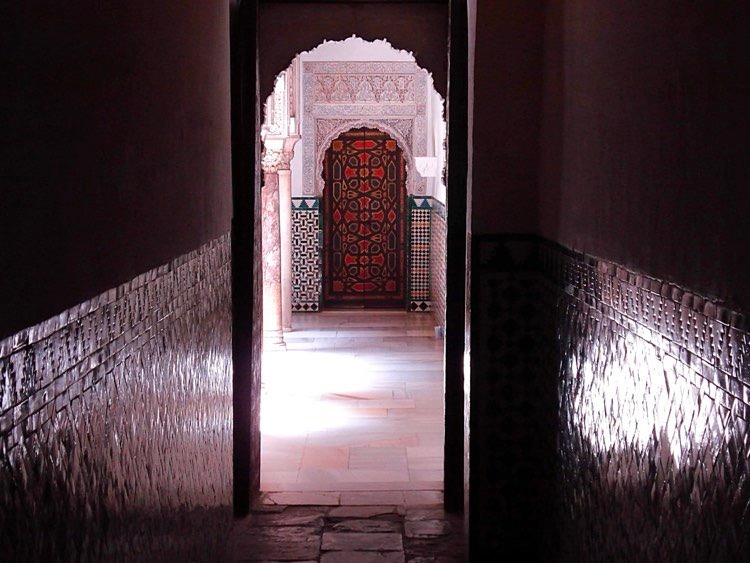
Image by Karl Powell, Real Alcazar (Sevilla), 2007

Down below in the cool of the shade, the day is all but over. The streets look tired and world weary in the way that life can sometimes feel after a dynasty of adventures. Bells that rang and peeled moments earlier only seem to drift down there now. Floating, falling, sinking down to the darkness. Loud. Soft. Tumbled echoes. A couple sit beside each other on a small wall outside the hotel. She is dark-haired, voluptuous; he is dark-haired, skinny. Both wear white shirts, open collared, matching black skirt and trousers. They share a cigarette together and smile in their own private Seville. The clouds of smoke that they create rise slowly upwards, lingering here and there, before dissolving forever on the journey. Doves coo and swallows continue to dart and dive into the vacant spaces above their heads. Rooftops and squares. Dark rectangular windows hiding inside white buildings. Oil drips from my fingers. Endless blue above.
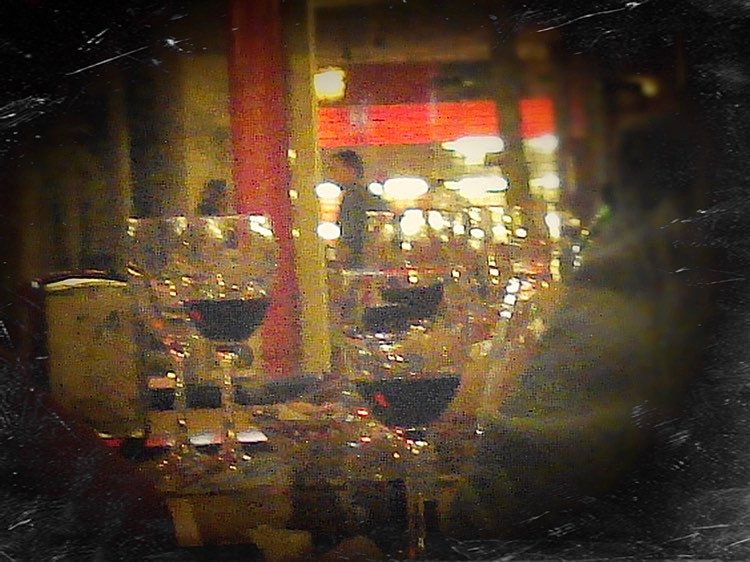
Image by Karl Powell, Vino (Sevilla), 2007

PART THREE: EL CENTRO
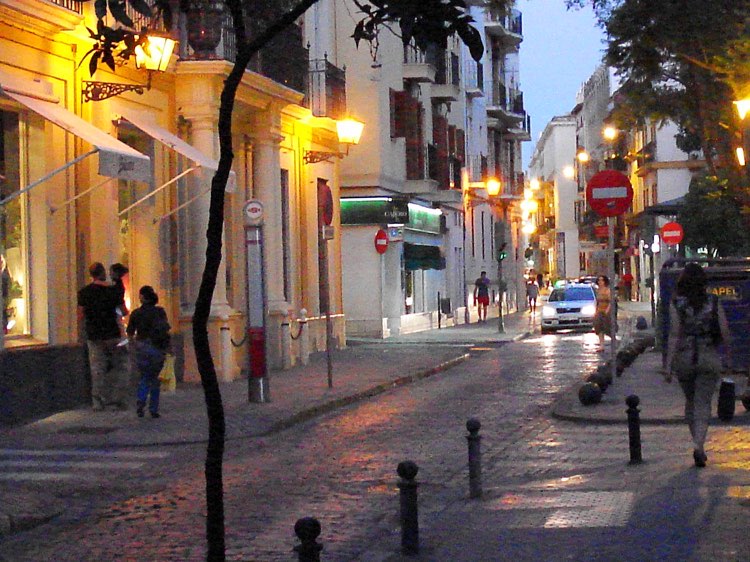
The sun set about an hour ago and the sky has sunk into a deep, violet fog. It is dark. Church bells clang into each other, sounding solitary markers for a half past ten. And at last the city of Seville is winding down. The place to be – as always – is seated outside, tucked up into a narrow street, heart beating, close enough to where the shadows and voices echo ever-upwards into the starlit skies. That tight, blank canvas of touchstone dreams – that stretched, black fabric where you know you and I will one day return. Underneath those twinkling inscriptions, tables are pulled together, people feast from small white dishes, share bread rolls, refill glasses of wine (even including grandma). This is the place to be. Unaffected by the steady stream of tourists, Seville seems focused on its own sequestered universe. Workers are walking home. Unhurried they move along the long, curving calles. Friends greet each other. Hands touch. Lips kiss. Cerveza pours. The world and its clutter exists elsewhere. Latticed windows reflect neon lights and the images of people searching for other places to go. But this is all there is. An eternal city has nothing else to prove. The dreams it dragged down and brought into being scar and mark the soul that thirsts for beauty; the dreams it dragged down and brought into being shine and charge the body that aches with beauty. And it knows it. There is nothing more to prove. Life becomes an indulgent dance of love in slow, patient footsteps, edging, nudging, moving ever closer to union.

Image by Karl Powell, Midnight (Sevilla), 2007

Midnight has arrived. The hollow chimes from the bells of the Convent de Santa Catalina sound their echoes across the rooftops of Seville. The heat of the day has gone. Only the feint scent of jasmine remains. My heart feels so happy and wishes this evening would never end. The longest day is already over. To quote from the stanzas of Wallace Stevens, “…at evening, casual flocks of pigeons make ambiguous undulations as they sink, downward to darkness, on extended wings.”   

Image by Karl Powell, Doves (Sevilla), 2007

*

21 Tapas in La Manga (Mar Menor)

MANAÑA
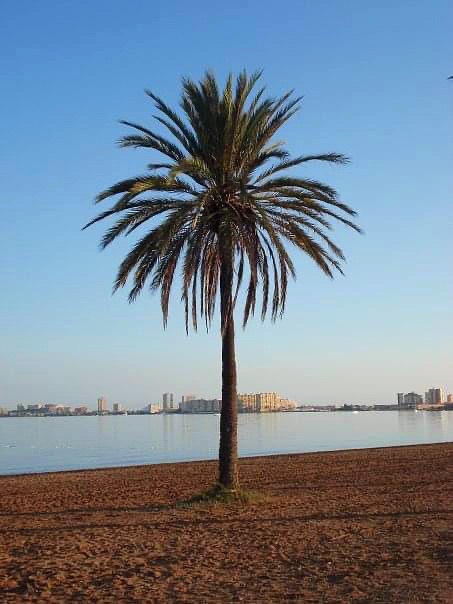
Quiet. Calm. Dawn. Mornings in La Manga always emerge from this silence. Sat on my balcony overlooking the lagoon and its five islands. I drink the first espresso of the day and try to write as half the world still sleeps. Waters at the beach do nothing. Waters in the lagoon do even less. Over on the salt flats pelicans and flamingos move slowly in this early morning light. The air smells cool and refreshed. Doves coo from nearby trees. Small birds chirp softly, hidden in the shade and leaves (still entwined in the dusks of dawn). In front of me I count again the five nearby islands protruding out of the Mediterranean blue; chunks of rock, conical shapes, towering cliffs. Palm trees rise up towards the light, columns of silhouettes, grouped in bunches of threes and fours, reaching upwards for the morning. The ocean continues to do very little; just pushing itself ashore with no effort, only seeming to reach the shoreline as an afterthought, waves that never break, water arriving on sand with a quiet sigh before dissolving forever. A dog barks somewhere in the distance. Morning has broken.

Image by Karl Powell, Mar Menor, 2007

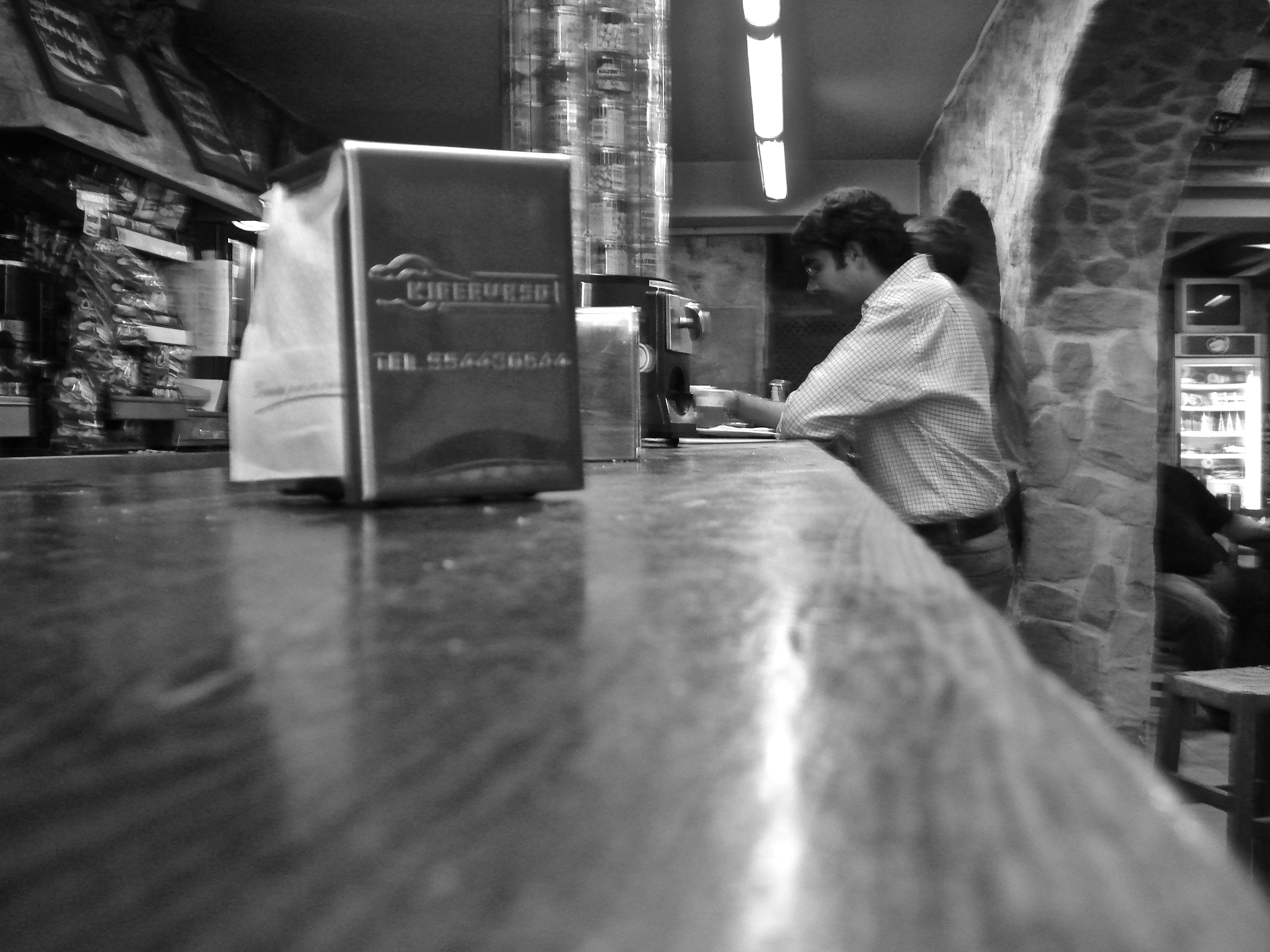
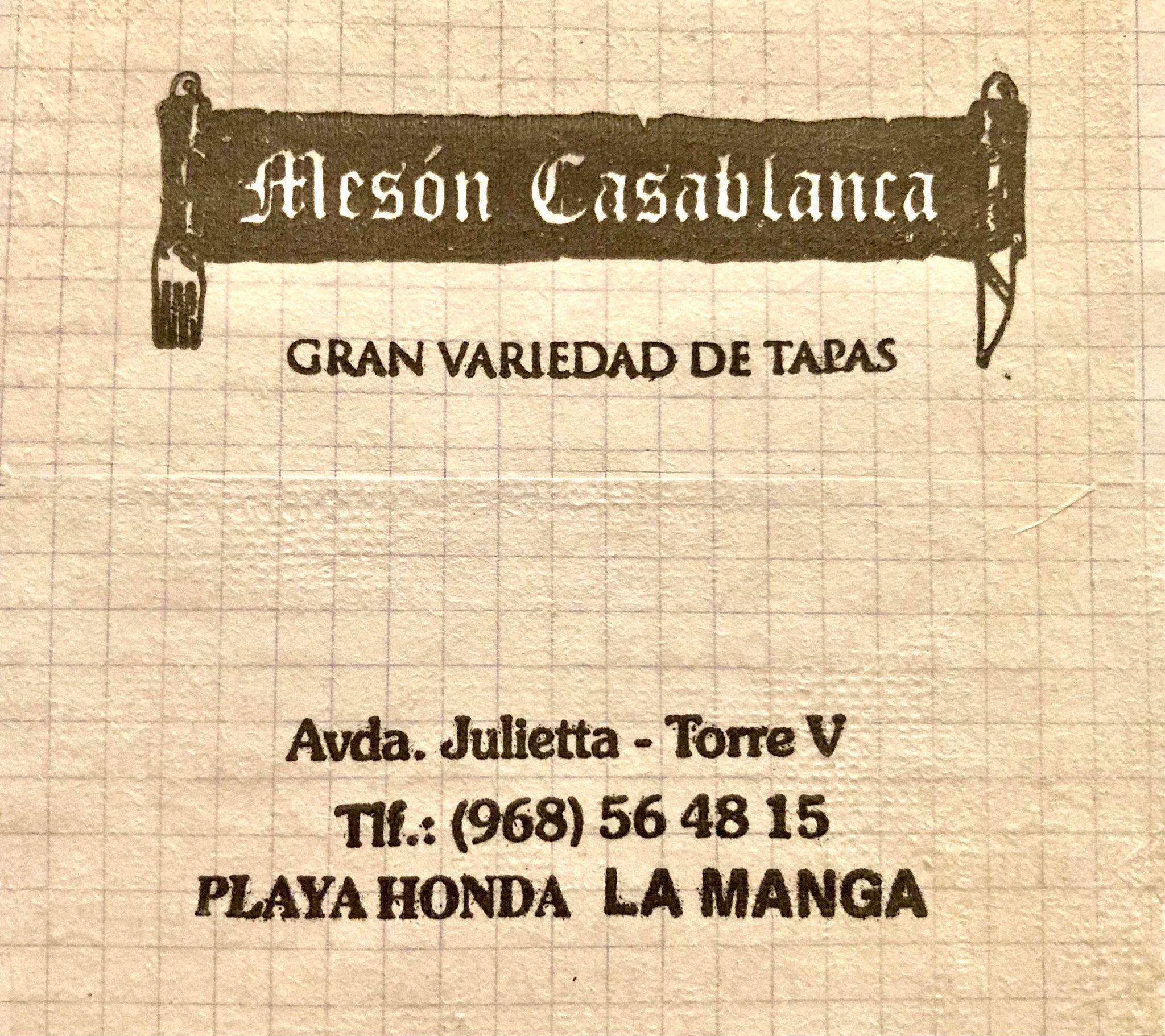
Found a café for breakfast. Mesón Casablanca. Not far from the lagoon, on the beach at Playa Honda. The morning sunshine reaches in and wraps itself around the building. The day still stretches out wide across the beach, yawning across the flat waters we face out onto. Like others here, I am sitting up at the long sturdy bar running along the length of this room, passing a series of hot grills and plates, coffee pots and white demitasse cups, bottles of beer and rioja, cut legs of jamón hang from the ceiling – partially obscuring the television screen which is broadcasting a daily game show on tve. A barista works inside here, serving coffee, serving food (there is also a large open window – a wooden hatch which swings open for business out onto a patio – people can order from outside and stand near the beach to eat or drink).

Image by Karl Powell, Comido Las Tapas, 2007

Small servings of tapas are offered for €3: pick what you like. For breakfast most people are eating slices of toasted bread covered in a spooning of hot, tomato salsa. The air is perfumed with garlic and saffron. A man in front of me eats this with his coffee. He has a baseball cap pulled down over a forest of tight wired, grey curls and his voice is a series of gruff barks. A friend sits next to him. Side by side they sit together, drink their coffees, eat their breakfast, smoke their cigarettes. Two women approach the hatch-bar to order something to go. The men have instantly noticed the sunlight creating a sheen of gloss along the length of their long black hair (they have possibly noticed more). The women order coffee and food. The men go back to eating. Their cigarettes burn, resting nose down in ashtrays, curling thin whisps of blue smoke up into the air. The morning sunshine continues to shine across the flat waters of Mar Menor and its five islands.

Image by Karl Powell, Playa Honda, 2007

TARDES
The midday sun has climbed as high as it can for today. It peers down from an intense height, causing eyes to squint when looking up. Shadows are now directly beneath your feet. Cicadas and crickets make the heat sound more intense than perhaps it is. Spent the morning over at Cartagena, not far, nearby, about twenty minutes away, still in the region of Murcia. Wandered around its small harboured streets, hot and dusty, sheltered in shade. Had an early lunch, elevenses, ate some seafood croquetas – deep fried and breadcrumbed, filled with musselmeat or crabmeat; I’d found a restaurant near the port, owned by two brothers. It overlooked the harbour, the lighthouse and the fishing boats bobbing about in the slick, still waters spilling in from the Costa Calida. Not long after, I caught a bus back to Mar Menor. There was a big fight in the middle of the journey – two old women shouting at each other. No idea what it was about or what they were saying, but both gave each other as good as they got.

Image by Karl Powell, Azuca de Cartagena, 2007

The bus dropped me off near enough to Méson Mesón Casablanca. I could see it from the bus stop. There was no one seated in the outside patio (or standing up against the latch-bar). Inside, things were happening, though. The owner greeted me with an Hola, como estas? I sat up at the bar and ordered a midday espresso (café solo). All was relaxed, all was mellow, Jimi Hendrix’s All Along the Watchtower played in the background from two small speakers tucked away in shelves between bottles of wine. Midday tapas were being served from metallic trays behind the bar, visible from behind counters of flat glass. Near where I sat I could see calamares being cooked in a tomato sauce; there was garlic, parsley and pine nuts in there, too. Next to that, were cuts of sea bass cooked in a broth with garlic, paprika and saffron – possibly with garbanzos (chick peas). I ordered both dishes with my coffee. Some bread was given to me for free. Everything in the bar had an unhurried pace. Nothing sounded louder than the spoken word. The owner seemed to know everyone who came in – either saying hola, or greeting some by their names. Sitting there time no longer mattered. I needed to be nowhere. And I guess this is one of the tricks to getting your money’s worth out of this life: to take time to savour the sunsets and tapas, to find the dolce far niente in each day’s frenetic convulsions and to linger there as long as possible. The bar was warm with the sound of smiles.

Image by Karl Powell, La Palma, 2007

NOCHE
Sunday night at Mesón Casablanca. The day is all but over. Just got back from watching the sun set down at Cabo de Palos. Went down to the beach there at late afternoon. Sat there watching the remains of the day sink behind the ocean. The sting of the sunshine had started to evaporate as I arrived, but with the approach of evening, coolness sunk deeper into the sand. I swam in the Mediterranean for as long as I could. Floating in waves, watching the colours of dusk fill and smudge the sky with oranges, reds and violets. Warm winds blew in off the ocean – facing that horizon you knew that you were looking into the beating heart of North Africa, possibly looking directly into the endless beauty of Morocco.

Image by Karl Powell, El Sol y La Mar, 2007

The light was dimming as I walked back to Mar Menor. It wasn’t a long walk (maybe thirty minutes or so). The sun had long disappeared over the mountains dividing Murcia from the white hot heat of Andalucía. Twilight consumed the sky, street lights blinked into life, cars began to drive with headlights on. I passed a small souvenir shop still open: Tabacos y Regalos. Inside all manner of gifts were displayed from postcards to ceramics to clothing. All I wanted was a bottle of water. The owner was an elderly man from A Coruña. We chatted a little. He told me about his region and said that all the greatest seafood came from the North West coast: Galicia, Cantabria, Asturias and the Basque Country. He told me to go there in the season when the months of the year ended with ‘re.’ That was the season that the best seafood could be found. He kept emphasising the ‘re’ sound several times so I understood what he meant before listing the months for me in repetition: Septiembre, Octubre, Noviembre, Diciembre. It was almost dark as I walked along the sand on Playa Honda. Music, salsa music, sounded from within the Deportivo Club on the beach (it was here you could hire a kayak or a kite surf for the day and use it in the lagoon). Rows and rows of palm trees reached up towards the stars.

Image by Karl Powell, Fin de Dia, 2007

And so, here at Mesón Casablanca, we are all relaxing. There is beer or wine to drink. The pace is slow. Busy hands move behind the bar – serving drinks, serving food. Busy hands move along the bar – smoking cigarettes, touching, moving. It is almost 8.30pm. There is a football match being shows on the television here. It is Getafe (blue) v Real Madrid (white). I’ve only just sat down, the match has already started (second half), and I can’t see what the score is from this seat. Have just ordered pulpo (octopus); it is delicious, I can taste vinegar, lemons and thyme (I can also see peppercorns, bay leaves and small, sweet onions). And then a goal! I don’t know who for. Looks like Real Madrid, looks like 1-0 to them. Two young men seated next to me wince and curse – they do not want Los Blancos to win tonight. People are entering the bar now. All are greeted by the owner: a couple from Spain, a lad from Africa, a lad from England. All sit here up at the bar (except the couple – they sit at a table facing each other, they look as if they are in love). Suddenly the bar explodes with noise and raised arms: Getafe have just hit the crossbar. On and on they press. All of us sit at this bar and drink our bottles of Mahou cerveza. We will watch this match until the end. An advertisement for a local bullfight over in Ronda flashes up across the screen mid-match.

Image by Karl Powell, La Noche de Mar Menor, 2007

MEDIANOCHE
Midnight. It is difficult to describe the silence here on my balcony in Mar Menor. Only the distant bark of dogs and songs of seagulls drift on the warm levant winds. The sky is black. So black. Stars shine clear and bright all around. Some brighter than others. Some bigger. Thin whispers of streaked chalkdust drift like stray veils flying across the indigo heavens. A glass bottle rolls about somewhere. The five, small peaked islands are visible by their outlines in the lagoon. You should hear this silence, this stillness. This is quiet.

Image by Karl Powell, Mesón Casablanca, 2007

*

11 The Last Sigh, Granada

In the city of Granada resides an expression (it is inscribed on a wall near the Catedral): Dale limosna mujer que no hay en la vida nada come la pena de ser ciego en Granada. Roughly translated it means, If you see a blind beggar in Granada, give him twice as much, for it is suffering enough not to be able to see this beauty. If you have the opportunity to visit Granada once in this life, then do so.

Image by Karl Powell, View of Alhambra, 2007

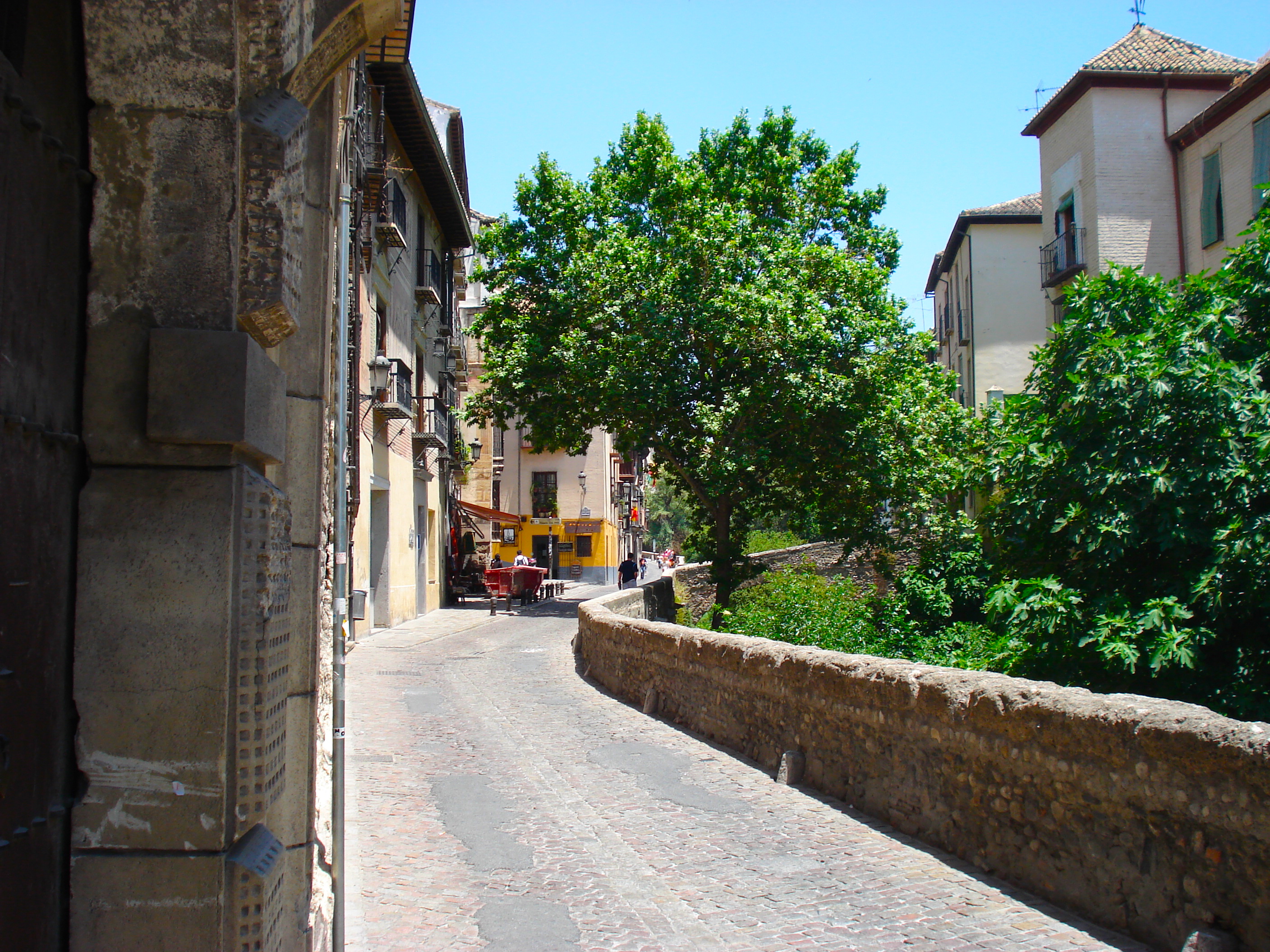
Everywhere you go in Granada the Alhambra maintains a certain presence. Your eyes instinctively search for it, both as a landmark and as a reassurance. It sits high on a foothill, near Sacromonte, looking down over the Albaicín and the city below. The morning sun climbs over it and the moon rises behind it. Sat at the Mirador de San Nicolás my gaze stretches out across the Paseo de los Tristes and the River Darro to directly look into its face. The sounds of castanets rattle around the patterned stones here (worn smooth over time). A mother tries to teach one of her infant children to dance. The child dressed in pink, laughs before stooping to stroke a dog who suns himself in the winter light. The castanets grow louder and a guitarist begins to sing Camarón’s ‘Soy Gitano.’ The sun is clear and warm. The wind is cold on the skin as it blows down from the mountainside. The mid-morning mists rise and start to clear, lifting to reveal the frozen peaks of the Sierra Nevada over there in the distance. The silhouette of the Alhambra appears to rise with the cypress trees. Below, the streets of the Albacín are filled with incense and the music of nightingales. The domes of the Catedral are visible, bells sound from the Convento de San Anton all the way up here to the Iglesia de San Nicolas and everywhere else between. All of Granada lays out before me. Beautiful Granada, paradise of light, skies filled with clear azure, sunbeams and darting sparrows. The beauty of the Alhambra is that it was once just a dream that someone dared to create.

Image by Karl Powell, View of Granada from the Alhambra, 2007

For the past few weeks I have been living in Granada learning to speak Spanish. Twice a day I have attended a school with others to practice grammar, conversation and also familiarise ourselves with the culture of Andalucia (through art, tours and movies). Yesterday was my last class – tonight I depart (flying from Malaga airport with my next destination Marrakech, Morocco). Everything is ready: a bus ticket reserved from Granada to Malaga, bags packed and my goodbyes and gratitude given to those who taught me. As has been customary with the many comings and goings of our group we ate, drank and danced together. We started, as usual, at a bar called Little Italy eating tapas before moving onto to a club called Habana. My closest friend during my duration, Marcel, was busy taking photographs of the evening from start to finish. At some stage of the evening one of us thought it a great idea to go and watch the sun rise over the Alhambra. Instead of going up to the lookout nearby – the Mirador de San Nicolás – it seemed more of an adventure to go beyond the medieval city walls to the other viewpoint, the Mirador de San Cristobal. We arranged to meet at 6.30am outside a Burger King, opposite the Convento de San Anton on the long calle which divides Granada down the middle, the Recogidas. Marcel and I left Habana at around 3am, laughing, and finding the spot to meet before we went our separate ways. Marcel went east towards his district across the River Genil, and I towards mine (San Anton).

Image by Marcel Bosch, Bridge over Genil in Rain, 2007

At 6am I heard my phone vibrate. I ignored it. I knew who it was. But it kept ringing. It was obviously Marcel. He had remembered. It kept ringing. In the darkness of my room at 6.25am I eventually answered. It was Marcel. He was now standing outside the Burger King. It was dark and cold. Reluctantly, I said I’d be there in a few minutes. The narrow streets, though lit, were deserted. Weaving through familiar, labyrinthine streets, I moved back to the spot where we had parted only a few hours earlier. The idea to watch the sun rise no longer had the same appeal that it had at the club. Why did we choose the Mirador de San Cristobal – especially as the Mirador de San Nicolás was much closer and always more popular (in fact, most Friday afternoons many of my classmates would meet and gravitate there before deciding on a place to eat). But Marcel was adamant. Half asleep, half annoyed I followed his lead down the Gran Via de Colon towards the old city gates. It would be about an hour before we would reach Mirador de San Cristobal. It was a long walk. No matter how fast we walked it was cold. In the haze of that hour, there were many people bouncing about in a state of exuberance having left bars and clubs trying to get a bus home from the main street that dissects across Granada.

Image by Karl Powell, Streets of Albacin near River Darro, 2007

Having walked the length of the Gran Via de Colon, Marcel and I eventually reached the Puerta de Elvira, the old city gates. We moved through a small square, Plaza de Triunfo, before following a quiet street, Cuesta de Alcahaba, which curved upwards towards the viewpoint. Marcel said we had to find a series of small streets which zigzagged off our track directly to the mirador. We couldn’t find them. We got lost several times. Came close to giving up. Eventually we found an old man who was drunk and it was he who helped point us in the right direction. We began climbing a series of steps. It was still cold. It was still dark, but, as we climbed upwards, the sky started to glow and change colour along the horizon behind the visible outline of the Sierra Nevada.

Image by Karl Powell, Flamenco Girl, 2007

In one of the poems of Federico Garcia Lorca he writes about watching a summer sunset move across these mountains and the Alhambra. The colours he describes were also present that winter morning:

When the sun vanishes behind the mountains of mist and rose,
and the atmosphere fills with a vast symphony of religious devotion,
Granada bathes in gold and pink and purple tulle.

Standing at the Mirador de San Cristobal, colours changed all around us. Time appeared to collapse, behaving differently – evading the tick-tock march towards an end point; that moment hung in the air. The veil of night lifted, exposing clear skies and the frosted stars that had hung there now melted back into the clear blue of day. Planes criss-crossed vapour trails high above the deep gorges and valleys of Andalucia. Cypress trees twirled upwards. The cold clung to every strand of cotton threaded through the fabric that tried to keep me warm. Legs were aching. Toes were numb. Church bells sounded from the city beyond the old walls. There was a morning mist near the mountains evaporating, revealing the majesty of the Sierra Nevada. The colours, once again, can be described from Garcia Lorca’s poem: The mountain slopes are coloured violet and bright blue, while the summits are rosy-white. There are still spirited patches of snow that resist the sun’s fire. And this description reminds us why poetry is important to the human experience; it is an expression of being that brings us close to timelessness, painting images and emotions that other mediums cannot map. A light breeze blew, lifting the fallen leaves left behind which clung to bare branches and rattled like echoes of the castanet. All of Granada lay out before us. Beautiful, beautiful Granada.

Image by Marcel Bosch, Dawn at Mirador de San Cristobal, 2007

Marcel and I walked back into Granada. We walked back along the Gran Via de Colon. Life was different now, things had changed gear – a different pace, different people, cars and buses going about their business. At the top of my street was a small, square park called Plaza Trinidad. It was an enclosure of communal green. People of all ages sat here during the day, during the evenings and shared the space together. There was a small, outdoor café along one side of the square. Marcel and I bought some coffee and bread to eat. We sat on one of the benches, still cold, but feeling better. The sunlight was bright, shining down on the snow along the top of the Sierra Nevada. It was brilliant white. We chatted for a while, reminiscing over several weeks of friendship and the highlights we shared with the other classmates. We made plans and suggestions about how and when and if we could meet up again. We daydreamed aloud about the possibility of us and the others all buying a house together in Granada that we could all use and share. One of those special daydreams that made no sense in reality but encapsulated the magic of friendship (especially when forged in bubbles outside our everyday lives). But it felt attainable. And like any dream the commitment to an idea (or a passion) must be followed through streets of darkness with perseverance and patience until the dawn comes, and then light dissolves doubt and wishes become reality.

Image by Karl Powell, Friday afternoon Mirador de San Nicolas, 2007

Then it was time to say goodbye. Our coffees were finished. We stood at the corner of my street until the inevitable – we shook hands and went our ways. I walked down Obispo Hurtado feeling sad that this adventure was over; feeling enriched for the experience (and Granada had been an experience like no other). At my casa, my elderly landlady, Carmen, was already awake – making coffee in her stove top cafetera and some breakfast. We spent the morning watching a cookery show, Cocina Hoy, from the kitchen table. In fact, we watched it together most Saturday mornings. I found it helped with my Spanish. She wrote down recipes of interest in a small notepad she kept in the front pocket of her apron. Carmen cried a little when I left for my midday bus to Malaga. It was hard to leave. And in this sadness can be found the true beauty of travel: you discover meaning and belonging in places and people that come to both shape and also represent some authentic aspect of you. These fleeting moments cultivate a humility within; we are touched by the spirit of others. All of which creates a permanent imprint onto our being which resonates out into the world. From this space dreams, ideas and passions journey through us to be shared with others. Granada is a city like no other.

Image by Karl Powell, Alhambra, 2007

*