PART I: REMBRANDTPLEIN
From the window of Room 422 inside the Eden Hotel, the Amstel became almost visible. The morning fog was struggling to lift out of the December darkness. A frosted grey hung in the air. Daylight had yet to arrive. Freezing neon signs and coloured Christmas bulbs danced in the tenebrous gloom brooding along the canal. People were walking about, going places, moving along the walkways. A few cafes were open. The scent of the cold and pine trees still stuck with me as I stood looking out across Amsterdam. My luggage, tagged and packed several hours ago in the 40.c summer heat of the Southern Hemisphere, stood cold and unopened against a wall. The hum of heated radiators filled the silence of the hotel room. A two day stopover in Holland.
The cold was the first thing I had noticed on arrival at Schiphol Airport. My flight had landed just before six in the morning. As the plane disembarked everyone followed someone to the queues for customs, through passport control, through security checks and out into the arrival hall of the airport. Disorientated, tired and hungry after eighteen hours of journeying I wanted something to eat. A few things were open – a café and a Burger King. An espresso and a burger deal would have to suffice. It was cold in the airport. Despite that, things were open and operating. An Information counter was situated directly in front of me. Three women in blue uniforms were working, helping people (arrivals and departures), directing them here and there, pointing left, right and straight ahead. Escalators slanted down, moving gently, descending slowly towards hidden train platforms beneath the airport. An illuminated Christmas tree towered upwards several meters, dominating the arrival hall. Beyond that, the darkness of morning waited outside with the passing lights of taxis, cars and traffic.

The distance from Schiphol to the centre of Amsterdam was not far. At the Information counter I purchased a Shuttle Bus ticket. It was a one-way service for €16 and took me from the airport to my hotel just off Rembrandtplein. The buses left every thirty minutes and I joined a small queue of others who had been waiting near a stand outside. The cold was so cold. It made your joints immediately ache and took the breath from out of your lungs. A driver soon appeared and let us board. Stacked suitcases rattled on the road in darkness as we drove. A heater tried its best to pump warm air in the bus – moving along unknown roads, passing streets and buildings, watching planes taking off and land; familiarity found only in the sight of large, glittered Christmas wreaths lit up in lights and fixed to the front of tall buildings as we drove past. At Rembrandtplein my journey ended and I left the bus to walk the short distance to the hotel. The bronze statues of Rembrandt’s ‘Night Watch’ stood motionless in the lifting darkness – their stoic silhouettes frozen as solid images behind a row of sleeping market stalls. Cold and Christmas lights all around. A city still to wake up. So quiet. So very beautiful.

PART II: LEIDESPLEIN
A night porter, a Londoner just finishing his shift at the hotel, had been kind enough to mark a map with suggestions when I had asked him how to get to Leidesplein (having arranged to meet a friend, Bouchra, outside the American Hotel at midday). The night porter took time to show me how to get there, pointing out places of interest nearby: chiefly, the Rijksmuseum and, if I had time, the Albert Cuyp Market. He also suggested buying a day pass for the public transport; while it was easy enough to walk through Amsterdam the trams could also be a welcome godsend when you needed them.
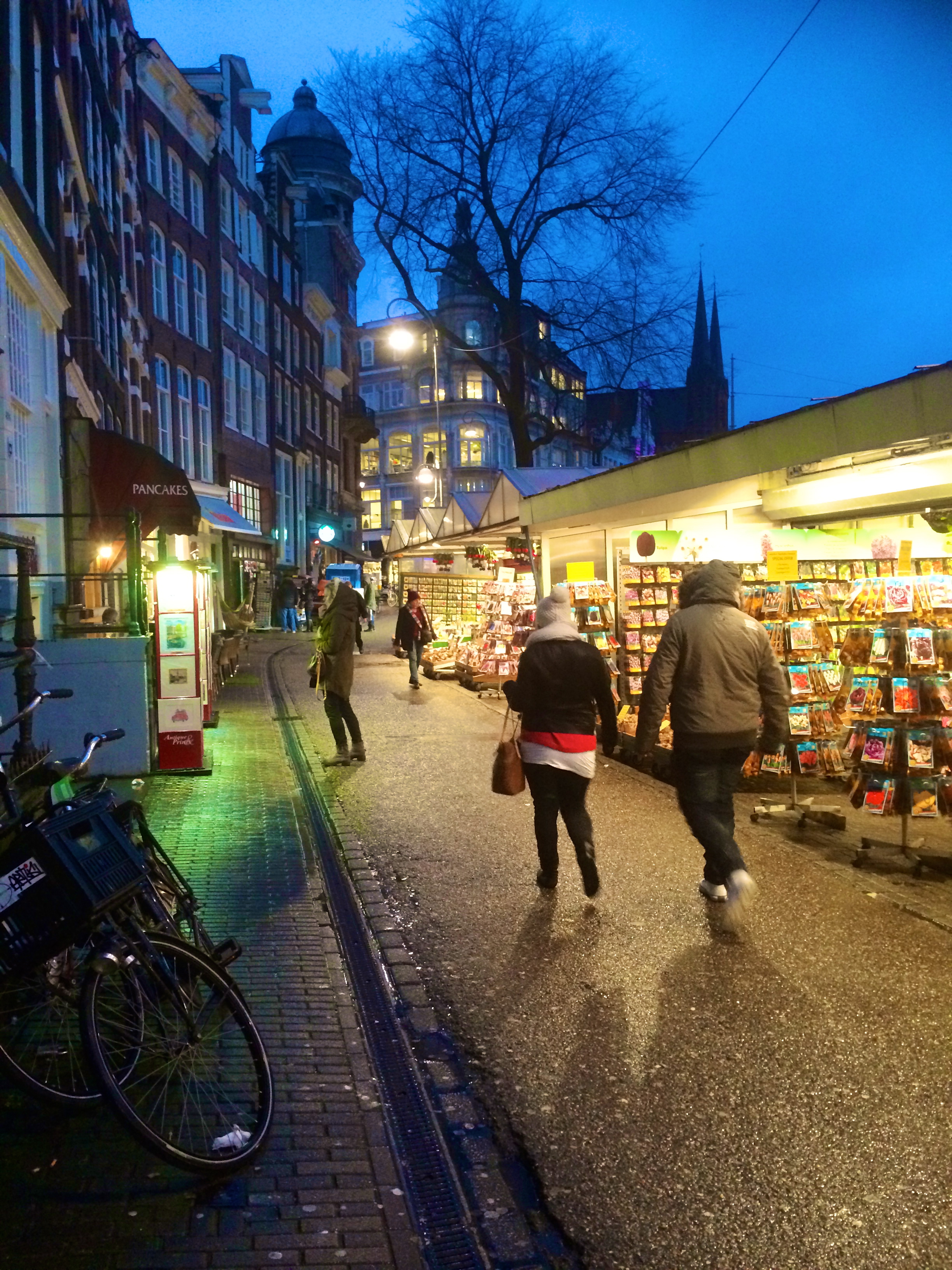
Just a little after 8am I left the hotel and walked out into the winter’s morning. Rembrandtplein was now awake in daylight – the small row of wooden huts selling Christmas fetes were starting to set up, were lit up and open; the bronze statues of the ‘Night Watch’ more visible and distinct. Following the Amstel, I walked to Muntplein and crossed over the square, descending down into a narrow street opposite the Flower Market. A few shops were open there, selling souvenirs, cheeses, chocolates. I found a café and sat there drinking coffee, idling time for a while, watching people walk in the cold, morning air.

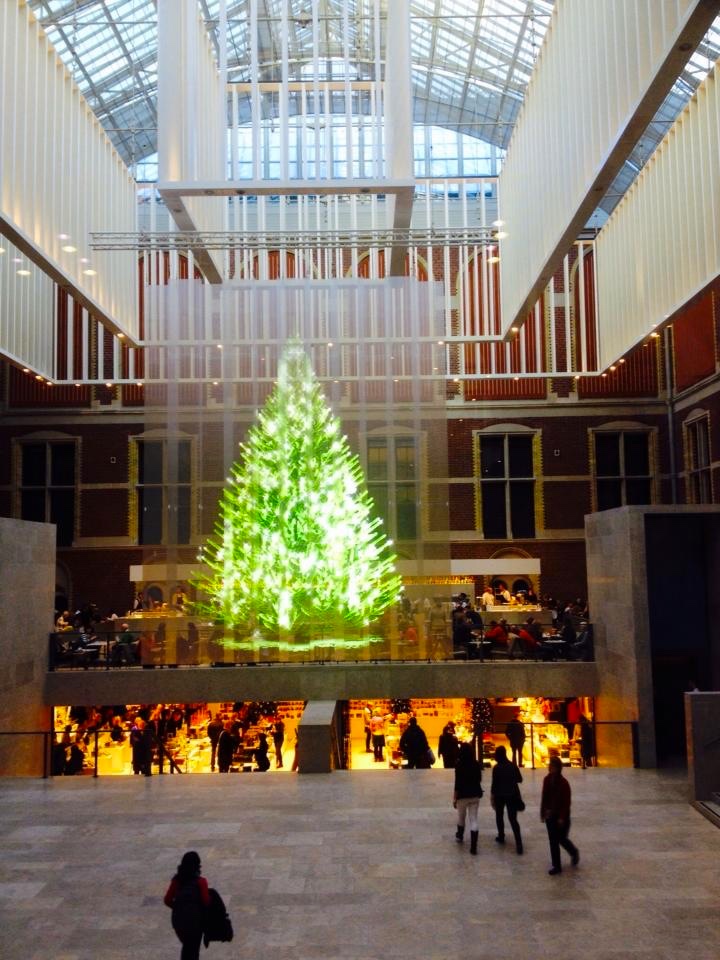
Later, I walked through Koningsplein, navigating my down Leidsestraat, across a few bridges, towards Leidseplein. Here stood the American Hotel, an elegant building sitting in one corner of a large square with other buildings surrounding the perimeter. Cyclists and trams chimed in all directions. Having found my meeting point, I relaxed and went off to explore my recommendations. A short tram ride took me across the Singelgracht canal to the Rijksmuseum. It was an imposing building with three floors of art and history pertinent to Holland. The museum had only just opened for the day and so queues had yet to really form. A large, hologram Christmas tree levitated in the atrium, rising up several floors, suspended in mid air. A flight of stairs led to the upper levels. Rembrandt’s ‘Night Watch’ was housed on the second floor. Once there, I made my way through the Great Hall and along a long, wide central corridor; the painting was visible by the amount of people milling about in front it. The canvas was also a giant in height and breadth. I tried taking photos but it was impossible to really capture any kind of experience, so I stood towards the back of the crowd and tried to absorb its majesty and significance. A woman with blonde hair, possibly in her forties, stood nearby and struck up a conversation with me – telling me that she travelled up from Leiden once a month just to see the painting. Every month she returned to the Rijksmuseum and tried to decide what it was that she loved about the artwork – the historical accuracy, the way the artist had included himself as a character in the picture, the physical attacks the canvas had survived, or just its sheer size. Each time she visited she left with a different conclusion.

After the Rijksmuseum I made the short distance to the Van Gogh Museum. The queues were bigger and busier. The museum was designed as a visual history to the life of the artist. There were giant recreations of his paintings from Arles – such as ‘The Yellow House’ and ‘Café Terrace at Night’ – allowing visitors to have their photographs in front of the background, giving the illusion they were part of the artwork themselves. From the Museumplein I walked the distance across to the Albert Cuyp Markets – an open air marketplace running the long length of Albert Cuypstraat. So many things were for sale – clothes, postcards, vegetables, fruits, souvenirs; voices from Europe, Suriname, Morocco, Turkey. The air was perfumed warm with melted sugar and roasted cinnamon; waffles were created in curling clouds of edible fog. A family sold me a bag of roasted cashews from their stall. A mother and son worked in tandem together, allowing me to sample, to purchase, to package, to share smiles of commonality in the cold despite the obstacles of our language barriers.
PART III – VONDELPARK
Clanging trams moved along Utrechtsestraat, on the way back to Rembrandtplein. The fatigue of the flight, the morning and the cold had caught up. It had been almost seven years since I had last seen my friend Bouchra and our meeting began again almost exactly where we had last left off. We had initially met in Marrakech, one evening, at a shared hotel. Somehow we had found ourselves engaged in a conversation that did not want to end – we allowed it to dance for as long as we could, carrying it out until the small hours, until realising our early flights out of Morocco (to other ends of he world) was nearing. As there was still more to say and share, we vowed to stay in touch. And so the conversation continued – via emails, phonecalls and messages; it was one of the wonderful attributes of the friendship that although there were great yawns of space and silence between our pockets of dialogue, the conversation always managed to pick up from where it had left off. As arranged, we had met outside the American Hotel at Leidesplein, and proceeded to walk towards Vondelpark. The sun was refusing to emerge from behind the overcast clouds, occasional clouds, swiftly moving, blowing by, low-laying overhead and passing by. Patches of mist drifted and the cold clung to the damp frozen dew caught between blades of grass and fallen leaves.

Vondelpark was a large seclusion of greenery – a place perfect to walk and talk. The long, meandering pathways lead nowhere and somewhere, circling lakes and ponds and waterways. Routes returned on themselves, offering exits and inroads, walks along perimeter walls. Bouchra and I spent over an hour there allowing the conversation to breath life into us again. We talked about everything and nothing, sharing stories, expressing our experiences, observing commonalities. One story told was about Bouchra’s upbringing in northern Morocco. It was a story that she had not been sure if was factual or fantasy. She had a memory – possibly an imagined memory – from her early childhood, aged around two years old. She had been carried on her mother’s back in a kind of papoose or sling and could remember travelling across a mountain to visit an old woman who lived alone. There her mother and the old woman began talking as a black kettle was placed over an open fire to make some tea. Bouchra, as an infant, was placed on the floor and could remember crawling and playing and eventually sitting upright underneath a table. She described how she looked up and could see a green snake in the underside of the table. She described in detail how she watched it move and how beautiful its colours were and how these colours – lots of colours – were more than just shades of green and how they had fascinated her. In fact, only a few weeks prior, Bouchra had spoken with her mother about this memory and had it confirmed that it had all been true. They had visited an old woman who lived in seclusion; she was quite a grumpy woman who wanted to live away from people. The story of the snake had been that one day it appeared in her home and the old woman chased it out with her walking stick. But it returned the next day. Several times she chased it out, but it kept returning. In the end, she accepted it and it lived with her, underneath the table, never once harming her.

Bouchra and I parted ways at the entrance at Vondelpark. Our conversation still had many miles to journey, but by mid afternoon, our time together to talk had once again run out. We said our goodbyes and vowed to stay in touch until the next meeting. And it was sad to have had to say goodbye but the conversation was always present, always alive.

I caught a tram that took me along Utrechtsestraat back towards Rembrandtplein. The statues of the ‘Night Watch’ came into view. I could see the entrance to my hotel. My body ached for sleep. The next stop. But then I felt the folded map in my pocket and remembered that the night porter at the hotel, the Londoner, had told me that if I got the chance to visit the Portuguese Synagogue then I should. He said it was a beautiful space, a place of meditation and clarity in candlelight (he said something about there being over a thousand candles lit there each day). The Portuguese Synagogue was only a few stops away. The tram stopped near my hotel. I waited. The doors opened. And then closed. And so I remained seated as the tram moved past my hotel – just wanting to visit one more thing.

*
 siesta del somewhere