The train stopped in the dark. The sun had set across the Indian Ocean a few stations ago and now the world was bruising into an indigo of evening. Silhouettes of palm tress were visible, overhanging above the station’s heavy, metallic roof. A few stars peered into our world. The station’s platform was illuminated by several electrical lights, showing off the station walls which were painted in pastel yellows and pinks, and decorated with fat, round pots of green palm plants encamped at the base of each supporting girder – holding up the heavy metallic roof.
The platform was empty; it was neat and clean and looked welcoming from the stillness of my stationary train. A solitary man stood centre-stage at the edge of the platform; well-dressed in shirt and trousers, one arm folded across his chest supporting the other arm that acted as a support for his chin. The man looked into the darkness that we had been journeying towards.
Moments earlier we had pulled into this station on our train from Galle. I was reurning to Aluthgama. Expecting the train to move on after alighting, it instead began to move backwards. Slowly at first. It bumped to a halt having cleared the platform then shunted forwards onto a central track – a no-man’s land of three lines running parallel to the little station. Here we stopped. Standing in the dark. Without announcements. Here we wait. Kept company by the stillness of the night.

I had spent the day in Galle (and was happy I had done so). I had actually visited the fort town a week earlier – as part of an organised tour, orchestrated by a guide who had pointed here and directed our attention there. I had grown frustrated on the tour, as Galle had struck me as one of those places that asks you to stay longer in its streets, to walk and wander along its shade and sunlight. During the tour, part of me wished I had booked a reservation to stay there instead. Galle struck me as somewhere unique – something that could not be found anywhere else. It had a vibrancy and sense of community encased within its walled streets as it sat on the coast of the Indian Ocean (it even had its own lighthouse). During the tour all I could think about was returning here, to spend more time, maybe a week or two, a period of time, to stay there with a blank notebook and to see what stories, ideas or daydreams ended up on paper.
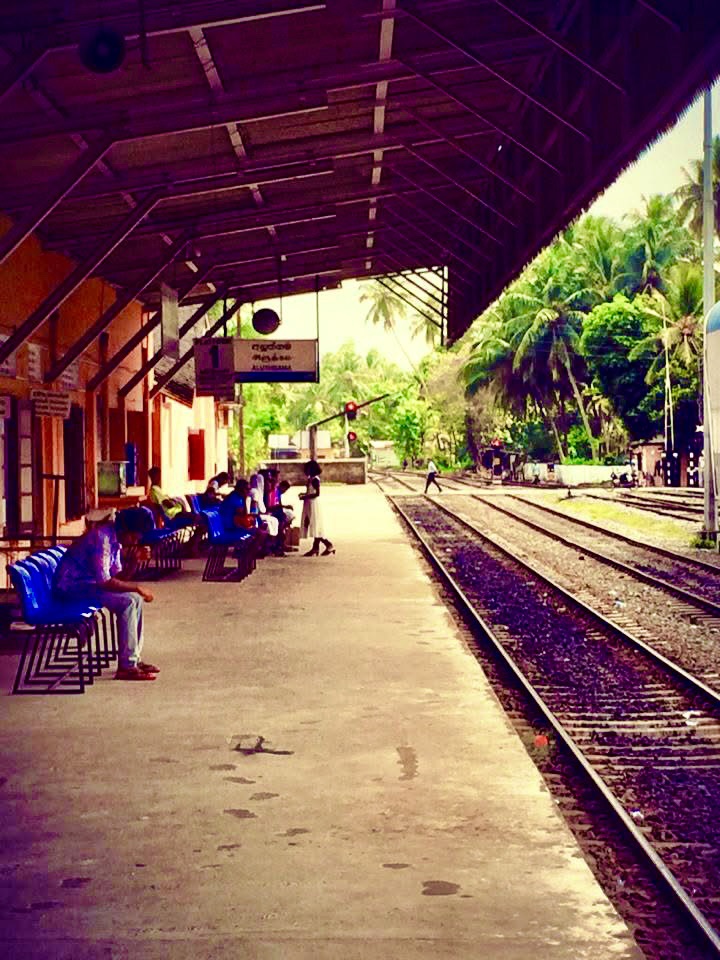
And so, today had begun with buying a ticket to Galle from Aluthgama early in the morning. It had cost me 55 SRL Rupees. The ticket was small (about the size of half my thumb), but made from thick, durable purple card. I had bought it at a small, manned ticket office at the station itself (which was only a two-minute tuk-tuk ride from my hotel). The station had orange walls and a large sloping roof that covered the platform and even the passing rails.
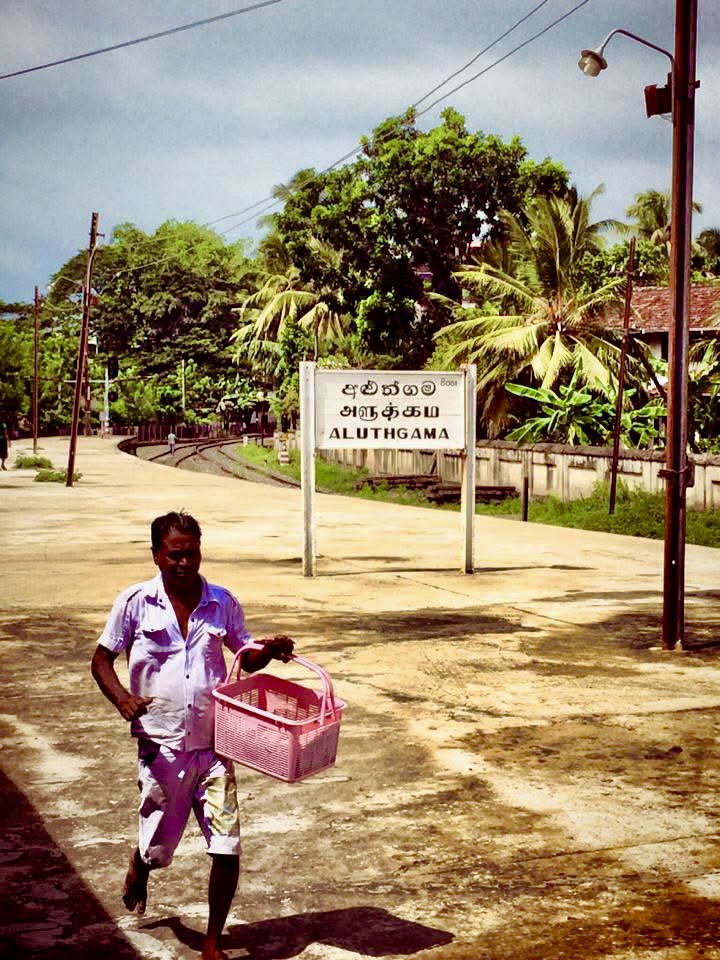
The train to Galle arrived on time. A tannoy announcement was made on the platform in Sinhalese and a few moments later a large, claret coloured diesel train appeared from out of the vanishing point where the illusion of parallel train tracks seem to meet and thundered into view. It blared its horn. The heavy locomotive pulled a stream of red carriages behind it. A stranger on the platform advised me in the collective commotion to board, which carriage I needed as the train pulled in.
The journey to Galle took just over an hour. This was an express train – only taking a limited number of stops along the southern coast of Sri Lanka. The track cut through countryside, villages, moving onwards the terminus, keeping parallel to the Galle Road and the Indian Ocean. Small fires burnt outside homes, colouring the green backdrop of palms and plants with dense, heavy patches of haze, humidity and grey smoke. Occasionally we passed people walking in both directions along the wooden sleepers between the train tracks. When the line opened out towards the ocean, the churning surf created great rainbows thrown into the air as the saltwater spray crashed onto the shore.

The carriage was packed tight. For a while I stood near the open doorway of the train. People around me held onto handrails as the train gathered speed. The moving air rushed inside the carriage making the task to stay onboard a challenge. As the train began to empty along its various stops, I eventually found a seat at an open window.
There was a good mix of tourists and locals on the train – a group of Japanese girls travelling together took photographs inside the carriage striking poses for the camera, flashing peace signs in each one.

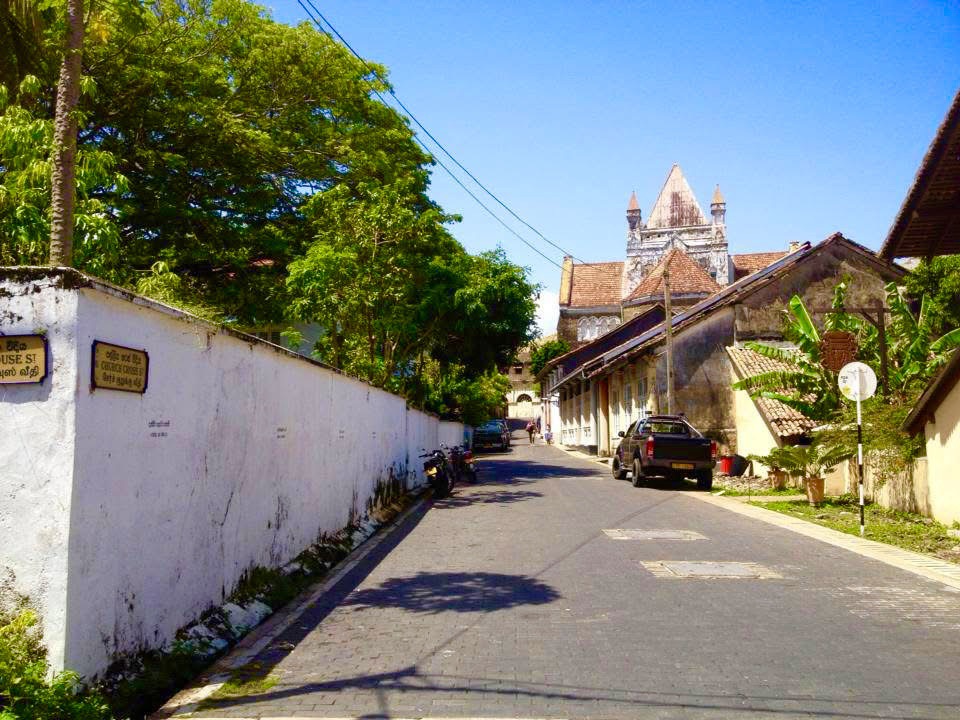
When the train arrived at Galle it did so in the middle of the confusion of midday. Galle was a busy station. Despite having a handmade map to navigate out of the train station to the fort, things were an immediate blur of moving swirls (traffic, heat, unfamiliarities and footsteps). I made my way to a large roundabout, then curled around it before heading into Galle Fort through the shade of the Main Gate – an archway in a stone wall between the Sun and Moon Bastions. This was a fortified town with narrow streets, cafes, guest houses, shops and homes. From this entrance, all roads led down towards the whitewashed lighthouse that stood on grass ramparts facing out to sea. I followed the first street that met me – there were lots of places open and serving meals.
I found a café and sat inside its shade looking out onto Church Street. I ordered coffee and something to eat. It was cool and quiet inside. I sat and wrote at a table for a good hour or so. I enjoyed being inside the building; I liked the fact it had orange walls, a brick floor and wooden slats on the window which seemed to let in a sea breeze without any of the heat of the day. Here, I wrote sketches – passing sights, sounds and impressions of Galle from that café. There was something about Galle that I found beautiful – no rational reason – just a feeling it gave me. It was a place I kept telling myself that I would come back to one day – to spend a chunk of time there solely to write.
After coffee I walked around and found some art shops, souvenir shops, took some photographs of the streets and houses. I had no real plans. It was just a free afternoon to meander until the five o’clock train back.
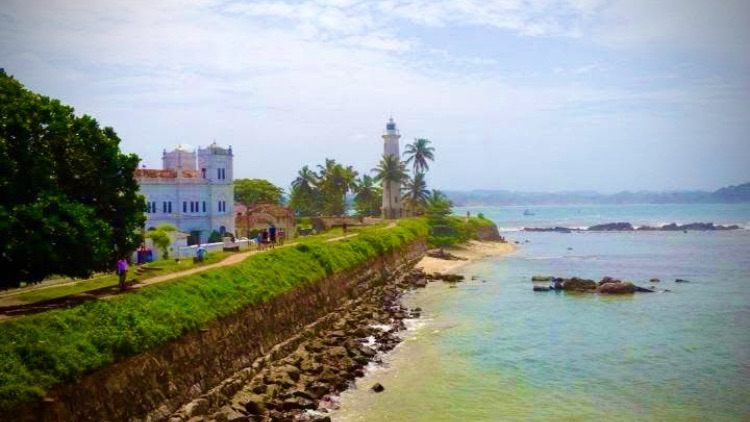
At the far end of the Galle Fort was the lighthouse. It stood like a white obelisk against the blues of the sky and Indian Ocean. It towered above a clump of palm trees which grew around it, sat on top of a grassy verge or rampart which was wide enough to walk along – giving an elevated view of both ocean and Galle. I walked along here, taking what photographs I could of the view. Sunlight moved through the body of water in the shallows – shimmering blues and greens in ripples. The afternoon was hot. Peanut sellers sold small packets of nuts alongside ice-cream vendors parked on the roadside.I bought both.
Opposite the lighthouse was a large, white two-storied mosque. The holy month of Ramadan had just finished. There were men and boys milling about outside, lifting cardboard boxes full of tinned foods and rice from a van and carrying them into an adjacent building. They smiled and said hello as I walked past. A conversation began; they were preparing food parcels to give to families who were less well-off. All were undertaking this work on a voluntary basis (the children were doing so on their school holidays). As we chatted, they asked me about my travels, where I was from, where I was going, if I had liked Sri Lanka – they invited me inside for some water.

Layers of wide slabbed steps led up to the mosque’s entrance. From white heat into shade. The mosque felt cool and serene inside. The sound of birdsong echoed in from surrounding gardens. There was a large, open prayer room towards the back of the building. Bookcases stood against one side of a wall. I was invited to sit at one of the many benches inside the shade. Circular fans blew cool air downwards. Somebody brought me a bottle of cold water. Beads of condensation ran down the bottle into my hand. There, in that pocket of time, we all introduced ourselves; they told me about their lives, I told them about mine. An Imam came and sat nearby to listen to the exchange.
There was a large, framed document on the wall behind me. I read it before I left: it was the Prophet’s last sermon and had been printed in Arabic, Sinhalese and English. The words were lovely. Long afterwards, the more I thought about what had I read that afternoon, the more I realised that all messengers of God express a truth from a Divine Source; only the names are different, the message is almost always the same – to love.

When it was time to leave, photographs were taken on the steps together (including a group one on the steps outside the mosque). We exchanged contact details and thanked each other for the serendipity in our meeting – hoping to meet again in the future. They offered to take me back to the train station but I was confident of getting there myself. A man called Feisal gave me his card – stating he was a storyteller who owned a gemstone shop nearby. On my way back to the train station I bought a map of the area. It was a large, oversized postcard of Galle from a souvenir shop. I did it so I would never forget this day and that I could remember as much of it as I could for as long as possible.
At the station, I bought my return ticket back to Aluthgama. There was enough time to buy some samosas from a vendor near the platform (the home-cooked food wrapped in pages of a student’s homework and advertisements from a newspaper) before the train hauled itself out of Galle. As we meandered alongside the beaches and shorelines of the Indian Ocean the sun began to sag down towards the ocean horizon. The late afternoon mellowed and the heat and light of the day hadsoftened. The sky began to fill with tints of peaches and pinks – a tangerine twilight came as we left Hikkaduwa station. The journey took on a feel of hypnosis; the transition from light to darkness, the repetitive clickety-clack of the moving train, row upon row of endless pencil-thin coconut trees passing the window – each with a thatch of leaves bending away from the evening’s sea breeze.

Lost in the mantras of movement through this beautiful land I suddenly remembered a passage I had read once in a book about train journeys. It had been somewhere in Paul Theroux’s ‘The Great Railway Bazaar’ where the author wrote about a particular sense of freedom he felt that only train journeys can provide. It had something to do with a train’s ability to take you to magical faraway places, moving through sleeping towns and tunnel, across bridges and mountains, meeting passengers in a way that planes, boats and cars cannot. I’m sure there was a sentence that said, trains were freedom on rails.
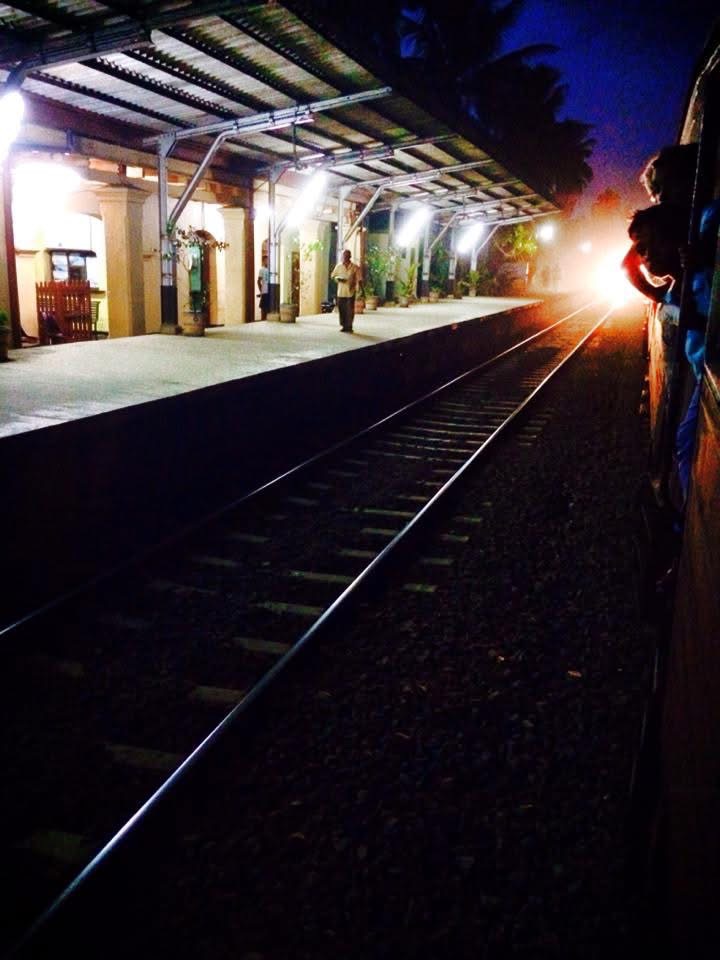
A pinprick of white light appeared from out of the darkness. Ahead of me, I noticed the swaying silhouettes of heads straining out of the windows to watch an approaching train. The white light grew brighter and illuminated the platform. In the marbled colours of dusk and darkness, the train’s headlight soon lit up the yellow platform and its green plants and palm trees. The white light began to move along the long, metal tracks of railway. The light grew brighter still. Then the noise arrived – a heavy train shuddered the ground as it passed with speed. It did not stop at the station. Its rush created a vortex of wind. Then, silence returned – as did the darkness. Our train reversed again to shunt back onto the line we had just been on. We carried on to Aluthgama, leaving behind the small lights of the station’s platform and the night sky filled with evening prayers.

*










 siesta del somewhere