36 – Yoga Ma (Thailand)

In Thai language the word for dog is หมา and when pronounced it sounds like ‘ma.’ Often the a sound is long and held a little before ending with a rising tone.

Yoga Ma – Picture by denpa.fit (September 2025)

Towards the far end of AoNang beach – near the little shrine at the foot of the Monkey Trail – there were yoga classes held each day at sunrise and sunset.  Having booked in for a morning class, I had arrived early and so waited near where I had seen the class advertised. I leant against a small wall facing the beach. While it had been raining when I first woke, the morning was overcast with rolling clouds, grey and thick, curdling low above the ocean. This was low season – or rainy season – when downpours and electrical storms were more frequent. Despite this, it remained warm and humid. Many relaxing afternoons had been spent under cover watching the rain and listening to it fall in AoNang.

It had taken me ten minutes to walk to that spot from my hotel along the shoreline. The beach was quiet. A few tourists were walking on the sand. There were about three or four elderly women crouched close to the ground digging for shellfish in the wet sand. They each wore pink headscarves as coverings, and collected whatever they found into small, plastic buckets. Their hunched bodies moved in silence across the shoreline. Behind them, an imposing ridge of limestone rock towered above the trees and hotels reaching out into the Andaman Sea – cutting off that end of AoNang from the neighbouring beaches of Railay and AoNam Mao.
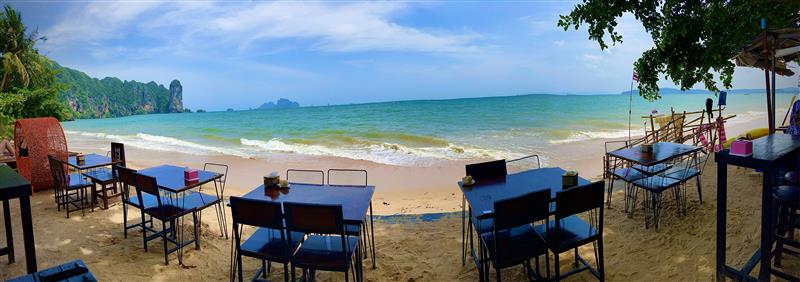
Outside Plaifa Restaurant – Picture by Karl Powell (August 2025)

A continuous warm breeze blew in offshore carrying the sounds of long tail boats labouring against the receding waves. In the shallows, a fisherman waded out waist deep into the Andaman Sea with bundles of red nets in his arms. I couldn’t tell if he was laying the nets or unravelling them in the water. The waves were breaking all around him, moving so fast, full of sound. Out on the horizon there were three or four islands, their outlines fixed and unmoveable. Koh Poda, the largest of them, was directly in front of me.

Early morning AoNang Beach – Picture by Karl Powell (August 2025)

A gust of wind made the wooden wind chimes hanging behind me rattle and echo. They belonged to the restaurant whose wall I was leaning up against: Plaifa. Its signs and menus sleep stacked up on the empty counter and closed kitchen (they opened for breakfast later in the morning). Plaifa had lots of aloe vera growing in short, fat pots outside an area between its service area and the next restaurant. Birds the size of matchboxes chirped and hopped about the pockmarked sand and fallen frangipani flowers there. Light struggled through the flat, broad leaves of the trees surrounding the restaurant. Dappled patches of shade moved on the ground as the wind blew in off the ocean. The scent of jasmine incense being burnt was present in the air for a brevity in time before the humidity and rolling waves overtook the senses.

Looking out all around me the two dominating colours were grey and green. Overcast grey, tropical green.
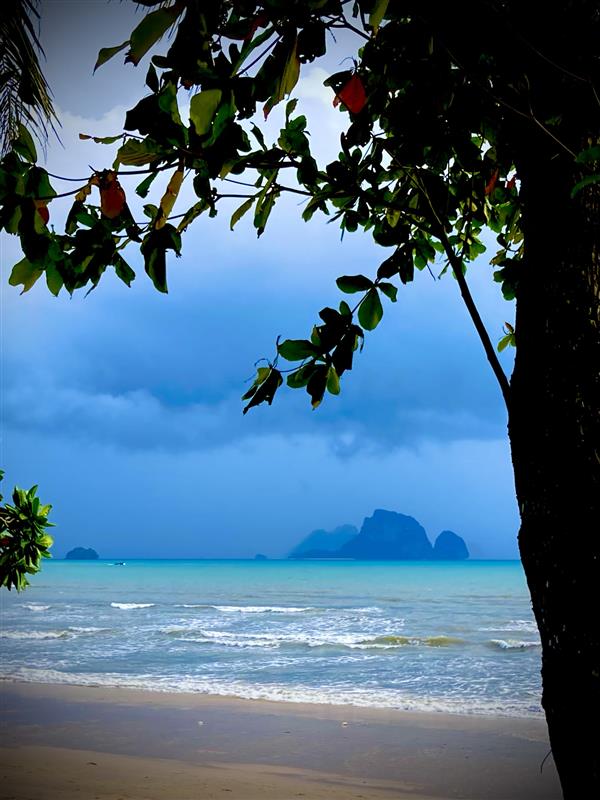
Storm at Sea – Picture by Karl Powell (September 2025)

The sound of a motorbike revved out of the silence. The bike travelled along a side road, and cut across a small stone bridge across a river, and parked at the side of Plaifa. A woman with long black hair tied behind her head, got off the bike which was fashioned with an open, roofed side carriage (like a tuk tuk). There it had carried a basket of towels and several black yoga mats rolled up together. This was to be the yoga instructor. Moving fast, she placed the basket and mats on the ground, beneath a tree, before making a couple of trips to carry all onto the beach. In no time she had done this and planted a tall, red flag nearby advertising her yoga class.

I moved down from the small wall to introduce myself to the instructor. She wore a red singlet and blue leggings and by the time I reached her, she was already setting up the mats on the beach. I offered if I could help her set up.

No need, she said, all ok.

The instructor rolled out four grass mats onto the sand, before placing a similar number of smaller, yoga mats on top. On top of each was placed a red hand towel with a bottle of water. There would be three others doing the class with me.

As the instructor set up her own mat – directly facing us with her back to the ocean – a girl walked along the beach to join the class. She introduced herself – she was travelling around Thailand and had come from China. As we all began chatting, a couple walked along the front of the restaurants (where I had just been) and dropped down on the sand. They were two Londoners repeating the class and knew the instructor – having first arrived in Krabi a few weeks earlier before spending some time over in Koh Samui and had now returned.

As we were now all present, the class could begin.

We were invited to sit down on a yoga mat. The instructor formally introduced herself and provided some information about herself, where in Thailand she was from, her own personal journey with yoga and what we would be doing in the class: some breathing exercises; stretches, twists and balancing poses (asanas); and, finish with a shavasana (or meditation). We all sat on our mats facing the instructor and the ocean. We were told to close our eyes.

Before the Yoga Class – Picture by Karl Powell (August 2025)

Our first practice was something called Nadi Shodhana. It was a practice of being seated and breathing in through one nostril and breathing out through the other. It was a practice used to still the mind and body, in preparation for yoga. We were each guided and shown how to do this: to rest our left hand on our knees and using our right hand to alternate the index finger and thumb in closing off our nostrils as we breathed. We brought our hands up and closed our left nostril and inhaled deeply and slowly through our right nostril. The instructor counted to four. We then pinched both nostrils closed and held our breath as the instructor counted again. Then we were told to release the left nostril and to breathe out slowly to a count of six. The practice then switched sides; we breathed in through our left nostril, pinched closed both nostrils and held our breath, before exhaling through our right.
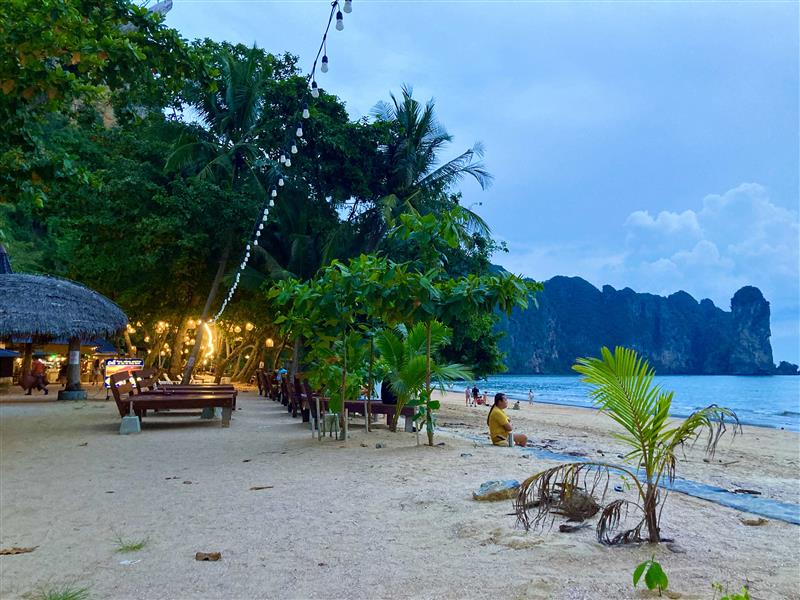
Chilling outside Plaifa Restaurant – Picture by Karl Powell (August 2025)

We practised this breathing technique several times. During the practice we were told it was a method to help calm the mind and calm the nervous system. In the thick humidity of the beach I laboured with this and felt my lungs begin to burn. Holding my breath was proving so difficult. Beads of sweat became more prominent on my skin. I felt sweat run down my forehead. I could hear my heart beating hard within my body, sounding with exaggerated thumps in my hearing. I kept my eyes closed and tried hard to follow the instructor’s count to breathe but I struggled and found myself needing to gasp and sip at the air. I couldn’t tell if it was my inexperience with the technique or the heat and humidity of being outside on the beach. Even though there was no sunshine that morning, the humidity had a presence and it felt as though it was building.

The practice was then cut short. I felt a sudden thump in my ribs and torso at the same time I heard a scream. Eyes open I saw myself as part of a tangle of limbs: the Chinese girl had crashed into me, lunging away from a wild dog that had encroached on her mat and now lay down on the sand.

It’s ok, it’s ok, said the instructor. This dog always comes here. He likes to join in meditation. He’s a good dog, not nasty, never bites, but always causing trouble.

The dog belonged to a group of dogs that seemed to live on the beach, never charging or bothering people; sometimes they barked. The dog seemed placid and at ease. If I had to guess, it looked like a small Labrador with thickish fur. It had a mixture of gold and black fur (its back, face and ears were black while its belly and legs were gold). Uninterested in us, the dog rested its gaze up the length of the beach laying on its stomach with its elbows bent – almost in a Sphinx pose.

The instructor told us not to worry about the dog. Just let him lay down, ignore him and he soon will go. He is a good dog. Has a good heart: ‘jai dee.’ She then told us in Thai language the word for dog was ‘ma.’

Trusting the instructor, we went back to our breathing exercises. When we had finished and opened our eyes again we noticed that the dog had gone. None of us had heard him leave (a trail of paw prints in the sand suggested that he had headed back up the beach).

With this aspect of the class complete, the instructor took us through the rest of the practice. This was the most challenging and demanding sequence. We did all sorts of poses and balances (seated and standing) such as the warrior and triangle poses. There were lots of twists – holding our bodies still as we tried to breathe space into any physical limitations we had on that morning.

Waiting for the Storm – Picture by Karl Powell (August 2025)

During one pose I looked out at the ocean. My perception of everything felt slower. The sea was changing colour before my eyes. Greens, blues and a kind of luminous shade of jade. Clouds had continued to build – as had the humidity. I felt drops of rain begin to fall on me. A sheet of cobalt blur drifted across the ocean. At first this seemed to be moving across the horizon, almost parallel to the shore, then one by one the islands in front of us began to fade. At first, they became outlines, then disappeared behind a curtain of mist. The more the wind gathered, I could begin to see the long, thin shadows of rain falling. This was a downpour moving towards the shore. Some tourists stood in the shallows of the ocean, all photographing the changing colours. A small child and a grandfather were walking nearby holding hands when suddenly the child broke free and ran to the ocean. There he had found something and held it aloft in his hand. He showed it to his grandfather and ran back to the ocean – skipping occasionally – before throwing whatever it was back into the rolling surf.
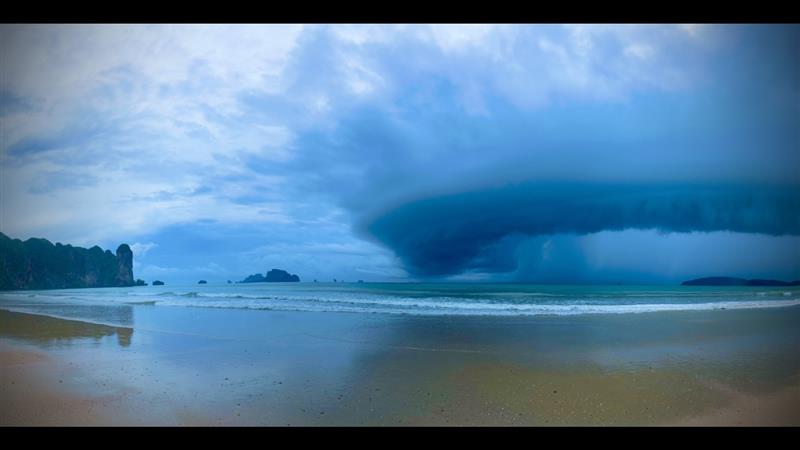
Storm AoNang – Picture by Karl Powell (July 2023)

Then a sudden gust of wind hit us like a wall of noise. The winds sounded loud and howled. Thunder rumbled somewhere in the distance. There was no horizon only grey. The instructor abandoned the class for a moment. We all ran, taking cover beneath the trees and bushes near Plaifa. Safe, we stopped – laughing, panting, listening to the downpour of rain on palm leaves over our heads. We saw the gang of stray dogs running further up the beach, seeking shelter near some massage huts towards the hotels.

And so, the rain fell. And it kept falling. At first the noise was deafening. The surface of the ocean danced and vibrated with concentric circles of rain – patterns appearing everywhere all at once then gone in an instant. The downpour muffled all other noises. The world for that moment sounded and felt so different. Visibility changed. The large limestone rocks at the end of the beach were obscured – just shades of green and grey. At my feet, small puddles of water formed in the wet sand. The small birds I’d seen hopping about earlier now hid in the upper branches, finding pockets of sanctuary, and struggled to balance as the wind continued to blow in gusts.

Then eventually, rain began to ease off before resting at a steady drizzle. Thunder continued to sound but was far away. The instructor gave us option of going to the yoga studio up in the town to continue the class there. But we were all happy to finish the remainder of the class under the trees and foliage we had camped beneath. We were already wet and there wasn’t long left of the practice. And so, this is what we did.

Plaifa Restaurant – Picture by Karl Powell (August 2025)

We continued with our class in a final flow of poses and balances. It felt so nice to be standing still and so fully present as the sound of rain tapped the banana palms and frangipani trees around us. The green of the limestone ridge and its trees seemed to come alive with a vibrancy I’d not appreciated before. Everything shone with a sheen and glossiness. I looked above me. At the trees. One trunk was covered in vine weepers, which curled and wrapped itself around the main stem before moving off onto other branches. Some branches were thicker than some of the tree trunks around us. Another gust of wind moved them in unison. Raindrops fell in concert landing on us and the wet sand. Many leaves managed to hold on the raindrops which seemed to sparkle with life as the light shone through them as the swayed on the moving leaves. The wind blew cooler air across the sea, dispersing the humidity. A large black and white butterfly flew between the raindrops, across my sight of vision until it disappeared into the dark green leaves.

I managed to look out again at the ocean. The whole body of water seemed calmer now, the waves moving as a single moving force breathing in and breathing out, collapsing as small waves onto the shallows at the shoreline.

As the class neared its end, the instructor asked us to stand motionless and to close our eyes. We were asked to just observe what we felt within and to be a witness to that.

I can remember closing my eyes. Standing there without thought. Just breathing in the warm, dense air. I can remember feeling the oxygen moving through my body and we began moving our arms over our heads, then in a circular motion down towards the sand, then back up towards the sky. We did this several times. Breathing. Eyes closed. Listening to the ocean. Listening to the rain falling on flat leaves. Everything felt centred. I could hear the waves of the ocean roaring towards shore. I could feel how wet my clothes were against my skin. I felt the warmth of the sea breeze continuing to blow. I felt contentment. I needed nothing. We kept moving our arms in circles. My body felt lighter, alive in movement, liberated by the breath moving within it. We were told to inhale and exhale in sync as we moved our bodies.
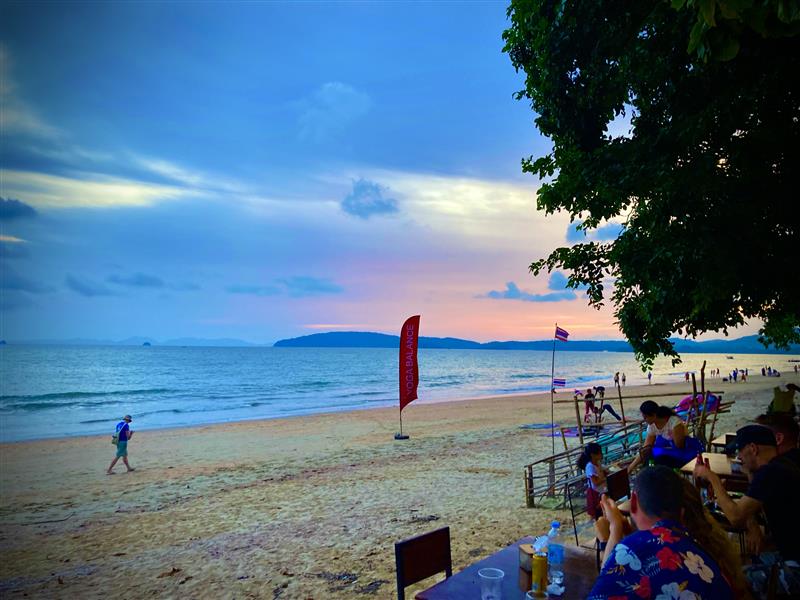
Yoga on the Beach – Picture by Karl Powell (July 2024)

Then we were told to stop. And to just stand still. Keep your eyes closed. Everything was black. I could hear the ocean. I could hear the wind. I knew I was standing on the beach but it was as if I was no longer within the body. There was no sensation of floating. There was no sensation of euphoria. It just felt as if I belonged to that moment in time. An intense belonging and harmony. As if I was a part of time and space (no longer a separate entity). There was energy within everything on that beach; the wind, the rain, the ocean, the sounds, the sand, all the people around me, all the animals on the beach – we all were united in that moment and belonged. And that belonging was its own sacred energy – alive in me, moving through all.

Belonging. No separateness. Oneness.

When I opened my eyes, I watched a wave come out of the depths of the ocean. I watched it rise up then crash onto the shore. It fell face first onto the wet sand. It became stillness. Then it seemed to move backwards, scooped up and dragged back by the tide of the sea. I watched it change into a new wave, rising above an oncoming swell before it disappeared back into the depths once again.  Belonging. No separateness. Oneness.

Koh Poda – Picture by Karl Powell (August 2025)

Finally, the instructor prepared us for shavasana. We returned to sitting on our mats and were again instructed to close our eyes.  We were guided through a set of breathing exercises. Filling our lungs with air. Asked to hold our breath. Then allowed to breath out through our mouth. This was repeated several times until we were told to return to allowing our own bodies to breathe. With eyes closed we sat in silence. I felt a feeling of contentment again. Of peace and happiness and belonging.  Then, keeping the eyes closed, we were told to rub our palms together to create heat. To keep rubbing and then place our palms over our eyes, then onto our shoulders. We were told to: send good energy out into the world – to our family, to our friends, to our parents, to our siblings, to all animals, to all beings, to ourselves.

Then the instructor sang Aum. It rose from within her. The sound resonated and reverberated. I had heard singing bowls do the same with a rising vibration – but the instructor was doing this with her voice. I could feel the vibration of sound moving through my body, through my chest. She sang this Aum three times. Each time as powerful as the first. Then when she had finished, we remained in silence before she asked us to gently open our eyes.

Waves were rolling ashore from the ocean. The sky was still overcast with clouds making the colours of the ocean jade in colour. At the end of the beach, the ridge of limestone rocks remained standing in the waters of the Andaman Sea. Longtail boats continued to streak across the ocean moving towards Railay Beach and AoNam Mao Pier. Chunks of cumulus cloud drifted along the horizon. Raindrops hung from branches like jewels.
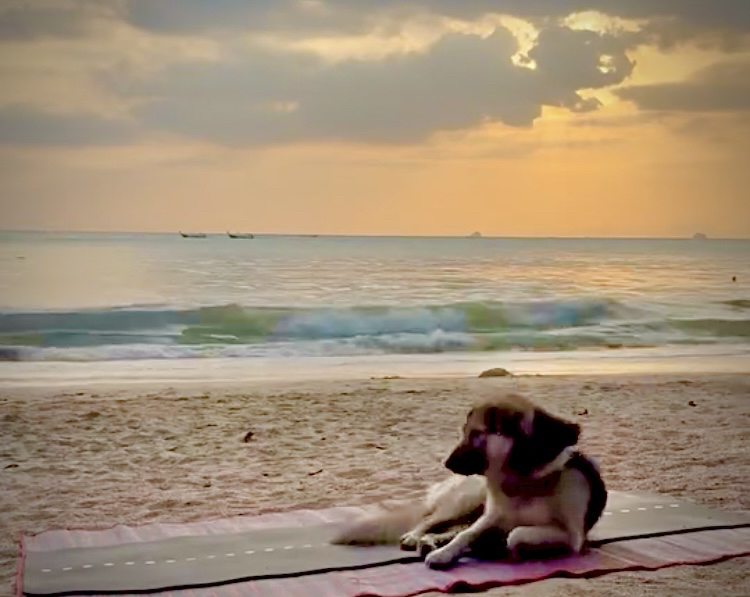
Yoga Ma Chilling – Picture by denpa.fit (December 2025)

And there laying on the beach, the dog had returned to the class (in meditation)

*

Yoga Balance AoNang:
web: https://www.yogabalancethailand.com/
contact:yogabalancethailand@gmail.com

Classes: AoNang Beach (Mon-Sun)
Morning Class 7:30 am – 9:00 am
Evening Class 5:15 pm – 6:45 pm
35 – Galle (Sri Lanka)

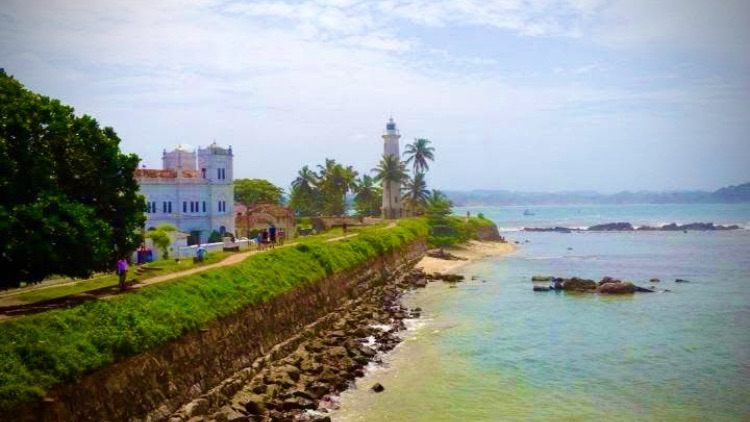
Image by Karl Powell (Galle, 2013)

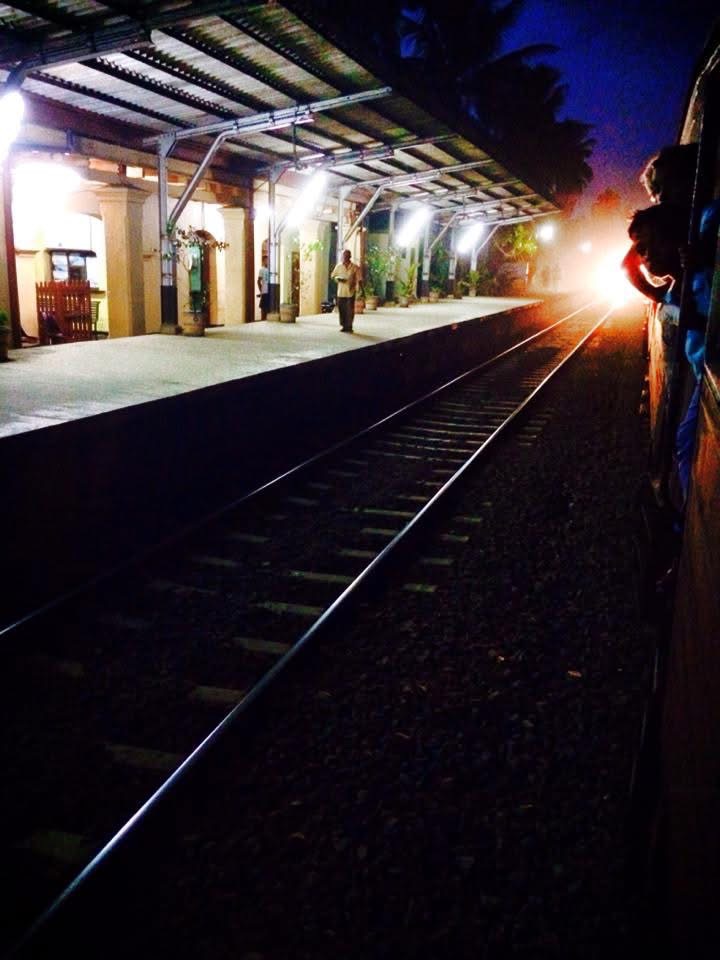
The train stopped in the dark. The sun had set across the Indian Ocean a few stations ago and now the world was bruising into an indigo of evening. Silhouettes of palm tress were visible, overhanging above the station’s heavy, metallic roof. A few stars peered into our world. The station’s platform was illuminated by several electrical lights, showing off the station walls which were painted in pastel yellows and pinks, and decorated with fat, round pots of green palm plants encamped at the base of each supporting girder – holding up the heavy metallic roof.

The platform was empty; it was neat and clean and looked welcoming from the stillness of my stationary train. A solitary man stood centre-stage at the edge of the platform; well-dressed in shirt and trousers, one arm folded across his chest supporting the other arm that acted as a support for his chin. The man looked into the darkness that we had been journeying towards.

Moments earlier we had pulled into this station on our train from Galle. I was reurning to Aluthgama. Expecting the train to move on after alighting, it instead began to move backwards. Slowly at first. It bumped to a halt having cleared the platform then shunted forwards onto a central track – a no-man’s land of three lines running parallel to the little station. Here we stopped. Standing in the dark. Without announcements. Here we wait. Kept company by the stillness of the night. 

Image by Karl Powell (Waiting for the Train, 2013)

I had spent the day in Galle (and was happy I had done so). I had actually visited the fort town a week earlier – as part of an organised tour, orchestrated by a guide who had pointed here and directed our attention there. I had grown frustrated on the tour, as Galle had struck me as one of those places that asks you to stay longer in its streets, to walk and wander along its shade and sunlight. During the tour, part of me wished I had booked a reservation to stay there instead. Galle struck me as somewhere unique – something that could not be found anywhere else. It had a vibrancy and sense of community encased within its walled streets as it sat on the coast of the Indian Ocean (it even had its own lighthouse). During the tour all I could think about was returning here, to spend more time, maybe a week or two, a period of time, to stay there with a blank notebook and to see what stories, ideas or daydreams ended up on paper.

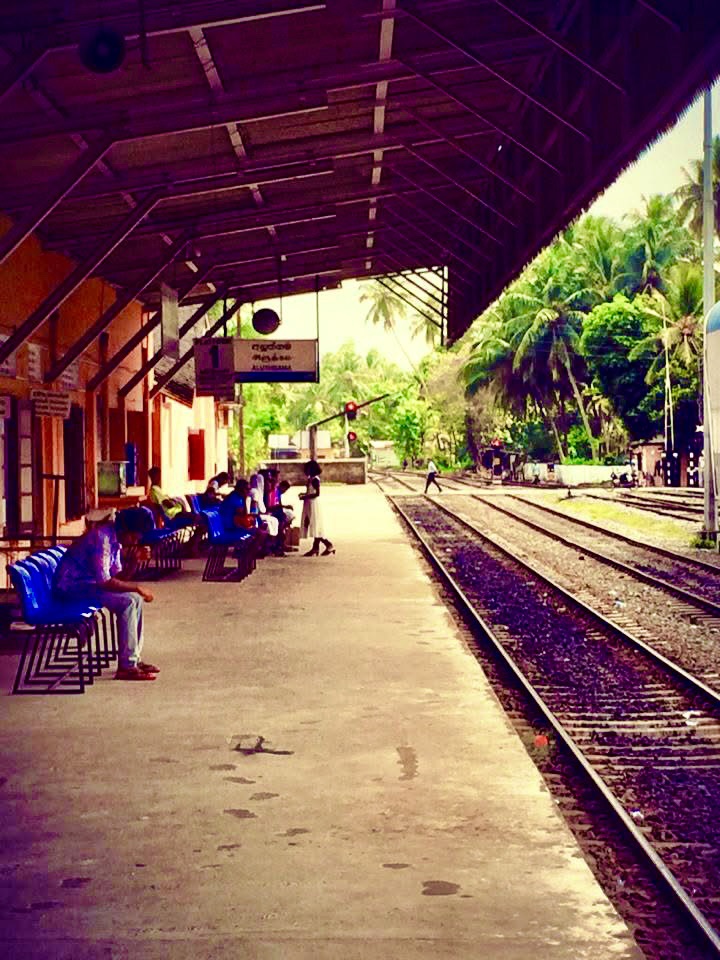
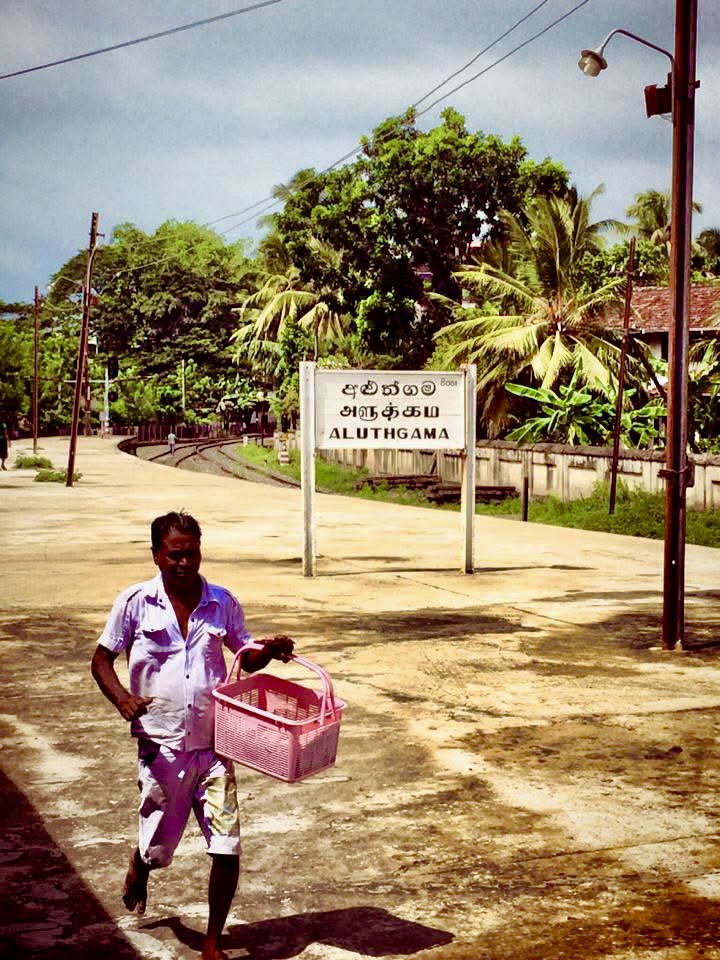
And so, today had begun with buying a ticket to Galle from Aluthgama early in the morning. It had cost me 55 SRL Rupees. The ticket was small (about the size of half my thumb), but made from thick, durable purple card. I had bought it at a small, manned ticket office at the station itself (which was only a two-minute tuk-tuk ride from my hotel). The station had orange walls and a large sloping roof that covered the platform and even the passing rails. 

Image by Karl Powell (At Aluthgama Station, 2013)

The train to Galle arrived on time. A tannoy announcement was made on the platform in Sinhalese and a few moments later a large, claret coloured diesel train appeared from out of the vanishing point where the illusion of parallel train tracks seem to meet and thundered into view. It blared its horn. The heavy locomotive pulled a stream of red carriages behind it. A stranger on the platform advised me in the collective commotion to board, which carriage I needed as the train pulled in. 

Image by Karl Powell (Boarding the Train, 2013)

The journey to Galle took just over an hour. This was an express train – only taking a limited number of stops along the southern coast of Sri Lanka. The track cut through countryside, villages, moving onwards the terminus, keeping parallel to the Galle Road and the Indian Ocean. Small fires burnt outside homes, colouring the green backdrop of palms and plants with dense, heavy patches of haze, humidity and grey smoke. Occasionally we passed people walking in both directions along the wooden sleepers between the train tracks. When the line opened out towards the ocean, the churning surf created great rainbows thrown into the air as the saltwater spray crashed onto the shore.

Image by Karl Powell (Walk the Line, 2013)

The carriage was packed tight. For a while I stood near the open doorway of the train. People around me held onto handrails as the train gathered speed. The moving air rushed inside the carriage making the task to stay onboard a challenge. As the train began to empty along its various stops, I eventually found a seat at an open window.

There was a good mix of tourists and locals on the train – a group of Japanese girls travelling together took photographs inside the carriage striking poses for the camera, flashing peace signs in each one.  

Image by Karl Powell (Train Ride to Galle, 2013)

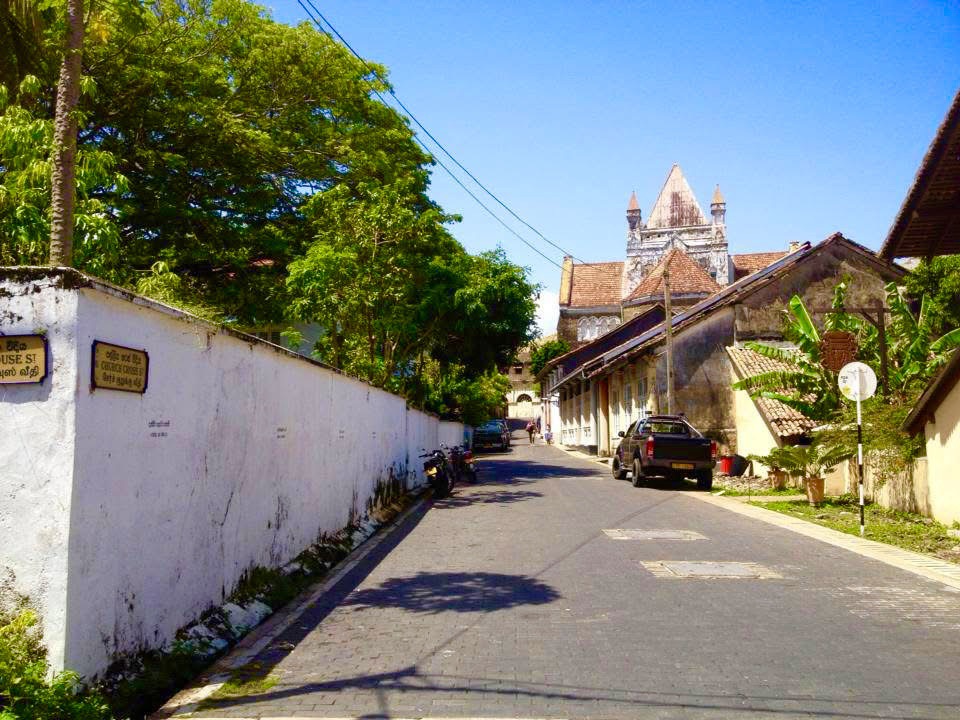
When the train arrived at Galle it did so in the middle of the confusion of midday. Galle was a busy station. Despite having a handmade map to navigate out of the train station to the fort, things were an immediate blur of moving swirls (traffic, heat, unfamiliarities and footsteps). I made my way to a large roundabout, then curled around it before heading into Galle Fort through the shade of the Main Gate – an archway in a stone wall between the Sun and Moon Bastions. This was a fortified town with narrow streets, cafes, guest houses, shops and homes. From this entrance, all roads led down towards the whitewashed lighthouse that stood on grass ramparts facing out to sea. I followed the first street that met me – there were lots of places open and serving meals.

I found a café and sat inside its shade looking out onto Church Street. I ordered coffee and something to eat. It was cool and quiet inside. I sat and wrote at a table for a good hour or so. I enjoyed being inside the building; I liked the fact it had orange walls, a brick floor and wooden slats on the window which seemed to let in a sea breeze without any of the heat of the day. Here, I wrote sketches – passing sights, sounds and impressions of Galle from that café. There was something about Galle that I found beautiful – no rational reason – just a feeling it gave me. It was a place I kept telling myself that I would come back to one day – to spend a chunk of time there solely to write.

After coffee I walked around and found some art shops, souvenir shops, took some photographs of the streets and houses. I had no real plans. It was just a free afternoon to meander until the five o’clock train back. 

Image by Karl Powell (Streets inside Galle Fort, 2013)

At the far end of the Galle Fort was the lighthouse. It stood like a white obelisk against the blues of the sky and Indian Ocean. It towered above a clump of palm trees which grew around it, sat on top of a grassy verge or rampart which was wide enough to walk along – giving an elevated view of both ocean and Galle. I walked along here, taking what photographs I could of the view. Sunlight moved through the body of water in the shallows – shimmering blues and greens in ripples. The afternoon was hot. Peanut sellers sold small packets of nuts alongside ice-cream vendors parked on the roadside.I bought both. 

Opposite the lighthouse was a large, white two-storied mosque. The holy month of Ramadan had just finished. There were men and boys milling about outside, lifting cardboard boxes full of tinned foods and rice from a van and carrying them into an adjacent building. They smiled and said hello as I walked past. A conversation began; they were preparing food parcels to give to families who were less well-off. All were undertaking this work on a voluntary basis (the children were doing so on their school holidays). As we chatted, they asked me about my travels, where I was from, where I was going, if I had liked Sri Lanka – they invited me inside for some water. 

Image by Karl Powell (Houses inside Galle Fort, 2013)

Layers of wide slabbed steps led up to the mosque’s entrance. From white heat into shade. The mosque felt cool and serene inside. The sound of birdsong echoed in from surrounding gardens. There was a large, open prayer room towards the back of the building. Bookcases stood against one side of a wall. I was invited to sit at one of the many benches inside the shade. Circular fans blew cool air downwards. Somebody brought me a bottle of cold water. Beads of condensation ran down the bottle into my hand. There, in that pocket of time, we all introduced ourselves; they told me about their lives, I told them about mine. An Imam came and sat nearby to listen to the exchange. 

There was a large, framed document on the wall behind me. I read it before I left: it was the Prophet’s last sermon and had been printed in Arabic, Sinhalese and English. The words were lovely. Long afterwards, the more I thought about what had I read that afternoon, the more I realised that all messengers of God express a truth from a Divine Source; only the names are different, the message is almost always the same – to love.

Image by Karl Powell (Passing Train, 2013)

When it was time to leave, photographs were taken on the steps together (including a group one on the steps outside the mosque). We exchanged contact details and thanked each other for the serendipity in our meeting – hoping to meet again in the future. They offered to take me back to the train station but I was confident of getting there myself. A man called Feisal gave me his card – stating he was a storyteller who owned a gemstone shop nearby. On my way back to the train station I bought a map of the area. It was a large, oversized postcard of Galle from a souvenir shop. I did it so I would never forget this day and that I could remember as much of it as I could for as long as possible. 

At the station, I bought my return ticket back to Aluthgama. There was enough time to buy some samosas from a vendor near the platform (the home-cooked food wrapped in pages of a student’s homework and advertisements from a newspaper) before the train hauled itself out of Galle. As we meandered alongside the beaches and shorelines of the Indian Ocean the sun began to sag down towards the ocean horizon. The late afternoon mellowed and the heat and light of the day hadsoftened. The sky began to fill with tints of peaches and pinks – a tangerine twilight came as we left Hikkaduwa station. The journey took on a feel of hypnosis; the transition from light to darkness, the repetitive clickety-clack of the moving train, row upon row of endless pencil-thin coconut trees passing the window – each with a thatch of leaves bending away from the evening’s sea breeze.

Image by Karl Powell (At Galle Station, 2013)

Lost in the mantras of movement through this beautiful land I suddenly remembered a passage I had read once in a book about train journeys. It had been somewhere in Paul Theroux’s ‘The Great Railway Bazaar’ where the author wrote about a particular sense of freedom he felt that only train journeys can provide. It had something to do with a train’s ability to take you to magical faraway places, moving through sleeping towns and tunnel, across bridges and mountains, meeting passengers in a way that planes, boats and cars cannot. I’m sure there was a sentence that said, trains were freedom on rails.

Image by Karl Powell (Approaching Train, 2013)

A pinprick of white light appeared from out of the darkness. Ahead of me, I noticed the swaying silhouettes of heads straining out of the windows to watch an approaching train. The white light grew brighter and illuminated the platform. In the marbled colours of dusk and darkness, the train’s headlight soon lit up the yellow platform and its green plants and palm trees. The white light began to move along the long, metal tracks of railway. The light grew brighter still. Then the noise arrived – a heavy train shuddered the ground as it passed with speed. It did not stop at the station. Its rush created a vortex of wind. Then, silence returned – as did the darkness. Our train reversed again to shunt back onto the line we had just been on. We carried on to Aluthgama, leaving behind the small lights of the station’s platform and the night sky filled with evening prayers.  

Image by Karl Powell (Hikkaduwa Sunset, 2013)

*

34 – High Street, Fremantle (Australia)

Image by Karl Powell (High Street), 2023

Sitting on the sunny side of the street, outside Breaks, I am waiting for my coffee to arrive. Late Friday morning, and already the feeling of another weekend yawns far and wide within languid daydreams – somehow stretching the confines of a week into an expanse of extra time. The sky is clear, blue and endless. Outside this café, people are walking through the sun-shined, sea-port town, leaving their half-caught conversations here and there for others to listen and love; streets are already filling up with day-tripping tourists keen to mooch along through the weekend markets further up on South Terrace. Scents of perfume hang heavy in the drifting breeze. A man with a fridge trolley pushes past everyone in his way labouring with a cargo of orange crates.  Large groups of lunchtime students drift – some going this way, some going that way – are meandering in conversations. The sun shines along the length of High Street. A feint moving breeze blows down from the Town Hall and out towards the sea.

Image by Karl Powell, (Sitting outside Breaks), 2017

The café was filled inside with the sound of female laughter and coffees being made – the hiss and rush of frothing milk. It was busy in and around the café. The High Street was full of noise and people. Almost all tables were taken at the café as well. I sat near the door and had the sun on my back. A girl with a coloured pencil case was writing something down on the table I normally wrote at. Some guy sat at the adjacent table, back turned slightly, almost facing the sunshine. He said good morning to some other guy called Ian who walked past. To my right were three young people talking in French. An old woman dressed like an English Vicar muddled past. An office worker walked quickly then dropped to his knee in the middle of the pavement to tie up a shoelace, then carried on walking, swinging his arms: grey shirt white pants. Lovers of all ages sauntered past arm in arm, hand in hand, sharing the sunshine and the moment of this morning.

A plane, low plane light aircraft fluttered overhead in the endless blue. An old man with short grey hair and an angry face grumbled past my table, limping with a stick. Behind him three youngsters walked past, oblivious to anything other than the delight of their own laughter as each jumped up to touch the awnings and overhanging shop signs. Across the road I saw my friend Shane the archaeologist walking down towards the Round House.

Image by Karl Powell, (Street Artist, South Terrace), 2017

At the corner of the next intersection a street artist was painting a large purple elephant in chalk on the floor.

Image by Karl Powell, (Street Artist’s Elephant, South Terrace), 2017

Everyone around me seemed to be reading – heads down in books and newspapers reading. A guy with a white ponytail sat nearby staring at a crossword. The crossword was large and took up most of the half-folded page of his newspaper. He bobbed his head and tapped his feet to music being played from the record shop next door. A watch on his wrist clearly told the time of a quarter past eleven. Nearby, a lady sketching sat in silence, drawing something with great care, crafting slowly, watching her ideas manifest in pictures. As she continued to draw, she leant on her left hand, elbow resting on the table. A giant pink stone sat in the ring on her finger. It matched the pink hue of her fingernails which shone in contrast to her olive skin. She coughed suddenly and turned her sketchbook: she was drawing rings.

Image by Karl Powell, (Pasta Addiction), 2023

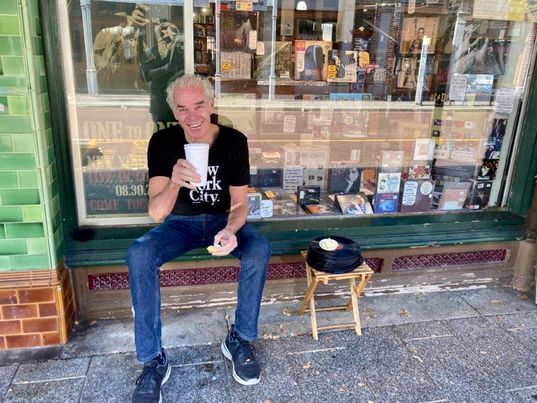
Next door, the record shop had just finished playing George Gershwin’s “Rhapsody in Blue.” I had missed most of the song when ordering my coffee but caught its ending. The record shop already had its doors open before I arrived. They had a big, yellow sign telling the whole of High Street who they were: Record Finder – Specialists in New & Quality Used Records and Cassettes. The interior of the shop looked dark and eclectic – hosting the entire body of music in all its forms. Theirs was a portal into another world – a voyage into new dimensions of Time hitherto unknown and undiscovered; music shops, like bookshops, offered up the opportunity to glimpse into distant corners of the universe and come face to face with something utterly unexpected which somehow aligns with your soul, strikes a chord and eventually changes how you see the world forever (such is the magic of music and poetry).

Image by Karl Powell, (Morning Coffee, Record Finder ), 2023

A large, plastic crate of vinyl records balanced on a stool, guarding the shop doorway. Books about jazz sat alongside vinyl in a glass cabinet with words written on a note. Rows of compact discs ran from the entrance into the darkness inside – each with a small, white label in the right-hand corner (like a postage stamp). The ceiling was high. Behind the posters, behind the stacks of records and compact discs, the walls were painted jade green. In the window there was a large poster of Johnny Cash; below it, a box with the name ‘Tchaikovsky’ printed on it. Sunlight fell inside the shop floor, arrowing in through the gaps at the shop’s front and searing the patches of carpet in long, horizontal cuts. A lone seagull moved about the doorway. The bird had flown down out of the sunshine to land at an outside table where people had been eating. The bird landed in silence grabbed a large crust of something, swallowed it whole in one gulp. It then jumped to the floor and moved as if to enter the music shop (loitering in the shadows of the threshold).

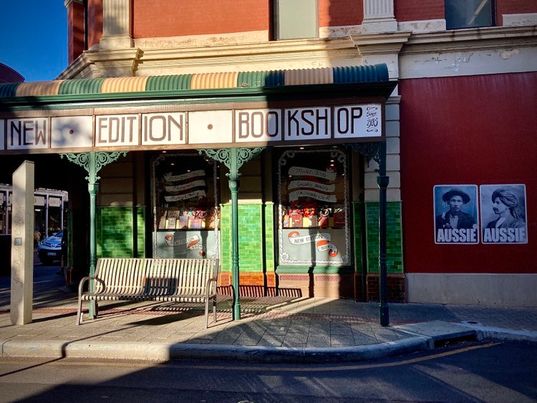
Image by Karl Powell, (New Edition), 2024

One of the record shop owners, sat outside the café on a table, watching the world walk by (offering out a greeting to whoever stopped to talk with him). As I took out my pen and paper and got ready to write on an adjacent table, he ordered another coffee from the waitress with blonde hair.

The humming thunder of a Harley Davidson purrs past us, hammering down towards the Round House and elsewhere. Van doors slam shut as morning deliveries are made. A young woman walks up towards town, carrying a book in one hand, with sunshine bouncing through each curl in her brown hair.

My pen cast a shadow on the table in front of me as I wrote. I watched the way it seemed to weave and dance in front of me on sunlit pages; my will, my ideas scorching blank paper forever.

Image by Karl Powell, (Sunshine on a Wooden Table), 2019

This is all I have today – ten minutes here at the cafe. This is all I have. And this is enough. This will work. With a flat pavement beneath your feet and the sun on your face. This is the place to be: sunshine on a wooden table, a coffee on its way and a ticket to ride. Writing on a wooden table, watching people passing by, blessed by the freedom of an empty page. Casting aside the irritations of seeking out a perfect time and place to write; there are no conditions worth pursuing (all are either absent or elusive). We need nothing more than to enjoy this moment: watching ink flow.

My coffee arrived. The blond waitress brought it.  She told me to ‘Enjoy.’ Midday sunshine was in abundance.

Image by Karl Powell, (Darawn Nature), 2023

I looked around the High Street. Opposite me sat an artist doodling and sketching something in oranges and greens. He had a glass jar of short, coloured pencils on the table in front of him. Eyes closed I could feel the warmth of the sun. The breeze moved past the skin on my face and hands. It was nice to have the sun on my face. I recalled the lines in Hunter S Thompson’s The Rum Diary where Kemp and Chenault have made love just as the novel begins to end, and the two lay together in the darkness of his apartment in Old San Juan – her head resting on his chest – drinking rum in the moonlight, listening to the clink of the ice in their glasses in the total silence they shared; it sounded loud enough to wake the whole of Puerto Rico.

Image by Karl Powell, (Bathers Beach House), 2023

I thought of the beach and began to write again. I began to think of the way that the ocean had looked and felt earlier that morning. Swimming in the endless blue. The feeling of saltwater all around. Floating in the waters of the Indian Ocean as they sparkled with summer’s sunshine. The waters had been sculpted and flat, moving slightly, here and there, broken only by the black dorsal fins of two dolphins coming up for air moving far out in the deep.

A scented candle burning somewhere filled the air with perfume.

Richard the journalist walked past my table and said hello. He stopped and we chatted about some news he had seen overnight in Europe. He told me about the new book he was writing. Told me how difficult the process was. Told me that it was a lot of effort for nothing. Told me the only reason you’d want to write something because you are passionate about it. I wished him luck (knowing he’d complete it and succeed – some people are so committed to their art that all the wind they need within their sails is always blowing near by).

Image by Karl Powell, (Cliff Street), 2019

The record shop began to play The Beatles. Sergeant Pepper’s Lonely Heart Club. After the eponymous track opened, the sounds of ‘With a Little Help From My Friends’ filled the air – and as the chorus tells the whole of High Street how to get high with a little help from our friends, an old man with a bulky, blue backpack appears from nowhere and begins to dance across the pavement, zig-zagging in fleet-footed fox-trots.

Everything was as it should be. Everything felt good. Everything was magic.

There was nothing but clear blue skies.

The sun was getting stronger. I sat still for a few moments more. I closed my eyes and felt the warmth of the sun on my back and heard laughter. It would be time to go soon. I failed to notice my friend, Liz, approach my table from out of my range of  peripheral vision. She’d been watching me write as she walked up the High Street. She came to say hello. We spoke for a while (she was on her lunchbreak, she had a cold and had to hurry as she was on her way to get something to eat).

Image by Karl Powell, (Breaks), 2017

Eventually it was time for me to leave. I finished what was left of my coffee and packed up what I had written. A customer entered the record shop as I stood up and the lone seagull scuttled out of the shadows back into the sunshine on High Street. Almost immediately they began to play ‘There’s Frost on the Moon’ by Artie Shaw. I walked down away from the café, down towards the Roundhouse and the sound of a clarinet followed me all the way down to the corner of Pakenham Street.

Image by Karl Powell, (Round House), 2017

The Round House basked in sandstone sunlight.  

*

33 Fragments of Venice

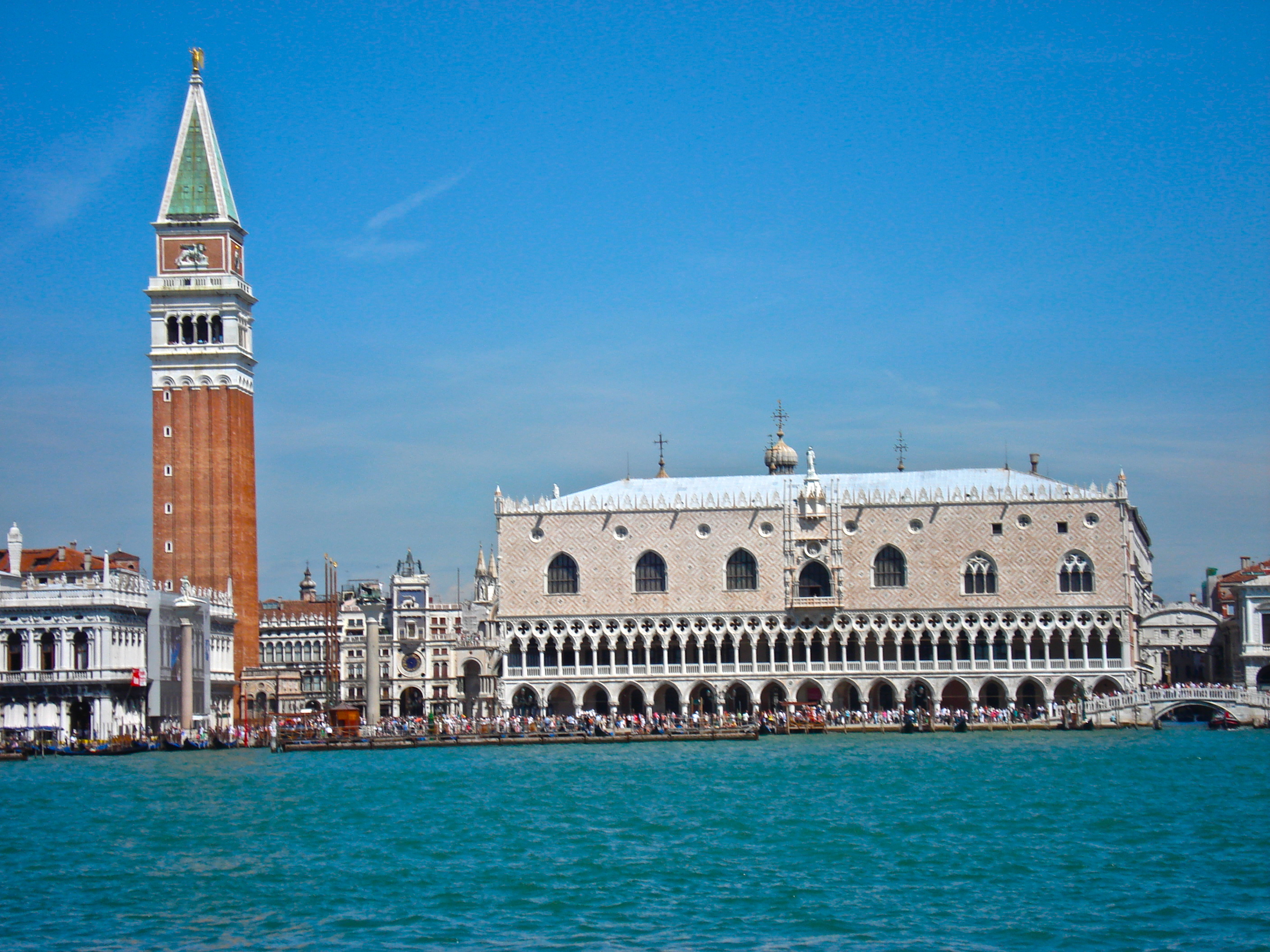
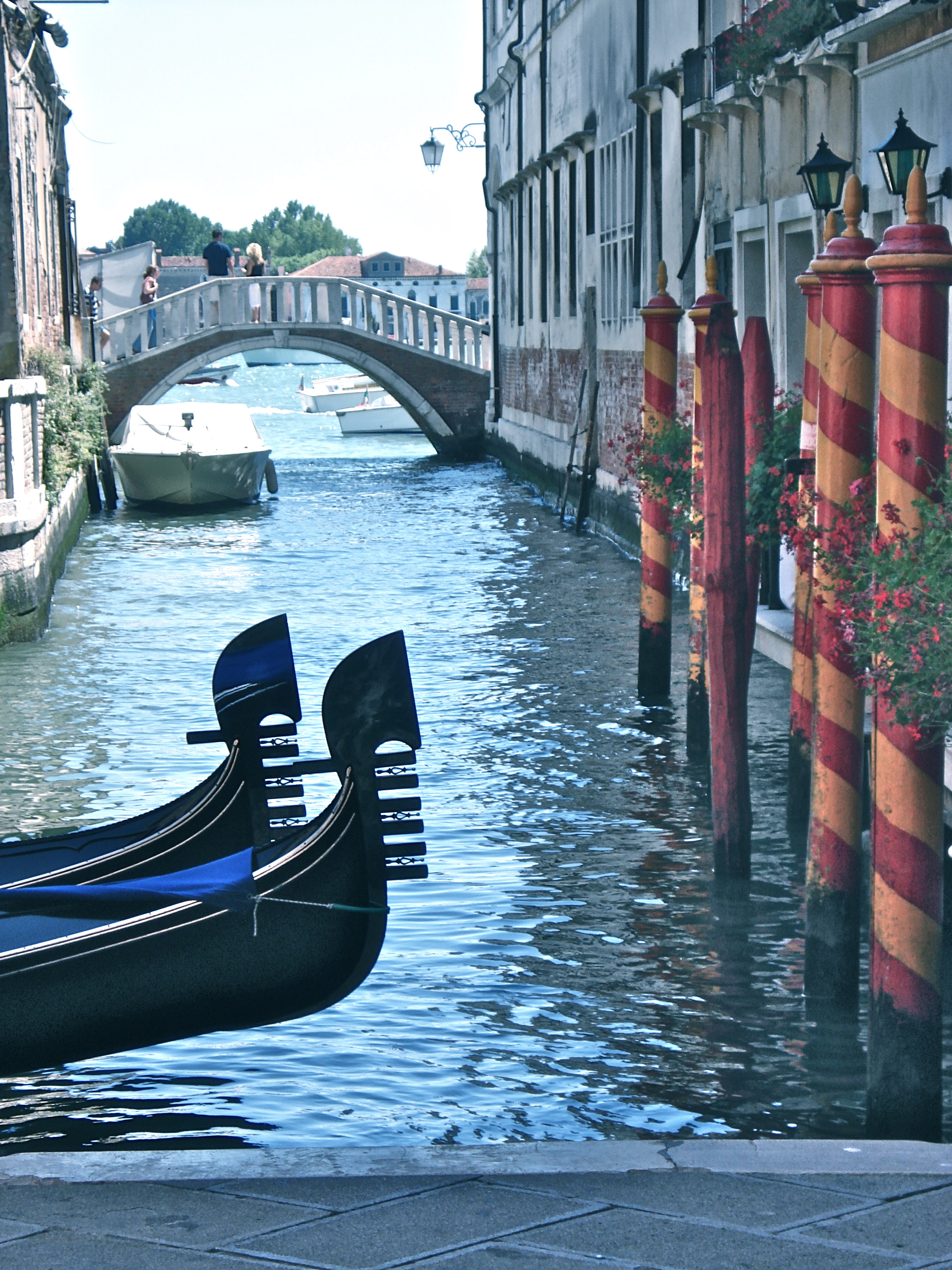
Image by Karl Powell, Venice (Venezia), 2007

Few things can prepare you for your first sight of Venice. It is a place like no other. It is one of the rare places – the very rare – that is difficult to describe. Words elude each page as you try to write honestly about it. Venice is living magic: a floating city regal in an Adriatic lagoon. To visit Venice is like stepping into a dream; time seems to behave differently (there is a kind of timelessness existing there). There is an other-world quality about the beauty created and expressed in its architecture. It is to look at someone else’s vision of a dream made manifest in this world and to realise that belief in creative ambition and imagination should always be fostered and encouraged. It is like hearing a wonderful story that meanders through such a wonderful choice of language and expression that you can often forget to listen for its aim or purpose; whatever is spoken is captivating enough to keep you spellbound throughout the narration. And for the artists, the dreamers, those who want to create beauty in their lives, Venice serves as a reminder that we should pursue our dreams and desires without concern or fears.

Image by Karl Powell, Approach to Venice (Venezia), 2007

There are two ways to arrive in Venice: one is by boat and the other by rail. If possible, arrive by boat. In Thomas Mann’s Death in Venice (1912),as the main character Gustav von Aschenbach makes his way to convalesce in the Venetian republic, the novella’s narrator shares this piece of advice:

Aschenbach saw it once more, that landing-place that takes the breath away, that amazing group of incredible structures the Republic set up to meet the awe-struck eye of the approaching sea-farer: the airy splendour of the palace and Bridge of Sighs, the columns of lion and saint on the shore, the glory of the projecting flank of the fairy temple, the vista of gateway and clock. Looking, he thought that to come to Venice by the station is like entering a palace by the back door. No one should approach, save by the high seas as he was doing now, the most improbable of cities.

I had deliberately chosen to arrive by boat having been captivated by the opening scene in Luchino Visconti’s cinematic adaptation of Mann’s text. In Visconti’s movie we share the view of von Aschenbach’s own arrival into the Venetian capital at dawn, ferried across the Laguna Veneta, accompanied by Mahler’s Adagietto from his Fifth Symphony. Floating along the Canale di San Marco, we see Aschenbach lost in a trance at the appearance of the Venetian republic; there is a sense of weightlessness as the character drifts towards the Piazza de San Marco. This approach is described by Mann as one which was ‘set up to the meet the awe-struck eye of the approaching seafarer.’ The approach to Venice remains one of the most amazing things I have ever seen.

Image by Karl Powell, Piazza de San Marco (Venezia), 2007

For the past month I’ve replayed that arrival back in my mind. Each time I close my eyes and return there I still feel a quality of magic in that approach. The journey by boat across a flat, open lagoon – travelling towards something unseen beyond the dip in the horizon. Small, solitary islands occasionally appear either side of the boat and glide past you in silence. Some islands have small buildings on them. In the distance a shape begins to take form. It is directly in front of you. A shape, a silhouette, something like an apparition. Landmarks appear, emerging out from the blur. The more you journey towards it, the more a familiarity makes itself present – you immediately recognise Venice. It is as if the great paintings of Canaletto are coming to life and you are about to step into a canvas – to touch the canals, its bridges, its buildings. All the while you and Venice ebb ever closer. You can almost see the wind flap at the flecks of crumbling paint on the facades of old houses; you can hear the sound of water lapping at the stone steps leading up into this masterpiece. Open your eyes and you will be there.

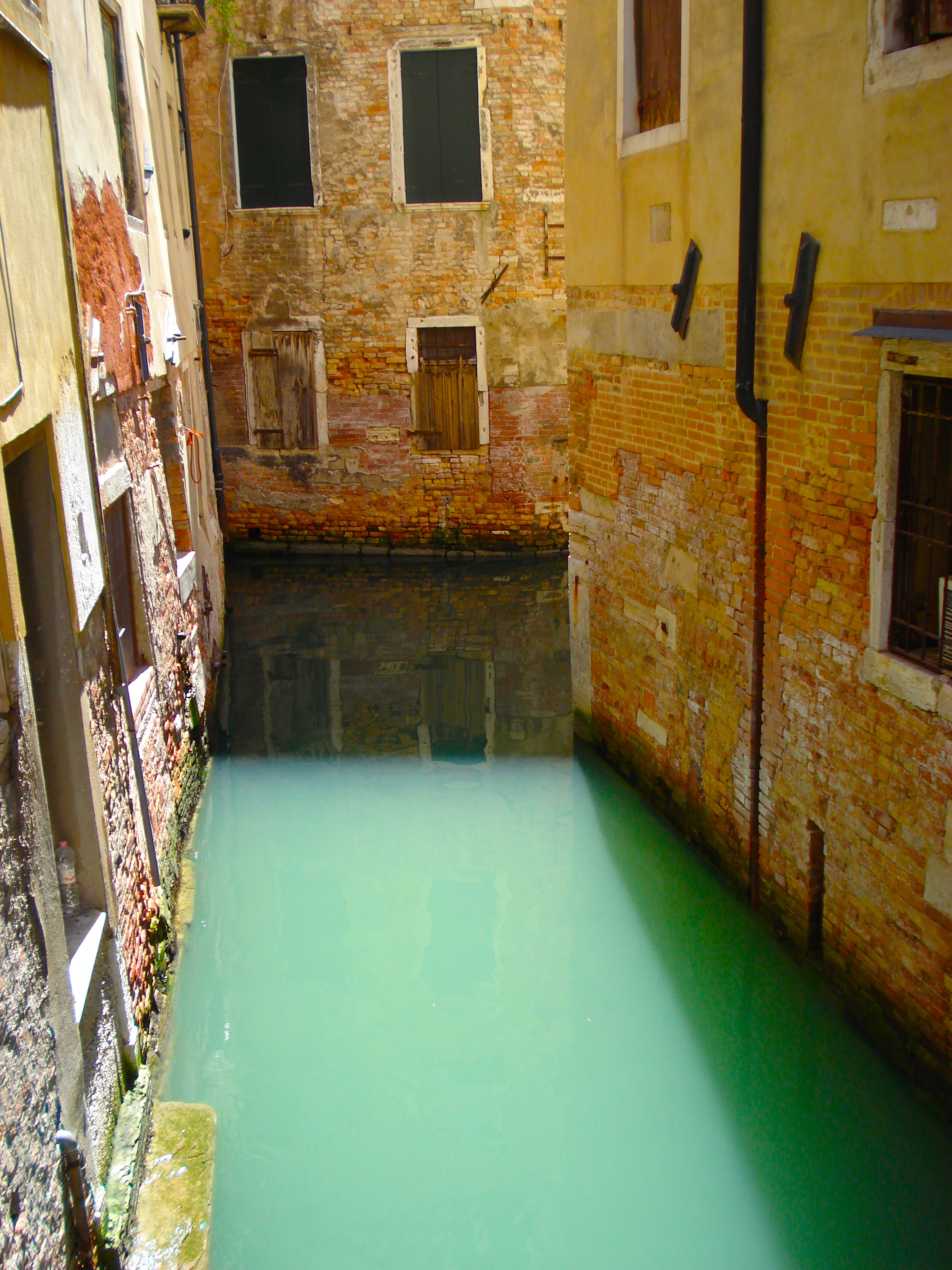
Image by Karl Powell, Sights of Venice (Venezia), 2007

For the past month I’ve tried to find anything that I wrote when I was in Venice. But there’s nothing there. I’ve read and re-read the journal I kept when I was in Italy but each time I go through those notes there are no entries for Venice. No sketches. No sentences scribbled on scraps of paper. Nothing. Just a gap. Not a word was written down the entire time I was there. And I don’t know why – it wasn’t a deliberate choice. I’ve gone back to that Venetian arrival so many times in my mind this last month and after arriving I can remember disembarking and walking across the Embankment… and then the whole thing becomes a kind of amnesia – a haze of sketches, fragments and impressions. Walking in awe. I’ve used maps to try and retrace my steps: a walk across the Piazza San Marco, saw a narrow calle leading somewhere, found a café and ordered a coffee, stayed a while, started walking through the back streets, found an art shop (bought a print), then wandered off following my footsteps wherever they wanted to go. They walked along narrow canals, past silent corners until they stopped somewhere on the Ponte di Rialto high above the Canal Grande. And there in front of me was the whole of Venice. And there was I suspended high above its waters and transported into a sense of timelessness – my eyes doubting the reality of the dream before me. Everything merged into blurred thinking, overwhelmed with beauty, trancelike looking, captivated with astonishment, buildings and vistas that looked like paintings standing still in moving waters, real as reality can hope to be.

Image by Karl Powell, Solitude (Venezia), 2007

Years later I studied a novel while reading a degree. The book, Night Letters, was about an Australian traveller who was coming to terms with an illness as he travelled through Italy and Switzerland. During the narration, the author, Robert Dessaix, visits Venice and experiences a similar disorientation of time and place. One morning, while walking along the Embankment Dessaix stood still and gazed east into the waking morning light. As he stood alone at the water’s edge he felt himself transported into another dimension (coming face to face with the soul of Venice) – the breeze which blew across the lagoon became ‘perfumed with nutmeg and cinnamon, saffron and pepper,’ and he heard ‘scores of strange languages [alive] in the air.’ Like looking directly into a trance, Dessaix seemed to slip through the fissures of reality commenting, ‘Time simply crumpled.  I have no idea how long I stood there.’ The art historian John Ruskin, who stayed in Venice during the 19th Century, even believed there was magic resonating in the stones used to build the Gothic, Byzantine and Renaissance buildings he saw. Ruskin, who campaigned for the preservation of old buildings in The Lamp of Memory (1849), asked us to reconsider the stones of old buildings (especially those in Venice) as we would the jewels in a crown:

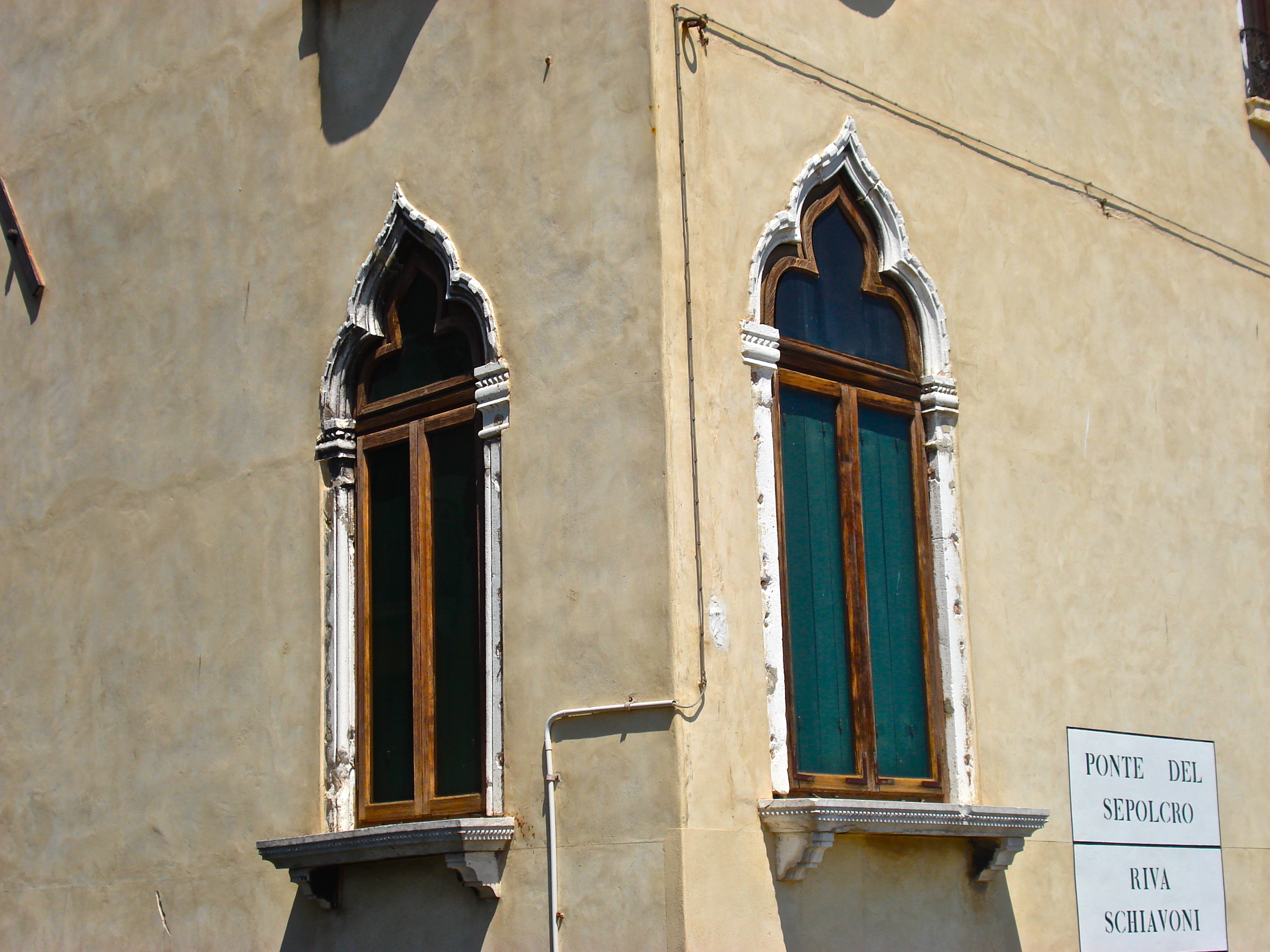
Image by Karl Powell, Street Corner (Venezia), 2007

We have no right to touch them. They are not ours. They belong partly to those who built them, and partly to all the future generations who are to follow us. We have no right obliterate. What we have ourselves built, we are at liberty to throw down; but what others gave their strength and wealth and life to accomplish, their right over them does not pass away with their death in those buildings they intended to be permanent.

Whether the stones of Venice are charged with magic, or can provide a metaphysical vision into a past where mercantile traders carried spices to these maritime ports, either way it is like nothing else on Earth. It is a place like no other.

Image by Karl Powell, il Ponte de Sospiri (Venezia), 2007

When we look at Venice with our own eyes, our understanding of beauty changes forever. When we look out onto Venice we witness someone else’s belief in the power of creativity and an acceptance in the infinite possibility contained within the human imagination. When Lord Byron stood on the Bridge of Sighs – il Ponte de Sospiri – he marvelled at the way that beauty always survives and endures in a world where everything else eventually perishes. And, in essence, this is the challenge we all face in wishing to create beauty in our lives, in manifesting our innermost dreams into an environment which is finite. We have limited time to visit Venice and to also create the things we want; Venice serves as a reminder that we should pursue our dreams without concern, to cultivate beauty in this world knowing that whatever we manage to accomplish with others that beauty will ultimately live forever. To create without attachment to any outcome and once completed to let go.

Image by Karl Powell, Time stands still (Venezia), 2007

Venice is one of those rare places where it is difficult to describe; Venice can only truly be experienced. And should be experienced (at least once if you can). Venice is one of those places where dreamers can feel free to dream knowing that everything is possible again. Some places raise our awareness of the reality we find ourselves in – Venice does this in so many way.  It remains one of the greatest attempts to capture a vision, a dream, something that floats upon the ether for a moment in front of our hearts and minds, and to transform it into something tangible that others like us can see and touch.

Image by Karl Powell, Magic Doors (Venezia), 2007

*

32 New Year’s Day – Kings Park (Australia)

When was the last time you saw the sun rise? When was the last time you stood before the morning’s yawn and waited motionless in the indigo hues of dawn to see the sun rise? When was the last time you saw the sun rise on New Year’s Day?

Image by Karl Powell,  Twenty Twenty-Three (Perth, Australia), 2023

A bird had been singing just before I woke. Only the voice of one bird. But its persistent chirping echoed through the dark city. There had been a wattle-bird sitting on my balcony the morning before but I really couldn’t tell if it was the same bird singing this morning. There were no other noises. No cars, no sirens, no voices. Nothing. The winds were blowing, though – cool winds, Easterly winds bringing heat from the deserts that would arrive in a day or two. Trees near my home rustled their leaves and branches whenever the gusts blew past. The world was almost dark. A few stars were still visible overhead, remaining fixed and shining. With the coming dawn a luminescence had begun to seep through the dark – there was some light present in the sky, giving it an appearance of a blue drained of its vigour and vibrancy. On the horizon, low in the Eastern horizon, colours formed. There was indigo, white tinged with violet, lightness and darkness. A deep orange pooled from nothing flooding that part of the sky with the intensity of a new day. The New Year was coming. I wanted to go to Kings Park to see the sun rise.

In the short period of time it took me to make a coffee all the colours of the sky changed. I stook near a window that faced out towards the east. There were bands and glows of pastel hues, of pinks, yellows and oranges generated out and dissolving into the dawn. In the city, street lights and office lights all along St Georges Terrace were still visible in the darkness. Silhouettes of buildings and trees were pronounced. Somewhere nearby, a neighbour’s gate had been left unlocked and the wind was persistent in nudging it, bumping it, making it tap and knock against its post needing to be closed tight. In the block of flats opposite me one apartment had its lights on (everything else asleep in the building). I drank my coffee and looked out at the world. I could have seen all this from my bed: sunk down and half-asleep, feeling the morning light enter my room, imagining the black becoming gold, then lifting to Verdelho, feeling the warmth of a waking room fill with sunshine and of being aware of the white light of a new day arriving. Even asleep you can feel the morning move over you. But this was New Year’s Day and I wanted to be engaged with its first sunrise – to go up to Kings Park, to watch the sun rise up over the river and to see it shine out across the city; to be able to remember that moment throughout the coming year (whatever the Fates decided was in store).

Image by Karl Powell, Fraser Ave (Perth, Australia), 2023

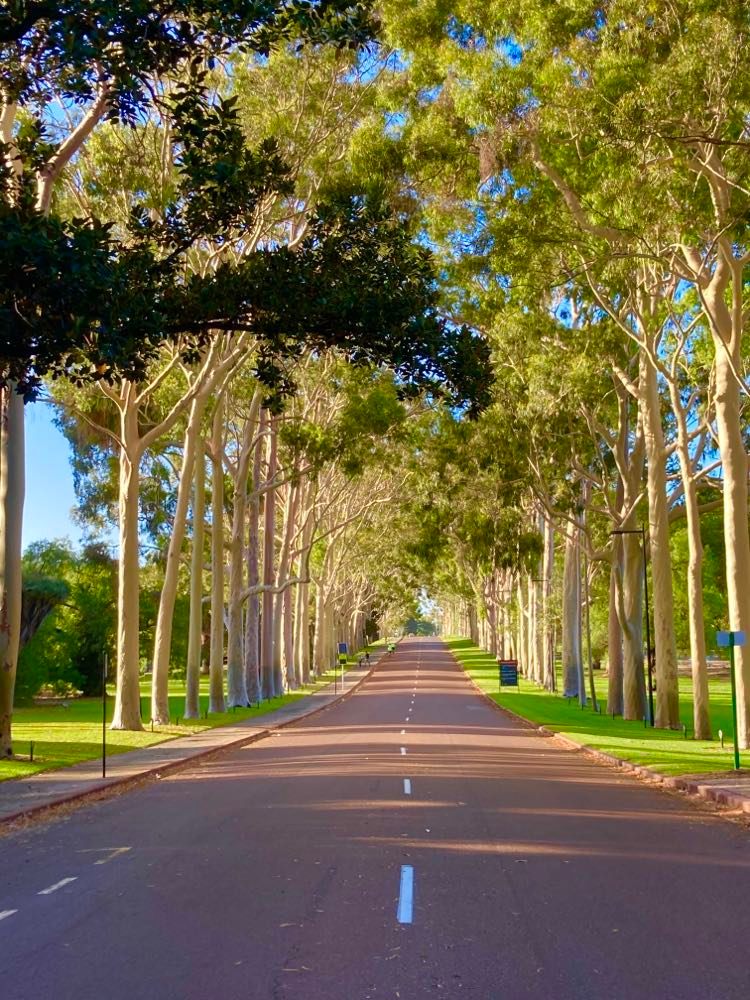
Fraser Avenue was the main road that led into Kings Park from the city. It was a long, straight road and from the park’s entrance conveyed a sense of beauty and elegance due the procession of lemon-scented eucalyptus trees that flanked it and rose high towards the sky. I had reached there a little after five (maybe about a quarter-past). It was light and the park was busy. There were cyclists, runners, dog walkers. The morning bus – the 935 from the park to Belmont Forum – was already operating, moving along out of the park towards the New Year. I made my way towards a slope of green grass, Mount Eliza Range, that faced east and out over the city. There were a lot of people already there before me (more than I had expected). They sat on the grass in groups as friends and family. Some leant against their parked cars. Others just stood between the trees facing the coming year. All waiting.

Image by Karl Powell, Kings Park (Perth, Australia), 2023

From where I stood it was easy to pinpoint exactly where the sun would appear. Most of the horizon was tainted orange with some overnight clouds clinging to the sky; the ridge of sharp edged buildings between the river and the city were silhouettes of varying heights (some reflected light and blurred images). As the morning breeze blew leaves moved all around me. There was traffic moving on the freeways that drove into, along and past the city centre itself. A train – maybe the first one of the day – climbed over the Narrows Bridge, rising up then gliding down into the maze of track leading towards Elizabeth Quay. And in front of this view an old man in a blue shirt and trousers walked his dog, yanking it back onto a path as it stopped to sniff and search inside one of the bushes adjacent there.

Image by Karl Powell, Fireworks (Perth, Australia), 2023

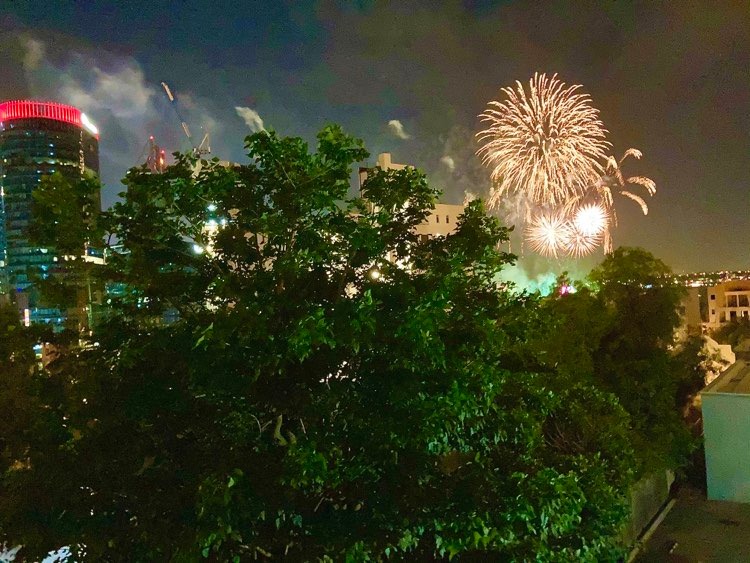
And so we waited. That corner of the horizon, a glowing swirl of orange and yellow would be where the sun rose. The colours were hypnotic to look at, waiting for the first chink of sunlight, the first glimpse of the New Year. My mind wandered. The breeze that blew was cool without being cold. Images entered my mind – just a few hours earlier I had been celebrating the arrival of midnight with friends – the passing of one year to another. It had been a fancy dress party; we all arrived in costume and inevitably in character. We had all shared a meal together, everyone had brought something. We ate as friends, talked as friends and then danced together as the midnight hour approached. There was a balcony and from there we watched fireworks crackle into the night sky above the city. From there you could see the whole of the city – almost touching some of the buildings with their lights, shadow and towering height. Down below we watched people walking alone, in groups, singing, laughing. Taxis and traffic drove along Hay Street and Milligan Street, illuminating the darkness with their headlights on. We celebrated the year that had been and wished each other good luck for the one that was to be.

Image by Karl Powell,  Box 28 (Perth, Australia), 2010

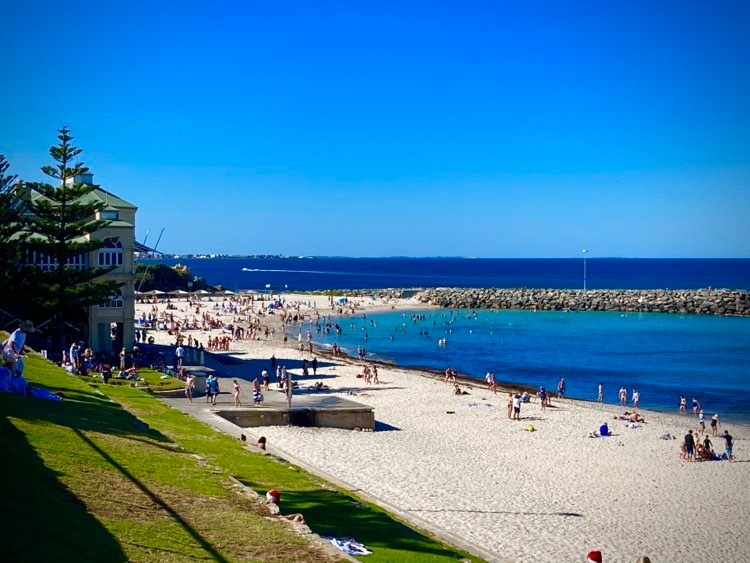
And still we waited in Kings Park. That corner of the horizon, where a glowing swirl of orange and yellow continued to grow. The colours were hypnotic to look at, eyes willing the first chink of sunlight to give us a glimpse of the New Year. My mind wandered again. Just a week ago I was sat on Cottesloe beach celebrating Christmas Day. It was a clear blue sky. Waves had rolled ashore (out of the stillness, out of the quiet ocean). A faint wind blew cool air from the East. The glare of sunlight grew stronger, bouncing off the brilliant sun-bleached sand.

Image by Karl Powell, Cottesloe Christmas (Perth, Australia), 2021

Despite arriving early – early enough that the sun shone behind the Indiana Tea House casting a giant shadow across the sand making it cool – the beach was busy. The sand had been pockmarked with small dunes of footprints – made worse with a small, black dog chasing seagulls that tried to stand there. People in groups, of friends and families, sat together facing the ocean. People were happy. Some drank fruit juice, or poured glasses of champagne, others shared food. There had been an old man, up near the rocks, who had sat alone in a chair, wearing a hat, reading a book; I remembered him because his chair had been positioned so close to the water’s edge that the legs of the chair had sunk deep into the wet sand and the occasional waves that washed over his feet made his toes dance. That day the ocean had been flat – flat from shore to horizon. There had been a swimmer just beyond the reef splashing in strokes between the patches of blue and aqua green. As ever, the shape of Rottnest Island was fixed straight ahead. A large tanker sat further out. No matter how many times you swam in the Indian Ocean blue it always left you feeling so alive and content. Floating in the shallows I looked back at the beach and saw all the people celebrating Christmas together on the sand.

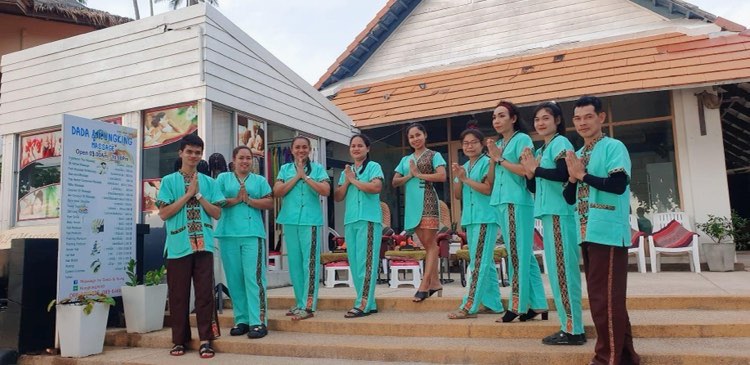
Image by Karl Powell, Christmas Morning North Cott (Perth, Australia), 2021

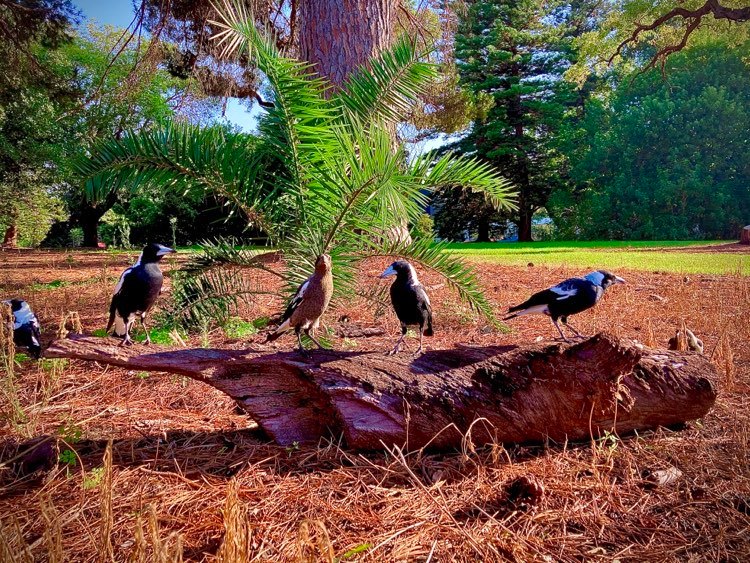
And here I now stand at Kings Park waiting for the sun to rise. I wait with others, facing east, looking out across the Swan River and Heirisson Island. Light is lifting. The entire sky is thawing from the night, turning into a cool blue. The colours of dawn appear in brevities of being, glowing in oranges and pinks before vanishing. More birds begins to sing. A family of magpies walked across the grass at Mt Eliza Ridge looking for food. Just over the Hills and the Darling Ranges yellow light dances and is alive. The sun will rise there. I think about the last time I saw the sun rise. Years ago – maybe ten – I last saw the sun rise here on a New Year’s Day.

Image by Karl Powell, The Magpies (Perth, Australia), 2022

Hints of sunshine glint and coat the side of the city buildings. Only light, not quite sunlight. A lone plane rises up from the land and climbs at an angle. Momentarily it passes in front of the dome of light that sits above the Darling Ranges. The plane turns towards us, aiming to fly overhead, up along the coast, across the Indian Ocean, maybe towards the Middle East or South East Asia. Sunlight touches it smooth body as it moves through the sky. Its engines leave a roar to echo in the empty heavens behind it. The wind continues to blow. Still cool air. Birds chirp and sing. Sky is changing colour. Sky is yellow, is blue, is white. A corona of light is visible. It will emerge there. The sun will rise there.

Image by Karl Powell, Waiting for 2023 (Perth, Australia), 2023

And then sunlight enters the world. The New Year has arrived. As the first arrow of yellow light fires out from beneath the horizon people clap and cheer in spontaneous unison. A bus stops to watch. Happy New Year. At first a small chink of light, a sunshaft, slowly the sun climbs, a sliver, a quarter, a half, and then the full disc of the sun with its full rainbow of glints, squinting blinding light.  A blank canvas. The day begins, the new year stretches out with all its dreams, hopes and promise.

Image by Karl Powell, The New Year (Perth, Australia), 2023

When was the last time you saw the sun rise?

*

31 Christmas in Wales

PART ONE: MOONLESS NIGHT… STARLESS AND BIBLE BLACK
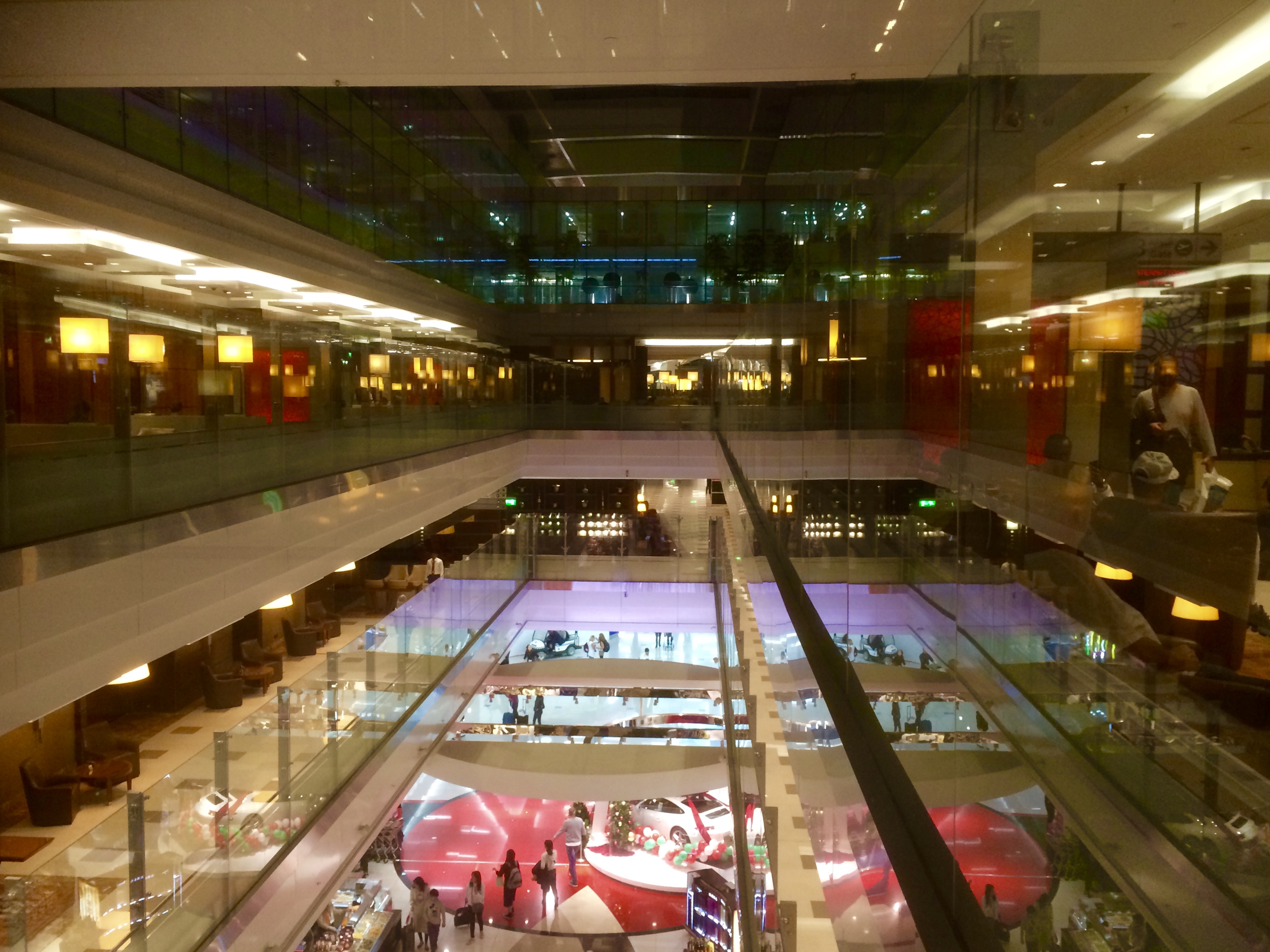
And so begins the long jet lag into darkness. Woke about an hour ago. Still only 2am local time. Wide awake. Everything silent. Everything dark. Everything Christmas. Blurred memories of the past twenty four hours – from airport to here – are distilled. Day began early long ago. Bit of a headache as I entered the airport. Did the check-in. Made my way through customs and immigration. Lots of people about. Felt hungry. Huge queues, overpriced food. Went and waited by my gate for the flight to board. Called in zones. Boarded. Had an aisle seat. Flight full. Quiet. Can’t recall watching much (if anything), just slept. Felt so tired. Looked at upgrade offers. Managed to sleep ok. Changed flights hours later. Half way home. Transit. Airport big so big. Airport easy to navigate. Escalators. Security checks. Walked through Duty Free (last minute Christmas gifts). Made my way over to gate E4. Lounge organised in zones ready to board. Guy sat nearby coughing, coughing, coughing.

Image by Karl Powell, DXB: Transit (Dubai), 2017

Flight home called on time. No delays. Had a window seat. Girl sat next to me and slept most of way. Guy sat next to her and kept his bobble hat on for entire flat. Awake for most of the flight (wish I’d brought a book to read). Runway lit up in darkness as we took off. Could see the lights on buoys and boats floating in the sea.

Flight soon passed. Time went fast. Flew over names of countries. Some parts seemed to take longer than others. Eventually landed. Home. Croeso i Cymru. Familiarity of the airport. Two languages side by side. Nadolig Llawen. Immigration stamped my passport. Home. Red Dragon visible everywhere. Y Ddraig Goch. Words of Dylan Thomas sound in the air:

Image by Karl Powell, Magic Lanterns Above PenyPych (Rhondda), 2017

To begin at the beginning:
It is spring, moonless night in the small town, starless and bible-black, the cobblestones silent and the hunched, courters’-and-rabbits’ wood limping invisible down to the sloeblack, slow, black, crowblack fishingboat-bobbing sea.

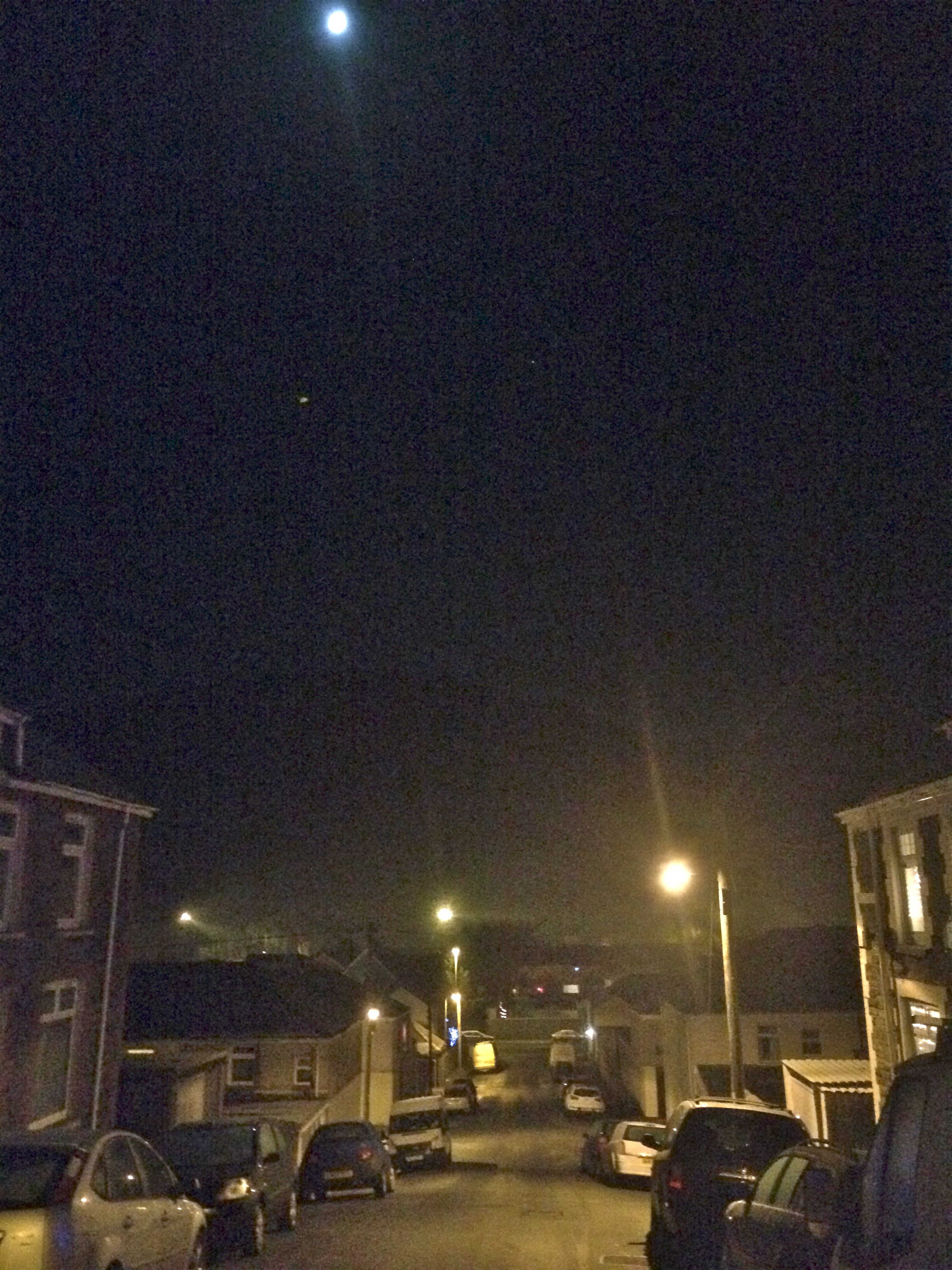
Familiar faces waiting to greet me. Familiar car. Familiar drive home. Familiar shapes and shadows of landscape. Arriving home for Christmas. Outlines of mountains against the night sky – frozen stars cast out across the endless black. Christmas lights shine in the Rhondda darkness below. Orange lights in homes and pubs, people talking, people coming and people going. Radio songs. Dreaming of whisky and open fires. Driving home. Familiar sights. Across the Bwlch mountain road, the lights of Cwmparc down below, the lights of Penrhys on the mountain across the valley, Cwm Saerbren with its back turned facing out instead towards Treherbert, temperatures close to zero. And then roads home that I know with my eyes closed. Body and eyes heavy. Home. Eat around a table. Talk and conversation. Body and eyes heavy. Crashing through the stars and the singing, hymning dreams. Home again. And then sleep.

Image by Karl Powell, Ninian Street (Rhondda), 2016

Wide awake. And so I decided to get up. Crept around the sleeping house. Showered. Ate breakfast. Coffee on the stove. The slow wait. Watching the silence of the blue gas flame dance around the metallic stovetop coffee pot. Waiting. Looking out into the darkness beyond the windows. Nothing else but the darkness of night. Endless night. Silent Night. Christmas Night. The coffee pot gurgles, hisses and steams through the silence. Golden brown aroma fills the chill of the winter kitchen. Slowly pour the coffee into a patterned cup. Steam rises into the dark moving slowly like the Star of Bethlehem. The house is still; the house is silent. The whole world is asleep.

Image by Karl Powell, The Baglan Field (Rhondda), 2015

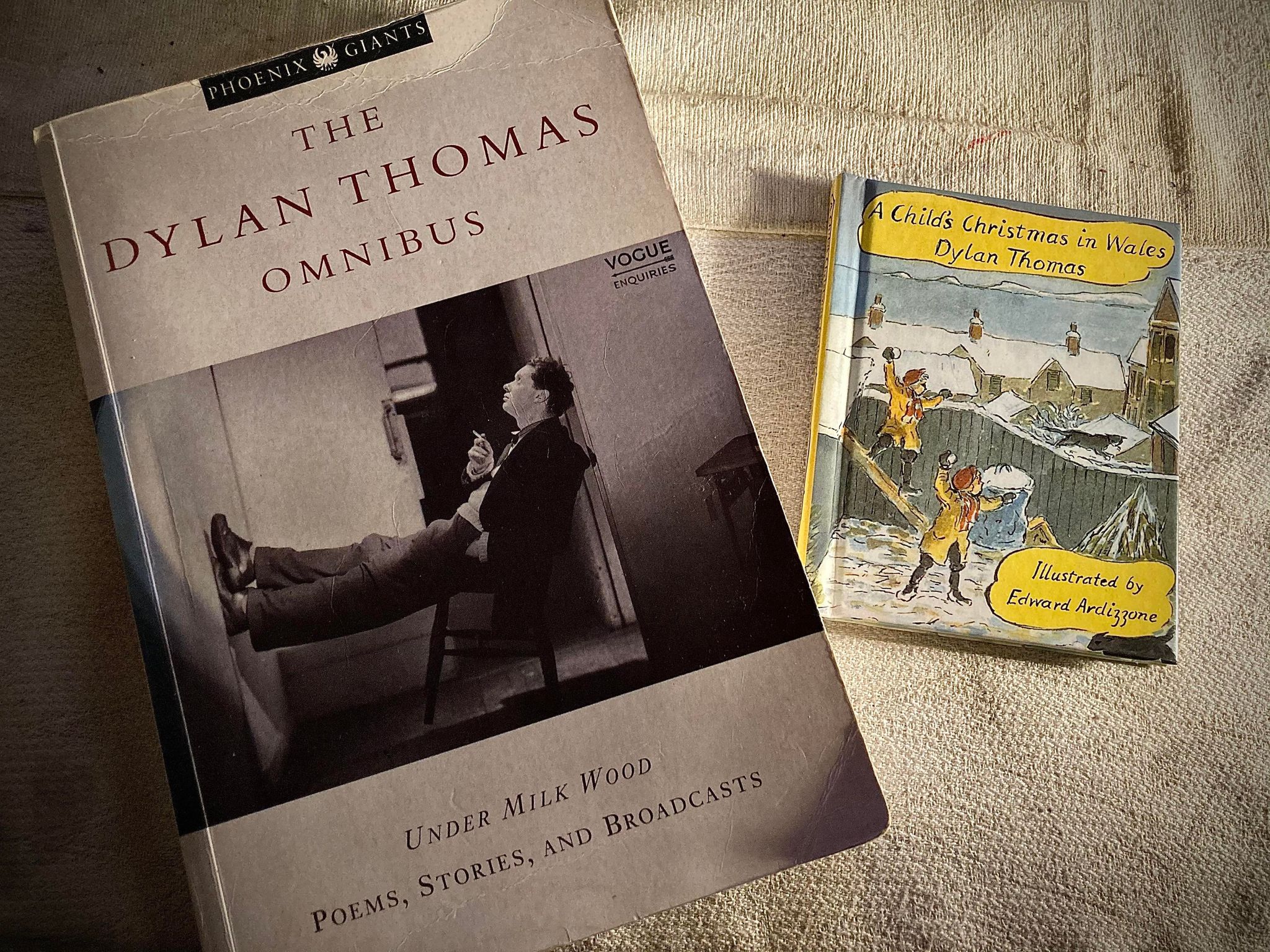
Here at the kitchen table, this table which has seen so many family dinners, Christmas dinners, birthdays, sadness and all the joys you can hope to imagine; here at this kitchen table there exists a stillness which is known only within this family home. And so, with a lighted fire heating the air, coloured lights casting Christmas shadows far and bright, I sit and drink my coffee. It will be hours before daylight comes. There is a book on this table – Dylan Thomas. And so, in this stillness, I sit and drink and read.

PART TWO: A CHILD’S CHRISTMAS IN WALES
The poet Dylan Marlais Thomas was born in Wales in 1914. An output cut short but ultimately prolific and fulfilled – words and verses sung across the rooftops in a brevity of colour, alive in moonlight, carried across the ages, spoken still, captured in celluloid, dancing in the waves along coastal shores and the deeper waters. There were poems. There was a play. There were short stories, too. Despite having Welsh-speaking parents, Thomas wrote only in English (his was a generation of people who had been discouraged from speaking the Celtic language of their parents and so were eventually passed down as ‘Anglo-Welsh’ writers). Despite this, the richness of sounds alive in the Welsh language – and its poetry, such as the chimed consonants which sound within verse known as cynghanedd – finds itself present in much of the prose and craft of Thomas. This mesmerical use of vocabulary (once described as a wrongness sounding right), plays a creative reinvention of the English dialect and conveys the sounds of an older language through it and on to a non-Welsh speaking audience.

Image by Karl Powell, Treherbert from Cwm Saerbren (Rhondda), 2017

Dylan Thomas wrote ‘A Child’s Christmas in Wales’ in 1945. The story draws on a flashback of an imagined childhood of the poet, borrowing from nostalgic memories of Christmas and his upbringing in South Wales. The story also highlights the way that Christmas can draw us home – physically or in our imaginations and memories; how it remains a tangible link to the embers of childhood and the blur of memories collected there from a time we can no longer access.

Image by Karl Powell, Dylan Thomas (Perth), 2023

It belongs to his collection of short stories, although originally appeared as a BBC radio broadcast a couple of years earlier; its title, then, ‘Reminisces of Childhood.’ As with all bodies of work, the draft keeps evolving – wants to improve – but at some stage you must let go. The myth of Icarus speaks to us of the dangers of flying ever upwards towards the Sun – the quest for high ambition. And if you hold on to a vision for too long, striving to create an unparalleled perfection, an awful realisation awaits you in that it has consumed every aspect of your life. As with all bodies of work, you must let go eventually in order for them (and you) to belong in the world. And so, amalgamating other talks, broadcasts and drafts, ‘A Child’s Christmas in Wales’ was published in Harper’s Bazaar in 1950 (before a final version was recorded commercially by RCA in New York in 1952).

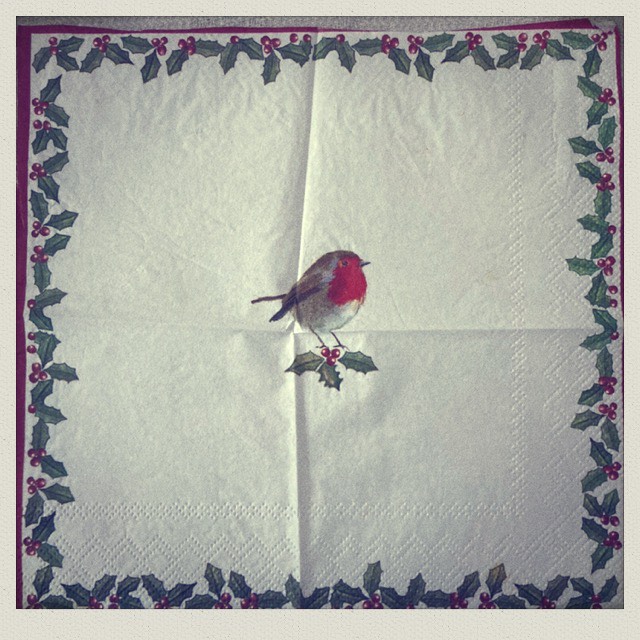
Image by Karl Powell, The Robin (Perth), 2023

It was this final version that helped establish the popularity and admiration of Thomas as a poet and a writer following his death in New York the following year.

Image by Karl Powell, Sunrise, Boxing Day (Rhondda), 2013

PART THREE: SAINT STEPHEN’S DAY – GŴYL SAN STEFFAN
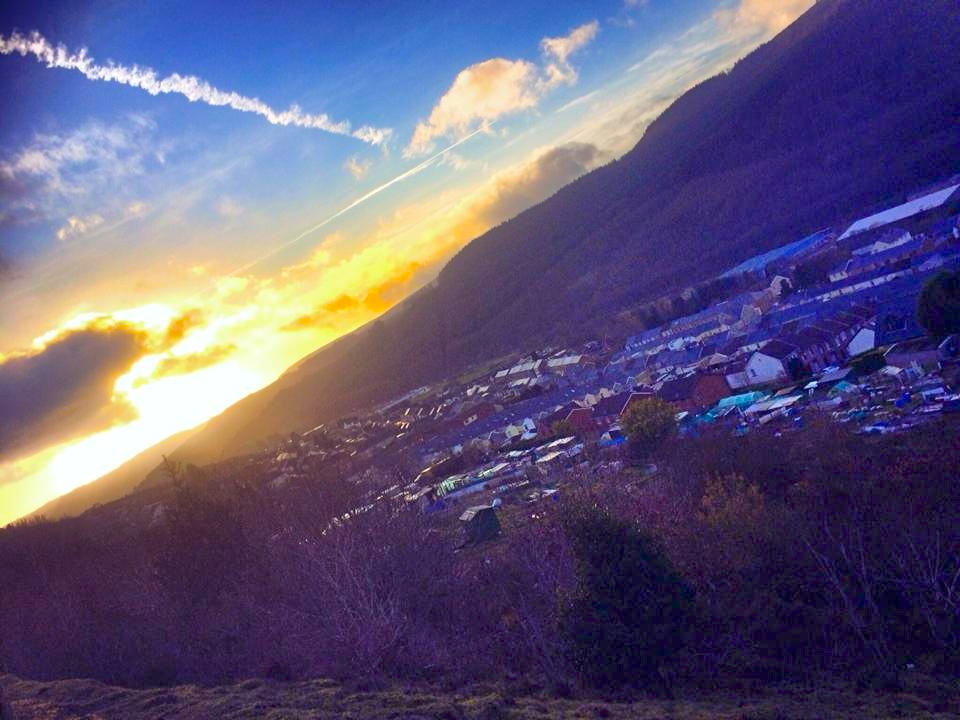
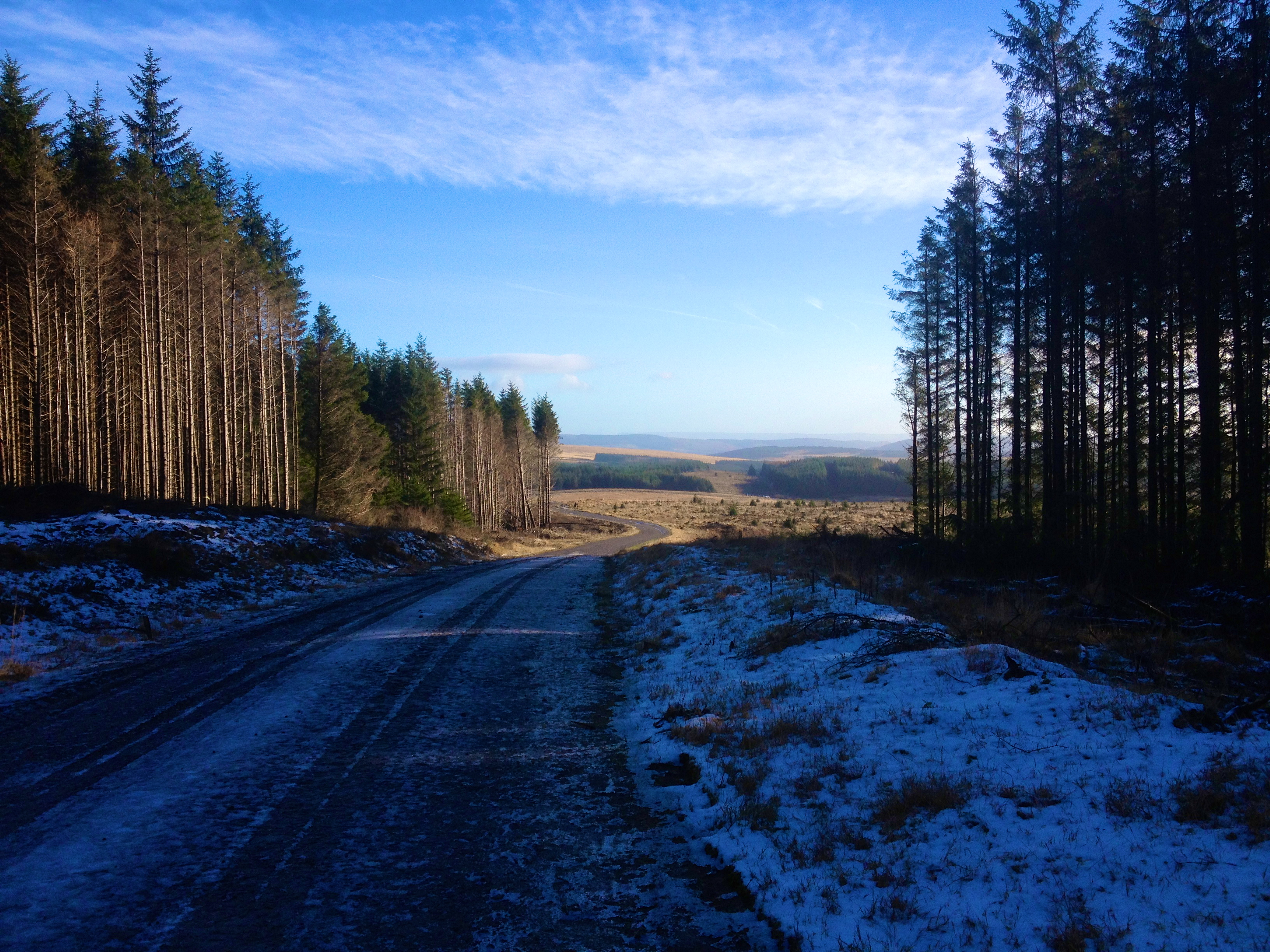
The sun is rising. From the vantage point of the horse-shoe bend up on the Rhigos mountain road I look down the Rhondda Valley and see the low-angled sunlight pierce through the freezing fog that clings to the landscape. Morning has broken. The sky is clear – its veil of night has now gone. A thin, crescent moon shines bright with Venus (both visible in the Eastern sky). The first light appeared at about a half-past seven. Slowly, darkness began to lift. Outside in familiar streets, frost sparkled. Coated on blades of grass, tarmacked roads, frozen stones, frost sparkles now. Everything is painted cold.

Image by Karl Powell, Station Street & Cwm Saerbren (Rhondda), 2013

Vapour trails from passing planes catch the streaks of yellow sunshine high in the blue winter sky, turning white in amongst the Christmas reds and rose of the morning chill, and hang suspended there in the glacial heights. Everything is so quiet. My eyes move along the valley, across the shivering homes and the trees without leaves. There are allotments empty and frozen on the mountainsides. There are horses roaming there and billowing great clouds of heat into the air from their nostrils. I watch a train pull in from Cardiff; sunlight blinking in reflections against the windows as it moves along the Baglan Field towards the station and the end of the line. From here I can see all the landmarks of home: the tall, clock tower of the old Ninian-Stuart Con Club in Station Street, the giant monkey tree now standing over the Marquis of Bute Hotel, roads and streets criss crossing as they always have, smoke rising from the Nag’s Head as it sits in the lap of the majestic Cwm Saerbren basin. And then in the silence of Christmas I realise that everyone I have ever known and loved has once lived there, down there, was from there, was once there.

Image by Karl Powell, Rhigos (Rhondda), 2013

The holy silence is complimented by the song of the robin. It is the robin’s winter song. This sacred bird sings so clear from the woods of the Rhigos mountainside behind me, and the song carries out across the valley bringing familiarity and meaning to the cold, Christmas morning. And then the words of Dylan Thomas reappear again. There’s a wonderful line that appears in  ‘A Child’s Christmas in Wales’ – right at the end – where the child narrator leaves the adventures of the December snow and the cold and returns back into the warmth of his family home: Everything was good again, and Christmas shone through all the familiar town. And here is home and everything is good, and Christmas shines on throughout all of Treherbert.

Image by Karl Powell, Christmas (Rhondda), 2014

*

30 Christmas in London

Image by Karl Powell, December (London), 2010

There were many ways in which to enjoy London during those December weekends before Christmas. Of course there were parties and friends to see; the calendar was as full then as it seems to be now. People always wanted to celebrate and share happiness together; in the bleak mid-winters of northern Europe Christmas punctured through the advent of long, cold hours of darkness with tinsel, coloured lights and wrapping paper. Days were busy. Yet London was one of those big cities in which you could just walk into, dissolve into a crowd and enjoy anonymity. It afforded you the opportunity to take some time out of life and to just be, to flow and wander, and become part of a city’s metropolis of passengers. Black cabs and red buses, riding tubes beneath city streets on the London Underground, changing lines heading north, heading south. These were some of my happiest days of my life – over thirty years ago – chasing dreams in a big city. It was one of those times when money never seemed an issue because the focus always seemed on adventure. Everyone I knew then was also following dreams, their vocations and callings – we all lived for our passions and were very happy. London was the type of city that was able to inspire with its spirit; you always knew that you were standing in one of the great epicentres of the world and that life was taking place around you. Wherever you were in London, you knew that you were a part of it and somehow belonged to a greater dance taking place.

Image by Karl Powell, Barons Court Westbound (London), 1994

I had moved to London to write and had done so when I was nineteen. It was a wonderful time in which to have written and to have been a writer. I learnt a lot and read a lot. The streets in which you walked were laced with stories waiting to be discovered. There were poems on the Underground. Theatres could be found in the basements of pubs at the end of your road. And in my street I spent many happy hours leaning out of a top floor window people-watching passing footsteps coming and going on the pavement beneath the trees below. Occasionally I would write down what I saw, what was happening; creating snatched impressions from the street scenes below my window. Most of what I wrote during that time has now been lost, however, some scribbles, memories and photographs remain (but not enough).

Image by Karl Powell, London W14 (London), 2006

One weekend in December remains vivid in my memory whenever I think of London and Christmas. It was to be my last Christmas spent living there. At the time I had no way of knowing it; I had been too engrossed living in the moments of each day and in being content. I had arranged to meet some friends in Camden Markets on a Sunday afternoon – the last weekend before Christmas. We wanted to buy some presents for our families and Camden Markets was one of the best places to visit on a weekend. It was one of those spots in North London where you could actively shop for something you needed or passively wander alongside the shoppers who searched for their hidden treasures. Either pursuit yielded its own reward.

Image by Karl Powell, Window Vereker Road, W14 (London), 2007

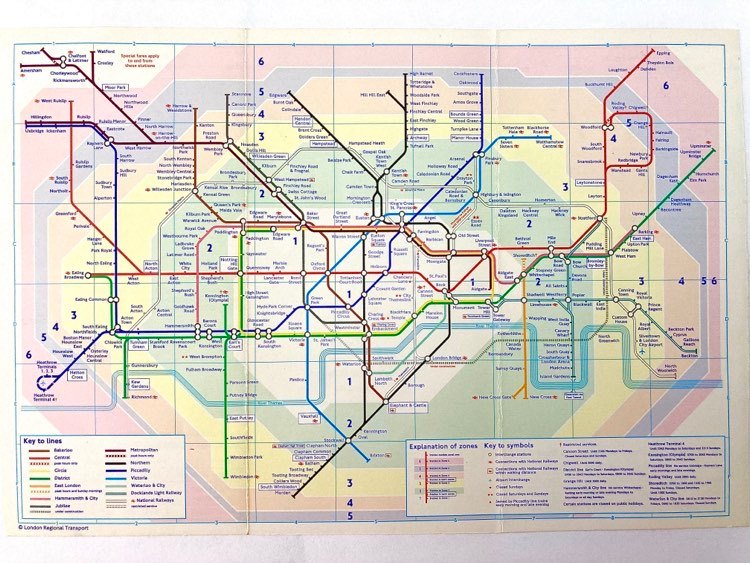
My friends and I, at that time, all lived in West London and were on the District Line of the Underground. We all worked together on the Kings Road in Chelsea. We had arranged to meet at Earls Court station around midday on a Sunday before Christmas. Earls Court was a kind of junction where the three branches of the District line – Ealing Broadway, Wimbledon and Richmond – each converged before moving east across the capital. From there we could travel on towards the Embankment station (where one of Cleopatra’s obelisks stood on the banks of the River Thames), and change tubes onto the Northern Line which ran upwards, north, towards Camden.

Image by Karl Powell, Going Underground (London), 1995

To get to the markets, which were immediately outside the tube station, you had to alight at the internal platform and look for the long, ascending escalators out of the underground and onto Camden High Street. The Northern Line could be busy, congested. People gently pushing, moving slowly, carried in a crowd upwards and out. On this day, at the foot of the escalators, a lone violinist was busking and played ‘White Christmas.’ The melody echoed around us as we moved past him, the sound reverberating in the silent tube tunnels behind as we exited out into the cold. And out into the cold there were market stalls selling clothes, books, jewellery, leatherwear. The air was scented with incense, tobacco and perfumed with chestnuts and almonds being roasted on brazier grills along the roads. People handed out flyers for various things; Big Issue sellers sold their magazines. There were also places to eat. My friends and I found an outdoor place somewhere near Camden Lock – the part of Camden Town where the Regent’s Canal ran through it. I can remember that we found an outdoor restaurant and took turns placing orders at a wooden kiosk while one person held the table. There were three of us and we ate together there. I cannot recall what we spoke about or what we ordered to eat. I can’t even remember where we went afterwards, or what we did but we were happy and live jazz had played that afternoon in the cold. We sat in Camden at Christmastime – around the corner from Bayham Street (the home of Bob Cratchit – the clerk of Ebeneezer Scrooge in Charles Dickens’ novella, A Christmas Carol).

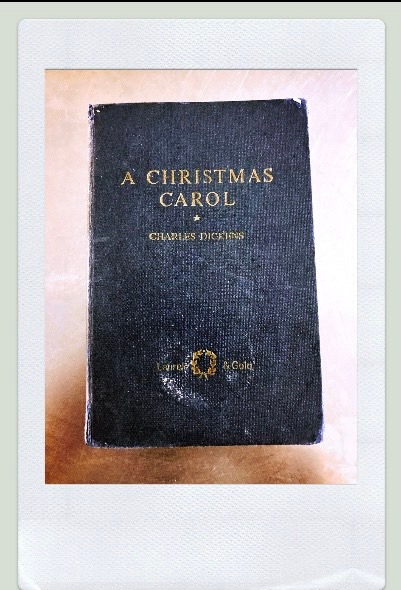
Image by Karl Powell, A Christmas Carol (London), 2013

And when the day had almost ended we made our way back to the tube station, back to West London. In December, the light fades early – the Winter Solstice being on the 21st – and with that the sun dips quite suddenly across the horizon before burning bright yellowed sunshine into the clear skies and frosted cirrus clouds. I know we were keen to leave Camden before the markets closed at five o’clock, so as to avoid a packed Northern Line back into the City. I had bought only one item – a wooden display case with dried flowers, fruit peels and cloves. It was handmade and produced a beautiful fragrance that smelled as warm in the way that mulled wine can in the winter chill. There had been a stall of them being made. I had bought one for my mother, and my friends had bought one each for theirs.

Image by Karl Powell, Underground Map (London), 2007

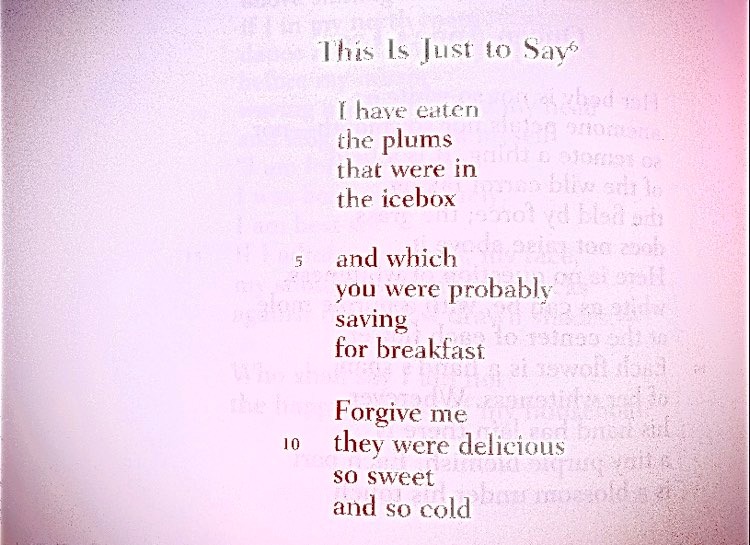
The Northern Line was busy. We squashed ourselves in to the tube, leaning against the crowd as it moved into the tube. Stood clear of the doors. Mind the gap. Doors closed. And the tube moved underground, beneath London. There had been a poem on the carriage that I had seen on my way to Earls Court that morning, and it appeared on that train again. Poems on the Underground had been an attempt to bring poetry to a wider audience of people as they used the tube system by including poems (classical and contemporary) among the advertisements on London Underground. There in the rocking carriage I read, “This is Just to Say” by William Carlos Williams:

I have eaten
the plums
that were in
the icebox

and which
you were probably
saving
for breakfast

Forgive me
they were delicious
so sweet
and so cold

Image by Karl Powell, Poems on the Underground (London), 2007

At Leicester Square we decided to get off the Northern Line with the intention of catching the Piccadilly Line down to Earls Court. But as it was still early we walked over to Trafalgar Square. Each Sunday at early evening a brass band had been playing Christmas carols near the large Norwegian Pine Tree (gifted by Norway each Christmas since the end of the Second World War). It was only a short walk there from the tube station, and as there was still time we entered the National Gallery for the last fifteen minutes of its day. We walked into the Modern art section – which had been on the right hand side of the steps leading from Trafalgar Square. There we looked at the paintings and sculptures of Pablo Picasso, the sunflowers of Vincent van Gogh and a painting by Camille Pissarro that had always fascinated me for no real rhyme or reason ever since I first saw it: The Cotes des Boeufs at L’Hermitage (1877). As we left the Gallery, their gift shop was also closing; they were playing Van Morrison’s song Glad Tidings as we walked down the entrance steps and out into Trafalgar Square. It was now dark, and very cold. Traffic and headlights circled around the square. Moving coloured lights. We made our way down towards the Christmas Tree where a crowd of people had stood. We sat at the feet of one of the giant lion statues and listened to the brass band as they played carols. I remember that we all spoke about our childhoods, about where we had each of us had grown up and how Christmas always seemed a tangible link to the past (a world of blurred memories and feelings). And the brass band played and a choir sang and the black cabs and red double decker buses kept moving. And everything felt right. It felt like Christmas.

Image by Karl Powell, Troubadour Coffee House (London), 2007

At Earls Court Station I said my goodbyes to my friends. We wished each other a Merry Christmas. They caught the line down to Putney and Wimbledon. I had to wait for the Richmond or Ealing Broadway route back to Barons Court. As their tube departed, I stood on the platform and waited for a while. But then something in me made me want to walk home instead. It wasn’t far. Maybe twenty minutes: out of the tube, turn right along Earls Court Road, turn right again and walk down the Old Brompton Road until it hit the North End Road in West Kensington and then home. About half way down I passed the Troubadour Café. As always, lights were on, tables were free, and it was just one of those places that you could go to and sit and eat or drink or sit and read or write. I usually went a couple of times each week at night. I’m sure I ordered something hot to drink that evening – maybe a coffee – and took a seat in one of the small booths beneath the rows of ceramic coffee pots that hung from the ceiling. Music always played in the Troubadour, and had always been part of its being. In the cellar where they held poetry nights and amateur plays, it was rumoured that during the 1960s Bob Dylan, Jimi Hendrix and the Rolling Stones had played there. Most evenings when I had gone there, classical music would sound until about ten o’clock, then the jazz would play. In the summer, with the front door wide open and the trees full of leaves, the jazz sounded amazing; it sounded right. This particular December night as I entered the café, they had been playing Camille Saint-Saens’ The Carnival of the Animals (Le Carnaval des Animaux, 1886). It sounded a good choice of music to reflect the cold outside. Frosted fairy lights twinkled coloured pinpricks of Christmas in the dark, and danced on the inside of the windows.

Image by Karl Powell, Light of the Troubadour Cafe (London), 2007

I stayed for the duration of the drink. The waitress wished me a Happy Christmas as I put on my coat to leave. The last song I had heard that night was Saint-Saens’ Aquarium movement. Out in the dark of the sky, with the brightness of the stars, frozen and transformed into shining glints of ice, it suddenly began to snow. Just a flurry. Snowflakes that fell for a few minutes. It was one of the most beautiful things I had ever seen in London. It had snowed, and it had snowed at Christmas. And all this had happened just a short distance from the Troubadour, outside the entrance to West Brompton cemetery. I stood still watching the snowflakes fall from the blackness above until a flash of colour appeared at my feet – the small, orange face of a fox emerged from between the railings of the cemetery gates. The fox looked up at me. Time stood still. I tried to stand as motionless as I could not to scare the animal or to ruin the moment. Snowflakes kept falling. Snowflakes fell from the dark sky. One landed on its black nose. And then it turned and darted off into the darkness. And with that I kept walking towards the North End Road. Walking in the cold of December.

Image by Karl Powell, Book from Camden Markets (London), 2022

That weekend in December remains so vivid in my memory whenever I think of London and Christmas. Maybe because it was to be my last Christmas spent living there. At the time I had no way of knowing that; I had been so engrossed in living in the moments of each day and feeling content. At that time of my life I never thought I would leave London – I had been very happy there and it felt a very special place in which to write. But adventures have a habit of taking you towards other paths, along other outcomes, far from home, and these are the roads we now tread. And while the past can ache with an emotion of a time now gone, with people no longer at our side, the feelings like all opportunities always remain present in our hearts. One of the great epiphanies of Ebenezer Scrooge was such a realisation when alone with the Ghost of Christmas Present, that all aspects of time need to be embraced in order to honour our lives: “I will honour Christmas in my heart, and try to keep it all the year. I will live in the past, the present, and the future.”

Image by Karl Powell, Christmas Present (Australia), 2022

*

29 Sunset: AoNang Beach

Image by Kungking, Sunset (Ao Nang), 2022

The day is ending and there are long-tail boats returning from Railay Beach. Despite the building presence of cloud cover folding over on itself along the horizon at Nopporat Thara, the setting sun should be visible through it soon. Already colours are changing in the sky. Long white streaks of high, cirrus cloud are tinted with orange and pink. As the Andaman Sea reaches the shores, these incoming boats switch off their engines and use momentum to glide into the tidal shallows, dropping anchor into the sands of AoNang. Passengers climb overboard and wade in ankle deep waters up onto the beach, moving up towards a concrete ramp outside the bright blue Ticket Office (where boat rides can be bought). The Ticket Office sits on the corner of AoNang Beach Road and a small, narrow Soi which branches off and runs along the sea front down towards the end of the beach (where the mountain meets the sea).

Image by KungKing, BF Massage Team (Ao Nang), 2022

Along this Soi – between the Ticket Office and just before the AoNang Villa Resort  KungKing and her massage team rest on small chairs outside their shop: Dada & KungKing BF Massage. There is a short lull in business, a pause in their day. The staff take this moment to rest. They sit and watch the sunset together. The sun pours out from a crack in the cloud cover. In an instant, honeyed sunshine fills this part of the world. Selfies and cameras instantly appear all over the beach. Those on the sand all become a part of this brevity of being; each person belonging to the colours and backgrounds as they begin to appear in the photographs of others.

Image by Karl Powell, At the Day’s End (Ao Nang), 2022

The staff take this moment to rest. They sit together outside their shop, talking, exchanging conversation, looking at the beach. Each member is highly visible by their jade and teal coloured uniforms, which shines in a contrast of colour to the setting light of the sun. Most of the staff finished work here at ten o’clock last night; some were in at a half-past seven this morning: cleaning, sweeping, preparing for the day (there are no days off). Suddenly along the Soi arrives a novelty: a blue tuktuk selling ice-cream. In unison, the staff all jump up off their chairs and stop the ice-cream seller – an elderly man who struggles to keep up with their orders. Jade green teal swarms around the blue vehicle, money exchanges for ice creams and smiles as the orange light of dusk sets across wet sand. And the sunlight seems to shine brighter for this moment.

Image by Karl Powell, Ice Cream (Ao Nang), 2022

Like many people in AoNang, everyone is aware that high season is approaching. All are hoping that the tourists will return. It has been a long two years for everyone and many stories exist concerning survival and hardship during the pandemic and its lockdowns.

Image by Karl Powell, Welcome to Ao Nang Villa (Ao Nang), 2022

One of the reasons I began writing the Siesta del Somewhere series was as a creative response to the pandemic. With travel restrictions imposed, I began to go through journals kept over the past twenty years of travelling and enjoyed re-visiting places, moments and observations long-forgotten but written down in ink. The decision to share these, along with photographs taken on the journeys, was an attempt to offer a distraction from the saturated coverage and anxiety of the pandemic. It was hoped that the ‘postcards’ uploaded would offer some kind of reminder that ‘normality’ could and did exist in the worst of times. One of the promises I made to myself was not to mention the pandemic in this series – something I managed up until now. But the purpose of writing, along with the purpose of travel, is elusive to define; sharing one’s experiences is only one aspect – telling the stories of others is equally as important.

Image by Karl Powell, Ton Ma Yom Restaurant (Ao Nang), 2022

The pandemic has changed this corner of the earth. Many people have been displaced – having to move elsewhere looking for work (to rural areas, to the cities, or back home with families). Many people had to leave what lives, friends, communities they belonged to in order to take care of themselves and their loved ones. A small roadside bar further down the Soi (just before the Centara Hotel) sells smoothies, roti pancakes and meals. The owners told me that they had no customers for two years. Without tourists there was, of course, no income. No income for two years. Many businesses, so reliant on tourism, disappeared. Stories are told of local restaurants providing free meals to those who lost their incomes during this period.

Image by Karl Powell, Beach Bar Sunset (Ao Nang), 2022

A little further along the Soi is the Beach Bar of the AoNang Villa Resort. It is happy hour and there is a good mix of people milling about and sharing the sunset. Guests sit and face out onto the Andaman Sea and Poda Island. The sun makes a final reprise – long rays stretch one last time across the beach. Down on the sand a mixed soccer match takes place. The pitch is unmarked on the receded shore line as the incoming tide or coming darkness will soon stop play. Colours of sunset are changing again; deepening and bruising, burning with the embers of intensity. A warm wind blows in off the shore. Bar managers and hotel managers are chatting with each other. People shift seats to photograph the sun and its colours – one last attempt to catch this beauty before it disappears into the night.

Image by Karl Powell, Mai Tai (Ao Nang), 2022

Casual customers wander up off the beach, past the large swings hanging from giant trees, and join the remains of the day. The bar is open to all. Some order food, some order drinks. Wait staff are working behind the bar, a red Mai Tai cocktail is being served in a poco grange glass (earlier this afternoon the food and beverage staff were having fun learning to make new cocktails in preparation for the high season). A woman is finally joined by her husband who has had a final fitting at De Marco’s Fashions just behind the bar. He is happy with his shirts, so very happy, and shows them to her (pointing towards the tailor’s shop).

Image by Karl Powell, AoNang Villa Cocktail Makers (Ao Nang), 2022

Slowly, slowly, tourism is returning. Even for more established businesses such as the Ao Nang Villa Resort (one of the first hotels in this area in 1989), the pandemic affected lives, friendships and business here. Rather than returning to normal, life has learnt to move on and adapt for now. Through the haze over the ocean, through the lost sunlight, another longtail boat cuts its engine and glides into the shallows at Ao Nang.

Image by Karl Powell, De Marco Fashion (Ao Nang), 2022

The sun has now set. Light is fading. Banks of cloud are stacked up on the horizon over at Nopporat Thara. Hanging lanterns blink into life with pin prick of greens, oranges and yellow illuminating a haze of colour around light bulbs strung within the dark branches of the palm and almond trees. The outlines of the islands along the horizon seem to grow in stature, embolden, standing taller in the dusk. The ocean changes colour with a milk-jade sheen washing through its surface as a shower of light rain falls. The air is moving but feels thick and humid. Mosquitos buzz about. Stray cats weave through the shadows. Darkness comes and it is time to eat.

Image by Karl Powell, Jeseao, AoNang Beach Road (Ao Nang), 2022

Many bars and restaurants also have their stories to tell from the past few years. The Fisherman’s Bar survives and, for now, is the last stop along this Soi which faces out onto the Sea. Should you wander further along, towards the Monkey Trail and the small Buddhist shrine where the river meets the ocean, now only abandoned and disused buildings stand empty. There was once a large community of around fifteen massage huts there – all open air, thatched roofs, standing on sand, facing out onto the Andaman Sea. It was a destination in itself for many returning tourists who established friendships and community with those who worked here. Currently, only two huts are still standing and in operation (the rest were cleared); KungKing was one of the fortunate ones who had the luck to find new premises.

Image by Karl Powell, Boogie Bar (Ao Nang), 2022

So many places had to adapt, so many disappeared, a few relocated and can be found elsewhere. As the Ao Nang Beach Road moves up away from the ocean, away from the bright blue Ticket Office and away from this Soi, it heads towards the Ao Nang Mosque and eventually on to Krabi Town. Along this road, new places can be found alongside the old: Jeseao, Boogie Bar, Thai Me Up, Thanya Kitchen, Lobster Restaurant, Ton Ma Yom. These, of course, are only a few of the many businesses here in Ao Nang – all have their stories to tell. All are waiting for the high season.

Image by Thanya Kitchen, Thanya Kitchen Restaurant (Ao Nang), 2022

The wind has started blowing and it sounds like rain on the roof of the Fisherman’s Bar. Night has now come. Sounds move all around me – different languages flowing in conversations. Bells bing for service. Soft jazz and bossanova play in the background. I sit up on one of the high bars, which looks out into the darkness covering the beach. I can hear the ocean; I can taste it on the wind.

Image by Karl Powell, The Last Fisherman’s Bar (Ao Nang), 2022

What a place this would be to come to write in the evenings, to sit here at the day’s end, to talk with strangers, to try to capture these moments forever in ink (and hope someone else reads them on another day). As travellers all we can do is to follow the beaten tracks of others and then explore our own. Whatever stories we discover they are never ours to keep; they encounter us in the hope they will be told again to others. The ocean is the perfect place in which to find dreamers and storytellers. Yellow light falls down on this blank page.

Image by Karl Powell, At Night (Ao Nang), 2022

*

27 Sevilla – Summer Solstice (España)

PART ONE: EL ARENAL

Image by Karl Powell, Seville (Sevilla), 2007

The heat from the Summer Solstice burns everything with white heat. Streets radiate with the midday sun – the midsummer’s sun – the Andalucían sun. Everything about being in Seville today feels that bit closer to the sun. The heat. The light. The glare. Palm trees rise to Heaven open armed with their long, rolled brevas cigar tree trunks toasted to black cinder. Sunshine bright and burning, glaring and dazzling; overhead, shadows shift beneath your feet. The day had started early, walking, wandering, looking, trying to explore what could be found before the bite of the day became too great. The Catedral and Real Alcázar were both within walking distance of the hotel; I managed the first and thought to see the latter after lunch. The morning had been crystalline with sunshine, even scented with the perfume from orange groves and bushes of rosemary. Doves sung within the protection of box hedge trees, near the play of water falling from fountains, which spouted out into octangular bases. Backstreets leant hard against the shadows, crisscrossing different times and ages; routes wandered past the small, orange house of Diego Velázquez, gave glimpses of the Torre del Oro (where once it shone with gold across the waters of the Rio Guadalquivir), and echoed the songs of Bizet’s ‘Carmen’ as she stands still outside the Real Fabrica de Tabacos. And in savouring the shadows, you learn to love Seville so deeply, enriching your own dreams and wishes in this waking life. In the words of Wallace Stevens, “…the day is like wide water, without sound, stilled for the passing of dreaming feet.”

Image by Karl Powell, Catedral y Rio Guadalquivir (Sevilla), 2007

Inside a bodega, a few moments before midday, a camarero chimes white china plates and saucers into stacks at the end of a long, wooden bar. Locals start to arrive and queue. Holas reverberate. A man sits reading a newspaper and smoking a cigarette. Legs of jamon hang from the ceiling. Orders sound, spoons rattle and coffee begins to grind. An old woman is served first. She stands at the bar carrying a small, red leather bag. The camarero asks what she would like:

Senora, qué quiere?
– Dame un whisky.
– Uno simple o doble?
– Simple. Gracias.

He turns and reaches for a large, green bottle of J&B on a shelf (its yellow label stands out, as do the large red letters). He pours her the single shot she ordered and asks if she wants ice:

– Con hielo?
– Sin hielo.

She pays and takes her glass of whisky to an empty table and sits alone. A pot bellied man, maybe in his fifties or sixties, smartly dressed next approaches the bar and asks for coin change. The thin belt around his waist is tight. He needs change for the slot machine against the wall. I watch him play for a while but he wins nothing. The coins go in, lights flash, the wheels spin and stop, but nothing happens. No jackpot. Only the silence of the bar signals another lost round. In the narrow, curved calles beyond an open window, swifts and swallows chirp – flitting in and out of the small, green Judas trees which stand baring their heart-shaped leaves to the searing light. Seville continues to bake.

Image by Karl Powell, Plaza de Toros (Sevilla), 2007

Here I sit, finishing a coffee and considering a wine. The raise of temperature makes perspiration prick through my skin. Am getting hungry, too. The camarero has stopped making café solos and begins slicing cured pork and ham for those who have ordered food. I read through the menu and my limitations with the Spanish language gives way to the desire to eat (some attempt to speak castellano seems to go a long way and smiles can easily be shared wherever the gaps appear). Without prompting, almost anticipating, the camarero comes to take my order, and in a busy bar I labour in language and point to what I’d like to eat from the menu:

Senor, qué quiere?
– Quiero anchoas, pan y otro jamon serrano.
– Y algo más?
– Si, quiero un vaso de vino blanco, por favor.

Soon, a small carafe of white wine was placed in front of me along with an empty glass. Condensation immediately began to cloud and ran like raindrops down the curved body of the glassware. Three small, square dishes then appeared in no particular order: thin shavings of soft, translucent ham, slices of bread and four, fat fillets of plump anchovy (ruby red in freshness and mirrored the length and breadth of my cutlery). These have to be the most delicious anchovies I have ever eaten –garlic and vinegar coat them all. The serrano ham is so sweet to eat. Oil drips from my fingers onto the table. Almost half past twelve now. And all is good. All is good.

Image by Karl Powell, Calles de Sevilla (Sevilla), 2007

PART TWO: BARRIO DE SANTA CRUZ
At seven o’clock the bells of Santa Catalina strike. The sun is still high in a cloudless sky. From the rooftop of my hotel most of Seville can be seen. From here, landmarks rise up above the buildings. The Giralda stands tallest (some eight centuries old and counting). Eyes dance along the city. Searching for the pathways taken this morning. Streets look different now. Can no longer see the river. Can barely see the shapes and contours of Triana (let alone hear its deep song of flamenco). Over in the Plaza de Toros, the yellow sand continues to burn. A giant palm tree pokes up over the rooftops. It must be tall as it’s the only one I can see. The trunk rises up to a golden knot. From there, around fifty or so palm leaves sprout. Green fingers wriggle in the air.

Image by Karl Powell, Summer Solstice (Sevilla), 2007

The bells have just finished singing from the Iglesia de la Anunciación. Their echoes fade around the streets of Seville. Even though it’s seven o’clock, it is still hot. The sun is strong. The levanter breeze that came in yesterday has all but evaporated. Nowhere to be seen. Up here on the rooftops the heat is sticky. Thousands of spires reach up to Heaven. White, flat buildings reflect the heat. Birds twitter still. Flies annoy. A dog barks. To quote from the verses of Wallace Stevens, “…what is divinity if it can come only in silent shadows and in dreams?”

Found my way up here yesterday and wanted to come back tonight – just to sit and write and watch the sun set over the Summer Solstice. Came prepared. Went to a shop a few doors down. Practised the language and bought some good things to eat: bread, octopus, cheese, olives, anchovies and a carafe of red wine. The oil on my fingers makes it difficult to hold this pen. There’s a few other people up on the roof tonight. A woman from Argentina came over and asked me what I was writing:

– Que estas escribiendo?
– Solo la puesta de sol.
– Puedo leerlo?

She took my book. She took my pen and wrote her name along with her room number and walked off saying nothing more. My head still spins from the afternoon at the Alcázares Reales. Quite the experience walking through things never seen before. The geometry of Moorish tiles and patterns stimulated imagination, intoxication and dislocated rational thought. The cool, standing stones in archways and soft marble carvings left impressions that began to change something within. I wanted to follow but remain here, determined to write down my dreams and draw a clear path of where I want this life to go. Impossible to know the direction, but the concealed labyrinths of the soul could only close in to show that a path was there. Belief was the way.

Image by Karl Powell, Real Alcazar (Sevilla), 2007

Down below in the cool of the shade, the day is all but over. The streets look tired and world weary in the way that life can sometimes feel after a dynasty of adventures. Bells that rang and peeled moments earlier only seem to drift down there now. Floating, falling, sinking down to the darkness. Loud. Soft. Tumbled echoes. A couple sit beside each other on a small wall outside the hotel. She is dark-haired, voluptuous; he is dark-haired, skinny. Both wear white shirts, open collared, matching black skirt and trousers. They share a cigarette together and smile in their own private Seville. The clouds of smoke that they create rise slowly upwards, lingering here and there, before dissolving forever on the journey. Doves coo and swallows continue to dart and dive into the vacant spaces above their heads. Rooftops and squares. Dark rectangular windows hiding inside white buildings. Oil drips from my fingers. Endless blue above.

Image by Karl Powell, Vino (Sevilla), 2007

PART THREE: EL CENTRO
The sun set about an hour ago and the sky has sunk into a deep, violet fog. It is dark. Church bells clang into each other, sounding solitary markers for a half past ten. And at last the city of Seville is winding down. The place to be – as always – is seated outside, tucked up into a narrow street, heart beating, close enough to where the shadows and voices echo ever-upwards into the starlit skies. That tight, blank canvas of touchstone dreams – that stretched, black fabric where you know you and I will one day return. Underneath those twinkling inscriptions, tables are pulled together, people feast from small white dishes, share bread rolls, refill glasses of wine (even including grandma). This is the place to be. Unaffected by the steady stream of tourists, Seville seems focused on its own sequestered universe. Workers are walking home. Unhurried they move along the long, curving calles. Friends greet each other. Hands touch. Lips kiss. Cerveza pours. The world and its clutter exists elsewhere. Latticed windows reflect neon lights and the images of people searching for other places to go. But this is all there is. An eternal city has nothing else to prove. The dreams it dragged down and brought into being scar and mark the soul that thirsts for beauty; the dreams it dragged down and brought into being shine and charge the body that aches with beauty. And it knows it. There is nothing more to prove. Life becomes an indulgent dance of love in slow, patient footsteps, edging, nudging, moving ever closer to union.

Image by Karl Powell, Midnight (Sevilla), 2007

Midnight has arrived. The hollow chimes from the bells of the Convent de Santa Catalina sound their echoes across the rooftops of Seville. The heat of the day has gone. Only the feint scent of jasmine remains. My heart feels so happy and wishes this evening would never end. The longest day is already over. To quote from the stanzas of Wallace Stevens, “…at evening, casual flocks of pigeons make ambiguous undulations as they sink, downward to darkness, on extended wings.”   

Image by Karl Powell, Doves (Sevilla), 2007

*

25 Nights in AoNang (Thailand)

THE LAST CAFÉ ON THE BEACH

Image by Karl Powell, Beat Music Festival (AoNang), 2018

At the day’s end, the beach is full of life. The warm waters of the Andaman Sea are rushing ashore. They move in to the receding tidal shoreline in running lines of foam. Fishermen are preparing their nets in the shallows, driving stakes in the wet sand before wading into the sea. A huge love heart is carved into the sand high on the beach. The clouds are changing colour. Despite the clouds blotting out the sunset, the colours begin to smudge the higher clouds. Some are already turning pink. Pink against an ebbing blue. Pastel blue. Hue of blue. There are so many people at the beach tonight, just walking together. Many, like me, stop to take photographs; make videos. Five young women, talk and walk and text on their phones; all five have long black hair. A woman in a red dress walks past me holding a little baby in a white dress. The mother stops near the love heart and points towards something out at sea, the toddler looks, the mother says something and then they carry on walking up the beach.

Image by Karl Powell, The Last Cafe (AoNang), 2018

Longtail boats begin to return for the night. Most are growling in the water, churning foam and fumes, returning from Railay Beach. Most stop at the AoNang kiosk – there’s a long, concrete slope moving up off the sand back to the Beach Road. Once the passengers climb down from the wooden boats, one by one, and wade knee deep in the Andaman Sea, the boats slowly reverse, turn, and chug onwards to Nopporat Tharra Pier (tucked around the corner). Having said that, four longtail boats are anchored near the giant marlin statue on the beachfront. All four float, bump, nudge and bob as they move on the shifting tide. Every time I come here, to spend time here, I fall more and more in love with this place. I can’t explain why but I feel so happy here. Just a profound sense of being. I am so happy I came here this evening to write all this down, to preserve it forever in this notebook, etched in ink between feint, ruled lines. This is such a beautiful part of the world.

Image by Karl Powell, Magic Lanterns at Monkey Trail (AoNang), 2018

It will be dark soon. My thoughts turn to moving on, finding something to eat. I look along the beach and can see the lights on in the community of beach massage huts. With the day at an end, they all sit together, share food together, eat a meal together, talk, unwind, relax, giving thanks before going home. I can see TikTik’s hut – the first one – Number 1 Love the Sea (she was worried yesterday that the storms are going to make her roof collapse).

Image by TikTik, Love the Sea (AoNang), 2019

Here, down near the Monkey Trail, close to the small, Buddhist shrine at the end of the beach, everything is magic. The shrine is tall and white – surrounded by small, stone elephants – and houses a golden Buddha that has four faces (looking in different directions simultaneously). Coloured sashes adorn the base of the monument. There are two coconut trees that almost touch, that lean closer and closer to each other – the fingers reaching out of the palm leaves will touch one day soon. The evening is coming. The Last Café on the Beach switches on its magic lanterns. In an instant everything feels magic. Evening winds, warm winds, blow and the branches of these trees move. A mynah bird sings. Chunks of cloud, far out at sea, move across the sky. The light begins to fade. The ocean rushes ashore.

Image by Karl Powell, The Giant Marlin (AoNang), 2018

GREEN CURRY RESTAURANT
The restaurants prepare for evening service. Ning takes my order at the Green Curry Restaurant and goes off into the kitchen. White, paper napkins flutter in the warm, evening breeze. Occasional raindrops blow in offshore. Hungry feet walk along AoNang Beach Road. They weave between bodies of people who are shopping, who are selling, who are just looking. Colour and noise merge and move. Everything is alluring, enticing – so many colours, so many moving parts – nothing overwhelms. Glittered shop fronts, hidden alleyways, taxis waiting, tuktuks driving, tourists and locals everything is one. Deep house music sounds from one of the new bars, Tribe, offering something else from the intensity of Centrepoint and its warren of live bands. A tannoy car drives past advertising a Muay Thai fight tonight at Krabi Stadium at 9pm: it announces in Thai and English. It drives along the Beach Road, deafening the pavements, heading up towards the Mosque and Tesco Lotus at the top end of town.

Image by Karl Powell, People, Colour and Noise (AoNang), 2018

Across the road, near the giant marlin statue, flickerings of lightning spark far out at sea. Pearl flashes colour the indigo darkness. People sit on the stone steps and watch one of the last longtail boats come ashore. It moves in from the darkness and anchors in the shallows. It has a small, round spotlight on its starboard side. The light it generates dances in the dark waters, bobbing near the surface of the ocean and just below. Dimly lit, across the horizon, the lime green lights of the deep sea trawlers can just barely be seen (but they are there – as are the immoveable outlines of Poda Island and those that surround). Last week, one night walking back to my room, I stood here with some people from New Zealand who were pointing into the waters. We all saw the sea sparkle in neon blues as the ocean crashed onto the sand. Glimmers and flickers; the phosphorous plankton bioluminescence alive in those dark, night-sky waters. Magic, magic moments at midnight. Rolling waves keep coming ashore. The breeze picks up again. White napkins flutter on the tables. My meal arrives.

Image by Karl Powell, Boogie Bar (AoNang), 2018

Down by the Boogie Bar, just a few footsteps into Walking Street, Vijay at HongKong Tailor waits for me. My shirts are ready. Deposit already paid, final fittings already done, just alterations to do. Ready to collect tomorrow. Settle bill then. Open 10am until 11pm. The air is thicker here – indoor and undercover. Footsteps follow footsteps. The live band sings ‘Satisfaction’ by the Rolling Stones and everything moves with people, colour and noise. Ceiling fans twist and turn. I stop at a shop selling clothes – I saw a t-shirt here yesterday. It was a red one, with a map of Thailand and all its provinces. Loved it and should have bought it there and then. But I buy it now. 200THB. As money changes hands, waiting for change, I watch a cat evade electrocution as it weaves between live cables tangled up from the floor to the neck of an ice-cream maker. Its eyes are blue and it looks up at me. And all around me, all I can see, is people, colour and noise. People moving, people browsing, people smiling.

Image by Karl Powell, Leaving Walking Street (AoNang), 2018

LONGHORN BAR
One drink and we go home. That’s the idea; that’s the poster outside the Longhorn Bar as the Beach Road runs back down towards the ocean. The sky flashed again with lightning. It’s been flickering away since sunset, but now it’s moved in, closer to shore. The staff recognise me from the other night and seat me on the high, long, wooden table again, facing inwards, sharing space with a guy from Kodagu, India (on holiday) and two friends from Santiago, Chile (backpacking). The band is singing Amy Winehouse’s ‘Know I’m No Good’ (they invite customer requests when you order a beer here).

Image by Karl Powell, The Longhorn Bar (AoNang), 2019

The warm wind continues to blow in off the Andaman Sea. The evening is beginning to bubble up with energy: people are walking past selling handmade items – messaged bracelets, glow sticks, small coloured shapes of wood that mimic the sounds of croaking frogs. Curious tourists walk down the RCA lane, people fade and morph into the neon noise and competition of colour between the shadows, a motorcycle pulls in off the road and begins to weave its way through the long legs and bar stools there, the band begin to sing ‘Highway to Hell.’ A street food stall pulls up at the kerb, firing up the coals for the evening: grilled satay sticks, chicken livers, papaya salads will soon perfume the air. Another flash of lightning illuminates and immediately energises everything.

Image by Karl Powell, Street Food (AoNang), 2018

My bottle of Singha arrives. It was brought by Phon, who I recognise from the other night. She asks me what I’m writing. I tell her it’s a story about AoNang and ask if she’d like to be in it. She looks at my notebook and says she can’t write English, can’t read English, never had money to go to school. As I pay for my beer she draws a smiley face on the bar receipt with her pen and writes something in Thai.

Image by Karl Powell, Sabai Sabai (AoNang), 2018

A group of Chinese tourists file in. There must be about a dozen. They are brought in to the middle of the bar; table and chairs are quickly arranged together to accommodate them. As they quietly sit down and patiently order drinks from the bar staff, a tray of blue shots, in plastic red glasses, is sent over to them. Each person receives one. Now the band sing the Beatles’ song, ‘Ob-La-Di, Ob-La-Da.’ There’s a young guy seated at the bar inside, chatting to a girl who reads something on her phone. Their faces stained by the coloured lights from bright advertisements for Singha, Leo and Chang beers. Both look thoroughly bored and soon leave without speaking, their game of Connect 4 left unfinished. La la la la la la life goes on.

Image by Karl Powell, Mr. AoNang (AoNang), 2018

The lightning crackles again. This time overhead. A flash within your eyes. Then the thunder rumbled booms and vibrations into the ground. Chairs are being moved inside, not just here, but all the restaurants nearby, the massage shops opposite. Everyone is moving inside. Raindrops splat onto the floor. They land with an audible slap. Big drops of water – the size of an old English penny. We are told to come inside, off the high, long, wooden table, away from the danger of lightning – we were reluctant to give up our vantage point, but the bar staff were persistent and concerned for our safety.

Image by Karl Powell, Sultans of Swing, Longhorn Bar (AoNang), 2018

Then water poured and the rain fell down. The noise reverberated inside the bar, muffling the band. From where we are now we look outside and can see only spray thrown into the air. Taxis and traffic try hard to drive, shining white headlights through the rain. People run to find shelter. This is when I wished I had a balcony overlooking AoNang – just to spend an evening watching storms move in off the sea. Just sitting there, smoking a cheroot, outside in the rain, feeling the spray of the downpour approach, tasting moisture in the air, feeling the thunder move in the soles of your feet.

Phon approaches and asks if I want another Singha. Sure, one more drink and then we go home.

Image by Karl Powell, One Drink and We Go Home (AoNang), 2018

*