
PART ONE: MEDINA
The day began in hues of rose sometime before the sunrise. There had been singing at that hour – the first call to prayer, or adhan. Dreamers were asked to wake, to engage with the forthcoming day, dreamers were asked to pray (instead of sleep), to wake and interact with the deeds of the world that had already begun to unfold around them. Everything about the sound felt like a fragment of a dream and I found myself awake and standing outside my room, in the December darkness of Marrakech. From the small, single-door balcony beside my bed, the outlines of the Atlas Mountains stood visible as shifting imprints against the pale jasmine horizon of dawn. Shades of pink and lavender dusted the sky, caught between the fabric of the frozen clouds and still shining wane blue stars. The mornings were cold, as could be some days, and once the sun disappeared at around six o’clock the previous evening an open sky in Marrakech could see winter mist descend down to the ochre earth. The singing continued for a little while longer. The contours of sound drifted through the morning air as colours of lilac lifted and coated this sacred part of Morocco. Then the dawn began to rise and sunlight slowly touched the red walls of the city.

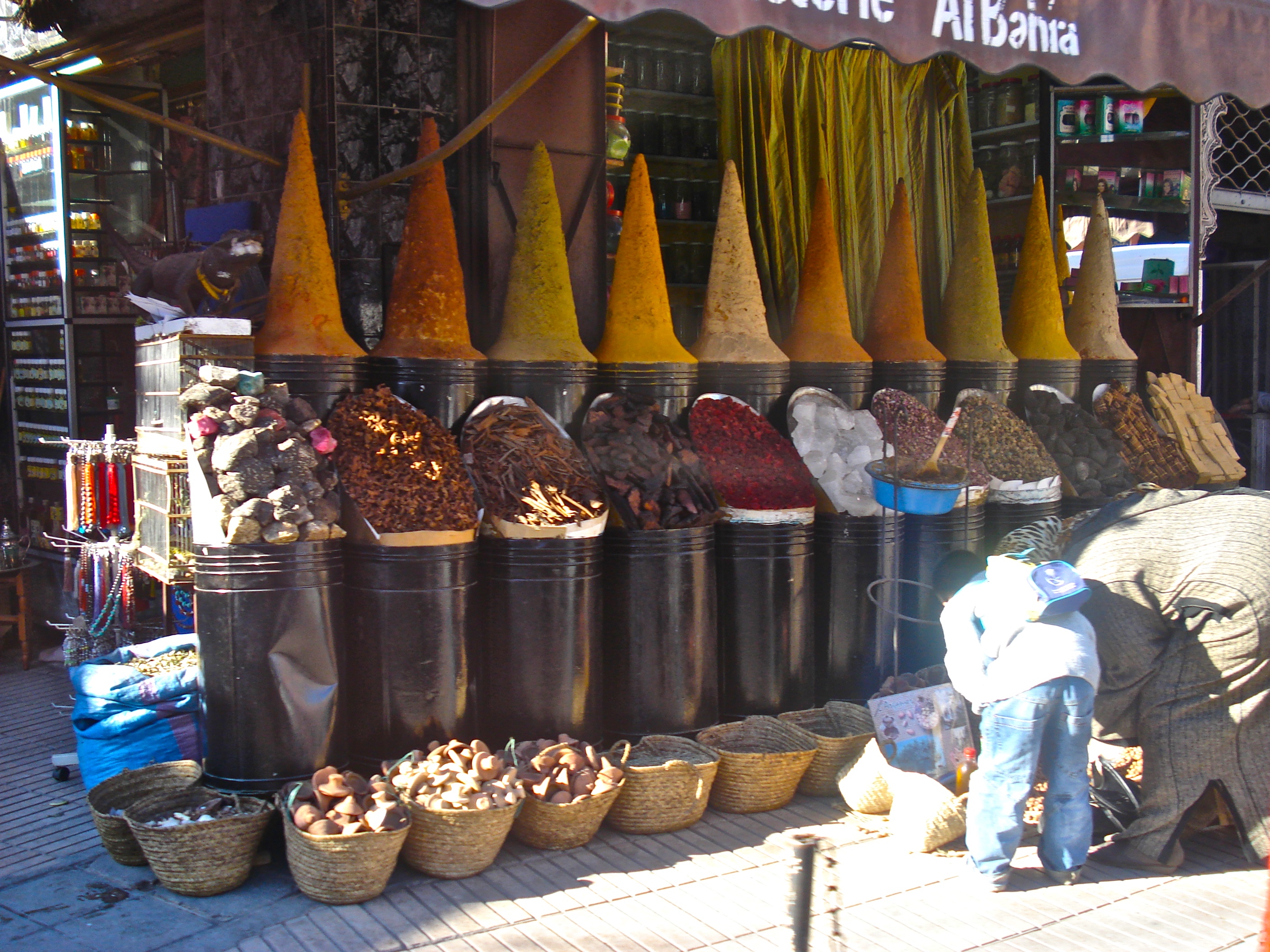
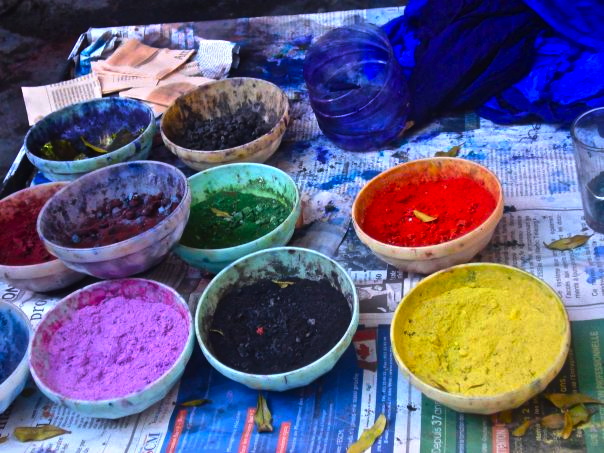
Footsteps wandered through the Medina. Leading never lost. The Medina was alive and awake. Narrow alleyways and winding routes. Archways and shortcuts. Donkeys and motorbikes squeezed past each other in the narrow lanes. Berber rugs and carpets were for sale. Silver, pottery, leather, men and boys making things, metalwork soldered within cobalt sparks, crouching figures worked in the winter sun, the chill of December lingering in the shadows, smoke rose from soldering guns. Donkeys, archways, motorbikes. Colour. Mazes. Bakers baking bread – small flat loaves cooled outside small shops (dirham changed hands; warm flat loaves for breakfast). Carnelian colours, cornelian walls, the Hand of Fatima glinted in gold and silver on almost every door. Ochre doors, almost every door an ochre door. Coloured lamps, painted hide, shining lanterns, dancing flames. Stalls of almonds, rose petals, colours of spice, scarlet mounds of felfla and smoked hlouwa, curled quills of karfa, vibrant yellow towers of quekoum, amber tones of kamoon, baskets with knuckled root of skinjbir, small pouches holding orange, crocus stigmas of zafrane. Donkeys, archways, motorbikes. Gateways lead in and lead out as they had done for a thousand years. Perfumed scent from shops selling cubes of musk and incense hung in the air. The chilled December air. Footsteps wandered through the Medina. Leading never lost. The Medina was alive and awake.
PART TWO: MAJORELLE BLUE
Somewhere near where the Kasbah and Medina met, almost underneath the Bab Agnaou gateway, sometime around midday, an old man called Aziz approached and recommended a rooftop restaurant for me to eat. Aziz introduced himself as a Berber, and spoke slowly and quietly. He led me through a building’s open doorway and up several flights of tight, narrow, L-shaped staircases. Our footsteps echoed as they climbed. Light poured down to greet us. Under a clear blue sky sat tables, cushions and coloured rugs on a large, open courtyard. The sunlight felt so warm on my face. The Medina’s quiet canopy concealed so much life and colour beneath it, yet the rest of Marrakech could be seen from here: the Koutoubia Minaret, the red earth walls of the city, the snow on the peaks of the Atlas Mountains. Bright blue day. Aziz showed me to a table, low down, cushioned, shaded from the sun. He gave me a menu and after I had ordered brought me water and recommended places I should go to see (carefully writing them down on a piece of paper for me): the Bahia Palace, the Saadian Tombs and the Majorelle Garden. He told me each place was a place of great beauty. Somewhere to go and sit with God, said Aziz, somewhere you can go and find the quiet present within each day.

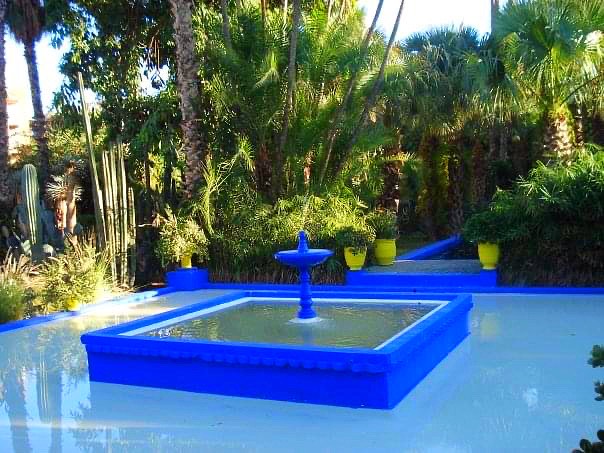
Lunch was long and lazy. The reflection of a giant palm tree floated in the small, blue, ornamental pool sitting in the centre of the restaurant. There was a fountain at the head of the pool which had running water flowing – rather than shooting – into the body of water. The sound was gentle and demanded little in the way of attention; what ripples that were produced soon dissolved into stillness at the pool’s outer edges. Courses came almost as a procession of entrées, tapas and flatbreads: olives, almonds and medjool dates in small, coloured ceramic bowls. A tagine of lamb was served with a bowl of cous-cous (decorated and divided into six parts with wedges and wheels of lemon, strips of cucumber, and a thick chilli sauce sat in its middle. For dessert – oranges and sweet, mint tea. I listened to the call of a bird which sounded like a long, low sigh and I felt glad that I had come here. The sky looked so blue – a kind of blue I had never seen before (a pure blue that was full of light and seemed endless). In the moments before I left, Aziz wanted me to have a quotation, written in French (from Theodore Monod). Days later I translated it: Immersion in the desert makes for profoundness of being, unattached from all responsibilities, freed from all that is accessory.
PART THREE: DJEMMA EL-FNA
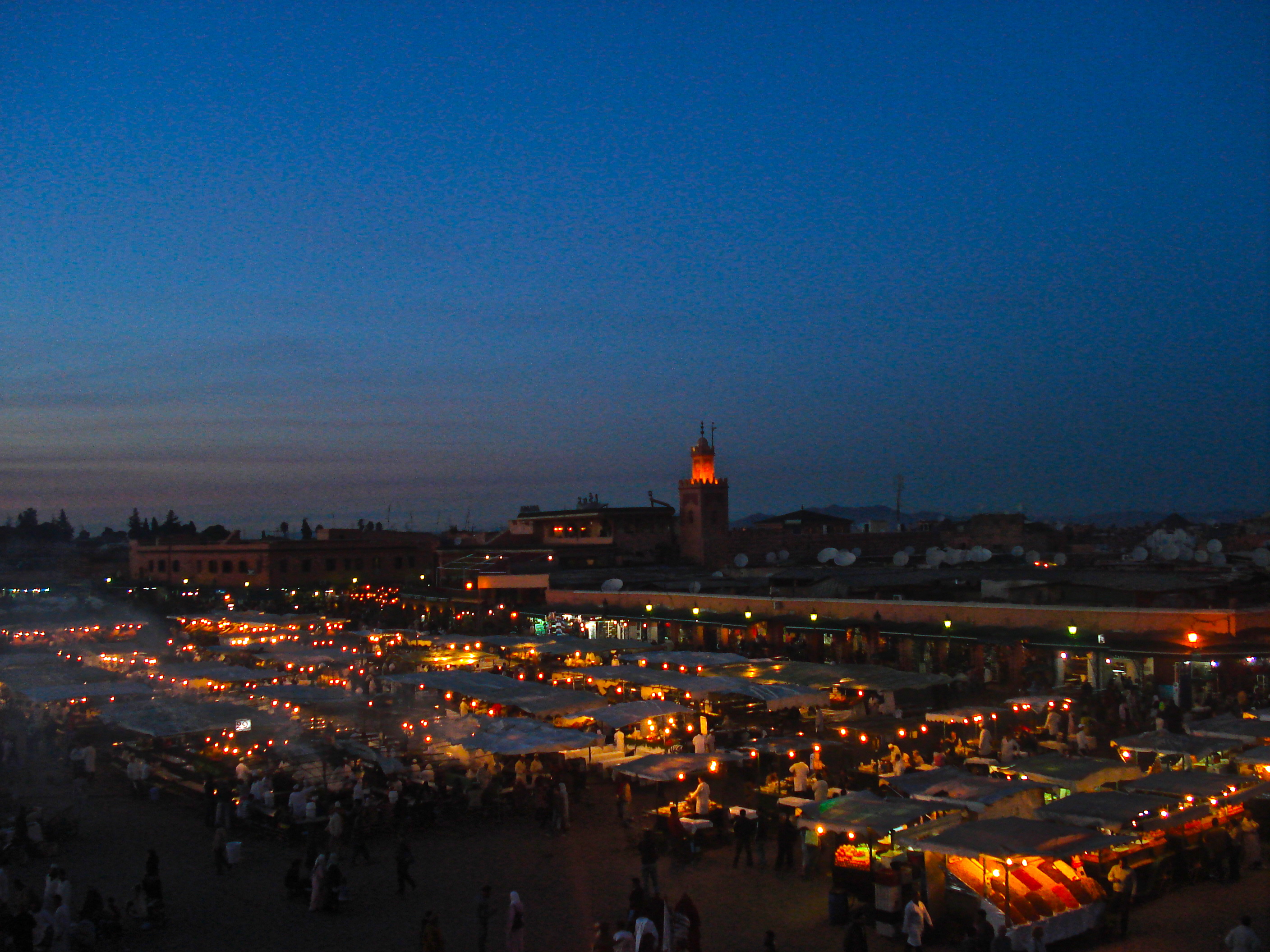
Sat looking out at the kaleidoscope of dusk catching the smoke of cooking food at the Djemma el-Fna Square. Clouds of edible fog rise over tarpaulin market stalls and are filled with every sound you could imagine: shouts, whistles, cymbals, cries, car horns, horses’ hooves, bells, drums, donkeys braying. Everywhere you look something is moving. The colours of the square swirl in all different directions at once: saffron, ochres, rose coloured walls, red robes, white robes, orange trees, clear blue skies, silhouettes of palm trees, the pink patches of snow along the tops of the Atlas Mountains caught in the dead embers of a December sunset. A child’s yellow balloon drifts upwards and across the square, past the minarets, past the people, above the colour and noise. Everywhere you look there is ceaseless movement. The concert of motion drags in one’s gaze, dancing inside a symmetry of chaos, swirling inwards and outwards, whirling in all different directions at once.

The dance goes on. Snake charmers play with hooded cobras, horses shake their heads chiming bells, lanterns blink into life in the low light, cameras flash, money changes hands, food is eaten, motorbikes thread themselves between narrow flinches of people, families, groups, individuals all together in the square. The more you look, the more it moves. Constant life, constant motion, orbital circles, figures of eight, loops of infinity. People pour into the Souk, people pour out of the Souk. Everything is overwhelming to the eyes. And then, everything comes to rest with the call to prayer, the maghrib or sunset prayer. Everything that resembled a world so busy, has emptied and stopped. The Atlas Mountains stand cloaked in purple hues. A time to reflect.

In the silence I wonder if I will ever return to this wonderful country. In my heart I sincerely hope so. I really wish I had booked more time to stay and explore; I really wish I had found the time to visit Essaouira (it was one of the things I had hoped to see, yet the planets had not aligned). Tomorrow I leave. In the silence I reflect on my time here. All I have encountered is kindness and friendship; this has been my experience and one that will remain inside me forever. And then, as the maghrib prayer ends, life returns to how it was minutes earlier. Motion begins again. The Djemma el-Fna square pulses with energy and good intention. Somewhere below me, I can hear Stir it Up. Loud. As a friend of mine likes to say: wherever you go in the world, someone is always playing the songs of Bob Marley. Darkness has now arrived to Djemma El Fna and soon I will have to find my way back to my hotel. This place is just amazing.

FLIGHT BA6923 (RAK > LGW)
Half way through a three-hour flight. Head thumping, lower back aching. Half way between Marrakech Menara and London Gatwick. Window seat. The flight flew north, towards Casablanca, then seemed to follow the Atlantic coast of Morocco as the African continent began to point up towards Tangier. Nothing but blue skies, only deep Atlantic blue waters, white-tipped waves far below, chalk-smudged cirrus cloud dusted and stretched across the sirocco winds moving across the Straits of Gibraltar. For a moment, the Mediterranean blue opened up on my right stretching out far and wide, then the flight began to tilt and moved across into Southern Spain. There in the distance, where they should be, stood out the mountains of the Sierra Nevada. Sharp, white with snow and pointed. They ran like a spine of visible vertebrae along the body of Andalucia. An elderly couple sit next to me – both from New Zealand. The husband was dressed in a shirt and tie, navy blazer with gold buttons. We spoke for a while after the inflight meal had been served and told me that he had been a Prisoner of War in Borneo. We spoke about Sandakan and he seemed grateful that I had visited there a few years earlier, had been there, to the museum there, and knew about it. He looked me in the eye to thank me for having gone there. Now both are asleep.
GATWICK AIRPORT
It is still December, stood outside Gatwick Airport, a suitcase at my feet, waiting for my National Express coach to take me home. It is due for departure at any minute. It is bitterly cold. The stars look frozen, encrusted in frost across the night sky. Nothing moves. The cold hangs frozen in the air. The darkness makes everything seem so much colder. Nothing moves. There are lights – orange streetlights and yellow headlights. But all the other colours are inside, behind me, there in the warmth of the airport. Pin pricks of colour in Christmas fairy lights, dancing tinsel, television screens showing replays of shows and the weekend’s football matches. Images of Djemma el-Fna keep presenting themselves to me in my mind. The sun would be setting there now. Sounds of bus engines rev up and rumble in the evening mist. A young woman comes out of the electric glass doors behind me, pushing a trolley of suitcases. She asks me if I know where the bus to Sheffield is. She tells me she is from Lithuania and is lost and is tired. All I can do is point her towards a departure board (which does list her bus departing in twenty minutes). She walks off pushing her trolley into the darkness. Into the bleak mid-winter. Into the Gatwick grey.
*
 siesta del somewhere