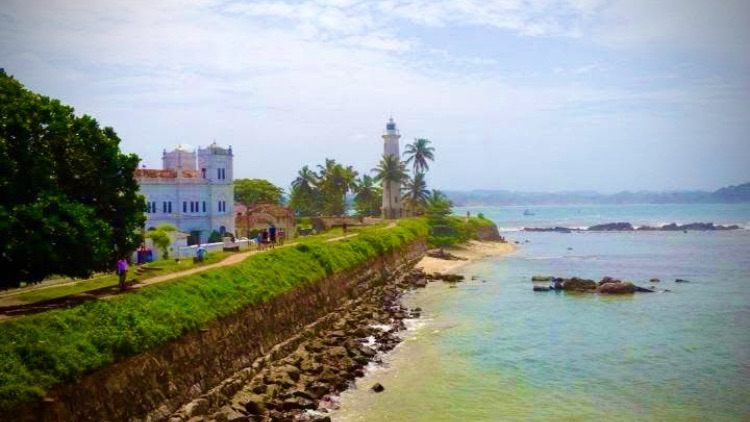
35 – Galle (Sri Lanka)

Image by Karl Powell (Galle, 2013)

The train stopped in the dark. The sun had set across the Indian Ocean a few stations ago and now the world was bruising into an indigo of evening. Silhouettes of palm tress were visible, overhanging above the station’s heavy, metallic roof. A few stars peered into our world. The station’s platform was illuminated by several electrical lights, showing off the station walls which were painted in pastel yellows and pinks, and decorated with fat, round pots of green palm plants encamped at the base of each supporting girder – holding up the heavy metallic roof.

The platform was empty; it was neat and clean and looked welcoming from the stillness of my stationary train. A solitary man stood centre-stage at the edge of the platform; well-dressed in shirt and trousers, one arm folded across his chest supporting the other arm that acted as a support for his chin. The man looked into the darkness that we had been journeying towards.

Moments earlier we had pulled into this station on our train from Galle. I was reurning to Aluthgama. Expecting the train to move on after alighting, it instead began to move backwards. Slowly at first. It bumped to a halt having cleared the platform then shunted forwards onto a central track – a no-man’s land of three lines running parallel to the little station. Here we stopped. Standing in the dark. Without announcements. Here we wait. Kept company by the stillness of the night. 

Image by Karl Powell (Waiting for the Train, 2013)

I had spent the day in Galle (and was happy I had done so). I had actually visited the fort town a week earlier – as part of an organised tour, orchestrated by a guide who had pointed here and directed our attention there. I had grown frustrated on the tour, as Galle had struck me as one of those places that asks you to stay longer in its streets, to walk and wander along its shade and sunlight. During the tour, part of me wished I had booked a reservation to stay there instead. Galle struck me as somewhere unique – something that could not be found anywhere else. It had a vibrancy and sense of community encased within its walled streets as it sat on the coast of the Indian Ocean (it even had its own lighthouse). During the tour all I could think about was returning here, to spend more time, maybe a week or two, a period of time, to stay there with a blank notebook and to see what stories, ideas or daydreams ended up on paper.

And so, today had begun with buying a ticket to Galle from Aluthgama early in the morning. It had cost me 55 SRL Rupees. The ticket was small (about the size of half my thumb), but made from thick, durable purple card. I had bought it at a small, manned ticket office at the station itself (which was only a two-minute tuk-tuk ride from my hotel). The station had orange walls and a large sloping roof that covered the platform and even the passing rails. 
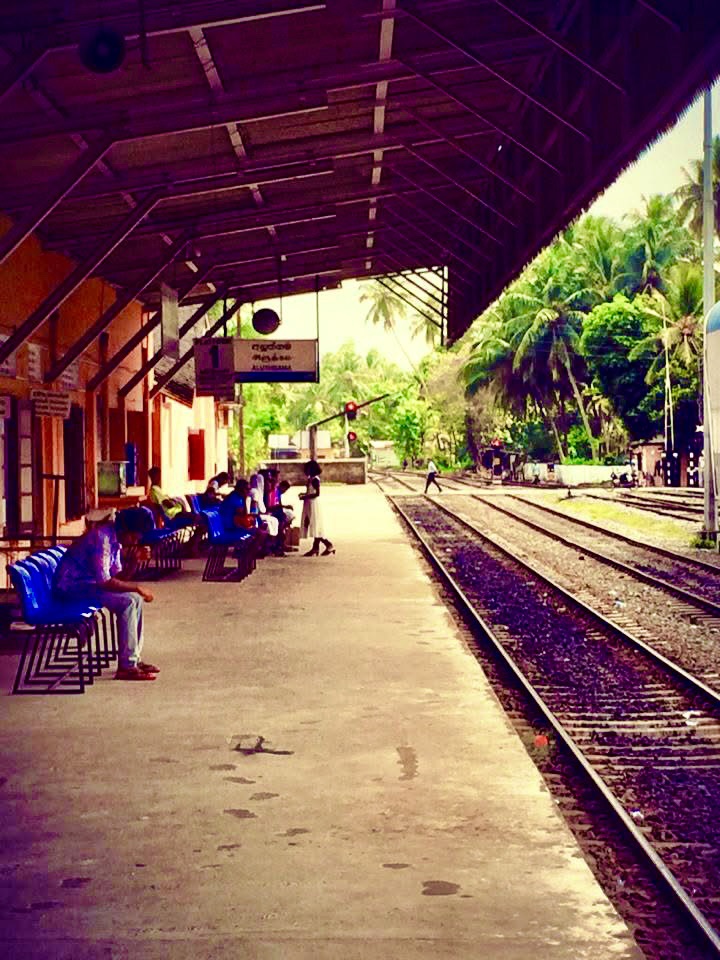
Image by Karl Powell (At Aluthgama Station, 2013)

The train to Galle arrived on time. A tannoy announcement was made on the platform in Sinhalese and a few moments later a large, claret coloured diesel train appeared from out of the vanishing point where the illusion of parallel train tracks seem to meet and thundered into view. It blared its horn. The heavy locomotive pulled a stream of red carriages behind it. A stranger on the platform advised me in the collective commotion to board, which carriage I needed as the train pulled in. 
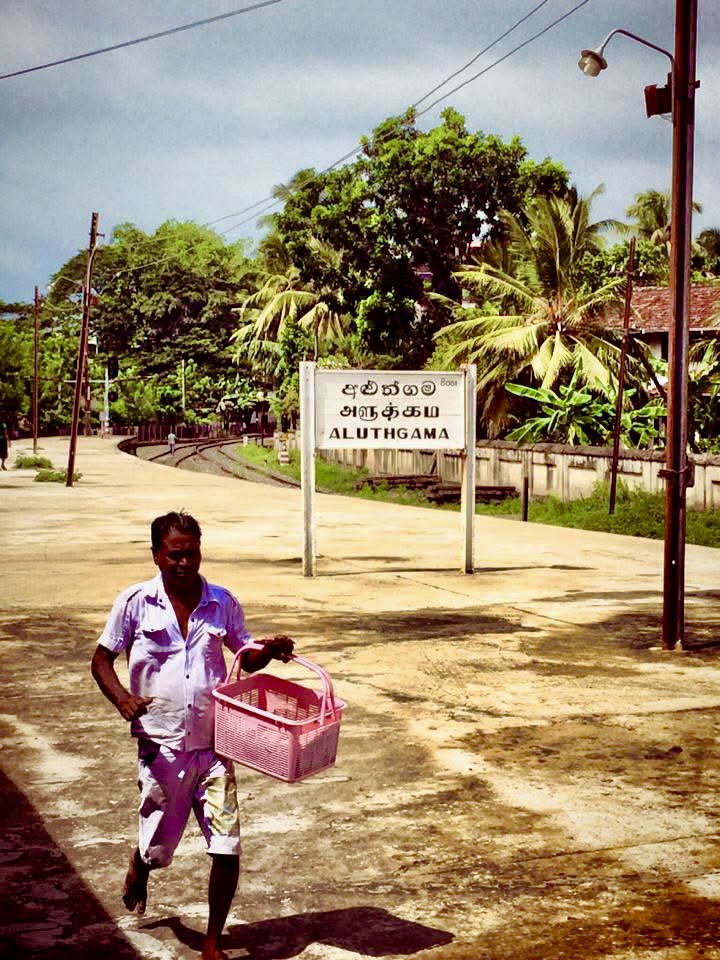
Image by Karl Powell (Boarding the Train, 2013)

The journey to Galle took just over an hour. This was an express train – only taking a limited number of stops along the southern coast of Sri Lanka. The track cut through countryside, villages, moving onwards the terminus, keeping parallel to the Galle Road and the Indian Ocean. Small fires burnt outside homes, colouring the green backdrop of palms and plants with dense, heavy patches of haze, humidity and grey smoke. Occasionally we passed people walking in both directions along the wooden sleepers between the train tracks. When the line opened out towards the ocean, the churning surf created great rainbows thrown into the air as the saltwater spray crashed onto the shore.

Image by Karl Powell (Walk the Line, 2013)

The carriage was packed tight. For a while I stood near the open doorway of the train. People around me held onto handrails as the train gathered speed. The moving air rushed inside the carriage making the task to stay onboard a challenge. As the train began to empty along its various stops, I eventually found a seat at an open window.

There was a good mix of tourists and locals on the train – a group of Japanese girls travelling together took photographs inside the carriage striking poses for the camera, flashing peace signs in each one.  

Image by Karl Powell (Train Ride to Galle, 2013)

When the train arrived at Galle it did so in the middle of the confusion of midday. Galle was a busy station. Despite having a handmade map to navigate out of the train station to the fort, things were an immediate blur of moving swirls (traffic, heat, unfamiliarities and footsteps). I made my way to a large roundabout, then curled around it before heading into Galle Fort through the shade of the Main Gate – an archway in a stone wall between the Sun and Moon Bastions. This was a fortified town with narrow streets, cafes, guest houses, shops and homes. From this entrance, all roads led down towards the whitewashed lighthouse that stood on grass ramparts facing out to sea. I followed the first street that met me – there were lots of places open and serving meals.

I found a café and sat inside its shade looking out onto Church Street. I ordered coffee and something to eat. It was cool and quiet inside. I sat and wrote at a table for a good hour or so. I enjoyed being inside the building; I liked the fact it had orange walls, a brick floor and wooden slats on the window which seemed to let in a sea breeze without any of the heat of the day. Here, I wrote sketches – passing sights, sounds and impressions of Galle from that café. There was something about Galle that I found beautiful – no rational reason – just a feeling it gave me. It was a place I kept telling myself that I would come back to one day – to spend a chunk of time there solely to write.

After coffee I walked around and found some art shops, souvenir shops, took some photographs of the streets and houses. I had no real plans. It was just a free afternoon to meander until the five o’clock train back. 
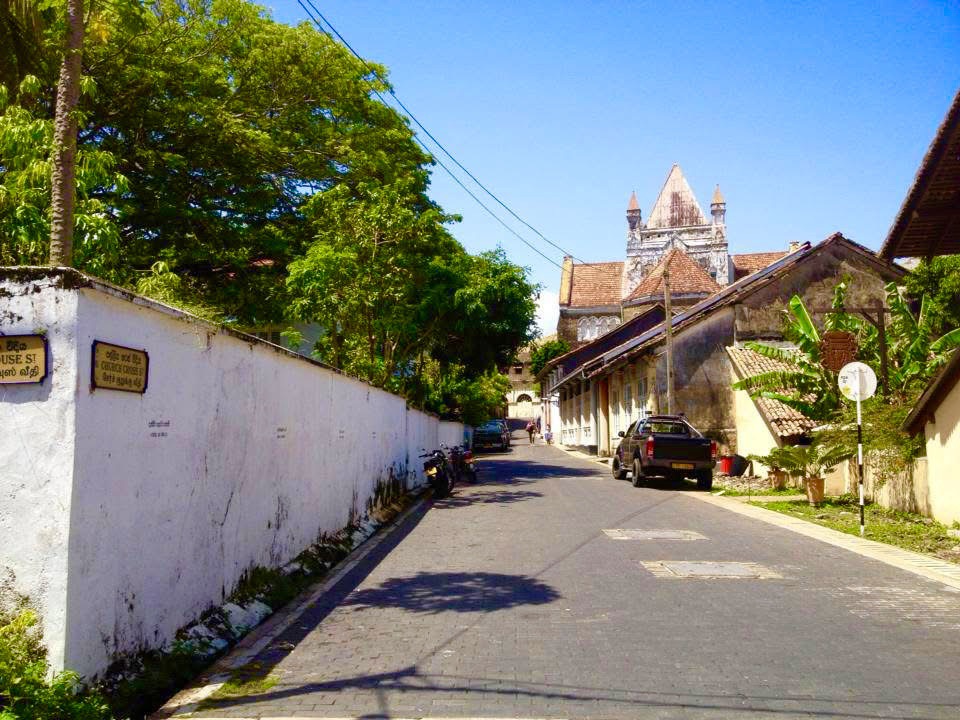
Image by Karl Powell (Streets inside Galle Fort, 2013)

At the far end of the Galle Fort was the lighthouse. It stood like a white obelisk against the blues of the sky and Indian Ocean. It towered above a clump of palm trees which grew around it, sat on top of a grassy verge or rampart which was wide enough to walk along – giving an elevated view of both ocean and Galle. I walked along here, taking what photographs I could of the view. Sunlight moved through the body of water in the shallows – shimmering blues and greens in ripples. The afternoon was hot. Peanut sellers sold small packets of nuts alongside ice-cream vendors parked on the roadside.I bought both. 

Opposite the lighthouse was a large, white two-storied mosque. The holy month of Ramadan had just finished. There were men and boys milling about outside, lifting cardboard boxes full of tinned foods and rice from a van and carrying them into an adjacent building. They smiled and said hello as I walked past. A conversation began; they were preparing food parcels to give to families who were less well-off. All were undertaking this work on a voluntary basis (the children were doing so on their school holidays). As we chatted, they asked me about my travels, where I was from, where I was going, if I had liked Sri Lanka – they invited me inside for some water. 

Image by Karl Powell (Houses inside Galle Fort, 2013)

Layers of wide slabbed steps led up to the mosque’s entrance. From white heat into shade. The mosque felt cool and serene inside. The sound of birdsong echoed in from surrounding gardens. There was a large, open prayer room towards the back of the building. Bookcases stood against one side of a wall. I was invited to sit at one of the many benches inside the shade. Circular fans blew cool air downwards. Somebody brought me a bottle of cold water. Beads of condensation ran down the bottle into my hand. There, in that pocket of time, we all introduced ourselves; they told me about their lives, I told them about mine. An Imam came and sat nearby to listen to the exchange. 

There was a large, framed document on the wall behind me. I read it before I left: it was the Prophet’s last sermon and had been printed in Arabic, Sinhalese and English. The words were lovely. Long afterwards, the more I thought about what had I read that afternoon, the more I realised that all messengers of God express a truth from a Divine Source; only the names are different, the message is almost always the same – to love.

Image by Karl Powell (Passing Train, 2013)

When it was time to leave, photographs were taken on the steps together (including a group one on the steps outside the mosque). We exchanged contact details and thanked each other for the serendipity in our meeting – hoping to meet again in the future. They offered to take me back to the train station but I was confident of getting there myself. A man called Feisal gave me his card – stating he was a storyteller who owned a gemstone shop nearby. On my way back to the train station I bought a map of the area. It was a large, oversized postcard of Galle from a souvenir shop. I did it so I would never forget this day and that I could remember as much of it as I could for as long as possible. 

At the station, I bought my return ticket back to Aluthgama. There was enough time to buy some samosas from a vendor near the platform (the home-cooked food wrapped in pages of a student’s homework and advertisements from a newspaper) before the train hauled itself out of Galle. As we meandered alongside the beaches and shorelines of the Indian Ocean the sun began to sag down towards the ocean horizon. The late afternoon mellowed and the heat and light of the day hadsoftened. The sky began to fill with tints of peaches and pinks – a tangerine twilight came as we left Hikkaduwa station. The journey took on a feel of hypnosis; the transition from light to darkness, the repetitive clickety-clack of the moving train, row upon row of endless pencil-thin coconut trees passing the window – each with a thatch of leaves bending away from the evening’s sea breeze.

Image by Karl Powell (At Galle Station, 2013)

Lost in the mantras of movement through this beautiful land I suddenly remembered a passage I had read once in a book about train journeys. It had been somewhere in Paul Theroux’s ‘The Great Railway Bazaar’ where the author wrote about a particular sense of freedom he felt that only train journeys can provide. It had something to do with a train’s ability to take you to magical faraway places, moving through sleeping towns and tunnel, across bridges and mountains, meeting passengers in a way that planes, boats and cars cannot. I’m sure there was a sentence that said, trains were freedom on rails.
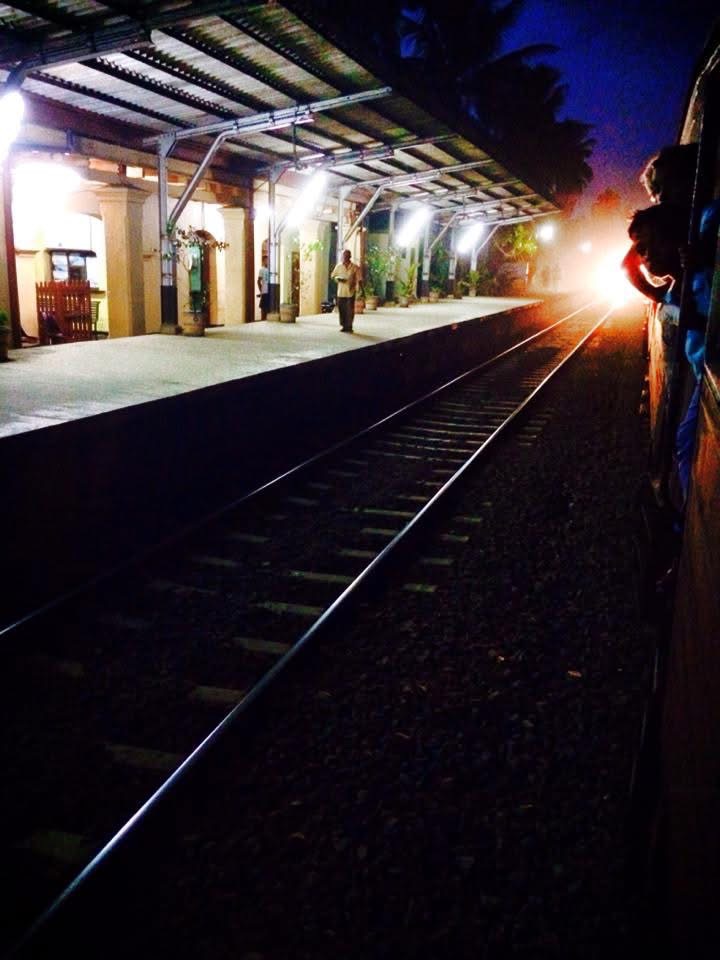
Image by Karl Powell (Approaching Train, 2013)

A pinprick of white light appeared from out of the darkness. Ahead of me, I noticed the swaying silhouettes of heads straining out of the windows to watch an approaching train. The white light grew brighter and illuminated the platform. In the marbled colours of dusk and darkness, the train’s headlight soon lit up the yellow platform and its green plants and palm trees. The white light began to move along the long, metal tracks of railway. The light grew brighter still. Then the noise arrived – a heavy train shuddered the ground as it passed with speed. It did not stop at the station. Its rush created a vortex of wind. Then, silence returned – as did the darkness. Our train reversed again to shunt back onto the line we had just been on. We carried on to Aluthgama, leaving behind the small lights of the station’s platform and the night sky filled with evening prayers.  

Image by Karl Powell (Hikkaduwa Sunset, 2013)

*

23 The Blue Buddha (Sri Lanka)

FIRST IMPRESSIONS OF BENTOTA

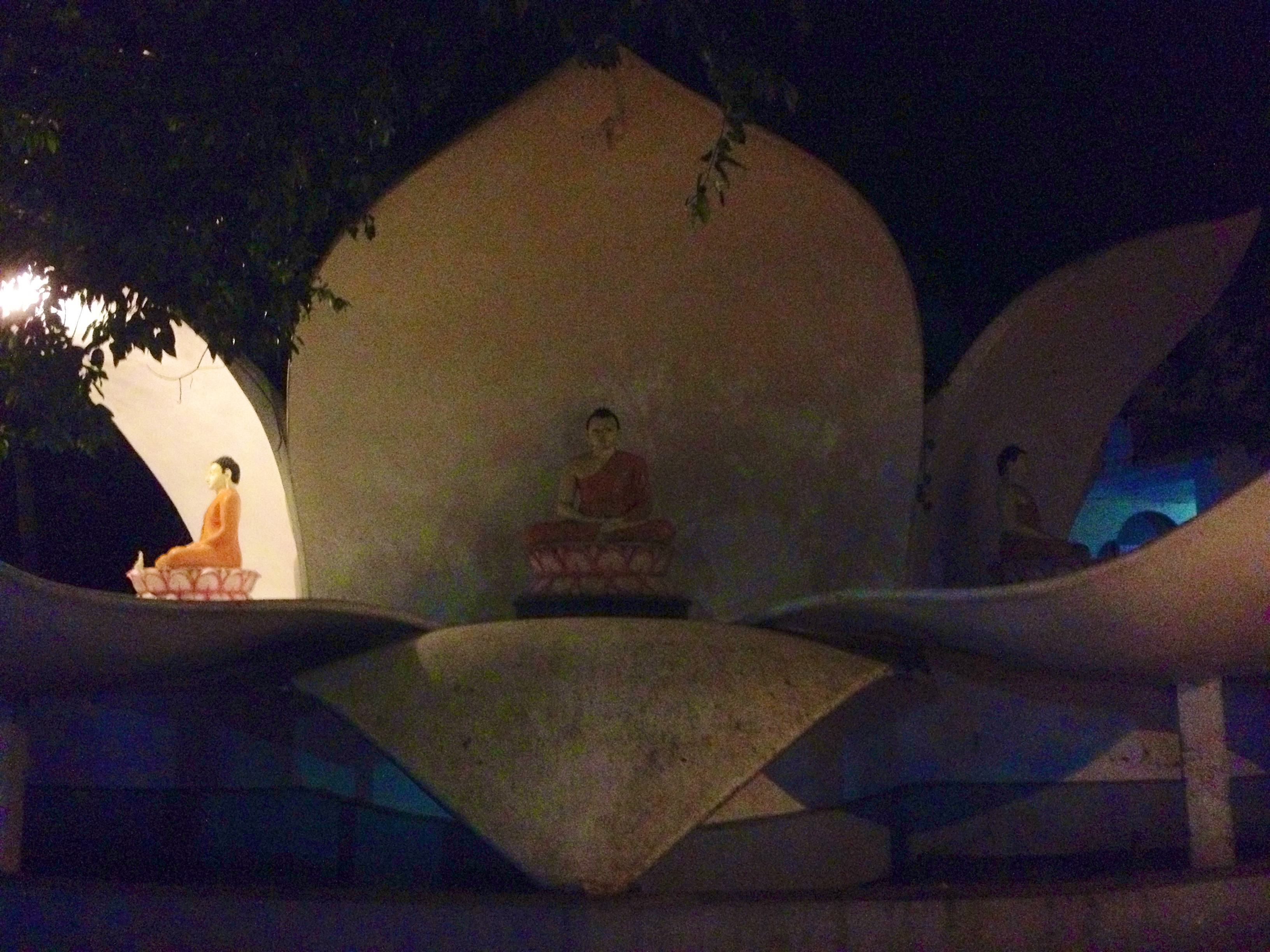
Image by Karl Powell, Temple at Night (Bentota), 2013

Towards the end of my first night at Bentota there had been singing sounding in the night sky. Just as everything softened to that blue-grey hue that coats the visible world once twilight arrives, there had been singing – chanting – sounding from somewhere. It was being amplified through a speaker, or a tannoy, carrying it through the air. Spoken words, prayers, devotion all dissolving into darkness.

A waitress at the restaurant where I’d eaten had told me there was a festival happening at a nearby Buddhist temple (it was due to the full moon). She told me it was within walking distance and that ‘You are welcome to visit.’ I tried to find the temple that night but never did.

Occasional drops of rain still hit the earth in scattered crashes – afterthoughts from a long, heavy downpour that had begun around dusk. Floor tiles and walkways were still wet, still slippery – almost glossy – with moisture and humidity. Low, sodden clouds dragged their bloated bodies across the unlit heavens, insulating all the sounds below. And there were so many sounds giving vibrancy to the night: birds sung their slow songs of gratitude for the day, insects chirped, frogs croaked. The rain fell. The day had ended. And in the midst of these things, the sound of singing carried on chanting into the fading light of Sri Lanka’s south.

Had I known the way to the temple then I’m sure it may have been within walking distance. But out in the unfamiliar settings it didn’t take long to become disorientated and lose heart in the adventure. Everything had looked so different in the dark. The gardens between my room and the restaurant had become a concussion of towering shapes and labyrinthine shadows. Small yellow lamps, set low in a wall scattered a burr of soft lights – casting circles of silent halos along a stone footpath and its flat-leafed plants. Trees rose up overhead in great sprawls – mostly palm trees fanning their outlines against the night sky. Three giant coconut tree reached up high – so high – mediating the worlds of darkness and downpour. Beyond that, the parameters of the unknown stretched out in all directions.

Image by Karl Powell, Night Train to Galle (Bentota), 2013

And then, rain returned, heavier than before. A million diamonds of raindrops fell from the sky. An evening train thundered past with its white headlight embellishing the downpour; the railway track ran cleavered Bentota in half, the train moved through the darkness down towards Galle. The sound of the singing could still be heard. A tuk-tuk took me back to my room. I tried to explain to my driver, what I had been looking for and about the sounds I had heard. He took me to a small, illuminated shrine near the side of the road, close to the railway track, but no one else was there and there was no singing.

That night I fell asleep listening to the sound of the chanting. It echoed in the air, blending with the falling rain and the sounds of the Indian Ocean. I remember waking once in the small hours and saw the light of the full moon shining on the tiles of my room but by then the singing had stopped.

IMPRESSIONS OF KANDY

I thought no more of that temple until my penultimate day in Sri Lanka. Over a week had now passed and I had seen so much – yet barely scratched the surface. This island required a more significant investment of time to fully immerse, explore and to fall deeply in love with it. My desire to see more of Sri Lanka led me to book a full day excursion to the ancient Sinhalese kingdom of Kandy, driving through the Hill Country in the Province of Sabaragumuwa. It was to be a long day’s drive. I knew that (and on reflection, perhaps, should have just stayed local for that last day – to watch one last sunset on the beach or something – but when you’re aware of the brevity of time, occasionally, you overstretch yourself). On reflection, my day to Kandy was one which was rushed, yet there are no regrets.

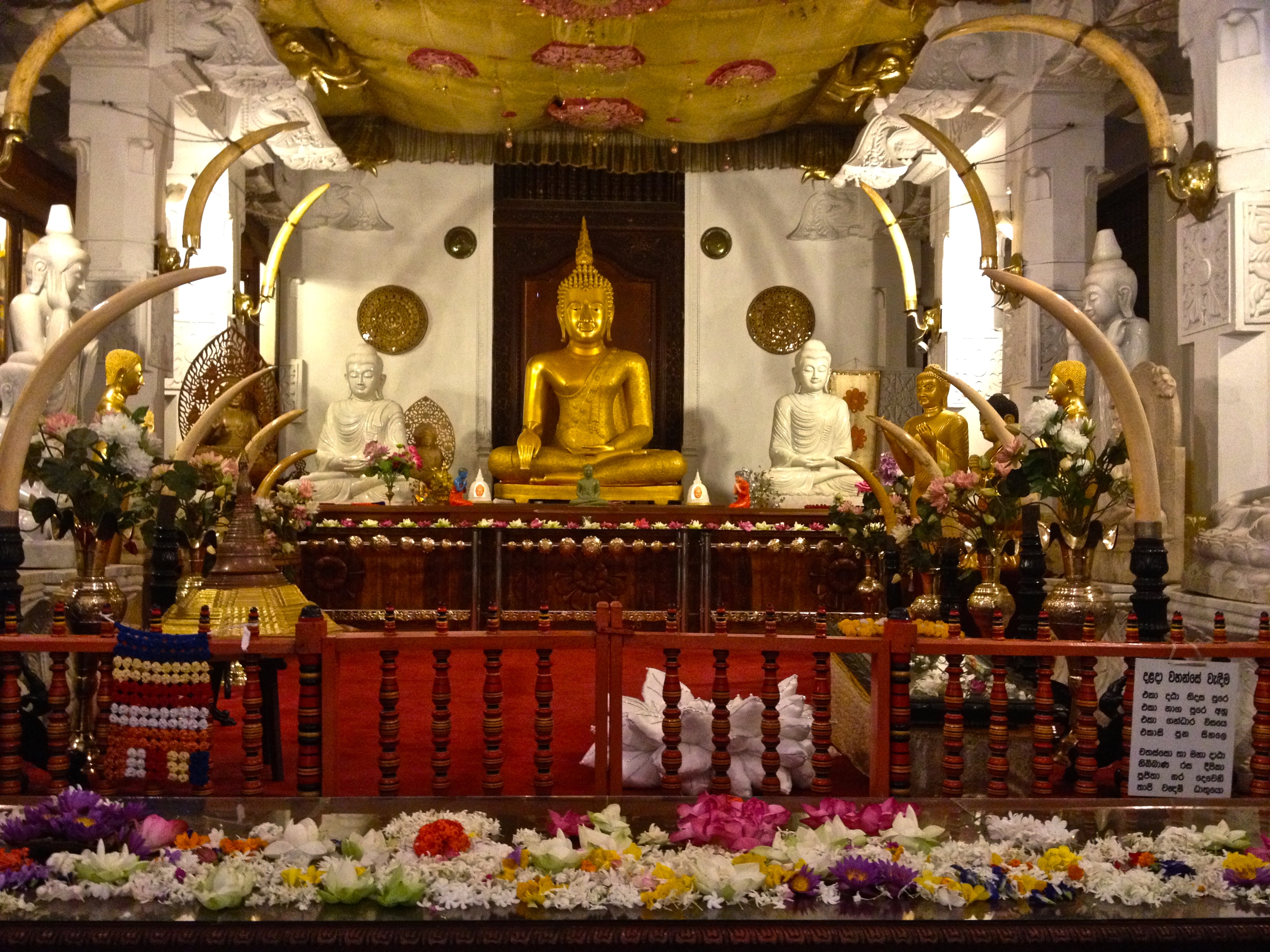
Image by Karl Powell, Sri Dalada Maligawa (Kandy), 2013

My driver had collected me just after breakfast. That morning, like most mornings there, I had eaten a large breakfast: yellow coconut rice, some dhal curry, a coconut relish with roasted chillies; there had been an egg hopper, too, some brinjal pickle and kottu rotis. It was delicious food – and I had found that eating this had kept me sustained for most of the day. The trip was scheduled to arrive at Kandy around midday (which we did) and return to Bentota late afternoon. But as we drove back to our point of origin, the vibrancy of the blue sky became lethargic, and the advent of dusk brought hues of colour to the horizon; it became apparent we were still at least several hours away from returning to the south. Headlights began to blink into life on the road in front of us. Soon, the motorway would be in darkness.

In that fading of light I decided to try and write down my impressions of the day. I wrote quickly as the recollections presented themselves to me in a snatched grab at the disorganised chronology of the day.

BENTOTA TO KANDY: passing small villages (some busy, some quiet); houses with small, window balconies overflowing with plants bearing flowers (colours of pink, white, purple, red); roads running through them like threaded beads on a necklace; roadside stalls selling brightly coloured rugs, fruits; there had been a tall, green mosque standing between two houses; a passing bus had ‘welcome’ written above  its passenger door.

OUTSKIRTS OF KANDY: the greenery; the palm trees; openings of forest and fields; singing greens and floating clouds; narrow bridges over long, flat rivers flanked with banks of dark, green leaves and vine; we passed pilgrims walking towards a large statue of the Buddha (traffic stopped on the wet tarmac to let them pass).

Image by Karl Powell, Sri Dalada Maligawa (Kandy), 2013

KANDY: cool air, clouds numerous; drops of rain falling from cushioned mist, landing in large, flat puddles – patterns of circles expanding out across the water’s surface. Beautiful Kandy. A large lake in Kandy; flat, calm waters, deep bottle green; buildings and mountains surround; clouds seemed lower.

INSIDE THE TEMPLE: A guide met us and took us inside the Temple: lots of people outside the temple; shoes off; walked inside – lots more people; colour, carvings, beauty; buildings within buildings; mantras on moonstone; saw the relic of the Buddha (locked in a casket); monks, robes, shrines; garlands of flowers, every colour imaginable, golden buddhas (eyes lowered in meditation). After the tour, we were ushered back into our vehicle for the drive back. Wanted to see more of Kandy. We had to drive back.

Image by Karl Powell, Sri Dalada Maligawa (Kandy), 2013

Then the daylight gave up entirely and it become impossible to see the words that were being written down. So I stopped. Staring out into the darkness of the landscape and motorway as they merged into one, my final impression of Kandy remained in my mind’s eye, unable to be committed to paper. After leaving the temple I had paused before stepping into our vehicle back to Bentota. My eyes had followed a road running away, downhill, from where I stood. It was a street full of people, colour and life. In that moment, something within me wanted to stay just a little longer – just to wander there and to be a part of it. But there had been no time. Everything had been hurried. Maybe one day I could return there, for a longer stay, and maybe travel by train from Colombo to Kandy to savour the journey and see more of the island. One day.

THE BLUE BUDDHA

The journey back to Bentota was punctured with a stop at a roadside service station. We were here for about 30minutes. My driver, Dharme, and I shared a table. My body was tired. His phone rang several times. We ordered biryani and bottles of water. We sat and ate as we spoke about our lives. He told me about his family, his children and his hopes for their futures. As we finished our meal he rang his wife and told her that we would be returning in around an hour. The red LED clock in the car told the time of 7:33pm. Then once again we drove into the darkness. As always, whenever we passed a Buddhist temple or shrine on the final leg of the journey, Dharme continued to clasp his hands together in prayerful reverence (like a Namaste or wai gesture) and spoke something. We reached the outskirts of Bentota a little under an hour later, and as we approached familiar surroundings he asked me if I would like to visit the temple where he and his family prayed. It was late, and I agreed.

Image by Karl Powell, Reclining Buddha (Bentota), 2013

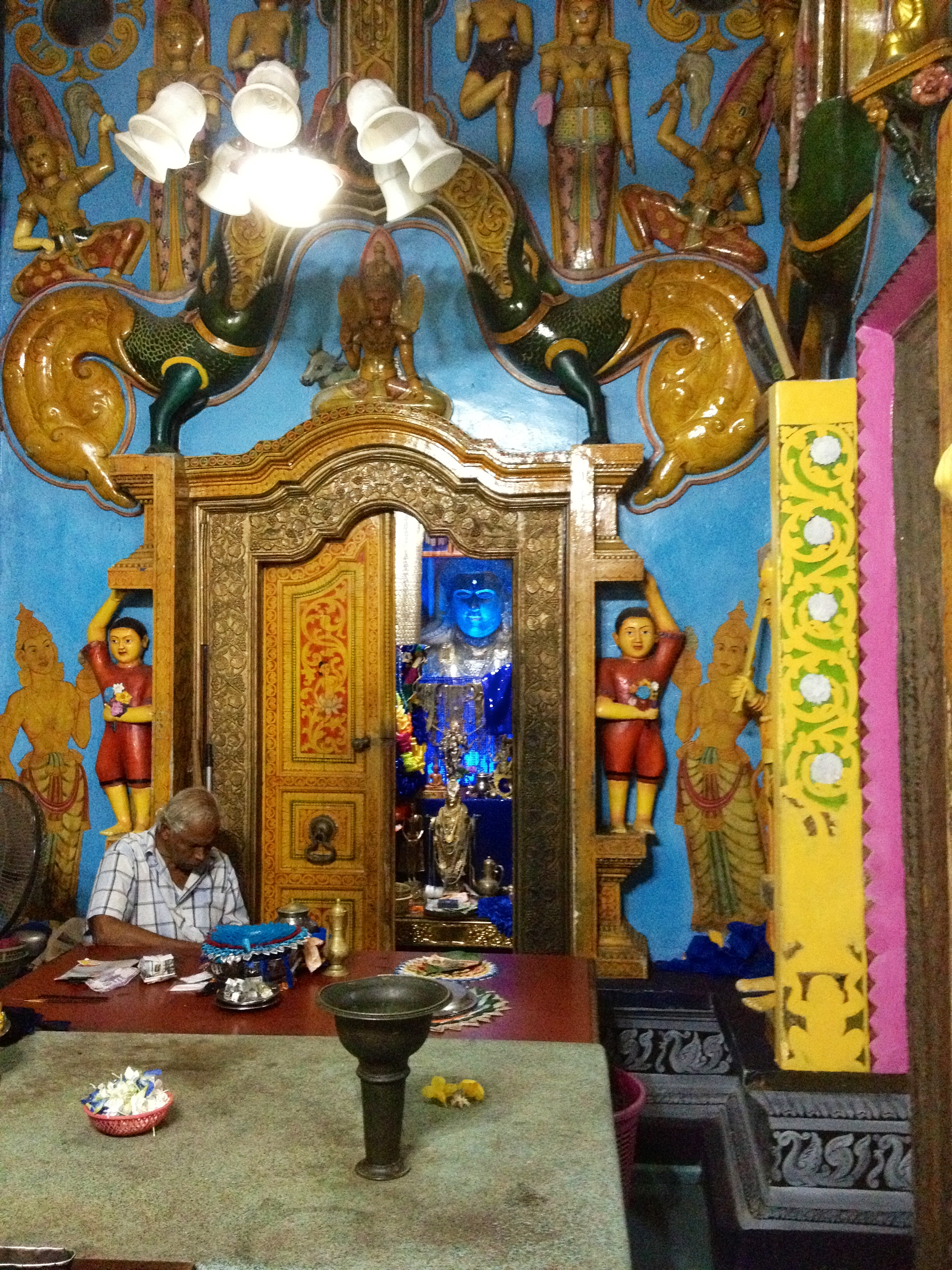
We approached the temple in darkness. A road led upwards towards a large, empty carpark. A giant statue of the Buddha, dimly lit, sat gazing out into the darkness behind us. Petals of the lotus flower surrounded the sculpture. And there I saw moonlight and palm trees moving in shadows. And then I was led inside the temple and saw colours and flowers, painted walls, painted images and symbols, rooms within rooms, doorways leading inwards and along, seated Buddhas, reclining Buddhas, I saw Sinhalese script etched onto painted walls aged and fading in patches, I saw patterned tiles, I saw serenity and beauty abide in this place, I saw a young man alone kneeling in a room without lights holding incense as he prayed, I saw the silhouette of a dharma wheel illuminated by candles against a red silk drape hanging against a wall. I saw an old man at a desk writing in a book and behind him a large wooden panel cut into the wall, with one door ajar and a blue Buddha statue facing outwards.

Image by Karl Powell, Lotus Leaves (Bentota), 2013

Back outside, in the grounds of the temple, there was a pervading sense of peace and stillness in the quiet night. Clouds of incense curled and perfumed the night air, sticks stuck in a broad vat full of sand burnt near several rows of small, lit tealight candles each with a flame dancing in silence. The more you looked, the more candles and flames you saw. There in the silence I tried to take a photo to capture all this, knowing it would never hold the moment I was witnessing. A seated dog watched me use my camera. It sat between the candles and the incense, the flames reflected in his eyes. And I saw that the dog was not alone, there were other dogs and even cats beside him, seated, sleeping, resting together. And time just dissolved and collapsed in on itself the way that it can do when depth becomes a part of its nature for a brief moment.

Image by Karl Powell, Blue Buddha (Bentota), 2013

I asked my driver, as we left the temple, if there had been chanting here the previous week. He wasn’t sure. It began to rain as we finally arrived at Bentota.

*

6 In transit, in Colombo

It is late afternoon. The sky begins to slide; peaches and pinks begin to mellow in the clouds, with their pastel hues starting to dance on a few waves far out at sea. The sting of the day’s heat has left now and humidity seems to be building in the air. The sun sags down towards the ocean horizon and is about an hour away from setting. It will be gone soon. The blues in the sky deepen and are filled with moving chunks of cumulus cloud coming in off the ocean, all bloated and saturated with moisture, gliding across the heavens like icecubes in scotch.

Image by Karl Powell, Coconut Trees, 2013

For a while I tried to photograph this changing canvas blooming overhead. One photograph became a frenzy of many, with each one more memorable than the previous (so I told myself). Then you realise the futility of trying to capture some experiences in a photograph. You just can’t. While clouds and colours mesmerise within a private dalliance of time, birds are flying through camera frames – darting past images, evasive when wanted in shot – their songs are audible, everywhere, soft and echoed through the moving leaves of tall, thin palm trees. Row upon row of tall, thin strings of long-lined coconut trees, rise upwards, rustling and alive in this afternoon breeze. Rain occasionally sprinkles. It falls and blots some of the ink from this pen on this page. Words blur as they are written. A rainbow flashes for a moment, radiant in colour, dissolves into nothing in a second. How to capture all this? Maybe it’s better to put away everything those and to just absorb all this beauty as it unfolds, until the day ends (until the adventure ends), all the way to a tangerine twilight. The determination to hold on to the end of something can often blind us to what actually remains; easier, then, to just let go and to be amongst the moments.

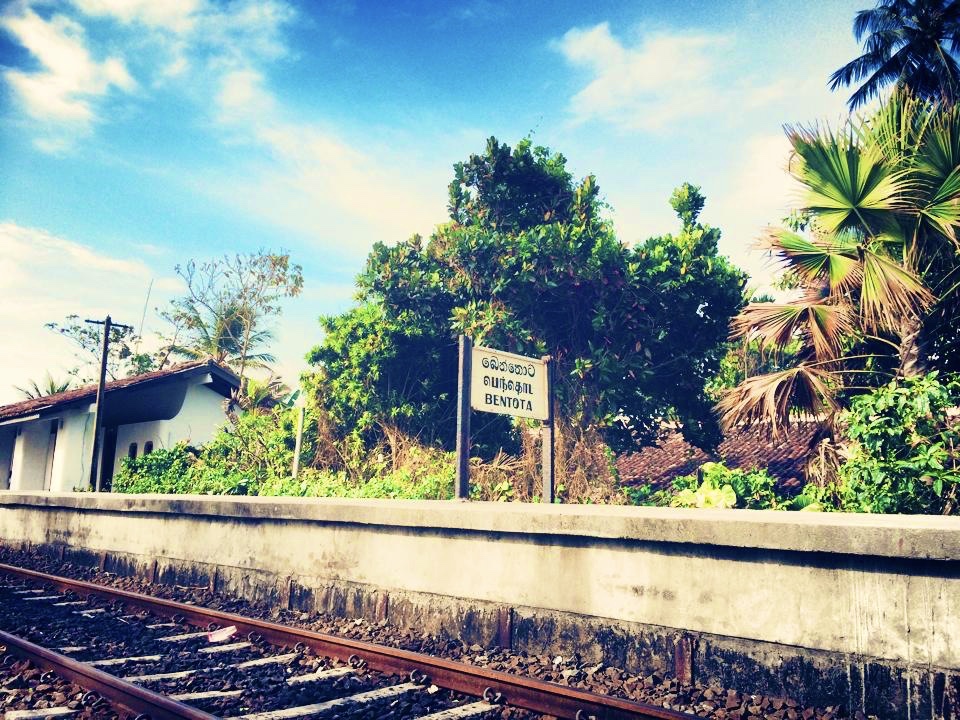
Image by Karl Powell, Bentota Railway Station, 2013

Reflecting, then, on this trip. Today has been lived through a blur of concerns: checking out and checking in, packing and unpacking, haring in and out of taxis. Cannot believe how tired I feel. I left Bentota this morning around 10. It was a three-hour road trip along the coast up to Colombo (arriving some time after 1 o’clock). The driver mentioned some new highway, Express 1 or Galle Road, linking the South to the capital (there wasn’t much conversation). My flight out of Sri Lanka leaves at 1am; rather than wait twelve hours at the airport for an overnight flight, I booked a room at a hotel close to the airport.  I’m glad I did. I’ve showered, slept and am now writing by a pool (only two flights ahead of me now – probably won’t be in my own bed for at least an entire day).

Image by Karl Powell, Galle Road, 2014

Sri Lanka has been an amazing experience. On reflection the trip was too short. I should have stayed for longer, a few weeks more, to travel, to have seen as much of this beautiful place as I could. And yet in the short time here I had, I did what I could. There was Galle Fort, a walled area of homes, churches, mosques, temples, shops and cafes (they even have a literary festival here each year). The journey there from Aluthagama on a train was something so special – a two-hour train line running the length of the shoreline with waves breaking as we thundered past en route to Galle (all windows were open and stayed open). There were many kind souls I met there. I hope I can return properly and spend time there. Think I need more time. Think I need to come back here again. There are many places I had earmarked months ago and wish I had seen: Sigiriya and Sri Pada (Adam’s Peak). Sometimes it’s just not practical or possible to do and see everything – better to leave room for next time. The sun is now setting. Wish I could stay here for a while longer. One more swim, then, one more, then time to let the holiday go, to gather up these poolside things and move indoors once again. Clouds continue to float in. I feel so relaxed. I have loved today so much.

Image by Karl Powell, Happy Passenger (Aluthagama to Galle), 2014

Back at my room in the hotel, time is running out. I am trying hard to slow this endless march towards the buzz of an airport but already it is seven o’clock (my taxi pick up is booked for ten-thirty). Everything is ready, everything is packed, everything is on edge – waiting for a departure lounge, luggage trucks on tarmac, flashing lights, empty seats, criss-crossing lives you will never meet or see again, standing still in swirling madness, inane and endless security checks, burning eyes, aching backs, searching for seats, searching for passports. To take a break from thinking, I go downstairs for a meal rather than room service – opting for dahl, coconut sambal, fish curry and an egg hoppa. On my way to the restaurant area, between the lifts and lobby, I had to walk through a mini mall in the hotel. It had a few transit shops flanking each side. Some were open, some were already closed. One shop open sold souvenirs, silks and clothes. An elderly couple worked there and were very kind and patient when I entered. I bought a few scarves and tea towels as presents. When they were being wrapped I saw a large table cloth for sale. It caught my eye immediately. It was made from cream linen and had five large elephants embroidered on it. It wasn’t cheap, nor was it beyond my budget, but the money I needed to buy it was back upstairs in my room. The shop closed at eight-thirty. I decided to eat first and to come back and buy it.

Image by Karl Powell, CMB > KUL, 2013

Opposite the souvenirs was a book shop. It was hard to resist a quick look inside. As always, on entering, you immediately you remember what magical places bookshops are. Able to transport and transform you through ideas and imagination. Shelves full of thoughts, dreams and observations, willing to be shared, waiting to be heard. A man who worked there chatted as I look to choose something to take on the flight. He asked where I was from. He asked about cricket. He asked me what I thought of his country. I told him the truth; that I had loved my stay and found it to be one of the most beautiful countries in the world. He looked at me in silence somewhat taken aback. I mentioned that I hoped to visit again some day and to see other places. I named those places I hadn’t been able to see. He recommended another place. He repeated the name of the place a few times, before I asked him to write its name down in the book I’d purchased: Nuwara Eliya.

After dinner, I returned to my room. Suitcase still packed, ready. I counted out cash for the tablecloth and put it down on my bed with me. There is something so unique about a hotel room. The silent anonymity of the room and your neighbours, the sanctuary from a bombardment of so many new sensations. A corridor of footsteps and a lobby bringing other worlds together. The wonderment of being a citizen of nowhere and the deliberate choice of being somewhere else in the world for a brevity of time. The bed felt heavy. I put on the television. There was a movie on one of the channels. It was Midnight’s Children, the cinematic version of Salman Rushdie’s novel. It was on in the background as I idled time, (re)checked my departure times, repeatedly wished I could stop time and just stay here for a while longer. I watched pockets of the movie before remembering the tablecloth; picked up my money, carried my door key, caught a lift to the ground floor and walked to the shops. The bookshop was closed. Its lights were out. The souvenir shop was closed; its lights were on. I walked closer to look inside for signs of life and read a sign on the door ‘Back in 5mins.’

Image by Karl Powell, CMB: Waiting to Board, 2014

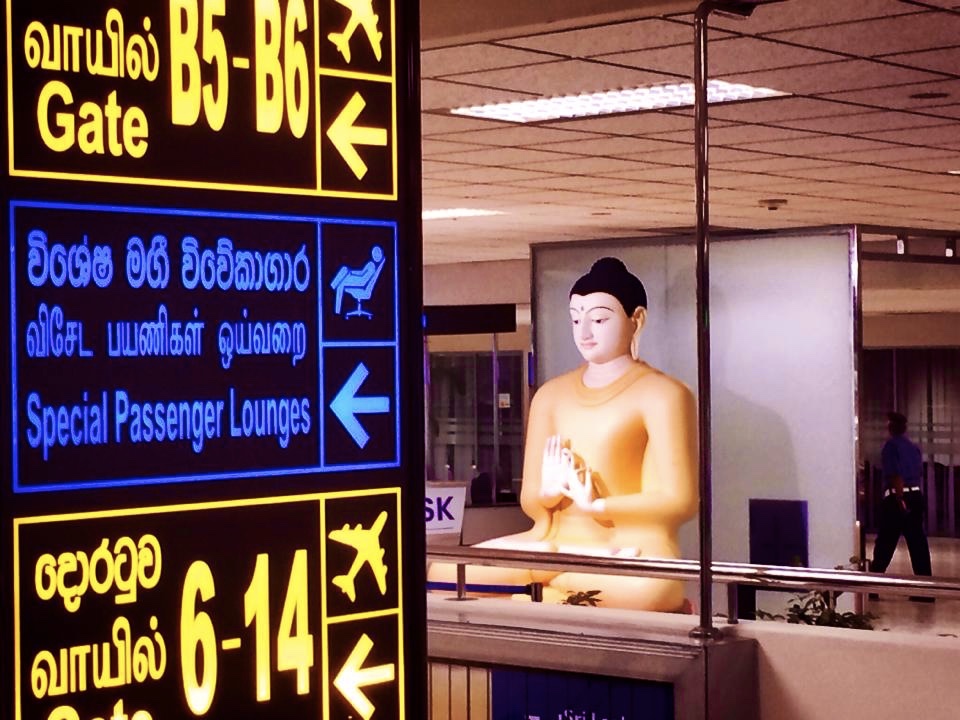
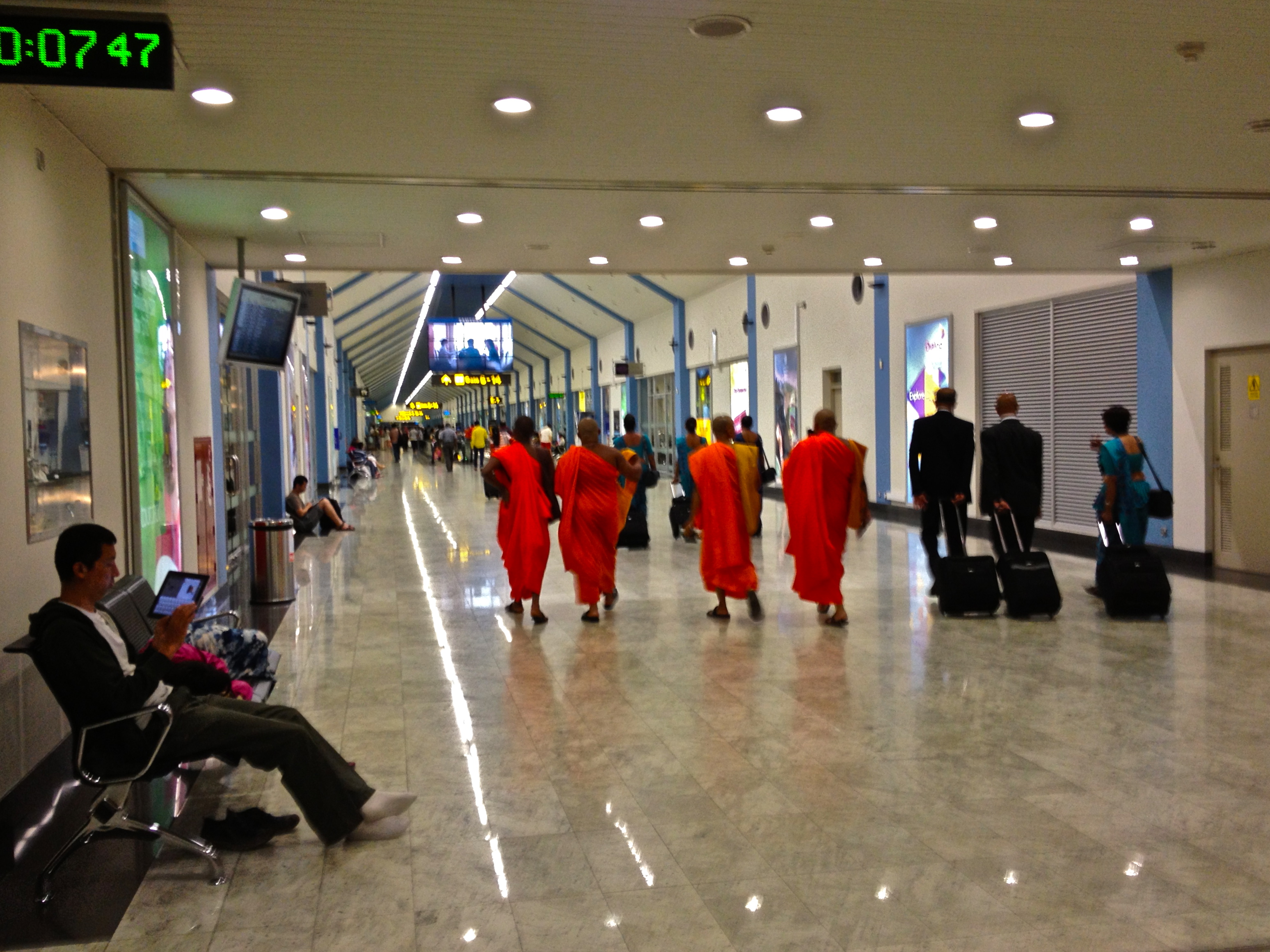
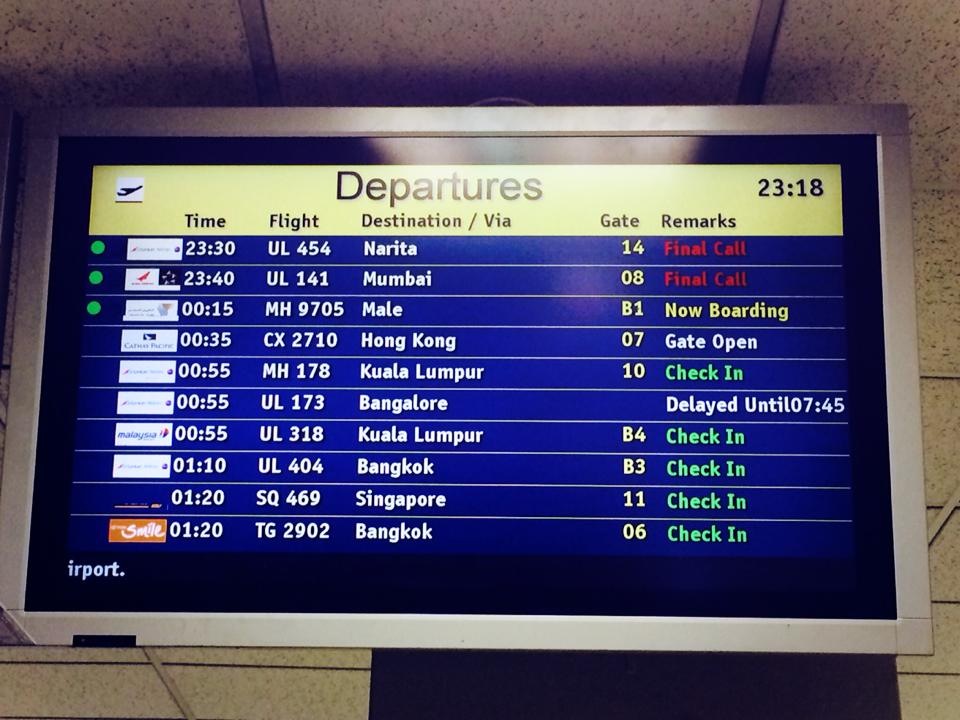
And so at 10.30pm I waited in my room. I was waiting for reception to call and to tell me my taxi had arrived to take me to the airport. Last minute brinkmanship; I could wait. Maybe the taxi was running late (stuck in traffic). There was no real urgency, after all, it was only a five minute drive. Maybe I had to ring to confirm first. At 10.45pm I gathered up my belongings and made my way down to the lobby. Maybe the driver was waiting there. It was empty. It was dark. It was quiet. The Duty Manager at the hotel rang the number I had been given for the taxi. There was no answer. He rang again and left a message on the answer phone. We waited for a short while, talking together, before he offered me a voucher for a complimentary taxi to the airport. It was a gesture much appreciated. I thanked him. Just as he was about to call a local driver, the one I had booked arrived out of the blue. It was now eleven o’clock. It was now time to go. We drove out of Colombo into the darkness, into the ending of another adventure, leaving behind a wonderful afternoon in the night. We drove out into unknown roads and unseen streets, moving, merging, turning, overtaking and arriving at Colombo international airport. This was it, then. The holiday was now over. Back into another airport. I checked in and wandered off towards the security checks. I stared at a flight board, found my flight and made my way to the boarding gate. Everything was on time.

Image by Karl Powell, The First Leg of the Journey, 2013

*