24 Magic Siena (Italia)

CIAO DE LAGO GARDA
Within a few hours we will be leaving Lago Garda. Have been here for a few days. Staying here, walking along this lake each morning, relaxing – yesterday we went exploring Venice… beautiful Venice (and if you have one obligation in this life, it is to visit Venice and to see it with your own eyes). The rest of the tour rumbles on in a few hours, onwards to Rome, along the Tyrrhenian Sea down towards to the Amalfi Coast chasing the sonnets of Byron and Shelley into the sea.
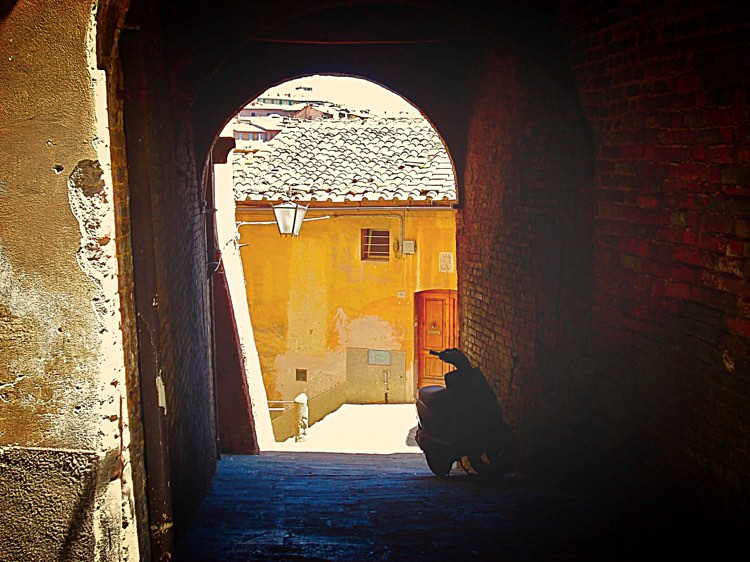
Image by Karl Powell, Magic (Siena), 2007

This morning, before the leaving, I wanted one more coffee, one more moment in the streets of Torbole as the world wakes up. I found a café, near the main square, and have come here early each morning. The street cleaners are out early brushing the kerbs, collecting leaves and rubbish; shops are sluicing the pavements with water and the owners scrub them clean. People and traffic are moving. Slowly. Buildings in front of me are painted blue – and either side of them buildings in pastel green. Another in yellow. The closer I look, the more I notice that almost all of the buildings are pastel coloured: blues, greens, pink, yellows, rose. All with wooden shutters – asleep or half awake – all with terracotta roofs. You sit and wonder and imagine who lives there. Coffee arrives. Espresso. No zucchero needed. Small birds hop between saucers and plates, eating the crumbs on the tablecloth.
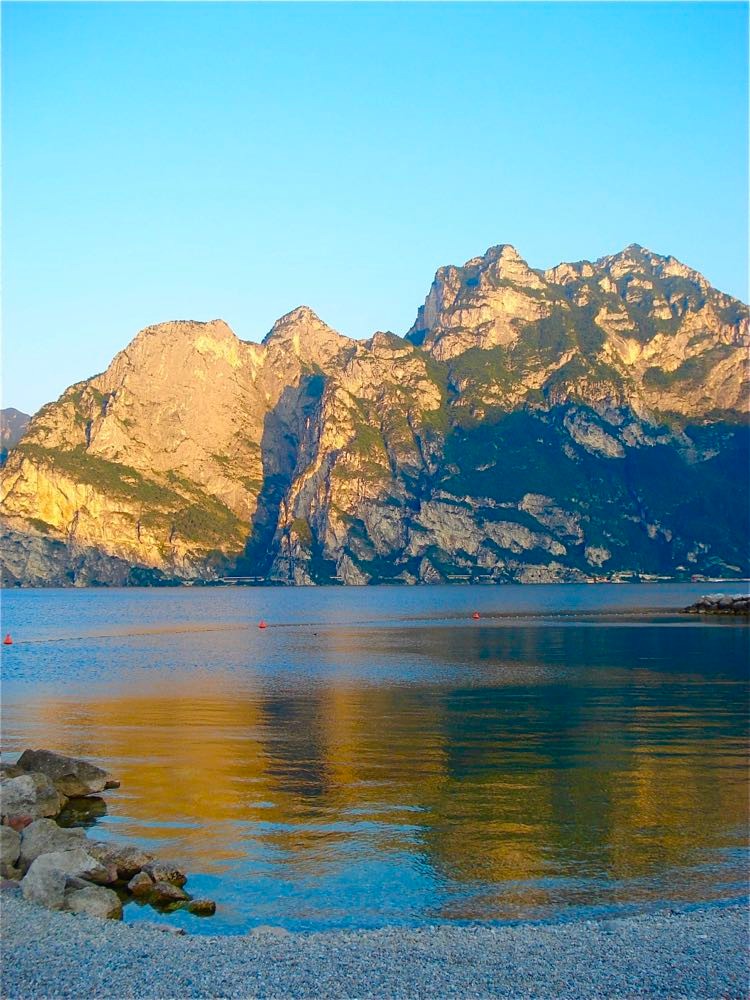
Image by Karl Powell, Sunrise (Lake Garda), 2007

The waters of Lago Garda are within earshot. The banks of Torbole rise all around. Sunshine pours down over one side of the surrounding mountains and over into the clear, still waters far out in front of me. A gentle breeze blows. Already it’s a warm wind. Ducks float in the quiet shallows; looking, preening feathers, one standing on a large stone near the water’s edge. Rolling waves gently ripple onto a shingled shoreline. A few people are up and about: runners, an old man cleaning the beach with a rake, and a lone yellow canoe gliding in silence across the water’s surface. Over to my right, giant cliffs rise up out of the blue waters and are coloured white as if the rocks are smudged in chalk dust. Tufts of green sprout in many places there, as do the clusters of villages and houses barnacled to the steep slopes. The slow descent of traffic slides down the long mountain road towards the lake; processions of vehicles moving with occasional glints and sparkles of sunlight reflecting from their windows and windscreens. They move towards the waters of Lago Garda like distant shooting stars – burning bright in some far off corner of the heavens for a brevity, then gone.

CIAO DE EMLIA-ROMAGNA
Another hot day. Watching scenery passing by, watching the world from behind a moving window. Passing fields and fields of green, which look like crops growing. The green stretches out on both sides of our bus. Endless grids of green replicate and duplicate, fanning out towards the falling sunshine at the ends of each horizon. We are on a road cutting through. Small, terracotta villages, farms, are dotted about this countryside. We never get close enough to stop, to peer in, to visit. The wheels on the bus keep going round and round. Mountains hint at being there, somewhere, flirting with our attention in the shifting mists low on the horizon. There. Winking. Disappearing. Gone. Then in a few minutes the earth seems to flatten out again and pure sunlight begins to burn the land from directly above. The fields seem to change colour and the green seems more intense, almost iridescent. Two white herons fly overhead. Lucky omens.

Image by Karl Powell, Brickwork (Siena), 2007

The driver of the bus has just announced that we should be in Siena within the hour. Not sure where we’re staying tonight, but think he said it’s close to Rome or Florence. Just looked at the itinerary: Fiuggi. Roger and Margaret are seated in front of me both looking out of the window into the sunlight. It’s their Golden Wedding Anniversary in a few days. Have really enjoyed their company on the bus so far. Have a feeling we’ll be friends for a long time; it’s amazing how friendships can establish when travelling in short spaces of time. Have enjoyed chatting with them – both have a great sense of humour and a meaningful approach to life. ‘Treat everyday as a bonus,’ – he’s said that a few times. He’s cracking jokes now, she’s telling him to lower his voice. There’s another couple on the trip, sat further down the bus, who like to talk about their wealth, what they’ve achieved and who they know; they both actually fell into a gondola at Venice the other day (which some of the other travellers saw). Roger’s laughing to himself and says something which I couldn’t hear – Margaret tells him to ‘shhh’ and opens a magazine to read.

The bus is quiet again.

Horoscope in Monday’s newspaper says: You are smart enough to strip away the flattering words and see what is really on offer before you make a choice. When it comes to love, a heart-to-heart chat is the start of good things, creative skills linked to writing or voice-recording opens the way to new successes. The paper has aged during the journey; it feels well-read, dog-eared, folded, thinner but the ink still smudges on your fingertips (the print is still alive).

Image by Karl Powell, Tuscan Sun (Siena), 2007

CIAO DE SIENA
Am sat near the pick up spot, on a wall, close to the Porta San Marco, high up on a vantage point looking out over Toscano. The bus to Rome departs here at 3.15pm. Behind me is a postcard of blue and green. Tufts of shrubs dot about the flat green grass carpeting over the rise and fall of the land. Tall, dark green cypress trees rise up and stand out – many surround the storied boxes of buildings, bunched up in burnt brickworks and sunlit shadows. The sky has a blue so clear and pure that it shines without apology, stretching above and overhead with colour – little wonder Shakespeare’s Hamlet was moved to described it as “this most excellent canopy… this brave o’er hanging firmament, this majestical roof, fretted with golden fire.” What an unexpected surprise Siena has been. I hope the impression it has made on me never fades – I hope on some dismal, overcast day I will remember to close my eyes and travel back here in my memory and walk these streets and feel this same sense of wonder.
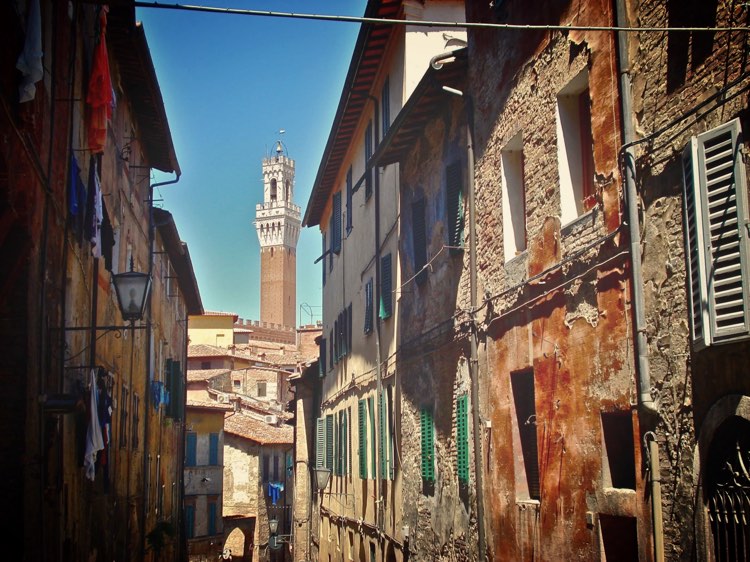
Image by Karl Powell, Torre del Mangia (Siena), 2007

Our day here began here, close to the Porta San Marco. We were all keen to get to the Duomo di Siena and to see the Piazza del Campo. There was enough time to do both before the bus departed. Together, we all walked up a long street, which stretched and twisted, changing its name, changing its course, eeling, merging eventually into the Via Giovanni. It led up into one of the corners of the Piazza. At every step, every pause, every checking of our maps, the Torre del Mangia remained a fixed pole star above the rooftops. That was our destination. Warrens of side streets ran off in haphazard right-angles, leading up, sloping down, offering shade and arches, alleyways and allurement. Scorched old bricks, piled high on top of each other, homes within, parchment plaster peeling and sunburnt, colours singing in the heat. The imagination wandered and dawdled in these old streets, wanting to stay, to conjure scenarios, to create visions of living there. The quiet windows and doorways concealed so much. The heart began to beat that much deeper.
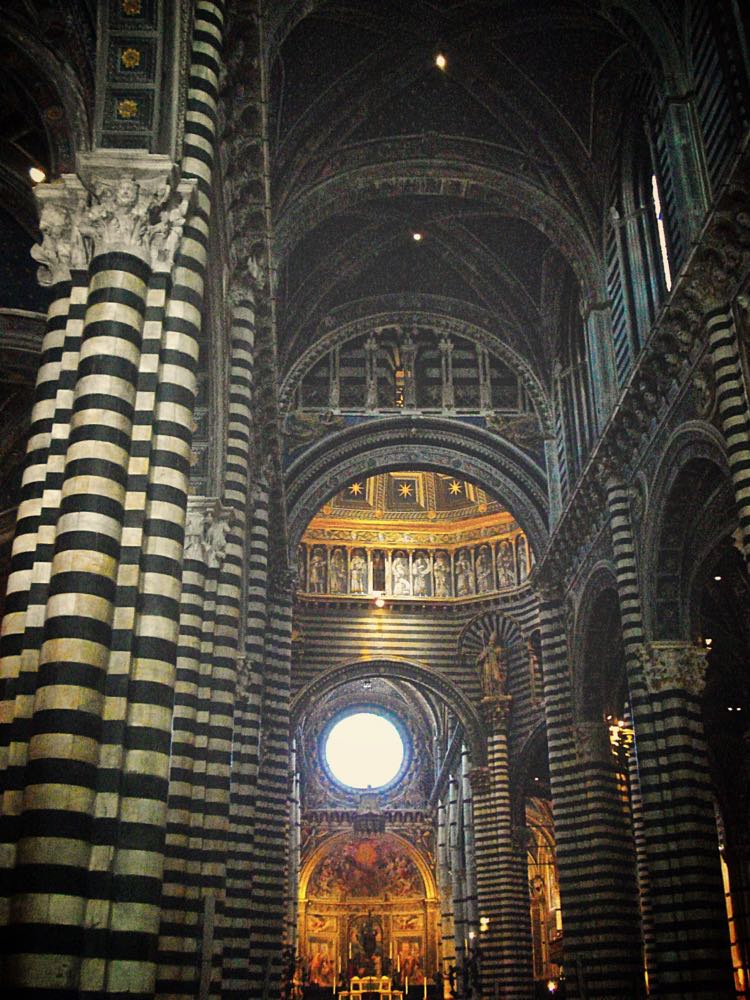
Image by Karl Powell, Inside the Duomo (Siena), 2007

At the Piazza we all went our separate ways. I did a circuit around the surrounding roads and shops. Eventually, I sat and had lunch in the shade, beneath arches, surrounded by voices speaking Italian, German and English (that I could hear). I watched a woman in a purple dress, black shoes, walk across the piazza towards a one-way street. She disappeared into the side entrance of a shop selling paintings. Sunshine reflected on the gold trim of her sunglasses for the briefest of moments before she disappeared. Afterwards, I found my way up to the Duomo and went inside. The air was cooler, a silent refuge from the heat. The air smelt sweeter and the space rose up towards a canopy of golden stars collected from all seven heavens and painted onto the ceiling, hoisted up by giant marble columns hooped in black, white and gold stripes. The floor, where I entered, had a mosaic of Hermes Trismegistus receiving divine gnosis – some of the alleged origins of hermeticism, alchemy and the Arts. And now, sitting on a wall, close to the Porta San Marco, our bus arrives. I see Roger and Margaret – they wave and are smiling; they loved Siena, too. Roger tells me he that he got talking to someone that told him that the Piazza is used for horse racing and a flag throwing parade and that we only just missed the festival by a few days.

Image by Karl Powell, Via San Agata (Siena), 2007

ARRIVERDERCI
Over a decade later and I still remember our goodbyes at the end of our bus tour around Italy. There were some wonderful friendships made on that trip, some wonderful moments. Siena had been at the start of the journey; we then ventured on to Rome, then down to the Bay of Naples before driving back up towards Florence, Pisa and then the Alps. In the two weeks that the journey took place, my friendship with Roger and Margaret continued to grow. There were other friendships and one evening we all celebrated their 50th Wedding Anniversary with a bottle of champagne, but it was Roger and Margaret I ended up keeping in touch with. They were just lovely people who I was lucky enough to cross paths with for a moment in time. As our bus arrived at Dover the coach became edgy, falling silent, everyone looking out of the windows, starting to say goodbyes and swapping addresses. It was sad as you knew you’d all never be in the same place all together again. Maybe never see them again. But everyone had been a part of each other’s journey. Then it was time to go our separate ways. Goodbye, goodbye, goodbye. Keep travelling. Keep looking for what it is you’re searching for. Treat everyday as a bonus. Then the silence. And we began to make our own ways home.

*

– Vale: Dedicated to Roger Fox –

23 The Blue Buddha (Sri Lanka)

FIRST IMPRESSIONS OF BENTOTA

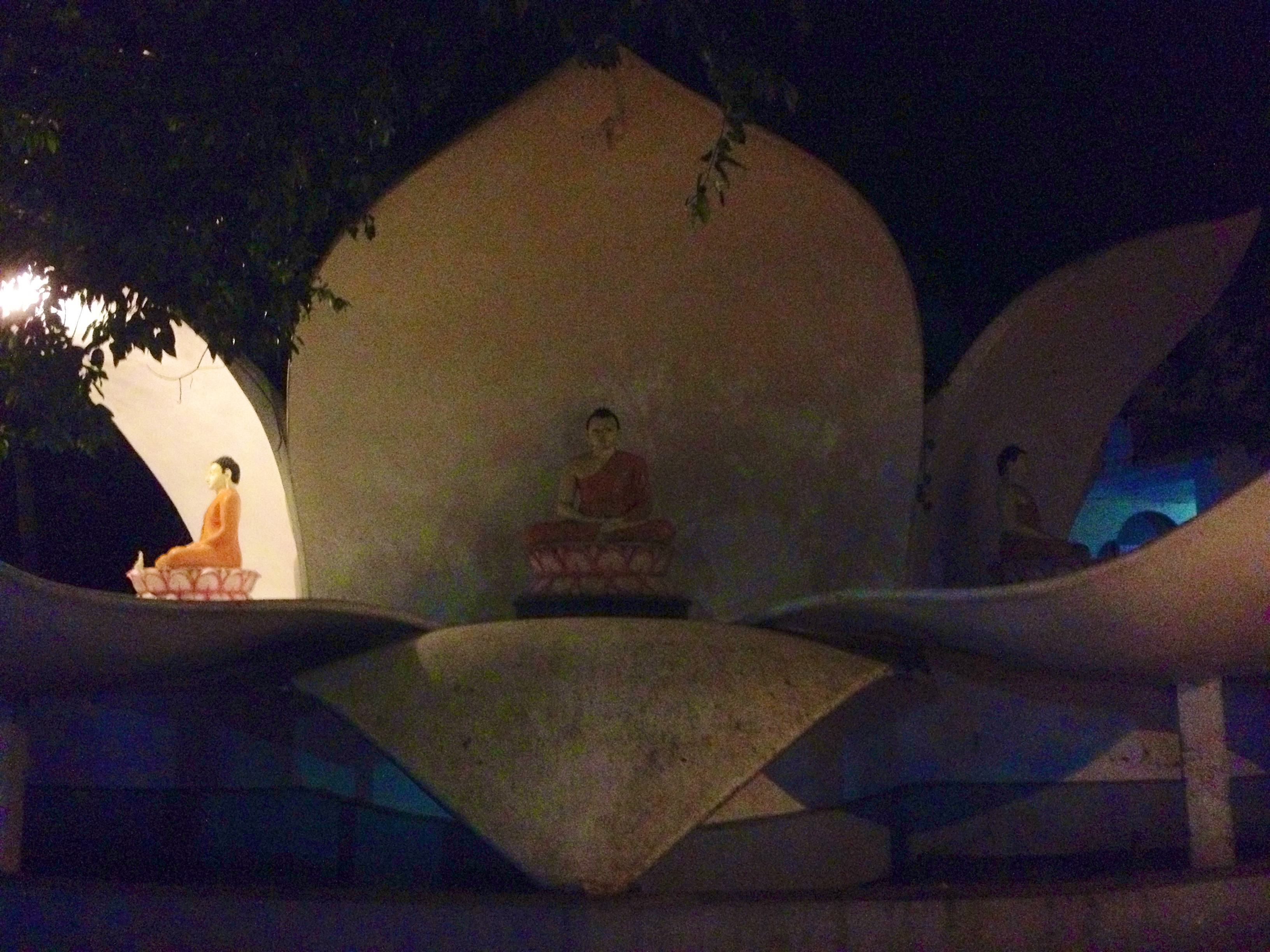
Image by Karl Powell, Temple at Night (Bentota), 2013

Towards the end of my first night at Bentota there had been singing sounding in the night sky. Just as everything softened to that blue-grey hue that coats the visible world once twilight arrives, there had been singing – chanting – sounding from somewhere. It was being amplified through a speaker, or a tannoy, carrying it through the air. Spoken words, prayers, devotion all dissolving into darkness.
A waitress at the restaurant where I’d eaten had told me there was a festival happening at a nearby Buddhist temple (it was due to the full moon). She told me it was within walking distance and that ‘You are welcome to visit.’ I tried to find the temple that night but never did.

Occasional drops of rain still hit the earth in scattered crashes – afterthoughts from a long, heavy downpour that had begun around dusk. Floor tiles and walkways were still wet, still slippery – almost glossy – with moisture and humidity. Low, sodden clouds dragged their bloated bodies across the unlit heavens, insulating all the sounds below. And there were so many sounds giving vibrancy to the night: birds sung their slow songs of gratitude for the day, insects chirped, frogs croaked. The rain fell. The day had ended. And in the midst of these things, the sound of singing carried on chanting into the fading light of Sri Lanka’s south.

Had I known the way to the temple then I’m sure it may have been within walking distance. But out in the unfamiliar settings it didn’t take long to become disorientated and lose heart in the adventure. Everything had looked so different in the dark. The gardens between my room and the restaurant had become a concussion of towering shapes and labyrinthine shadows. Small yellow lamps, set low in a wall scattered a burr of soft lights – casting circles of silent halos along a stone footpath and its flat-leafed plants. Trees rose up overhead in great sprawls – mostly palm trees fanning their outlines against the night sky. Three giant coconut tree reached up high – so high – mediating the worlds of darkness and downpour. Beyond that, the parameters of the unknown stretched out in all directions.

Image by Karl Powell, Night Train to Galle (Bentota), 2013

And then, rain returned, heavier than before. A million diamonds of raindrops fell from the sky. An evening train thundered past with its white headlight embellishing the downpour; the railway track ran cleavered Bentota in half, the train moved through the darkness down towards Galle. The sound of the singing could still be heard. A tuk-tuk took me back to my room. I tried to explain to my driver, what I had been looking for and about the sounds I had heard. He took me to a small, illuminated shrine near the side of the road, close to the railway track, but no one else was there and there was no singing.

That night I fell asleep listening to the sound of the chanting. It echoed in the air, blending with the falling rain and the sounds of the Indian Ocean. I remember waking once in the small hours and saw the light of the full moon shining on the tiles of my room but by then the singing had stopped.

IMPRESSIONS OF KANDY

I thought no more of that temple until my penultimate day in Sri Lanka. Over a week had now passed and I had seen so much – yet barely scratched the surface. This island required a more significant investment of time to fully immerse, explore and to fall deeply in love with it. My desire to see more of Sri Lanka led me to book a full day excursion to the ancient Sinhalese kingdom of Kandy, driving through the Hill Country in the Province of Sabaragumuwa. It was to be a long day’s drive. I knew that (and on reflection, perhaps, should have just stayed local for that last day – to watch one last sunset on the beach or something – but when you’re aware of the brevity of time, occasionally, you overstretch yourself). On reflection, my day to Kandy was one which was rushed, yet there are no regrets.

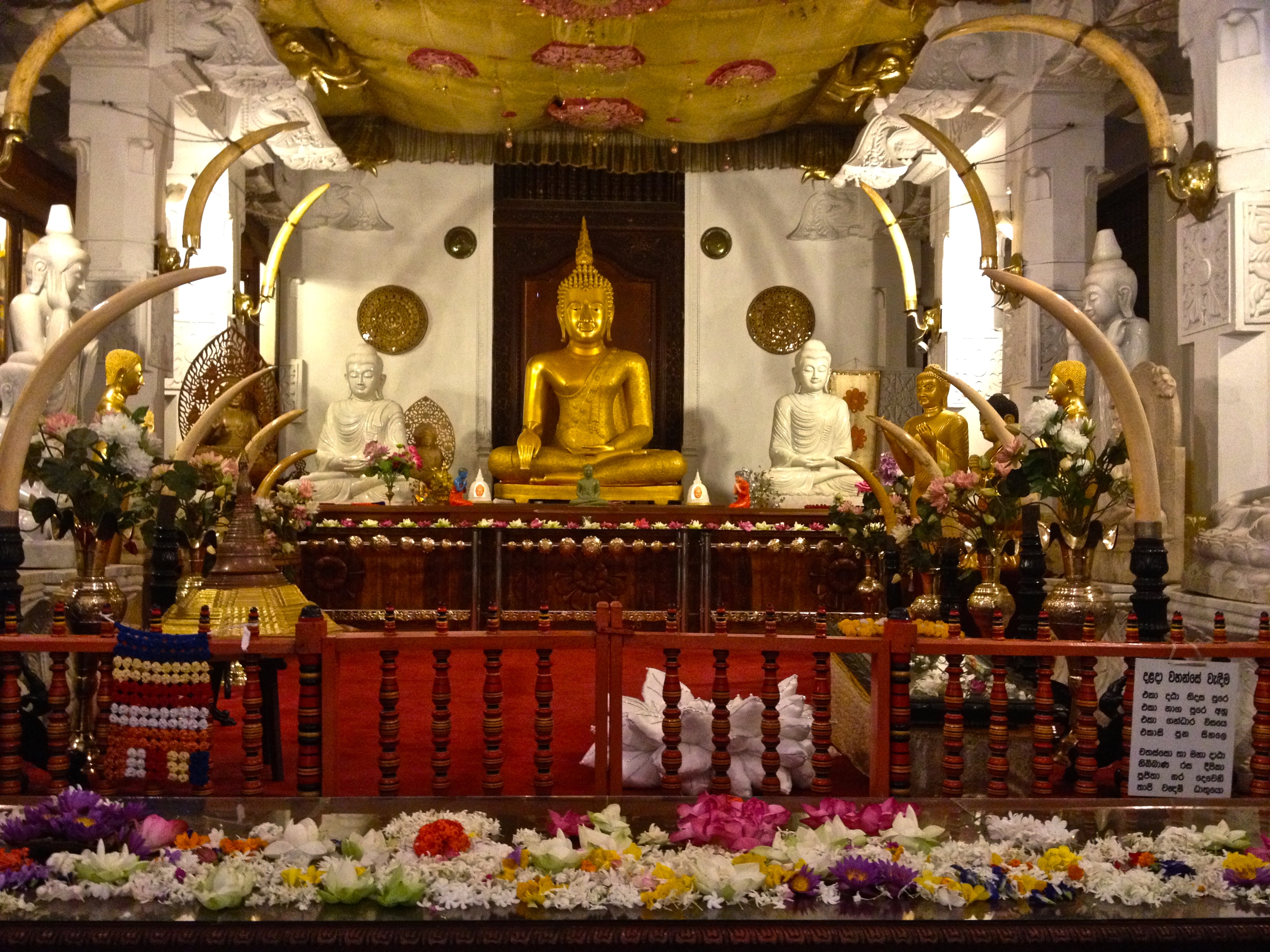
Image by Karl Powell, Sri Dalada Maligawa (Kandy), 2013

My driver had collected me just after breakfast. That morning, like most mornings there, I had eaten a large breakfast: yellow coconut rice, some dhal curry, a coconut relish with roasted chillies; there had been an egg hopper, too, some brinjal pickle and kottu rotis. It was delicious food – and I had found that eating this had kept me sustained for most of the day. The trip was scheduled to arrive at Kandy around midday (which we did) and return to Bentota late afternoon. But as we drove back to our point of origin, the vibrancy of the blue sky became lethargic, and the advent of dusk brought hues of colour to the horizon; it became apparent we were still at least several hours away from returning to the south. Headlights began to blink into life on the road in front of us. Soon, the motorway would be in darkness.

In that fading of light I decided to try and write down my impressions of the day. I wrote quickly as the recollections presented themselves to me in a snatched grab at the disorganised chronology of the day.

BENTOTA TO KANDY: passing small villages (some busy, some quiet); houses with small, window balconies overflowing with plants bearing flowers (colours of pink, white, purple, red); roads running through them like threaded beads on a necklace; roadside stalls selling brightly coloured rugs, fruits; there had been a tall, green mosque standing between two houses; a passing bus had ‘welcome’ written above  its passenger door.

OUTSKIRTS OF KANDY: the greenery; the palm trees; openings of forest and fields; singing greens and floating clouds; narrow bridges over long, flat rivers flanked with banks of dark, green leaves and vine; we passed pilgrims walking towards a large statue of the Buddha (traffic stopped on the wet tarmac to let them pass).

Image by Karl Powell, Sri Dalada Maligawa (Kandy), 2013

KANDY: cool air, clouds numerous; drops of rain falling from cushioned mist, landing in large, flat puddles – patterns of circles expanding out across the water’s surface. Beautiful Kandy. A large lake in Kandy; flat, calm waters, deep bottle green; buildings and mountains surround; clouds seemed lower.

INSIDE THE TEMPLE: A guide met us and took us inside the Temple: lots of people outside the temple; shoes off; walked inside – lots more people; colour, carvings, beauty; buildings within buildings; mantras on moonstone; saw the relic of the Buddha (locked in a casket); monks, robes, shrines; garlands of flowers, every colour imaginable, golden buddhas (eyes lowered in meditation). After the tour, we were ushered back into our vehicle for the drive back. Wanted to see more of Kandy. We had to drive back.

Image by Karl Powell, Sri Dalada Maligawa (Kandy), 2013

Then the daylight gave up entirely and it become impossible to see the words that were being written down. So I stopped. Staring out into the darkness of the landscape and motorway as they merged into one, my final impression of Kandy remained in my mind’s eye, unable to be committed to paper. After leaving the temple I had paused before stepping into our vehicle back to Bentota. My eyes had followed a road running away, downhill, from where I stood. It was a street full of people, colour and life. In that moment, something within me wanted to stay just a little longer – just to wander there and to be a part of it. But there had been no time. Everything had been hurried. Maybe one day I could return there, for a longer stay, and maybe travel by train from Colombo to Kandy to savour the journey and see more of the island. One day.

THE BLUE BUDDHA

The journey back to Bentota was punctured with a stop at a roadside service station. We were here for about 30minutes. My driver, Dharme, and I shared a table. My body was tired. His phone rang several times. We ordered biryani and bottles of water. We sat and ate as we spoke about our lives. He told me about his family, his children and his hopes for their futures. As we finished our meal he rang his wife and told her that we would be returning in around an hour. The red LED clock in the car told the time of 7:33pm. Then once again we drove into the darkness. As always, whenever we passed a Buddhist temple or shrine on the final leg of the journey, Dharme continued to clasp his hands together in prayerful reverence (like a Namaste or wai gesture) and spoke something. We reached the outskirts of Bentota a little under an hour later, and as we approached familiar surroundings he asked me if I would like to visit the temple where he and his family prayed. It was late, and I agreed.

Image by Karl Powell, Reclining Buddha (Bentota), 2013

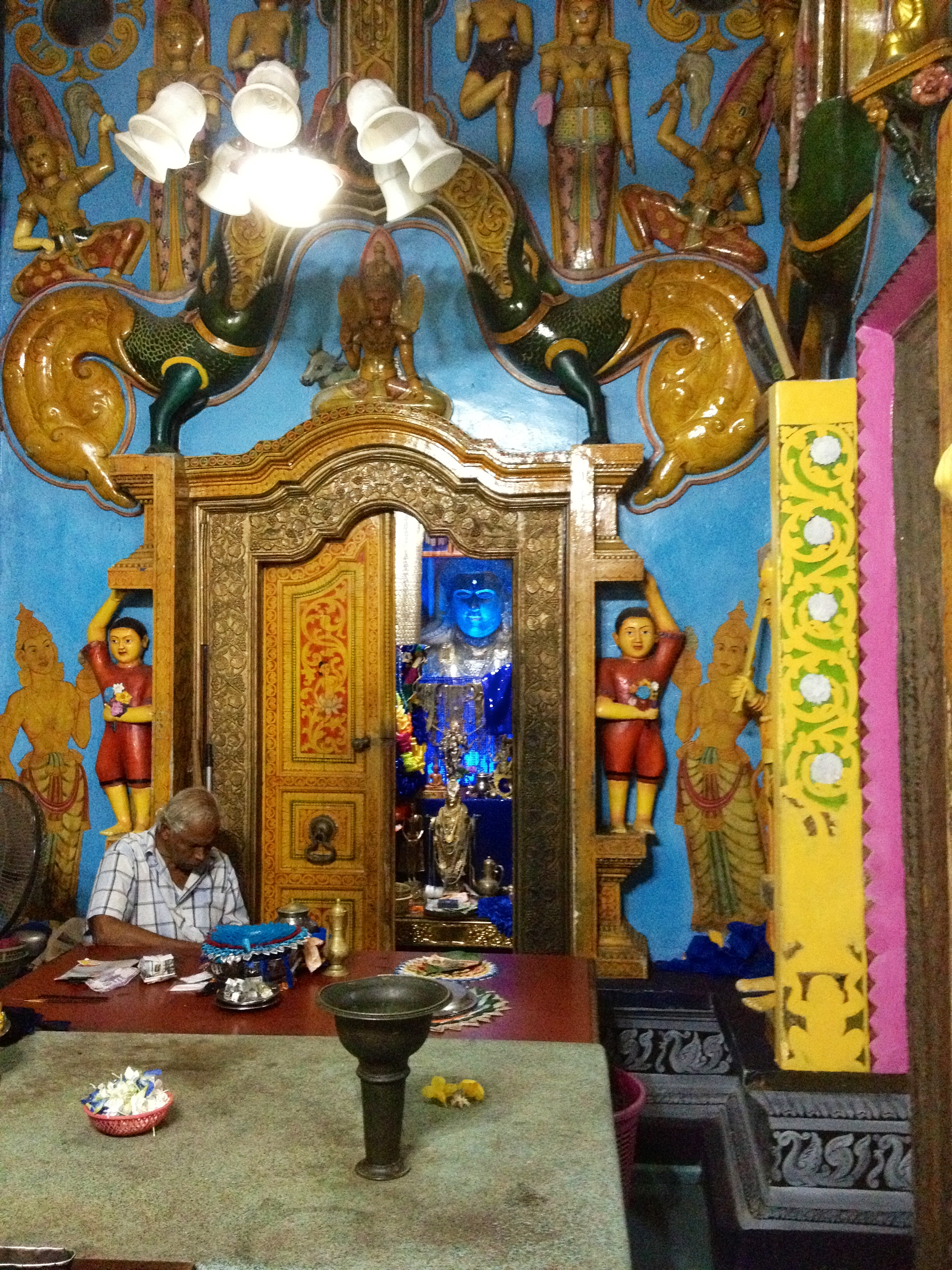
We approached the temple in darkness. A road led upwards towards a large, empty carpark. A giant statue of the Buddha, dimly lit, sat gazing out into the darkness behind us. Petals of the lotus flower surrounded the sculpture. And there I saw moonlight and palm trees moving in shadows. And then I was led inside the temple and saw colours and flowers, painted walls, painted images and symbols, rooms within rooms, doorways leading inwards and along, seated Buddhas, reclining Buddhas, I saw Sinhalese script etched onto painted walls aged and fading in patches, I saw patterned tiles, I saw serenity and beauty abide in this place, I saw a young man alone kneeling in a room without lights holding incense as he prayed, I saw the silhouette of a dharma wheel illuminated by candles against a red silk drape hanging against a wall. I saw an old man at a desk writing in a book and behind him a large wooden panel cut into the wall, with one door ajar and a blue Buddha statue facing outwards.

Image by Karl Powell, Lotus Leaves (Bentota), 2013

Back outside, in the grounds of the temple, there was a pervading sense of peace and stillness in the quiet night. Clouds of incense curled and perfumed the night air, sticks stuck in a broad vat full of sand burnt near several rows of small, lit tealight candles each with a flame dancing in silence. The more you looked, the more candles and flames you saw. There in the silence I tried to take a photo to capture all this, knowing it would never hold the moment I was witnessing. A seated dog watched me use my camera. It sat between the candles and the incense, the flames reflected in his eyes. And I saw that the dog was not alone, there were other dogs and even cats beside him, seated, sleeping, resting together. And time just dissolved and collapsed in on itself the way that it can do when depth becomes a part of its nature for a brief moment.

Image by Karl Powell, Blue Buddha (Bentota), 2013

I asked my driver, as we left the temple, if there had been chanting here the previous week. He wasn’t sure. It began to rain as we finally arrived at Bentota.

*

22 Sunsets of Rottnest (Australia)

LAZING ON THE SAND
Must be nearly six by now. There or there abouts. The late afternoon stretch to sunset has somehow lumbered into being – dragging itself from out of the bite of the white hot heat of the day. The air feels easier to breathe. The sun seems more relaxed now. The whole world – horizons of sky and ocean – are seared blue. Every shade of blue. And blue they will stay.

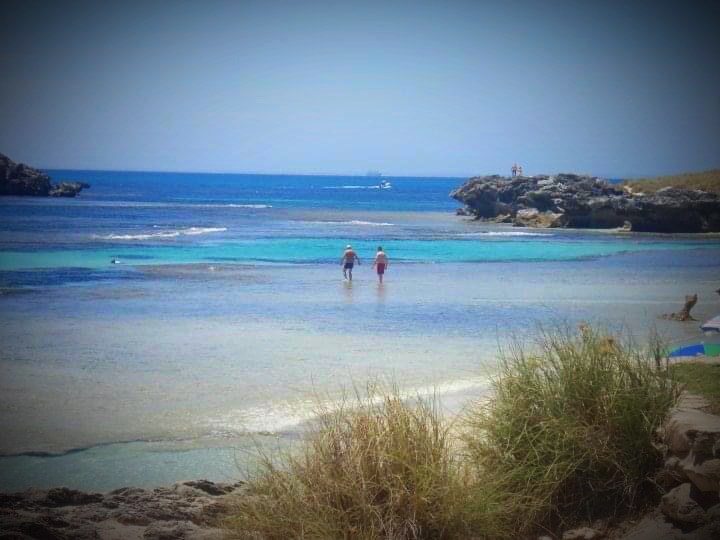
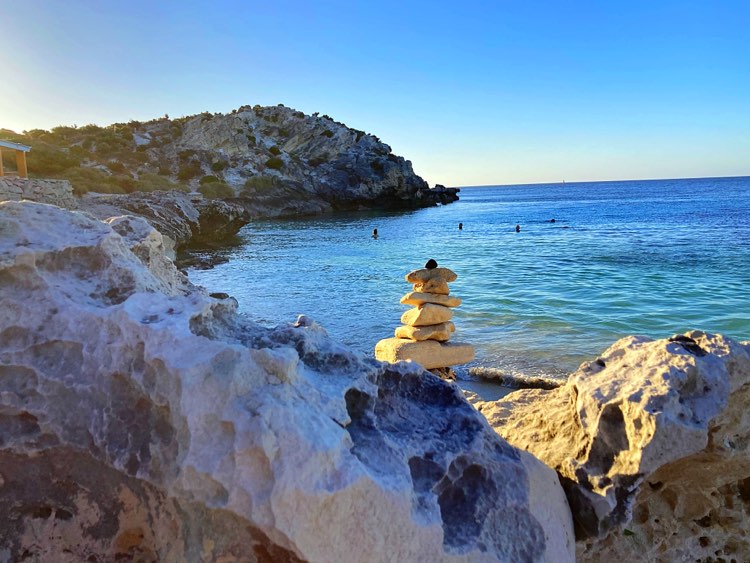
Image by Karl Powell, Indian Ocean, 2009

Down at the jetty, down at Thompson Bay, the ferries were readying to leave, readying to depart, returning back to Fremantle, North Port and Hillarys. Hot tarmac and summer heat shimmered, boats floated, growing queues stretched, bikes rested in rows patiently waiting to be hoisted on board those vessels heading home. People slowly file on board. Those on the outdoor, upper deck turn to face the island. Some laugh in groups. Many are lost in their thoughts, watching the honeyed light soften in the  sky.

Up at the Settlement all had been busy. It had had an air of chaos to all its moving parts – the kids, the crows, the bicycle bings. People sitting and eating, talking and calling. Noise and colour moved in and around the shops, merged and blurring, sometimes sounding the echoes of peacocks from over at the Lodge. A table had made itself vacant and I sat down there to open my bag and to drink from a bottle of water I had carried in there. Lost in the moment, sat in the shade, a woman came and sat at my table opposite me. She looked at me until I looked up. Two brown eyes I recognised. Lost in the moment, sat in the shade, we said everything that needed to be said with our smiles. She spun a shell upon the table and our hands met. Lost in the moment, sat in the shade, she looked into my eyes and everything in the dream said, I’m in love with you.

Image by Karl Powell, The Basin, 2009

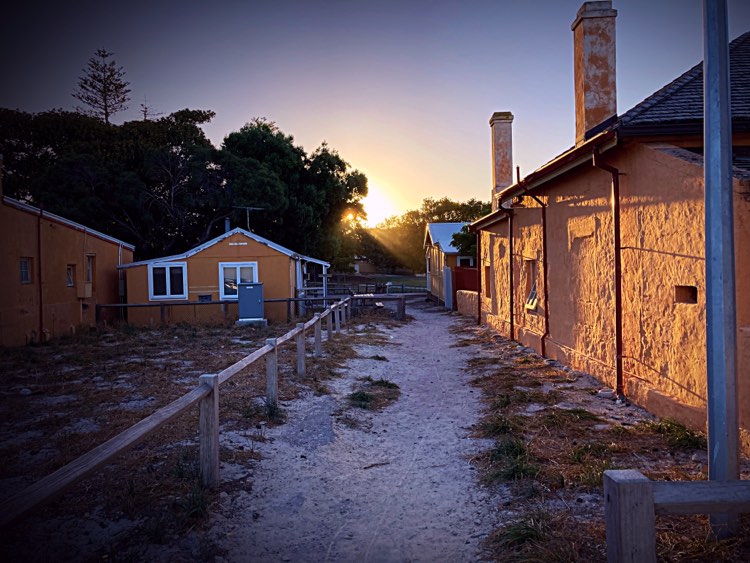
The path out of the Settlement had led forwards, then split and fractured and meandered into several different directions. Orange chalets with white, wooden verandas were dotted about in the dust of the day’s heat. Busy villas overlooked the still waters of Thompson Bay. Pelicans glided across the serenity of gondola waterways. We walked towards the ocean, through a grove of silent trees, over holy ground, along the perimeter fence of an oval. Bicycles flitted past. Quokkas hopped in the bushes and on dried leaves. Sand had began to appear at the edges of the tarmac. And so we left the moment and walked on into the sunshine, moving towards the Basin and down to the ocean waters that pooled there. Giant Norfolk pines rose up before us as silhouettes. Rows of mounted bicycles stretched across, locked and parked (helmets hanging from handlebars). Below, just below them, the sound of waves called. And everything became blue again.

Image by Karl Powell, Silhouettes, 2019

AT THE BASIN
At the Basin the tide was right in. Never seen it so high. The sky was high and wide and everywhere all at once. All clouds had evaporated long ago. The air was hot and smelt of salt water and sunscreen. The waters of the Indian Ocean, as always, were charged with magic. Patches of dark blue allowing long, flat sheens of dancing colour to illuminate and float beneath the sounds of crashing waves. Far beyond them, rolling waves curled and foamed over surrounding reefs hiding in the depths.

We found some sandstone rocks to sit up on, perched up, looking down onto the sand. They were comfortable enough to sit on. Warm rocks, roasted all day by the January sun. Hardly an inch of sand to spare. Normally there was ample space, gaps and pockets among the towels to sit and stretch out. If the tide was right out then it was possible to walk across the reef, ankle deep, out towards the blue and dive off into its endless silence.

Image by Karl Powell, Low Tide, 2009

There was a big, white lighthouse basking in the sun at the far end of the beach. It was mounted on a cluster of rocks, barnacled and bleached by the sunlight. In my line of vision, bloated waves rose up and smashed their moving topaz against the protrusions of limestone stuck in the sand; wild sprays of rainbow coloured the air. Foam and ocean fell to the shoreline. Then long lulls of silence lapping up onto the sand. The air barely breathing. Nothing hardly moving. The fingers of nearby palm trees desperately seeking something to breeze through them. But only the waters were moving. And those waters shone with its divinities of blue – tinted gins, Moroccan majorelles, clichés of turquoise.

Image by Karl Powell, Blues, 2022

A lone seagull flew overhead. I watched its shadow move across the floating ocean. The bird eventually dropped to the sand, just where the shoreline soaked itself into saltwater. It walked about looking for insects to eat until one enthusiastic wave almost claimed it. And just beyond the reef, a boat full of young men played music; they took turns in occasionally jumping off into the blue. I watched for a while, then their music stopped suddenly and the silence encroached again. Several unsuccessful attempts to start up the boat’s engine engulfed the vessel in choking billows of black smoke. It drifted and twisted for a while before the engine revved up again and then took off slowly around the lighthouse back towards Thompson Bay. There were now only a handful of people remaining; some dotted about the sand, most in the ocean, a few snorkelling around the reef. A small child was throwing a tantrum because his snorkel was not working (his face mask was leaking water). His arms were waving everywhere in frustration. Eventually he threw it into the sand and sat on a towel (ignoring his family’s calls to return to the water).

INTO THE BLUE
And so into the blue. Into the Basin. Cool, cool water, endless and weightless. Stillness and silence. Great drapes of sunlight moving through the floating depths. Fish shimmer nearby. I touch the seabed with my hands, my fingers churn up clouds of sand. Like a mermaid she swims beneath the rolling waves. The slender shoal of long, black hair dances in her every move. The world glints in sea-soaked sunshine. Buoyancy brings us back to reality. She pops up in front of me. I feel her arms around my neck. We kiss. She tastes warm and of the salt water. Her body shines with the ocean dripping from her skin. And that kiss loses itself somewhere between the one hundred sonnets of Pablo Neruda:

There where the waves shatter on the restless rocks…

  Al golpe de la ola contra la piedra indócil…

You and I, amor mío, together we ratify the silence…

  Juntos tú y yo, amor mío, sellamos el silencio…

…we make the only permanent tenderness.

  … sostenemos la unica y acosada ternura.

But these were the dreams you had to follow. These were dreams that ached for you to find them. These were dreams you had to realise to touch.

Image by Karl Powell, Sunset at Basin, 2022

EYES CLOSED
Back on the rocks, above the sand, sleeping in the late afternoon. Side by side. Eyes closed and the sound of the ocean keeps calling. Feels so good. Rhythmic lullabies, hushing and moving. Sun feels so warm on my skin, can feel its warmth on my eyelids. The ocean keeps calling until I sit up and look out across it. Waters in the shallows crash then criss-cross and sigh at the shoreline. Sunlight dances through them. Shells are spinning on the beach, smashed corals within the sand (whites, yellows, oranges – flecked and speckled, pinks and greys); some shells are left upturned on their backs transformed into hollowed cups of seawater. A big wave rolls in from the depths. Over to my right a fisherman casts a line from his yellow fishing rod out into the sea. Pockets of sunshine glow in underwater iridescence, shining bright in the navy darkness. A white yacht sails across the horizon from right to left. After a few more crashes, the world is silent again. Over to my left, above the rise of rocks crumbling down to the ocean, the sun has started a noticeable descent; it’ll end up behind them within an hour or so. The sand is already tinted with pinks and softer hues. Hands touch hands. Eyes close again.

Image by Karl Powell, At the End of the Day, 2022

THE STARS AT THE SETTLEMENT
Colours fill the sky. The blue is there, but fading, waning. The sun is setting behind the island coating the landscape in golden warmth. The sun burns its last in a large orange glow. Silhouettes appear everywhere. The lightest of evening breeze skims across the surface of the water. A small boat pulls out. A man in a denim shirt stands on board skippering a voyage into the dusk. Over at the hotel a string of coloured fairy lights and lanterns sway, illuminating the branches there. And you feel so relaxed because after only a few hours this feels like an entire holiday. And you feel so happy when you overhear a girl ask a guy if he’s still here tomorrow night. And the day is ending. Looking at the blinking lights of the buoys anchored in the bays I know I’m in love with you. What a way to watch the day end. The words begin to leave you bit by bit by bit. But I’m in love with you and everything is so quiet and so very peaceful. Grains of sand stick to the skin on your arm. And the stars begin to shine. These are the things that can last for only a day. And I’m so in love with you.

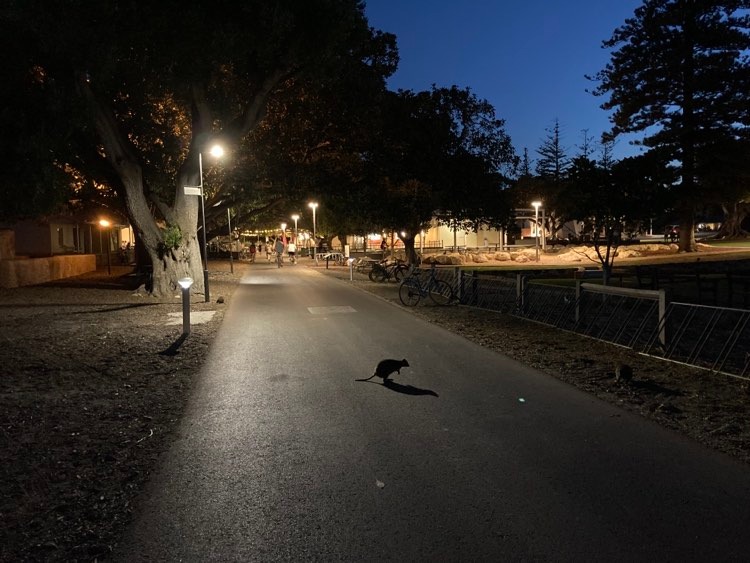
Image by Karl Powell, Quokka at Night, 2022

*

21 Tapas in La Manga (Mar Menor)

MANAÑA
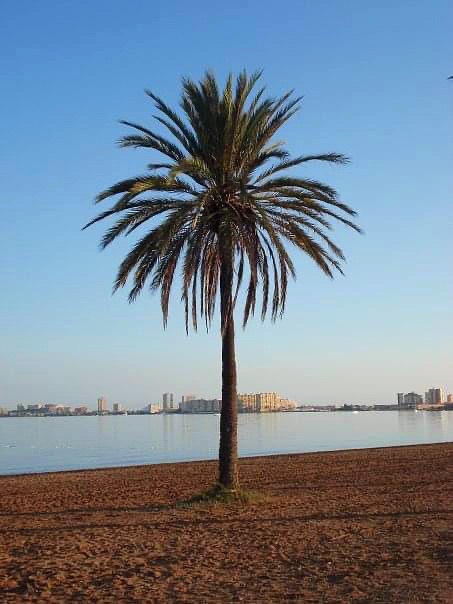
Quiet. Calm. Dawn. Mornings in La Manga always emerge from this silence. Sat on my balcony overlooking the lagoon and its five islands. I drink the first espresso of the day and try to write as half the world still sleeps. Waters at the beach do nothing. Waters in the lagoon do even less. Over on the salt flats pelicans and flamingos move slowly in this early morning light. The air smells cool and refreshed. Doves coo from nearby trees. Small birds chirp softly, hidden in the shade and leaves (still entwined in the dusks of dawn). In front of me I count again the five nearby islands protruding out of the Mediterranean blue; chunks of rock, conical shapes, towering cliffs. Palm trees rise up towards the light, columns of silhouettes, grouped in bunches of threes and fours, reaching upwards for the morning. The ocean continues to do very little; just pushing itself ashore with no effort, only seeming to reach the shoreline as an afterthought, waves that never break, water arriving on sand with a quiet sigh before dissolving forever. A dog barks somewhere in the distance. Morning has broken.

Image by Karl Powell, Mar Menor, 2007

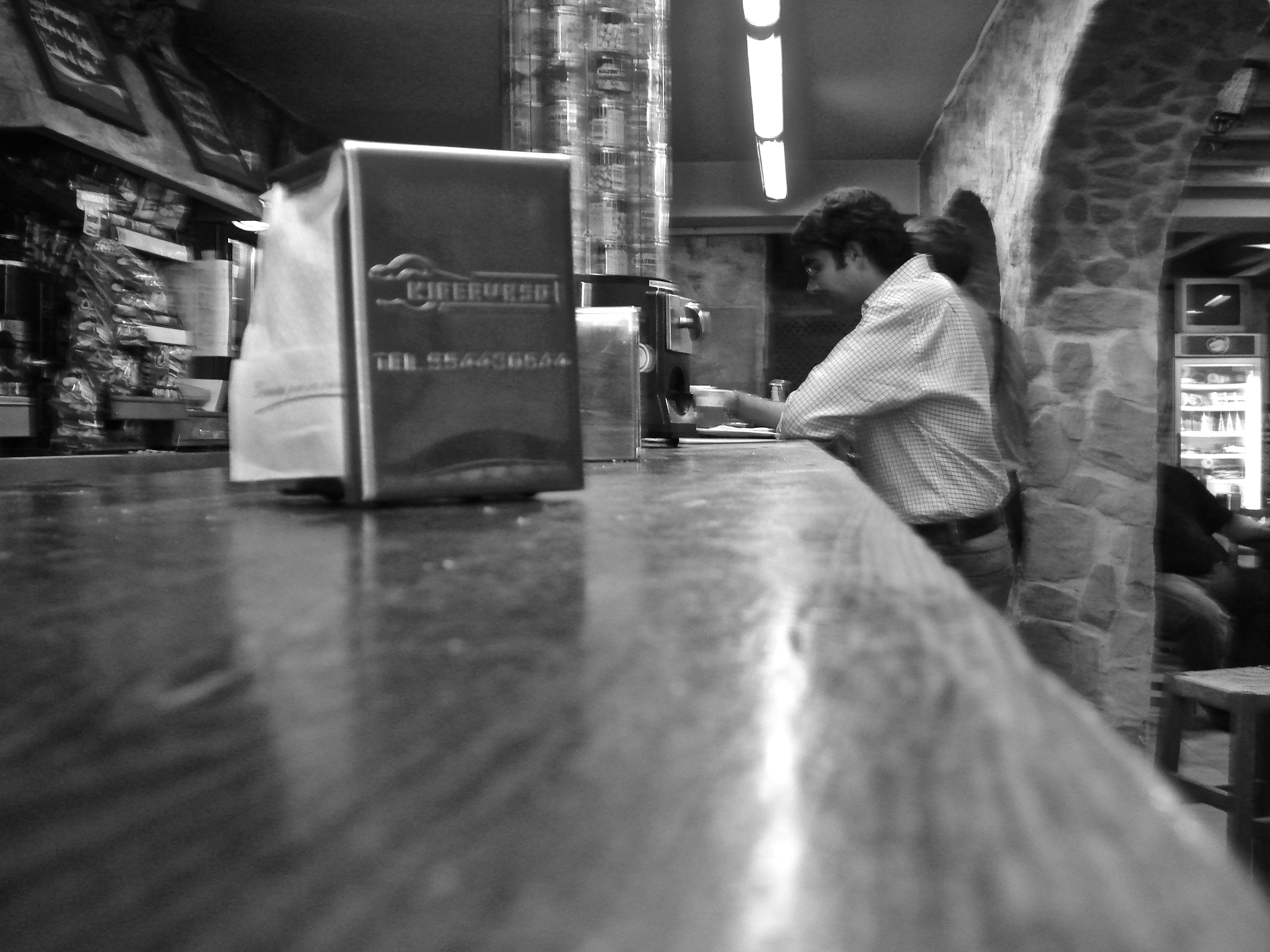
Found a café for breakfast. Mesón Casablanca. Not far from the lagoon, on the beach at Playa Honda. The morning sunshine reaches in and wraps itself around the building. The day still stretches out wide across the beach, yawning across the flat waters we face out onto. Like others here, I am sitting up at the long sturdy bar running along the length of this room, passing a series of hot grills and plates, coffee pots and white demitasse cups, bottles of beer and rioja, cut legs of jamón hang from the ceiling – partially obscuring the television screen which is broadcasting a daily game show on tve. A barista works inside here, serving coffee, serving food (there is also a large open window – a wooden hatch which swings open for business out onto a patio – people can order from outside and stand near the beach to eat or drink).

Image by Karl Powell, Comido Las Tapas, 2007

Small servings of tapas are offered for €3: pick what you like. For breakfast most people are eating slices of toasted bread covered in a spooning of hot, tomato salsa. The air is perfumed with garlic and saffron. A man in front of me eats this with his coffee. He has a baseball cap pulled down over a forest of tight wired, grey curls and his voice is a series of gruff barks. A friend sits next to him. Side by side they sit together, drink their coffees, eat their breakfast, smoke their cigarettes. Two women approach the hatch-bar to order something to go. The men have instantly noticed the sunlight creating a sheen of gloss along the length of their long black hair (they have possibly noticed more). The women order coffee and food. The men go back to eating. Their cigarettes burn, resting nose down in ashtrays, curling thin whisps of blue smoke up into the air. The morning sunshine continues to shine across the flat waters of Mar Menor and its five islands.

Image by Karl Powell, Playa Honda, 2007

TARDES
The midday sun has climbed as high as it can for today. It peers down from an intense height, causing eyes to squint when looking up. Shadows are now directly beneath your feet. Cicadas and crickets make the heat sound more intense than perhaps it is. Spent the morning over at Cartagena, not far, nearby, about twenty minutes away, still in the region of Murcia. Wandered around its small harboured streets, hot and dusty, sheltered in shade. Had an early lunch, elevenses, ate some seafood croquetas – deep fried and breadcrumbed, filled with musselmeat or crabmeat; I’d found a restaurant near the port, owned by two brothers. It overlooked the harbour, the lighthouse and the fishing boats bobbing about in the slick, still waters spilling in from the Costa Calida. Not long after, I caught a bus back to Mar Menor. There was a big fight in the middle of the journey – two old women shouting at each other. No idea what it was about or what they were saying, but both gave each other as good as they got.

Image by Karl Powell, Azuca de Cartagena, 2007

The bus dropped me off near enough to Méson Mesón Casablanca. I could see it from the bus stop. There was no one seated in the outside patio (or standing up against the latch-bar). Inside, things were happening, though. The owner greeted me with an Hola, como estas? I sat up at the bar and ordered a midday espresso (café solo). All was relaxed, all was mellow, Jimi Hendrix’s All Along the Watchtower played in the background from two small speakers tucked away in shelves between bottles of wine. Midday tapas were being served from metallic trays behind the bar, visible from behind counters of flat glass. Near where I sat I could see calamares being cooked in a tomato sauce; there was garlic, parsley and pine nuts in there, too. Next to that, were cuts of sea bass cooked in a broth with garlic, paprika and saffron – possibly with garbanzos (chick peas). I ordered both dishes with my coffee. Some bread was given to me for free. Everything in the bar had an unhurried pace. Nothing sounded louder than the spoken word. The owner seemed to know everyone who came in – either saying hola, or greeting some by their names. Sitting there time no longer mattered. I needed to be nowhere. And I guess this is one of the tricks to getting your money’s worth out of this life: to take time to savour the sunsets and tapas, to find the dolce far niente in each day’s frenetic convulsions and to linger there as long as possible. The bar was warm with the sound of smiles.

Image by Karl Powell, La Palma, 2007

NOCHE
Sunday night at Mesón Casablanca. The day is all but over. Just got back from watching the sun set down at Cabo de Palos. Went down to the beach there at late afternoon. Sat there watching the remains of the day sink behind the ocean. The sting of the sunshine had started to evaporate as I arrived, but with the approach of evening, coolness sunk deeper into the sand. I swam in the Mediterranean for as long as I could. Floating in waves, watching the colours of dusk fill and smudge the sky with oranges, reds and violets. Warm winds blew in off the ocean – facing that horizon you knew that you were looking into the beating heart of North Africa, possibly looking directly into the endless beauty of Morocco.

Image by Karl Powell, El Sol y La Mar, 2007

The light was dimming as I walked back to Mar Menor. It wasn’t a long walk (maybe thirty minutes or so). The sun had long disappeared over the mountains dividing Murcia from the white hot heat of Andalucía. Twilight consumed the sky, street lights blinked into life, cars began to drive with headlights on. I passed a small souvenir shop still open: Tabacos y Regalos. Inside all manner of gifts were displayed from postcards to ceramics to clothing. All I wanted was a bottle of water. The owner was an elderly man from A Coruña. We chatted a little. He told me about his region and said that all the greatest seafood came from the North West coast: Galicia, Cantabria, Asturias and the Basque Country. He told me to go there in the season when the months of the year ended with ‘re.’ That was the season that the best seafood could be found. He kept emphasising the ‘re’ sound several times so I understood what he meant before listing the months for me in repetition: Septiembre, Octubre, Noviembre, Diciembre. It was almost dark as I walked along the sand on Playa Honda. Music, salsa music, sounded from within the Deportivo Club on the beach (it was here you could hire a kayak or a kite surf for the day and use it in the lagoon). Rows and rows of palm trees reached up towards the stars.

Image by Karl Powell, Fin de Dia, 2007

And so, here at Mesón Casablanca, we are all relaxing. There is beer or wine to drink. The pace is slow. Busy hands move behind the bar – serving drinks, serving food. Busy hands move along the bar – smoking cigarettes, touching, moving. It is almost 8.30pm. There is a football match being shows on the television here. It is Getafe (blue) v Real Madrid (white). I’ve only just sat down, the match has already started (second half), and I can’t see what the score is from this seat. Have just ordered pulpo (octopus); it is delicious, I can taste vinegar, lemons and thyme (I can also see peppercorns, bay leaves and small, sweet onions). And then a goal! I don’t know who for. Looks like Real Madrid, looks like 1-0 to them. Two young men seated next to me wince and curse – they do not want Los Blancos to win tonight. People are entering the bar now. All are greeted by the owner: a couple from Spain, a lad from Africa, a lad from England. All sit here up at the bar (except the couple – they sit at a table facing each other, they look as if they are in love). Suddenly the bar explodes with noise and raised arms: Getafe have just hit the crossbar. On and on they press. All of us sit at this bar and drink our bottles of Mahou cerveza. We will watch this match until the end. An advertisement for a local bullfight over in Ronda flashes up across the screen mid-match.

Image by Karl Powell, La Noche de Mar Menor, 2007

MEDIANOCHE
Midnight. It is difficult to describe the silence here on my balcony in Mar Menor. Only the distant bark of dogs and songs of seagulls drift on the warm levant winds. The sky is black. So black. Stars shine clear and bright all around. Some brighter than others. Some bigger. Thin whispers of streaked chalkdust drift like stray veils flying across the indigo heavens. A glass bottle rolls about somewhere. The five, small peaked islands are visible by their outlines in the lagoon. You should hear this silence, this stillness. This is quiet.

Image by Karl Powell, Mesón Casablanca, 2007

*

20 Singapore: Chinese New Year

NEWTON ROAD
Along Newton Road, traffic disappears into the darkness of night. The endless black has long brushstrokes of illuminated lights, of reds and whites from flowing taillights and headlights, moving from left to right, into view then out of sight. From the behind the tall windows in the lobby of the Royal Hotel, I watch the traffic move. Already having checked out and settled my account, I am waiting for my taxi to take me back to Changi Airport; my flight departs at midnight, my taxi is booked for 9.30pm (which is about an hour or so away). Nothing more to do now other than sit with my cases and keep myself occupied. The lobby is large, polished floors, a long reception counter; things are happening, staff are busy, sounds are muffled into hushed silence. At times you find yourself wondering how time you have spent waiting – in transit, in limbo – at lobbies and airports when travelling; existing in a bubble of patience as the rest of the world attends to what needs to be done. You find yourself feeling like a character in one of Edward Hopper’s paintings – Night Hawks is the one that springs to mind. In this painting we see people siting in a diner, at the bar, at night. Nothing seems to be happening. No conversation seems to be shared. It is viewed from the outside, from the darkness looking in. And despite being in this vantage point (outside looking in) it is those in the diner who seem to be inhabiting a transitory existence, killing time, strangers isolated in a strange city almost as if they are the ones passing through. As an audience, we are people-watching them. On Newtown Road, I am waiting for my taxi to the airport.

Image by Karl Powell, Hanging Lanterns, Singapore 2008

Singapore had been recommended to me, as a stop over, by someone who loved it. Just somewhere to break a journey and see something of somewhere I had only ever transited in at the airport. I arrived here two days ago with no expectations, just the weight and baggage of missing those I loved who could not journey with me (it will be some time until I see them again). Lost in thoughts, I tried to write here during my stay but felt distracted – wishing they were here as well, sharing the immediate experience with me. Waiting now on Newton Road, re-reading what I’ve written in notebooks to share with them later.

ORCHARD ROAD
Arrived in Singapore sometime this afternoon. Arrival was a blur. The flight was a blur. A long flight – emotions of departure, sadness of leaving someplace, heavy lethargy, letting heartstrings sound through the ache of racing timezones, sunsets, coloured clouds, clear night sky, the bright shine of the moon, moving through the starlit skies, chimes of turbulence, morning meal, surreal reality, touchdown soon, welcome to Changi. Thirteen hours over. Arrivals, passports, luggage. Taxi to the hotel. Near to Orchard Road. Check in. Room 1124. Showered. Snoozed. Late afternoon. Need to eat, time to explore.

Image by Karl Powell, The Year of the Rat, Singapore 2008

Found my way onto Orchard Road and walked east, towards the river, towards Raffles. Felt so fatigued from the flight. Felt shattered and drained, disorientated, hot humid,  sweaty sticky light-headed thirsty. Managed to find a Turkish Café. Sat and ordered a biryani and some water. Pores on the skin wide open. Perspiration rises to the surface of the skin in little beads, evaporating in the breeze of the day.  

Image by Karl Powell, Walking in Chinatown, Singapore 2008

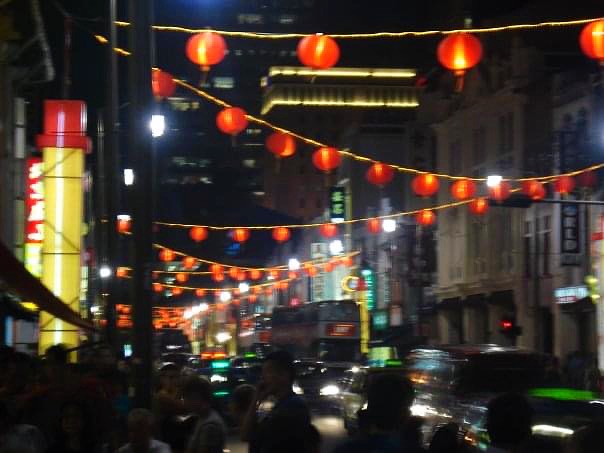
After eating, I ended up walking down towards Chinatown. Evening had appeared in the sky. Followed Orchard Road into Stamford Road then walked down New Bridge Road into Chinatown. Got there as daylight departed. Got lost in a series of side streets, all festooned with red lanterns, coloured lanterns, noises and smells of cooking food, buzz of activity, a crowd carried forward in motion, in slow stagnations, not looking where it was going, just looking and stopping milling and moving again. The Chinese New Year was being celebrated (it was the Year of the Rat). There were images of the rodent everywhere, caricatured, emblazoned in red, appearing on bags and walls. Part of the swaying crowd, too tired to stray I instead surfed the flow, walking, milling, moving forward. Allowing yourself to get lost within that safe blur of human movement. Eventually I made my way back up to Orchard Road and found a bus stop going to Newton. I was the only one on the bus. I spoke to the bus driver, a man from India, who told me to go to the Esplanade tomorrow night to watch the fireworks. He stopped the bus opposite my hotel so I could get off safely. We waved good night and goodbye and good luck as it drove off up Newton Road into the darkness forever.

Image by Karl Powell, City Lights, Singapore 2008

HAJI LANE
Slept all night. It was a deep sleep with intense dreams that made little sense. Disorientating dreams. When I woke up I had no idea where I was. It was the darkness that threw me. I sat up then felt the unfamiliar sheets, sensed the dimensions of the room, remembered I was in Singapore. Woke up again for breakfast. Showered, ate, went and swam in the pool. It was small – ample – and tucked around the side of the hotel with a patio. It seemed to catch what was there of the morning sun, steaming behind the tropical bank of cloud cover, shadows fell. It was nice to feel weightless and float in the water. Dozing face up in the heat and humidity (sunshine spread out and fanned evenly behind a bedspread of cloud cover).

Image by Karl Powell, Golden Domes, Singapore 2008

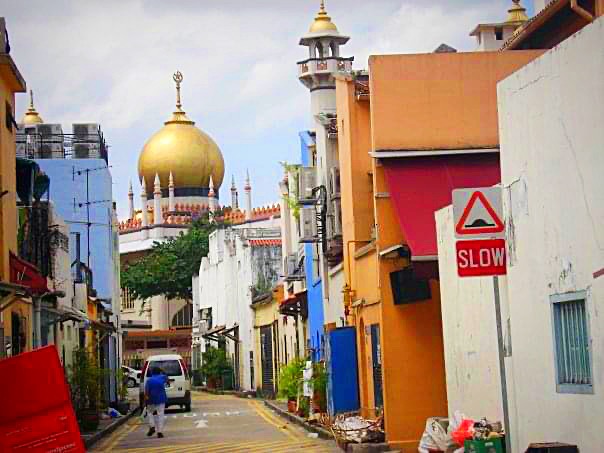
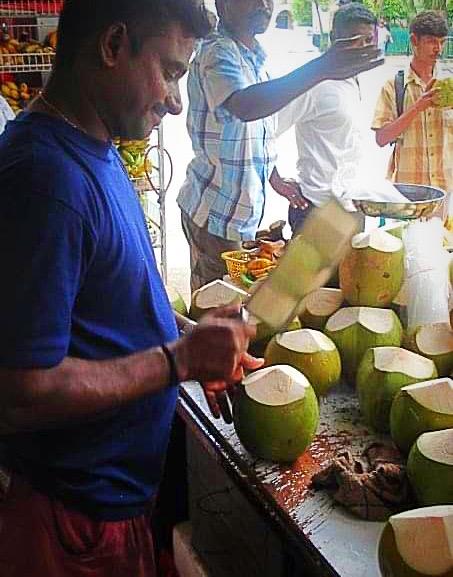
Sometime after midday, I made my way back to Orchard Road. Caught a bus from hotel. Already there was a sense of familiarity, creating landmarks, recognising buildings. Walked the length of Orchard Road and turned up North Bridge Road towards Little India. Bought a green coconut from a street vendor who had so many floating in a portable tank of iced water. He cut it open with a few chops from a machete and popped in a straw for me to drink. Walked along Arab Street and Bussorah Street. Found somewhere to sit and eat. It was quiet and peaceful – how an afternoon lunch should be. The golden domes of the Masjid Sultan Mosque shone above the surrounding skyline of this area. Afterwards, I walked around these quiet streets. Found another mosque, the Massjid Abdul Gaffoor Mosque that bore a sign outside its perimeter fence: Visitors are Most Welcome. So I walked in. I was greeted and welcomed and told to enjoy my visit. I walked inside the green mosque, around the edge of the prayer hall (musalla). It was a large, open space. Stillness pervaded the area. It was cool and birds could be heard singing. Book cases stood along the outer walls. An elderly man sat on the floor, leaning against a pillar, reading. As I passed he looked up, smiled and said hello.

Image by Karl Powell, Coconuts, Singapore 2008

ESPLANADE PARK
Near the Elgin Bridge, I crossed over from Orchard Road onto the Esplanade Park. It was here the bus driver had told me to go to watch the firework display celebrating the Chinese New Year. At night Singapore looked so beautiful. The city lights glowed in the humming buzz of neon emissions, colourful, bright, constant and flashing. The spectrum of colours danced and reflected on the surface of black water in the Singapore River. It was busy with people. There were many families there together walking in groups. Food stalls were cooking. Great clouds of flavour curled and tumbled, rising up out of grills and hotplates, drifting through the park. Red Chinese lanterns and lights hung from the branches of trees. After walking for some time, I found a small wall, near Anderson Bridge, where lots of people were sitting waiting for the firework display. A young couple next to me offered me some snacks they were eating and we all began a conversation; their names were Sean and Cheryl and were from Singapore. As we waited for the fireworks they told me about their lives – their working lives – in Singapore. They told me they were very happy and often worked long hours (most days twelve hours each day, only seeing each other for breakfast and at night sometimes).

Image by Karl Powell, Esplanade Park, Singapore 2008

And then the fireworks interrupted and exploded from nowhere across the night sky. Amid the bright flashes, crackles, thumps and booms were the oohs and ahhs of all of us watching coloured patchworks illuminate the canvas above. It was great to be inside a crowd, reminded how something like fireworks can captivate an audience. Whenever you try to describe fireworks – in writing, in conversation – you always feel as if you’re doing them a disservice. We all know what they look like and sound like; you are mindful not to overtly gush about them, or sell a display short. There’s a wonderful description which comes to mind about fireworks in Jack Kerouac’s On the Road when he describes his love of people who live their lives passionately and with wild authenticity:

…the ones who are mad to live… [who] burn burn burn like fabulous yellow roman candles exploding like spiders across the stars and in the middle you see the blue centerlight pop and everybody goes “Awww!”

Image by Karl Powell, CNY: Fireworks, Singapore 2008

After the fireworks had finished, and after Sean and Cheryl and I had wished each other good night and goodbye and good luck, I made my way back to the hotel. The city was deserted. Everything seemed quieter than the night before. I caught a metro from somewhere back to Orchard Road. From there it was so late (about 1.30am) and all buses had stopped – maybe it was even a public holiday – but I found a taxi and made it back to my room.

NEWTON ROAD
On Newton Road, I am still waiting for my taxi to the airport. Traffic is still driving, still moving, still disappearing. Sitting here reflecting, looking at suitcases, watching the check ins and check outs, I begin to realise that my stay here barely scratched the surface of this beautiful island. Realising as I’m leaving that I would like to return and explore more, see more and travel around more – to just sit by the river, to belong in a crowd, to ride metros and buses with no destination in mind. To just ride and ride. Like Iggy Pop’s Passenger: just looking out from glass, looking through a window, seeing stars come out, seeing bright and hollow skies, seeing that everything in the city looks good tonight. To be the passenger. I put my notebooks away. Headlights pull up to the hotel. A white car parks in a bay. It says ‘Taxi.’ A driver speaks to a doorman and enters the hotel lobby. He makes his way to the front desk. Could be my taxi to Changi.

Image by Karl Powell, The Passenger, Singapore 2008

*

19 Amsterdam Morning

PART I: REMBRANDTPLEIN
From the window of Room 422 inside the Eden Hotel, the Amstel became almost visible. The morning fog was struggling to lift out of the December darkness. A frosted grey hung in the air. Daylight had yet to arrive. Freezing neon signs and coloured Christmas bulbs danced in the tenebrous gloom brooding along the canal. People were walking about, going places, moving along the walkways. A few cafes were open. The scent of the cold and pine trees still stuck with me as I stood looking out across Amsterdam. My luggage, tagged and packed several hours ago in the 40.c summer heat of the Southern Hemisphere, stood cold and unopened against a wall. The hum of heated radiators filled the silence of the hotel room. A two day stopover in Holland.

Image by Karl Powell, Amsterdam, 2012

The cold was the first thing I had noticed on arrival at Schiphol Airport. My flight had landed just before six in the morning. As the plane disembarked everyone followed someone to the queues for customs, through passport control, through security checks and out into the arrival hall of the airport. Disorientated, tired and hungry after eighteen hours of journeying I wanted something to eat. A few things were open – a café and a Burger King. An espresso and a burger deal would have to suffice. It was cold in the airport. Despite that, things were open and operating. An Information counter was situated directly in front of me. Three women in blue uniforms were working, helping people (arrivals and departures), directing them here and there, pointing left, right and straight ahead. Escalators slanted down, moving gently, descending slowly towards hidden train platforms beneath the airport. An illuminated Christmas tree towered upwards several meters, dominating the arrival hall. Beyond that, the darkness of morning waited outside with the passing lights of taxis, cars and traffic.

Image by Karl Powell, Rembrandtplein, 2014

The distance from Schiphol to the centre of Amsterdam was not far. At the Information counter I purchased a Shuttle Bus ticket. It was a one-way service for €16 and took me from the airport to my hotel just off Rembrandtplein. The buses left every thirty minutes and I joined a small queue of others who had been waiting near a stand outside. The cold was so cold. It made your joints immediately ache and took the breath from out of your lungs. A driver soon appeared and let us board. Stacked suitcases rattled on the road in darkness as we drove. A heater tried its best to pump warm air in the bus – moving along unknown roads, passing streets and buildings, watching planes taking off and land; familiarity found only in the sight of large, glittered Christmas wreaths lit up in lights and fixed to the front of tall buildings as we drove past. At Rembrandtplein my journey ended and I left the bus to walk the short distance to the hotel. The bronze statues of Rembrandt’s ‘Night Watch’ stood motionless in the lifting darkness – their stoic silhouettes frozen as solid images behind a row of sleeping market stalls. Cold and Christmas lights all around. A city still to wake up. So quiet. So very beautiful. 

Image by Karl Powell, Waiting for the tram, 2014

PART II: LEIDESPLEIN
A night porter, a Londoner just finishing his shift at the hotel, had been kind enough to mark a map with suggestions when I had asked him how to get to Leidesplein (having arranged to meet a friend, Bouchra, outside the American Hotel at midday). The night porter took time to show me how to get there, pointing out places of interest nearby: chiefly, the Rijksmuseum and, if I had time, the Albert Cuyp Market. He also suggested buying a day pass for the public transport; while it was easy enough to walk through Amsterdam the trams could also be a welcome godsend when you needed them.

Image by Karl Powell, Coffee in Flower Market, 2014

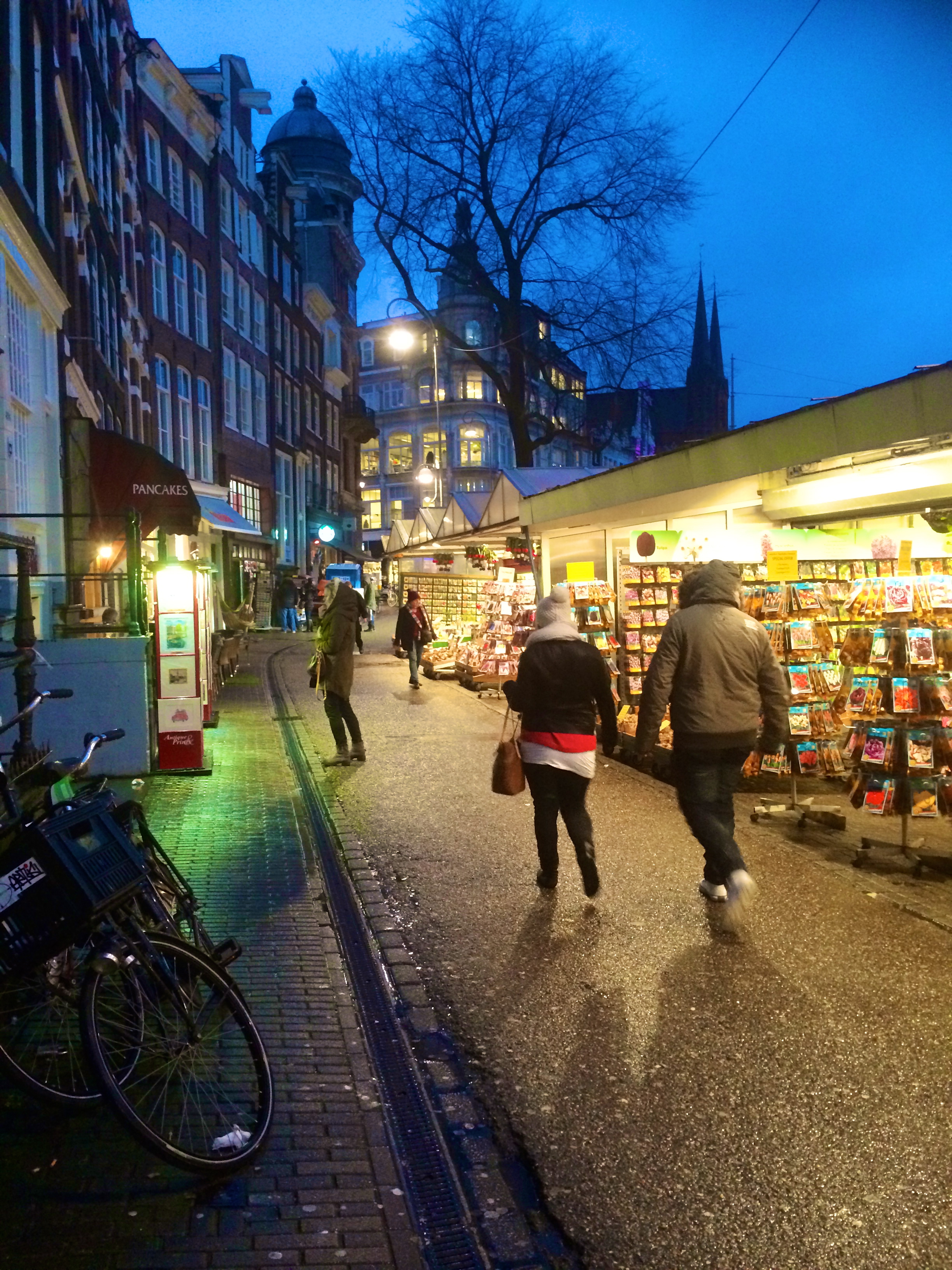
Just a little after 8am I left the hotel and walked out into the winter’s morning. Rembrandtplein was now awake in daylight – the small row of wooden huts selling Christmas fetes were starting to set up, were lit up and open; the bronze statues of the ‘Night Watch’ more visible and distinct. Following the Amstel, I walked to Muntplein and crossed over the square, descending down into a narrow street opposite the Flower Market. A few shops were open there, selling souvenirs, cheeses, chocolates. I found a café and sat there drinking coffee, idling time for a while, watching people walk in the cold, morning air.

Image by Karl Powell, Tram Lines, 2014

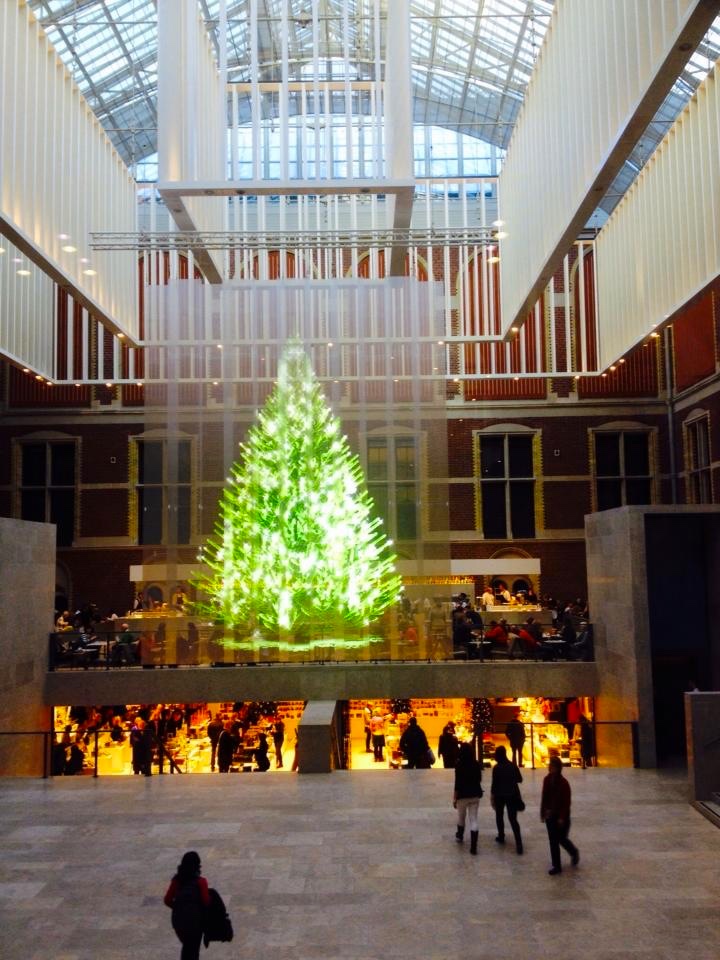
Later, I walked through Koningsplein, navigating my down Leidsestraat, across a few bridges, towards Leidseplein. Here stood the American Hotel, an elegant building sitting in one corner of a large square with other buildings surrounding the perimeter. Cyclists and trams chimed in all directions. Having found my meeting point, I relaxed and went off to explore my recommendations. A short tram ride took me across the Singelgracht canal to the Rijksmuseum. It was an imposing building with three floors of art and history pertinent to Holland. The museum had only just opened for the day and so queues had yet to really form. A large, hologram Christmas tree levitated in the atrium, rising up several floors, suspended in mid air. A flight of stairs led to the upper levels. Rembrandt’s ‘Night Watch’ was housed on the second floor. Once there, I made my way through the Great Hall and along a long, wide central corridor; the painting was visible by the amount of people milling about in front it. The canvas was also a giant in height and breadth. I tried taking photos but it was impossible to really capture any kind of experience, so I stood towards the back of the crowd and tried to absorb its majesty and significance. A woman with blonde hair, possibly in her forties, stood nearby and struck up a conversation with me – telling me that she travelled up from Leiden once a month just to see the painting. Every month she returned to the Rijksmuseum and tried to decide what it was that she loved about the artwork – the historical accuracy, the way the artist had included himself as a character in the picture, the physical attacks the canvas had survived, or just its sheer size. Each time she visited she left with a different conclusion.

Image by Karl Powell, At the Rijksmuseum, 2014

After the Rijksmuseum I made the short distance to the Van Gogh Museum. The queues were bigger and busier. The museum was designed as a visual history to the life of the artist. There were giant recreations of his paintings from Arles – such as  ‘The Yellow House’ and ‘Café Terrace at Night’ – allowing visitors to have their photographs in front of the background, giving the illusion they were part of the artwork themselves. From the Museumplein I walked the distance across to the Albert Cuyp Markets – an open air marketplace running the long length of Albert Cuypstraat. So many things were for sale – clothes, postcards, vegetables, fruits, souvenirs; voices from Europe, Suriname, Morocco, Turkey. The air was perfumed warm with melted sugar and roasted cinnamon; waffles were created in curling clouds of edible fog. A family sold me a bag of roasted cashews from their stall. A mother and son worked in tandem together, allowing me to sample, to purchase, to package, to share smiles of commonality in the cold despite the obstacles of our language barriers.

Image by Karl Powell, Christmas Hologram, 2014

PART III – VONDELPARK
Clanging trams moved along Utrechtsestraat, on the way back to Rembrandtplein. The fatigue of the flight, the morning and the cold had caught up. It had been almost seven years since I had last seen my friend Bouchra and our meeting began again almost exactly where we had last left off. We had initially met in Marrakech, one evening, at a shared hotel. Somehow we had found ourselves engaged in a conversation that did not want to end – we allowed it to dance for as long as we could, carrying it out until the small hours, until realising our early flights out of Morocco (to other ends of he world) was nearing. As there was still more to say and share, we vowed to stay in touch. And so the conversation continued – via emails, phonecalls and messages; it was one of the wonderful attributes of the friendship that although there were great yawns of space and silence between our pockets of dialogue, the conversation always managed to pick up from where it had left off. As arranged, we had met outside the American Hotel at Leidesplein, and proceeded to walk towards Vondelpark. The sun was refusing to emerge from behind the overcast clouds, occasional clouds, swiftly moving, blowing by, low-laying overhead and passing by. Patches of mist drifted and the cold clung to the damp frozen dew caught between blades of grass and fallen leaves.

Image by Karl Powell, Amstel Morning, 2012

Vondelpark was a large seclusion of greenery – a place perfect to walk and talk. The long, meandering pathways lead nowhere and somewhere, circling lakes and ponds and waterways. Routes returned on themselves, offering exits and inroads, walks along perimeter walls. Bouchra and I spent over an hour there allowing the conversation to breath life into us again. We talked about everything and nothing, sharing stories, expressing our experiences, observing commonalities. One story told was about Bouchra’s upbringing in northern Morocco. It was a story that she had not been sure if was factual or fantasy. She had a memory – possibly an imagined memory – from her early childhood, aged around two years old. She had been carried on her mother’s back in a kind of papoose or sling and could remember travelling across a mountain to visit an old woman who lived alone. There her mother and the old woman began talking as a black kettle was placed over an open fire to make some tea. Bouchra, as an infant, was placed on the floor and could remember crawling and playing and eventually sitting upright underneath a table. She described how she looked up and could see a green snake in the underside of the table. She described in detail how she watched it move and how beautiful its colours were and how these colours – lots of colours – were more than just shades of green and how they had fascinated her. In fact, only a few weeks prior, Bouchra had spoken with her mother about this memory and had it confirmed that it had all been true. They had visited an old woman who lived in seclusion; she was quite a grumpy woman who wanted to live away from people. The story of the snake had been that one day it appeared in her home and the old woman chased it out with her walking stick. But it returned the next day. Several times she chased it out, but it kept returning. In the end, she accepted it and it lived with her, underneath the table, never once harming her.

Image by Bouchra Lamkadmi

Bouchra and I parted ways at the entrance at Vondelpark. Our conversation still had many miles to journey, but by mid afternoon, our time together to talk had once again run out. We said our goodbyes and vowed to stay in touch until the next meeting. And it was sad to have had to say goodbye but the conversation was always present, always alive.

Image by Bouchra Lamkadmi

I caught a tram that took me along Utrechtsestraat back towards Rembrandtplein. The statues of the ‘Night Watch’ came into view. I could see the entrance to my hotel. My body ached for sleep. The next stop. But then I felt the folded map in my pocket and remembered that the night porter at the hotel, the Londoner, had told me that if I got the chance to visit the Portuguese Synagogue then I should. He said it was a beautiful space, a place of meditation and clarity in candlelight (he said something about there being over a thousand candles lit there each day). The Portuguese Synagogue was only a few stops away. The tram stopped near my hotel. I waited. The doors opened. And then closed. And so I remained seated as the tram moved past my hotel – just wanting to visit one more thing.

Image by Karl Powell, Portuguese Synagogue, 2013

*

18 Christmas in Paris

Café au Pere Rousseau (Rue Caulaincourt, Montmartre)
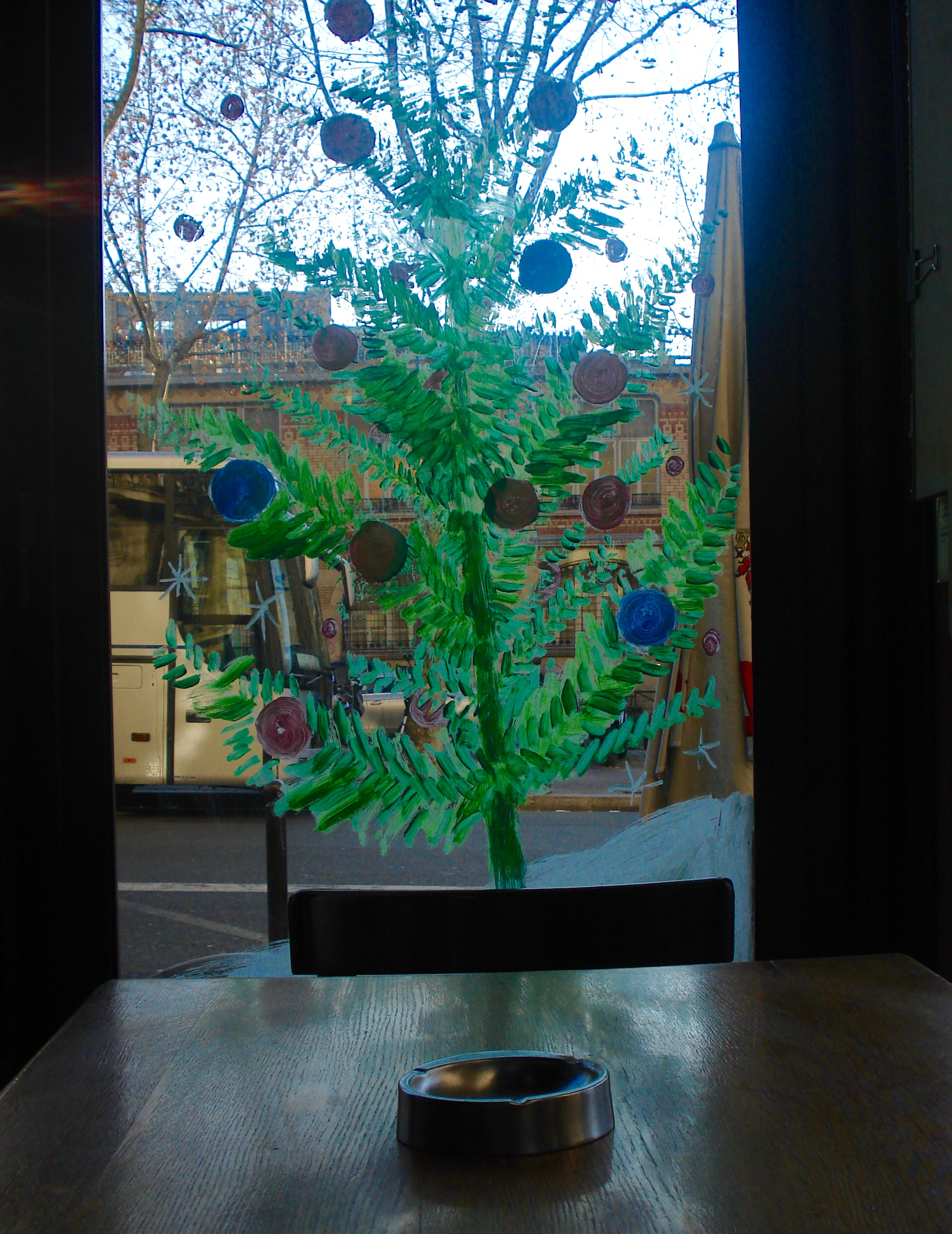
The morning had been stretched out across Montmartre for only a few hours. The December skies sparkled with winter sunlight, but because it angled up from such a low position near the horizon only the tallest rooftops felt the melting benefit. The numerous streets running off Boulevard de Clichy remained below zero in freezing shadows. Despite the brittle cold, the biting cold, Montmartre was filled with warmth. Shops were coloured and decorated ready for the advent of Christmas. There were lots of tinselled trimmings, starbursts of pinpricked coloured light and Joyeux Fêtes painted on shop windows. Pine trees stood outside in the frost.

Image by Karl Powell, Boulevard de Clichy, 2007

People are walking, busy, going places. Christmas will be here within the week. Everywhere you look on this Saturday morning, people wear scarves. Woollen hats cover heads. Hands are in gloves, or in pockets. Pockets of hot air fur and curl in tumbling clouds above the Metro air-vents, rising up from underground alive with the sound of rumbling carriages approaching the Place de Clichy station. People are waiting to cross the road. An elderly couple stand patiently holding hands, clutching bags of shopping; one is dressed in a coat of brown leather, the other in a coat of tan suede. The trees above them are bare; there is no green left on any of the branches. A woman sits on the steps of a statue (she was there yesterday). All she has is a sign that reads ‘Aidez-moi’ (help me). All I had was an orange. She gave a blessing in exchange. Traffic slows down to a standstill. Lights change colour. People cross the road. A blackbird flies up towards the frozen sun.

Image by Karl Powell, Saturday Morning, 2007

Brasseries and bistros beckon you in from the cold. This one on Rue Caulaincourt opened its doors at eleven. I had watched the owner clean its bay windows earlier this morning from my room. He polished them first from inside, before moving outdoors. Once this was done, he carried a bucket of hot, steaming water outside and cleaned the pavement in front of the café. Steam rose as he brushed the flagstones with a long broom. After he had finished, a large patch of white frost clung to the surface of the walkway. It is still there now (albeit pockmarked with footsteps of those who have passed by). The owner is making a coffee for an old man with no teeth and barely a voice standing behind me at the bar. Moments earlier three men walked in and ordered the first beers of the day. They sit at a table near the window, all looking out at the traffic. The cold seemed to follow them in, concealed and hidden inside the creases of their clothes before thawing into silence. My coffee has been drunk and I wait for my order to arrive (a baguette beurre jambon). It is quiet inside here. The front door opens and again a bell dings. An old woman in a large, red, padded coat struggles in carrying two large, plastic bags. She asks the owner if she may use the toilet. The owner of Au Pere Rousseau stops what he is doing and speaks in a quiet, soft voice ‘Of course.’ He helps her put down her bags, and directs her to the bathrooms. He returns to making coffee and produces an espresso for the old man behind me. It is thrown back in a second. My order arrives.

Words cannot convey just how cold this morning feels.

Image by Karl Powell, Au Pere Rousseau (Rue Caulaincourt), 2007

Église Saint Germain de Prés (Left Bank)
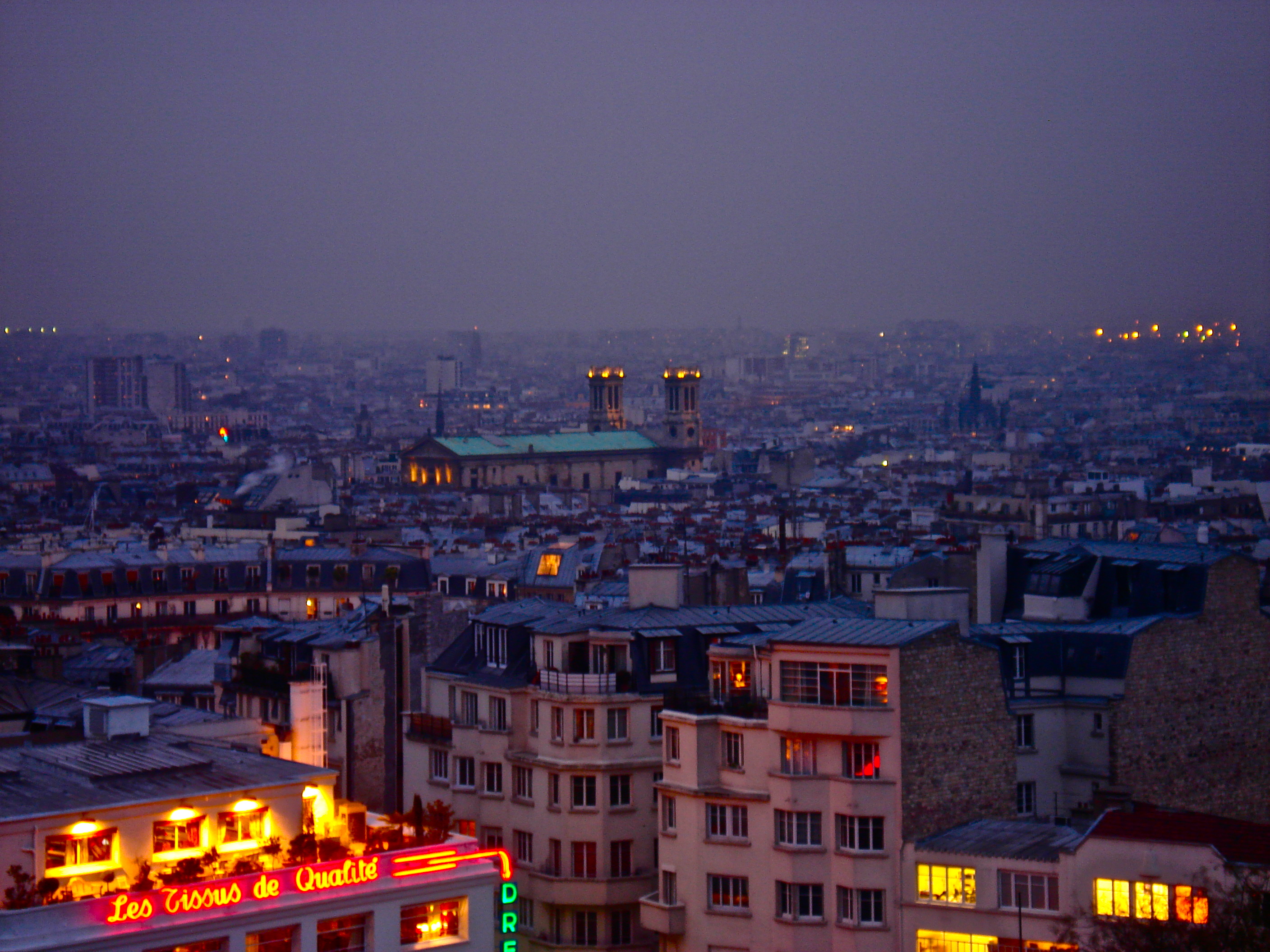
The day unravelled as the sun struggled to climb above the rooftops. I followed Rue Caulaincourt as it curled around the sloping sides of Montmartre, leading up to its summit. The street was longer that I had anticipated, and the laboured climb felt much steeper in the cold. Somewhere near the Moulin de la Galette I saw a street vendor in a small, mobile booth selling hot crêpes. I ordered and watched him pour a mixture of batter across a hot, flat iron. Steam rose. The griddle was circular and he used some kind of spatula smooth the batter, to make it round, so it cooked evenly. Then it was turned over and just before the cooked side began to smoke he added a broad stroke of nutella and a spoonful of chopped almonds, folding the snack up into quarters. The crêpe was hot in my hands and the chocolate melted as I ate it. Within a few minutes of walking the Sacré Coeur came into view (the basilica’s distinctive curved, white dome peered above the rooftops and floated up into the sunlight). Despite the cold there were lots of people milling about outside – tourists, priests, nuns, locals – pushing in together through a doorway to shuffle into the candlelit warmth of the church. Outside were numerous spaces to sit or stand and look out across the city. I sat on some steps to finish eating my crêpe. It was a wonderful view, facing out over a frozen Paris. The difference in height gave the appearance that the entire city was hibernating in a valley frozen in sub-zero shadows. Fog hung along the horizon. Steam and smoke rose from occasional chimneys. Coloured lights lit up pockets of freezing gloom. December sunlight only managed to touch the green roof and twin spires of Notre Dame and illuminate the Grand Palais and Eiffel Tower. Paris stretches out so far and wide from this vista.

Image by Karl Powell, From the Steps of the Sacré Coeur, 2007

The steps in front of the Sacré Coeur led down to where Boulevard Clichy met Pigalle. There was a metro station there called Anvers. It moved sideways across the city towards Gare du Nord (away from Place de Clichy). I journeyed underground, changing lines at Barbés Rouchechoart in order to travel south towards the Seine and the Cité station. From there it was a short walk across the two islands in the middle of the river: l’Île de la Cité and l’Île Saint Louis. Both were alive with people and colour. There were Christmas shoppers mingling with Saturday shoppers; tourists alongside locals. I visited a few shops, buying cheeses and wine, things to eat, things to share, gifts to give for Christmas. The wind stung as it blew across the Seine. The sun looked so tired, so distant, so far away. The narrow streets on l’Île Saint Louis provided some shelter from the wind, but eventually they gave way Pont de Sully and having crossed the river, I followed Boulevard Saint-Germain as it moved through the Left Bank. Outside the abbey of Saint-Germain-des-Prés a Christmas market had been erected – rows of small, wooden stalls all lit up with fairy lights, tinsel and holly. Chocolates, scarves and tobacco were some of the things I saw for sale. The open square was blazing bright with roasted chestnuts for sale. Blue lights shone in decoration from the surrounding trees. The abbey had loudspeakers outside, broadcasting songs from inside.

Image by Karl Powell, Saint-Germain-des-Pres, 2007

To escape the cold for a moment, I pushed open the main door and sat near the back of the church. Warm and candlelit, it was filled with the scent of incense and muffled sounds of the congregation listening to a mass in Spanish. Songs were being sung accompanied with a guitarist. I sat through the remainder of the service, near the back. As it finished, more people filled in from the cold; the French mass began almost immediately. I was too content to move, so stayed where I was. This service lasted about an hour. A choir sang, prayers were given and an elderly priest delivered a sermon in which he spoke about the need for us all to exercise patience and tolerance at this time of year. He spoke quietly but with authority about how Christmas is not always as it appears on television or Hollywood; that Christmas, while a time of celebration, can bring up difficult emotions for others. Hence the need for our patience for all those around us. After the mass, it felt time to head back to Montmartre. It was now dark outside. The sun had set. I began to navigate my route back to Place de Clichy (criss-crossing my way beneath the Left Bank and Saint Germain-des-Prés along a couple of connecting stations all the while heading north).

Words cannot convey just how cold this evening feels.

Image by Karl Powell, Les Chanteurs, 2007

Le Carolus (Boulevard de Clichy, Montmartre)
The light from the Eiffel Tower spins around in the darkness, dancing across the rooftops of Paris and out into the endless reaches of the frosted night sky. Passing by Le Carolus – a bar on Boulevard de Clichy – I enter and sit at the long bar (marble topped, polished and clean with a curling brass bar-rail running all around). Everything is clean and is warm. Colours dance and blend in the tinsel and candlelight. Rugby is shown muted on a large TV screen (a match between Montpellier and Petrarca). Music sounds from a radio behind the bar. It plays a song called ‘Falling’ by Julee Cruise. Somehow the song feels right, fits the evening. People are relaxed and talking, the guy next to me is reading a newspaper, the kitchen sizzles within the stove of an orange glow. Busy hands are working: polishing glasses, delivering food, cleaning cutlery. A waitress walks out from the kitchen feigning injury in an act of theatre to melt the heart of the owner (a big, bearded man who stands behind the bar with his arms folded). He watches her approach. A small game of affection breaks out. She tells him she has been burnt, and holds her hand out to show him. His eyes drop down to the hand. He looks unimpressed. She says something and playfully flutters her eyelashes. His arms remain folded. The pair lock eye contact – her smiling, him impassive. Time stands still. A customer sneezes. Then the big man, the owner, cracks his poker-face façade and breaks out into a loud laugh through his black beard – he grabs both her cheeks and plants a kiss on her lips, she wraps her arms around his wide midriff and the pair hold an embrace. She walks off into the service area smiling, her ‘injured’ hand swinging at her side. He watches her walk off, smiles, and lights up a cigarette.

Image by Karl Powell, Winter Solstice, 2007

Outside the bar, walking back to my room along Boulevard de Clichy, I walk a little further towards Pigalle. The Moulin Rouge was lit up in warm, red neon and light bulbs. It looked so striking in the dark. Tourists and locals walked past – some stopping to take photographs. Words cannot convey just how cold this night feels. The newspaper, which had been read by the man at the bar, had a map of France and forecasted that temperatures would drop to -4.c tonight.

As I write, words cannot convey how cold it is outside.

Image by Karl Powell, Christmas in Le Carolus, 2007

*

17 Mo’orea (Tahiti)

Opposite the ferry terminal at Quai de Vaiare, on the Route de Cienture, was a small restaurant called Maeve Pizza. There was nothing spectacular or flamboyant about it. It just happened to be there as I walked past and I took a chance on it. There had been a large red Coca-Cola advertisement board leant against a palm tree, on which was handwritten in yellow chalk: Café – Thé – Chocolat Chaud – Glace – Pizzas – Hamburgers. A small courtyard turned in off the road. Occasional tables and chairs were dotted about in pockets of sunlight. Against one wall, beneath a large hand painted frangipani flower, was a long table and bench which faced out towards the Quai. A large generic menu was on display in front of a wooden countertop. The menu, weather-beaten in the corners, displayed a long list of pizzas in French and English. Having ordered Hawaienne avec anchois, I sat down at the long table resting my back against the wall. In front of me was the empty berth waiting for the ferry back to Tahiti. It would have to arrive from its afternoon service from Papeete first.

Image by Karl Powell, Tahiti from Mo’orea, 2012

Despite being only a couple of meters in from the busy road of Route de Cienture, the courtyard of Maeve Pizza created another world. It was quiet. Incredibly quiet. All seats and tables were shaded due to the dark green foliage of vine leaves and palm trees criss-crossing and interlocking overhead. Sound became insulated here. A cockerel wandered free in the courtyard. The moon was already visible in the sky. A breeze moved through the towering forests growing on volcanic peaks and moved down towards the sea. I rested here in the silence waiting for my ferry to arrive. The owner soon brought me my pizza in due course and asked me where I was from and why I had visited Mo’orea. I explained that today was birthday and I had come to the island to do something different, to make the day memorable in some way so that when I came to look back and think what I had done to celebrate turning forty that I could think back to this day on Mo’orea and could always say I had been here. The owner called out to her husband who came outside the restaurant, bringing a bottle of vanilla rum. Both sat with me for a few minutes, toasting my birthday with a shot of red rum. The owner told me that she was from France and since childhood it had been her dream to visit Tahiti. Once she arrived here, many years ago, she vowed never to leave – and so she stayed. She said how much she loved everything here, how much she loved her life on Mo’orea and would never return to Europe. She told me that she always encouraged travellers to follow their dreams because she was grateful that she had possessed the courage to follow hers. She told me that when you follow a dream it will take you to the most amazing places.

Image by Karl Powell, Maeve Pizza, 2012

The day had begun early. I caught the morning shuttle bus from my hotel at 8.30am to Papeete. The bus, a short journey, dropped me outside the Mairie de Papeete – a large red-roofed colonial town hall in the city centre. From here I walked down Rue Paul Gauguin, past the Tahitian Pearl Market and towards the harbour along Boulevard Pomare. There I had been instructed to look for the Agence Aremiti to buy a ferry ticket to Mo’orea. Time was ticking on and the morning ferry departed at 9.15am. After some initial difficulty I eventually found the ticketing agency near the Quai des Ferries. A return ticket cost 3,000 French Pacific Francs. I paid my money and boarded the vessel.

Image by Karl Powell, Baie de Cook, 2012

The journey itself was scheduled to take 30mins across the Pacific Ocean. As with most ferries there was an indoor, air conditioned deck but as it was still early and a relatively short journey I chose to sit on the smaller rooftop deck. There were a few other people doing the same – in groups and in pairs. Slowly, the ferry began to pull out of Papeete. The shops, the houses, dotted about on the sloping green ebbed away. I took out my camera and began to photograph what I could of Tahiti as it receded from view.

Image by Karl Powell, Tahiti from ferry, 2012

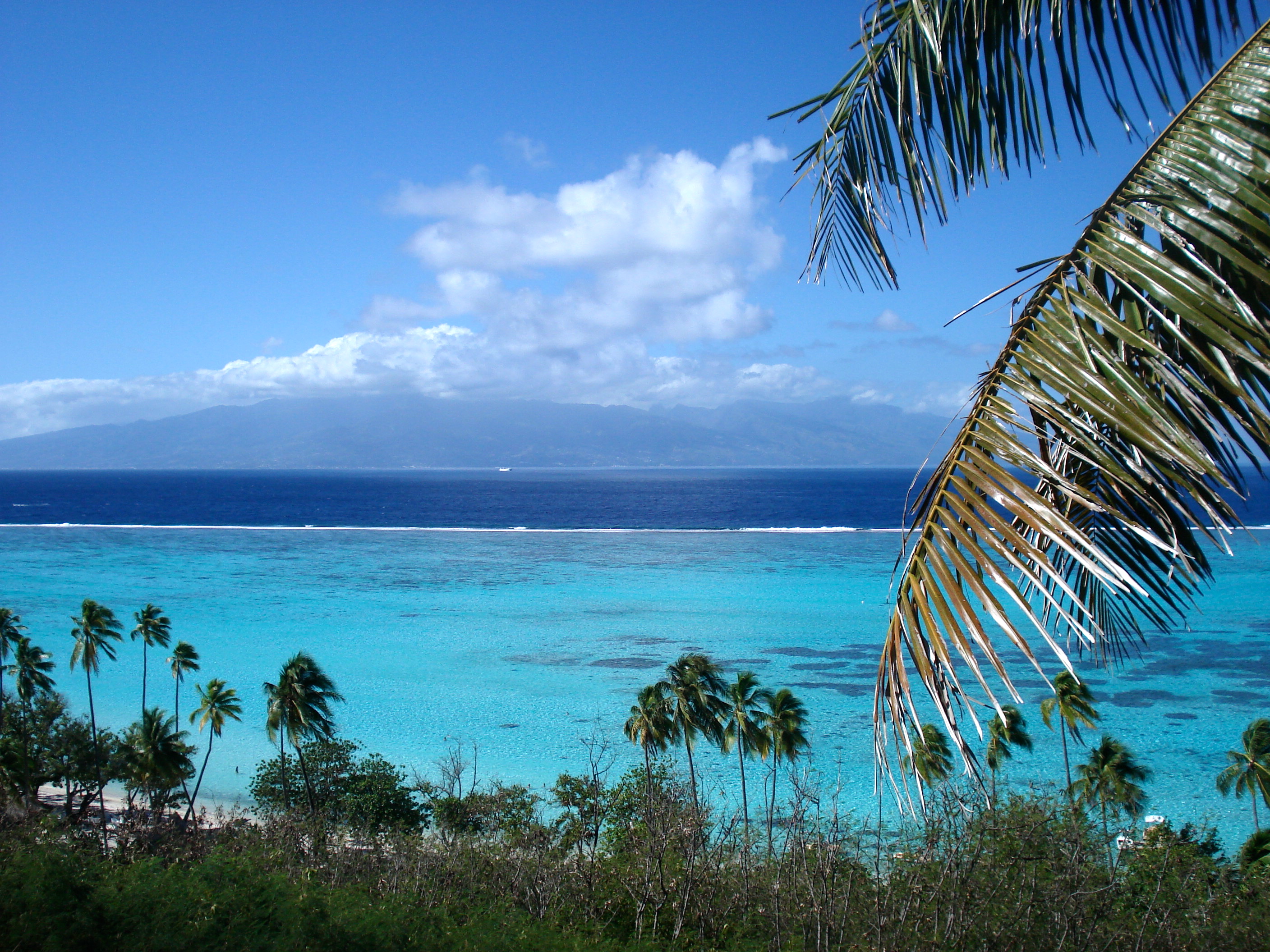
All week the silhouette of Mo’orea had been visible from my beach. It was a collection of dark purple, jagged peaks which rose up out of the ocean and remained there, visible in silence, throughout the day and the entire darkness of night. In his Tahitian journal, Noa Noa, Paul Gauguin wrote numerous times about the island as he sat smoking cigarettes on the sand at the day’s end, “The sun, rapidly sinking on the horizon is already half concealed behind the island of Morea [sic] which lays to my right. The conflict of light made the mountains stand out sharply in black against the violet glow of the sky.”

There is something so magical about watching an island emerge as you voyage towards it across a body of water. Its mystery fades as you approach; patches of green slowly become distinguishable, individualised trees rising up towards sunlight, while conical mountains and peaks take form and character. Around Mo’orea was a visible reef, circling the island like a barrier, distancing it from the ocean and ensuring its waters were shallow lagoons alive and vibrant in gem-like colours. A clear pathway from the deep Pacific funnelled through a break in the coral, allowing dark blue waters and the ferries from Tahiti to berth at Quai de Vaiare. As the ferry slowed and steered in to dock at Mo’orea, a tall Polynesian man broke rank from a group of friends who had been on the roof deck and approached me. Behind him a car park with a thin line of small shops came into view. For the duration of the journey, I had been photographing and writing in a small, black moleskine notebook as many impressions as I could – of Tahiti, of Mo’orea, of the endless desolation of the Pacific Ocean and the way sunlight seemed to dance on its flat surface; I had done this so I would never forget these moments. The man, wearing mirrored sunglasses, came closer and became more imposing the closer he got – he asked me if I was a journalist. I shook my head and answered, ‘traveller.’ He smiled, nodded and said in English, “Welcome to my island.”

Image by Karl Powell, Sainte Famille Church Ha’apiti, 2012

Once on Mo’orea I made my way to a Shell Petrol Station near the Quai. It was here I had been told to meet someone from a scooter/motorbike rental company who would give me a bike hire for the day. The guy was there waiting for me. The price had been agreed the day before, so I paid in cash and signed documentation, was given a phone number should something go wrong and told to return the bike with a full tank of petrol. The speedometer was broken, but that was fine I was told: just don’t speed. There was enough fuel in the bike to drive it around the island; the return ferry back to Papeete departed at 2.45pm so there five hours to enjoy.

Image by Karl Powell, Baie de Cook, 2012

There was only one road – the Route de Cienture – which circumnavigated the outer edge of the island. For the duration of that ride around Mo’orea, orbiting the volcanic peak of Mount Tohiea, the mountain was always on my left and the Pacific Ocean on my right. There was no real plan in mind, other than to use the time available to me, to follow my nose, to maybe find a beach to swim, to just journey and see what happened. All I had was one of those free tourist maps that somehow ends up in your possession. Fortunately the one I had was well-detailed. Moving off from Vaiare, I figured I could drive around to the north of the island and see the two bays – Baie de Cook and Baie de Opunohu (the map indicated a beach nearby). Both were beautiful in their appearance and serenity, the quiet lapping waters milling about in coral shallows, catching perfect shadows of overhanging palm trees. Sandwiched between both bays was a road veering off the circle route and climbing some 240 metres up towards a lookout (Le Belvedere). I chanced a detour up, which was steeper than anticipated along a zig-zagging path which kept rising as my gears dropped. The view from this lookout was worth the climb and took in the coloured waters surrounding Mo’orea, the settlement of Paopao, the surrounding mountainside and forests; it was something magical.

Image by Karl Powell, Day in Mo’orea, 2021

On journeys such as these, time has a tendency to operate differently to when experienced in routine. What had seemed like a couple of hours was barely that; any concerns I had to remain close to the ferry quay – gave way to me deciding to keep on driving. It was hot, and while I had wanted a swim to cool off, once moving on the bike I barely noticed any heat. There was enough petrol in the tank and, I calculated, enough time to spare to keep on going, to push on for a full circumnavigation of the island. Coming down the hill from Le Belvedere, I turned left and opened the throttle. Names and villages rushed past me, Papetoa, Tiahura, Te Nunoa, Varari, Ha’apiti; the road was flanked by row upon row of palm trees as I sped past. While I drove around my map, using villages as landmarks, reassurance remained in having Mount Tohiea on my left and the Pacific blue on my right. While time was on my side, occasionally I would stop and switch off the engine to just absorb what beauty I saw and witnessed on the island. Sometimes it was just enough to stand beside giant palm trees watching the wind move through them, or to listen to the breeze touch the coral lagoons. Near Vaianae I watched an old man walk across a flat patch of submerged reef to cast a fishing line out into the deeper blue. On reflection, I wish I had written these observations down and described them in detail; I should have written those moments down because I knew (as I know now) the chances of me ever returning to Mo’orea in this life would be next to nil. I could have written about how happy I had felt riding around that island, the utter freedom I experienced through archways of palm trees, accompanied by ancient volcanic peaks rising up to the clouds. I could have written about those emotions, to just have had a record to read right now but in all honesty I was too busy having fun. I was lost in the moment. I experienced such freedom in the anonymity of knowing that no one else on this planet knew where I was at that precise time. Perhaps committing those emotions into words may have diluted the feelings I still have from that day.

Image by Karl Powell, Fisherman Mo’orea, 2012

The road continued down to the southern tip of the island, past Atiha, before turning sharply north (leading back to the ferry harbour at Vaiare). As I approached the village of Maatea, my day had accumulated close to four hours on the bike. I can remember feeling a particular kind of sadness knowing that the adventure had (almost) run its course, yet it was countered with a buoyancy in having done this and enjoyed it. Stopping at the side of the road, I took in the silence for one last time before I surrendered the bike. As I took the last of my photographs a young man on a motorbike (no helmet), emerged out onto the Route de Cienture from an uncovered track. He stopped at the junction. He looked my way. For some unknown reason I waved. The driver waved back, then revved his engine several times before pulling out onto the empty road and headed to Vaiare. As he gained speed he lifted the front wheel of his bike up off the road, turning the handlebars as he shot off into the distance. A long trail of white smoke tumbled in the air. Within fifteen minutes I would be back at the Shell Petrol Station (next door there had a restaurant called Maeve Pizza which was opening for breakfast as I had set off).

Image by Karl Powell, On the Road Mo’orea, 2012

As the ferry pulled out of Mo’orea, I noticed the colour of the water in the Quai de Vaiare was teal, an opaque teal. On the ferry back I slept most of the way – choosing to sit inside the air conditioned deck. Voices spoke around me. Some in French, some in Tahitian. I understood nothing but every word sounded divine. I felt happy. I remember watching a coconut floating out to sea. It travelled alongside us as we voyaged into the deep blue. Then my eyes fell heavy and I slept to Tahiti.

*

15 Voices of Men (Adelaide, Australia)

Fireworks thump hard into the springtime night sky. It is dark. No starburst of colour is visible in the smooth velvet stillness. Occasional light illuminates in patchwork shadows, finding pockets of space crushed between the city buildings which reach up to obscure all horizons. Noise booms through the warm evening air. There have been fireworks sounding most evenings this week. The holy festival of Diwali has been celebrated here – a time, when it is said, the goddess Laksmi visits homes to bring happiness and prosperity during this Festival of Light. There are fairy lights blinking in some of the frangipani trees in nearby apartment gardens, pinpricks of yellow colour flashing light in the dark. Outside my window, the city itself is quiet. An easterly wind moves through the branches of trees, bringing hot desert air from the Goldfields towards the metropolis. Some of the skyscrapers have coloured neon lights; mainly logos and names – some are just illuminated facades. Crickets sound. A full moon is forecast within a week, but as I write no moonlight is visible within the cosmos (yet). And then, for some reason, I think of the description of the moonless night given by the First Voice in Dylan Thomas’ play for voices, Under Milk Wood:

It is spring, moonless night in the small town, starless and bible-black, the cobblestreets silent and the hunched, courters’-and-rabbits’ wood limping invisible down to the sloeblack, slow, black, crowblack fishingboat-bobbing sea.

Image by Karl Powell, Bwlch Mountain, 2017

I think of home. Being a migrant on the other side of the world is a curious existence to have. It is both transient and of belonging to other places simultaneously (the old and the new). It is an existence between things; of being changed forever, almost in limbo. Sometimes caught in a concussion of cultures, languages and other identities. Looking in this box tonight I found a small folder of photographs, titled: Treorchy Male Voice Choir (Adelaide). Opening the wallet, I look at these physical pictures and can see and hear sounds and people from over two decades ago. There is a disc of their music here, too, which I am playing now.

Image by Karl Powell, Backstage with the Choir, 2009

Some twenty years ago I was transported home by the voices of men. It was the first time I had possibly understood the true breadth of homesickness. Months earlier, I had been made aware of the famous Treorchy Male Voice Choir touring Australia (for the first time since 1986). In the choir, I had family friends, familiar faces and my woodwork teacher, Mr (Meurig) Hughes – and it was he who had first told me of the choir’s intention to tour. And so dates were confirmed: the choristers would perform twenty-four concerts within a month moving through locations predominately on the eastern side of the sunburn continent: singing in New South Wales, Queensland, Victoria before concluding in South Australia. This final leg of their tour is were I decided to meet them. A long weekend in Adelaide. I was forwarded a copy of their itinerary and was able to plot dates, book flights and secure accommodation in the city of Churches.

Image by Treorchy Male Choir, Parliament Square (Adelaide), 1999

And so, near the conclusion of their Australian tour, I crossed the Nullarbor Plain to fly three hours or so into Adelaide. It was my first time into South Australia. The city centre was a grid of navigable right angled streets, divided in half by a long, straight avenue called King William Street. Sandwiching these interlocking inner-city roads were North Terrace and South Terrace. As luck would have it, the choir was on the South and I the North. On arrival to the capital, I took a taxi from the domestic airport to my hotel, checked in and then walked down to the Chifley Hotel where I had been told the choir were staying. It was now late afternoon. There were two big buses, or coaches, parked opposite the hotel advertising their tour. Outside a few choristers in uniform blue polo shirts were smoking. Their accents told me I was were I was needed to be. Inside the hotel lobby there were lots more blue polo shirts – their official tour shirt when not dressed in black tie for performances. The choir had spent the day travelling from Mount Gambier in the morning, to sing in front of National TV cameras on Parliament Square promoting the tour, to then check in briefly at the hotel before preparing to go to the Festival Theatre to sing. It sounded an arduous schedule. In the hour or so that I was in the Chifley Hotel I managed to find a family friend, Clive Taylor, who told everyone – particularly designated officials – that I was his nephew. This half-truth became my passport to going everywhere with the choir during the weekend in Adelaide.

Image by Karl Powell, Dad, 2008

Later that night, I sat with some two-thousand people in the Adelaide Festival Theatre. It was the first time I had seen or heard the Treorchy Male Voice Choir sing as an adult. These were men I had known all my life, some there from childhood, up on stage in front of us all. After the applause of their entrance, after the muffled hush of taking places, after the first sound of melody from their voices, I was transported elsewhere. They sang songs in Italian, English, Xhosa Zulu and Welsh. They sang songs I had grown up with and grown accustomed to. There were songs sung that I knew the names of, there were some songs sung whereby I only knew the sound. The power and beauty in their voices carried through the air and thumped deep upon some hidden space of the heart. There, the emotions of exile shattered in starburst. The power within their spoken words transported me back to childhood, back to a place I left before I truly understood it; with closed eyes, I could see the colours Max Boyce sung about in his ballad ‘Rhondda Grey‘ – that it was the faces of people who lived in the old mining community that coloured the world existing there. When the choir sang the spiritual hymn ‘Oh My Lord What a Morning’ an old man in a dark suit, sat in front of me, began to cry. And in that swell of emotional longing – the brooding ache of hiraeth – there was also present a deep and never-ending bond of belonging to place and time.

Image by Karl Powell, Sunrise over Treherbert, 2017

The performance lasted across two halves. There had been an intermission and interludes from solo performances of choristers and singers, such as the rendition of Unwaith Eto’n Nghymru Annwyl from the compere and publicity officer of the choir, Dean Powell. There was an encore at the end. After the performance, Uncle Clive smuggled me on board one of the buses back to the choir’s hotel. There, in the lobby of the Chifley Hotel, the mood with the choristers was gregarious. We drank together and I met many friends (old and now new). There was also a grand piano there and someone began to play, and the men sung. I stayed until late, very late, before the bar closed and I caught a taxi back to North Terrace. It had been a long day. Before leaving, I had been told to report back to the hotel the next morning to accompany the choir into the Barossa Valley to see them perform in an afternoon concert at Tanundra.

Image by Karl Powell, On Top of the World, 2016

It was an early start the next day. There were two buses of choristers departing the city towards the north east. As to plan, I was smuggled on board one of the buses, sitting next to Uncle Clive. Most of the men were obviously tired, some hungover. The long and demanding schedule was beginning to catch up on their bodies and vocal chords. Throw in the stresses of jet-lag, an eight hour time difference, a month-long separation from families, as well as the transient nature of living in hotels, many were happy to see the long tour draw to a close. This, their final day, required them to perform twice; once at Tanundra before returning to Adelaide for a second evening at the Festival Theatre. Due to ill-health, Uncle Clive sat out the matinee performance, so we were able to sit together in the audience and watch the choristers sing. It was a much smaller audience than the previous night. But it was the first time Uncle Clive had been able to see or hear the choir since becoming a member. During their rendition of Joseph Parry’s Myfanwy, he kept saying how proud he was to belong to them, whispering aloud to himself how good the choir sounded. And they did.

Image by Karl Powell, Choristers in Rehearsal, 2009

On the drive back to Adelaide one of the buses broke down. No one paid any real attention to what was happening until it was announced that the soloists and elderly choristers should go back to the hotel on the other bus, while the rest of us waited on a hard shoulder. We waited for over an hour. It was a hot afternoon, in that dry heat Australia can have, and without a working engine there was no air conditioning either. Only the radio worked. There was nothing that could be done until assistance arrived. We were in the middle of nowhere. Yet no one complained. Most slept or tried to rest. The radio helped – some sung along to the music played to pass time; an impromptu accompaniment of Cat Stevens’ Moonshadow was one which remains in the memory. Eventually help arrived, the engine was fixed and we made it back to Adelaide with enough time to return to Festival Theatre before the curtain went up. The performance – the last performance of the Australian tour – went well. Sitting among the cheering crowd as the curtain came down I felt so honoured to have been adopted by the choir over the weekend, as well as in admiration for these men who had given up their time and money to sing. They had carried their songs across oceans and continents, sung from a place deep within despite being close to exhaustion. Watching them all stand, wave and bow I felt immense sense of admiration for their craft and desire to share their passion and create belonging.

Image by Karl Powell, Tommy’s Bend, Bwlch Mountain, 2017

There was sadness the next morning. There was sadness because I was saying goodbye to family friends (some old, some new). They were going home. Back to where I had once belonged. There was also sadness because I was leaving their familiar reality, this understanding without explanation, to journey three hours west across the Nullarbor Plain. I did not want the connection to end. Our departing flights from Adelaide were scheduled more or less at the same time – albeit from different terminals (them the International, me from the Domestic). The choir made sure I was on their bus to the airport. In fact, they had even smuggled me to an official engagement immediately after the final concert – a sit down reception with an open bar. It had been a late night, but one which I had enjoyed, creating many new friendships – sharing in that special bond that travel can easily create between strangers. With suitcases stacked up in rows outside the bus we said our goodbyes.

Image by Karl Powell, Rockin’ Roger 2007

Looking out now at the silent cityscape tonight, the fireworks have stopped. The sound of the wind still blows through the branches of nearby trees. Tonight I am listening again to the voices of those men singing. Their music is alive here tonight. And I know, that some twenty years later, some of those voices are no longer singing. But they are singing. They are singing in concert out across the darkness of this night sky, this moonless spring night sky. The voices of those men colour the darkness from the twinkling neon lights up towards the shining Southern Cross. Across oceans and continents. Their voices are alive here tonight.

Image by Karl Powell, Boyo, 2009

*

14 Ferry to PhiPhi Island (Thailand)

7.30am
A leaf falls from the Holy Almond tree and a sea breeze gathers pace. It carries the muffled sound of thunder from somewhere but there are no clouds visible in front of me. I watch another large brown leaf fall from the giant overhanging branch of this tree. It flutters down and tumbles, curling through gravity’s reeling pull. It seems to take an age to fall. But here, time lives within Time and plans made unfold of their own accord. The ocean has been flat all week – all the way from sand to the edge of the world, flat glass water for the past few days. Brightly coloured longtail boats float on this endless expanse – their painted hulls shine as they emerge up into the morning sunshine, lifted by small, shoreline waves. At the far end of the beach, two people swim in these waters of the Andaman Sea. They have the whole ocean to themselves. Then, a bird the size of my thumb suddenly lands on my table. There is an empty cup of coffee between us. I move only my eyes to look at it. Motionless. It chirps, twitches and fires off into the day.

Image by Karl Powell, Long Beach (Koh PhiPhi Don), 2019

9.01am
The sea breeze keeps on moving, a warm steady stream of air. I am sat on the roof of a ferry ready to depart Krabi for PhiPhi Island. Engines are revving, the vessel is beginning to move. It should be around a 2hour trip leaving these mangroves and waterways, moving past the beaches of Rai Lay and Ban Ao Nang and out into the Andaman Sea. My taxi came at 8am. I had enough time after breakfast to go to the small fruit stall opposite my hotel to buy a bag of mangosteens. Saw my friend Khwan who was waiting for her taxi at the gates – she’s also going to PhiPhi Island (albeit on another trip). Maybe we’ll see each other on the island. Gave her some mangosteen for her journey. My taxi drove quickly to Krabi and to the ferry terminal. Bought my ferry tickets there 400THB (3.30pm return) then through some doors, along a walkway all the way towards the ferry. It is three tiered: hull, deck and rooftop. On the rooftop it is clean, painted white and people and milling about up here. Tourists, day trippers, backpackers, we are all sitting sprawled out together, staring at the world through cameras and phones and our imagination. To my right, the familiar landmarks and coastline veers away; to my left the open sea – before us the wide, flat water of a new adventure approaches, dancing with the diamonds and sunbeams reflected on this magical ocean.

Image by Karl Powell, Waiting for Taxis, 2019

9.45am
A voyage across a body of water is one of the great underestimated opiates of our time. There is something so calming, hypnotic and intense about the whole experience. The mind slows down and becomes still. You enter a world within our world; perceive a new universe where horizons appear to stretch and fan out in all directions. Time dislocates itself from uniform patterns and instead is found hidden in deep pockets of now. You find yourself existing somewhere within the opening lines of William Blake’s “Auguries of Innocence” – somehow existing as an infinity held in the palm of your hand while being the Eternity present within an hour

Image by Karl Powell, Sail the World, 2017

A small trawler chugs past, belching thin clouds of black smoke into the blue. In the distance, on these serene, slow moving horizons, conical islands and giant towers of limestone rock glide past like silent icebergs. Giant white puffed clouds appear. The water is so flat. The whole ocean is still – from one horizon to the other (and all horizons now are shining, flat slabs of water soaking in sunlight). Occasional longtail boats appear far away. A shark’s white flashes in the blue, just for a moment – the briefest of glimpses – the triangular fin and tail had slashed and broken through the polished surface to disappear into the deep.

Image by Karl Powell, Colours of The Andaman Sea, 2019

10.45am
This will be my first visit to Koh PhiPhi Don for 15years. Like many I was inspired to travel here because of the 2000 movie The Beach. Based on Alex Garland’s novel (1996), a Hollywood storyline created a fantasy which never existed in reality. The story suggested finding a hidden paradise in the Gulf of Thailand:

Think about a lagoon, hidden from the sea and passing boats by a high, curving wall of rock. Then imagine white sands and coral gardens never damaged by dynamite fishing or trawling nets. Freshwater falls scatter the island, surrounded by jungle – not the forests of Thailand, but jungle. Canopies three levels deep, plants untouched for a thousand years, strangely coloured birds and monkeys in the trees. (Alex Garland)

The movie was filmed on location in Koh PhiPhi Le. Like the literal translation of utopia (Greek: no place), these lost Edens never exist – yet PhiPhi island does. I first came here in 2004, five months before the Tsunami. I did a boat tour – similar to the one Khwan is doing today – had an afternoon on the island. I made some friends on that trip and we spent the day together, sharing, swimming and exploring. One memory I have from the afternoon is that we found a shop that made its own t-shirts. There were so many hand made ones. Completely unique. There was one shirt I loved, but it was sold in only one size – and that was way too small for me – but the owner allowed me to photograph so I could keep it forever.

Image by Karl Powell, One Size Fits All), 2004

Approaching Koh PhiPhi Don now. The two islands – PhiPhi Don and PhiPhi Le – rise up and tower above. Beautiful, amazing shaped islands. We are approaching along the eastern side; I can see the sand on beaches there, I can see buildings, a golden Buddha is visible within the green. Trees are now visible as individual trees. We are getting closer. Giant clouds climb high nearby. Boats are whizzing past, leaving long trails of white foam behind in the dark blue. And here we go. The ferry swings around into the busy approach to Ton Sai Pier. And the island opens up. The island opens its arms wide, the bay draws you in, you are flanked by imposing mountain formations the closer you move in. The approach is magic, utter magic. People on the ferry are moving about now: taking photographs, gathering bags. The ferry boat sounds a horn. The bay is full of boats. The engines slow and stop. Arrived.

Image by Karl Powell, ViewPoint (Koh PhiPhi Don), 2019

12.04pm
Got through the confusion of unpacking ferries, daytrips and tours alighting all at once. Paid my 20THB entry fee for the upkeep of the island and then weaved my way down the pier, through more noise, tour guides, and rows of suitcases soon to be claimed then wheeled to hotels and hostels. Made my way towards the large Burger King landmark, then walked along one of the laneways into the dense rabbit warren of streets that I first visited in 2004. There was still a happy, relaxed feel to the streets that I remembered. I followed my map of instructions to find my friend, Far, in her shop. Once we met we made our way up towards the high points of the island to visit one of its viewpoints. The climb took about half an hour, up an incline of steps and flat pathways leading out of the heat and humidity towards a summit covered in butterflies and a steady breeze. There is a café here. We are drinking mango juice, sat in the shade and looking out at the two bays of PhiPhi Don. I can see where I swam here on my first visit (Loh Dalum Bay). The waters have so many colours of blue. There seems no point in attempting to describe what I can see. Words will never do this view justice. Lots of people are having their photos taken here. Groups of friends, exhausted from the climb, fall into collective silence absorbing the vista in front of them. It is beyond words.

Image by Karl Powell, Far Above the Water (Koh PhiPhi Don), 2019

1.09pm
Lunch at Long Beach. Waiting for our orders to arrive. We descended down the hillside back into the humidity and narrow alleyways. The heat of the day has arrived. We walked through the maze of side streets, hawkers and backpackers. I followed Far’s lead along a thin meandering strip of paving stones which moved around the edge of the island towards Long Beach. There were lots of little coves – some deserted. One had a hammock there with the wreck of a rowing boat now sunk into the sand. Another had an abandoned reggae bar with its menu still visible; a large wooden sign was nailed to a coconut tree with the word ‘Love’ on it. Throughout our walk, the water shone with incredible clarity – utterly alive with sunlight. Water so radiant with brilliance it practically begged you to swim in it. Bare feet across sand, warm, soft sand. Walk in, dive in and open your eyes as you float through an entire lexicon of clear blue descriptions feeling a sea bed slope off sharp beneath you. In front of us now is the giant outline of Koh PhiPhi Le. Waiting for our orders to arrive. Hopefully soon. There has be time for another swim before the walk back to Ton Sai Bay.

Image by Karl Powell, Hammock (Koh PhiPhi Don), 2019

3.41pm
My ferry is pulling out of Ton Sai Pier. Said my goodbyes. Found my ferry. A different model to the one which brought me here. There is a kind of lipped edge promenade deck around the edge of the boat on the middle deck. I can sit here, my legs hang safely over the edge. The water far below. The ferry is pulling out of Koh PhiPhi Don. There is always a certain sadness felt when you leave a particular place. Time to think and reflect. Palm trees recede into being green patches once again. The engines of the ferry fire up. Slowly, these anchored monoliths of the Andaman begin to move away. I sit and feel grateful. I feel happy, content. I hope Far has lots of customers in her shop. I wonder how Khwan enjoyed her day touring these islands by speedboat. I think back to my first visit. At the end of that visit I also sat outside to watch the ocean slip past for the duration of the journey. The boat that day was similar to this; possibly smaller. I struck up a conversation with a backpacker called Will who was sitting next to me. He was at the end of his holiday. He had been on PhiPhi Don for two weeks, said he had been hungover and drunk for almost all of it and as we departed rued the fact he hadn’t seen anything of the island. The hum of the ferry’s engines now fire up and drown out all thoughts. Time to sit and be close to the ocean. The open water stretches far and wide. We leave PhiPhi.

Image by Karl Powell, Inbetween Paradise (Koh PhiPhi Don), 2019

5.23pm
Ferry pulling in to Krabi now. The engines have been cut and we are gliding through the mangroves towards the pier. The time went quick. I am still sitting outside. The colours in the sky have changed as sunset approaches. Clouds have appeared in the west. Mysterious islands appeared, loomed and were passed. Watched the greens and blues of the Andaman Sea merge together and dance in the sunlight. Felt so happy. Felt so free. Time just dissolved. The ocean is another world – a world without landmarks but always navigable. The pier approaches. The ferry bumps and is anchored. Time to find a taxi. Back at the hotel in about an hour.

Image by Karl Powell, Open Water (Andaman Sea), 2019

*