In the city of Granada resides an expression (it is inscribed on a wall near the Catedral): Dale limosna mujer que no hay en la vida nada come la pena de ser ciego en Granada. Roughly translated it means, If you see a blind beggar in Granada, give him twice as much, for it is suffering enough not to be able to see this beauty. If you have the opportunity to visit Granada once in this life, then do so.

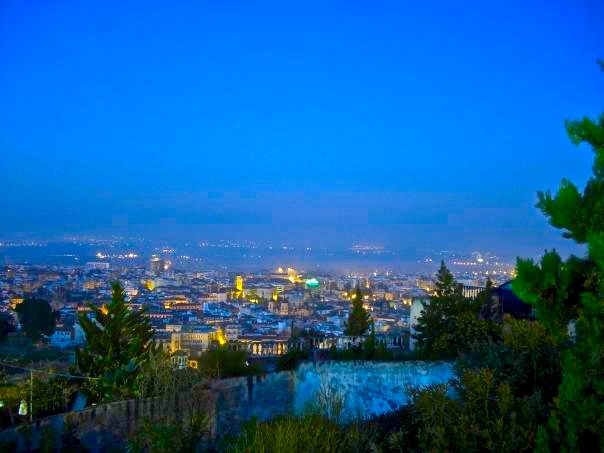
Everywhere you go in Granada the Alhambra maintains a certain presence. Your eyes instinctively search for it, both as a landmark and as a reassurance. It sits high on a foothill, near Sacromonte, looking down over the Albaicín and the city below. The morning sun climbs over it and the moon rises behind it. Sat at the Mirador de San Nicolás my gaze stretches out across the Paseo de los Tristes and the River Darro to directly look into its face. The sounds of castanets rattle around the patterned stones here (worn smooth over time). A mother tries to teach one of her infant children to dance. The child dressed in pink, laughs before stooping to stroke a dog who suns himself in the winter light. The castanets grow louder and a guitarist begins to sing Camarón’s ‘Soy Gitano.’ The sun is clear and warm. The wind is cold on the skin as it blows down from the mountainside. The mid-morning mists rise and start to clear, lifting to reveal the frozen peaks of the Sierra Nevada over there in the distance. The silhouette of the Alhambra appears to rise with the cypress trees. Below, the streets of the Albacín are filled with incense and the music of nightingales. The domes of the Catedral are visible, bells sound from the Convento de San Anton all the way up here to the Iglesia de San Nicolas and everywhere else between. All of Granada lays out before me. Beautiful Granada, paradise of light, skies filled with clear azure, sunbeams and darting sparrows. The beauty of the Alhambra is that it was once just a dream that someone dared to create.

For the past few weeks I have been living in Granada learning to speak Spanish. Twice a day I have attended a school with others to practice grammar, conversation and also familiarise ourselves with the culture of Andalucia (through art, tours and movies). Yesterday was my last class – tonight I depart (flying from Malaga airport with my next destination Marrakech, Morocco). Everything is ready: a bus ticket reserved from Granada to Malaga, bags packed and my goodbyes and gratitude given to those who taught me. As has been customary with the many comings and goings of our group we ate, drank and danced together. We started, as usual, at a bar called Little Italy eating tapas before moving onto to a club called Habana. My closest friend during my duration, Marcel, was busy taking photographs of the evening from start to finish. At some stage of the evening one of us thought it a great idea to go and watch the sun rise over the Alhambra. Instead of going up to the lookout nearby – the Mirador de San Nicolás – it seemed more of an adventure to go beyond the medieval city walls to the other viewpoint, the Mirador de San Cristobal. We arranged to meet at 6.30am outside a Burger King, opposite the Convento de San Anton on the long calle which divides Granada down the middle, the Recogidas. Marcel and I left Habana at around 3am, laughing, and finding the spot to meet before we went our separate ways. Marcel went east towards his district across the River Genil, and I towards mine (San Anton).

At 6am I heard my phone vibrate. I ignored it. I knew who it was. But it kept ringing. It was obviously Marcel. He had remembered. It kept ringing. In the darkness of my room at 6.25am I eventually answered. It was Marcel. He was now standing outside the Burger King. It was dark and cold. Reluctantly, I said I’d be there in a few minutes. The narrow streets, though lit, were deserted. Weaving through familiar, labyrinthine streets, I moved back to the spot where we had parted only a few hours earlier. The idea to watch the sun rise no longer had the same appeal that it had at the club. Why did we choose the Mirador de San Cristobal – especially as the Mirador de San Nicolás was much closer and always more popular (in fact, most Friday afternoons many of my classmates would meet and gravitate there before deciding on a place to eat). But Marcel was adamant. Half asleep, half annoyed I followed his lead down the Gran Via de Colon towards the old city gates. It would be about an hour before we would reach Mirador de San Cristobal. It was a long walk. No matter how fast we walked it was cold. In the haze of that hour, there were many people bouncing about in a state of exuberance having left bars and clubs trying to get a bus home from the main street that dissects across Granada.
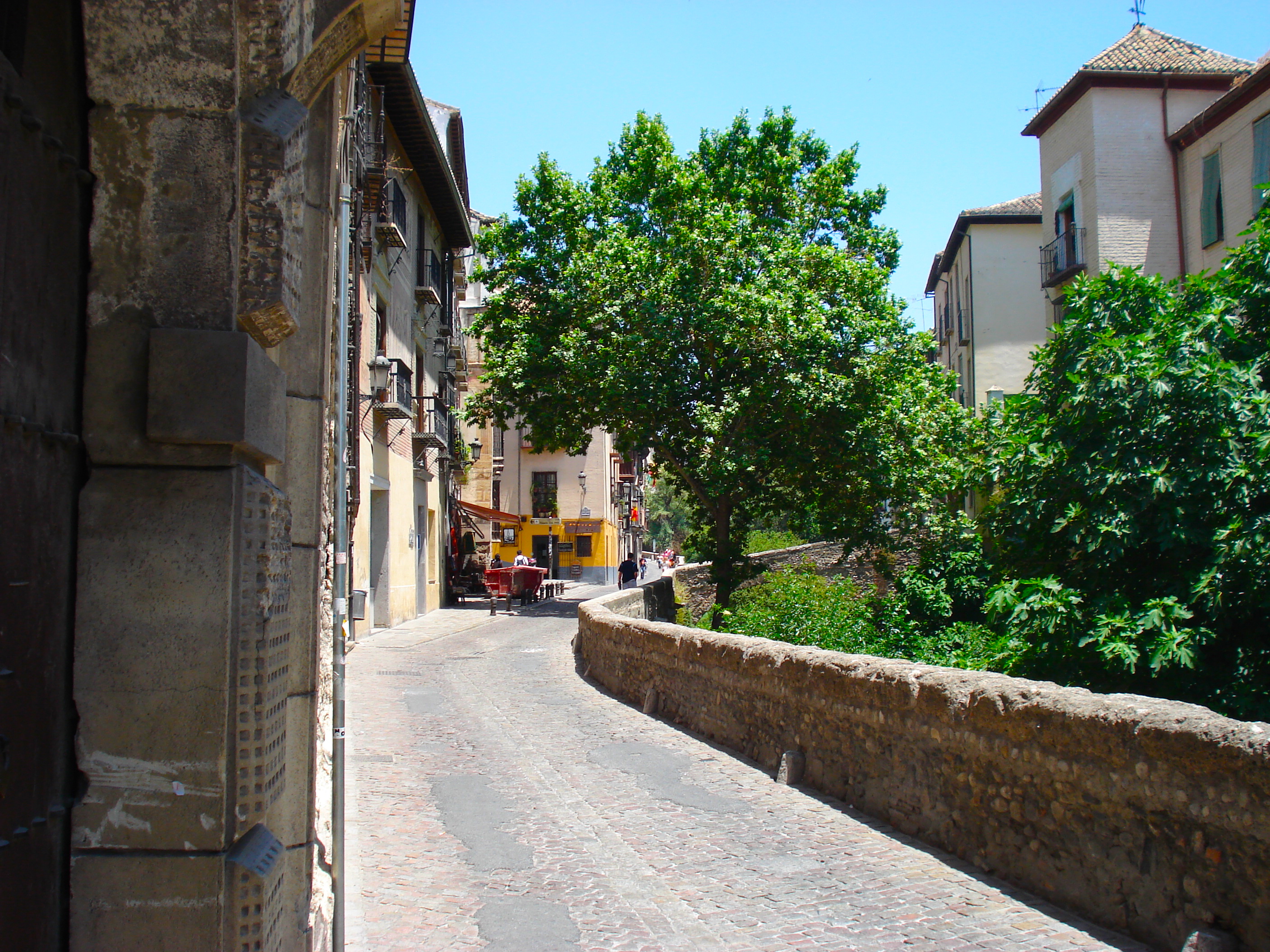
Having walked the length of the Gran Via de Colon, Marcel and I eventually reached the Puerta de Elvira, the old city gates. We moved through a small square, Plaza de Triunfo, before following a quiet street, Cuesta de Alcahaba, which curved upwards towards the viewpoint. Marcel said we had to find a series of small streets which zigzagged off our track directly to the mirador. We couldn’t find them. We got lost several times. Came close to giving up. Eventually we found an old man who was drunk and it was he who helped point us in the right direction. We began climbing a series of steps. It was still cold. It was still dark, but, as we climbed upwards, the sky started to glow and change colour along the horizon behind the visible outline of the Sierra Nevada.

In one of the poems of Federico Garcia Lorca he writes about watching a summer sunset move across these mountains and the Alhambra. The colours he describes were also present that winter morning:
When the sun vanishes behind the mountains of mist and rose,
and the atmosphere fills with a vast symphony of religious devotion,
Granada bathes in gold and pink and purple tulle.
Standing at the Mirador de San Cristobal, colours changed all around us. Time appeared to collapse, behaving differently – evading the tick-tock march towards an end point; that moment hung in the air. The veil of night lifted, exposing clear skies and the frosted stars that had hung there now melted back into the clear blue of day. Planes criss-crossed vapour trails high above the deep gorges and valleys of Andalucia. Cypress trees twirled upwards. The cold clung to every strand of cotton threaded through the fabric that tried to keep me warm. Legs were aching. Toes were numb. Church bells sounded from the city beyond the old walls. There was a morning mist near the mountains evaporating, revealing the majesty of the Sierra Nevada. The colours, once again, can be described from Garcia Lorca’s poem: The mountain slopes are coloured violet and bright blue, while the summits are rosy-white. There are still spirited patches of snow that resist the sun’s fire. And this description reminds us why poetry is important to the human experience; it is an expression of being that brings us close to timelessness, painting images and emotions that other mediums cannot map. A light breeze blew, lifting the fallen leaves left behind which clung to bare branches and rattled like echoes of the castanet. All of Granada lay out before us. Beautiful, beautiful Granada.
Marcel and I walked back into Granada. We walked back along the Gran Via de Colon. Life was different now, things had changed gear – a different pace, different people, cars and buses going about their business. At the top of my street was a small, square park called Plaza Trinidad. It was an enclosure of communal green. People of all ages sat here during the day, during the evenings and shared the space together. There was a small, outdoor café along one side of the square. Marcel and I bought some coffee and bread to eat. We sat on one of the benches, still cold, but feeling better. The sunlight was bright, shining down on the snow along the top of the Sierra Nevada. It was brilliant white. We chatted for a while, reminiscing over several weeks of friendship and the highlights we shared with the other classmates. We made plans and suggestions about how and when and if we could meet up again. We daydreamed aloud about the possibility of us and the others all buying a house together in Granada that we could all use and share. One of those special daydreams that made no sense in reality but encapsulated the magic of friendship (especially when forged in bubbles outside our everyday lives). But it felt attainable. And like any dream the commitment to an idea (or a passion) must be followed through streets of darkness with perseverance and patience until the dawn comes, and then light dissolves doubt and wishes become reality.

Then it was time to say goodbye. Our coffees were finished. We stood at the corner of my street until the inevitable – we shook hands and went our ways. I walked down Obispo Hurtado feeling sad that this adventure was over; feeling enriched for the experience (and Granada had been an experience like no other). At my casa, my elderly landlady, Carmen, was already awake – making coffee in her stove top cafetera and some breakfast. We spent the morning watching a cookery show, Cocina Hoy, from the kitchen table. In fact, we watched it together most Saturday mornings. I found it helped with my Spanish. She wrote down recipes of interest in a small notepad she kept in the front pocket of her apron. Carmen cried a little when I left for my midday bus to Malaga. It was hard to leave. And in this sadness can be found the true beauty of travel: you discover meaning and belonging in places and people that come to both shape and also represent some authentic aspect of you. These fleeting moments cultivate a humility within; we are touched by the spirit of others. All of which creates a permanent imprint onto our being which resonates out into the world. From this space dreams, ideas and passions journey through us to be shared with others. Granada is a city like no other.

*


Great reading karl.
Take care.
LikeLiked by 1 person